

Cover image: SUT powerplant prototype in Manzanares, Spain, seen from a point 8 km to the South – Widakora / licensed under CC BY 3.0.
Table of Contents
So what exactly is an energy tower? At its core, it’s a giant hollow cylinder — we’re talking up to 1000 m tall and about 400 m across at the base. Inside it, you get this really intense air circulation going, and at the end of the whole process you end up with electricity. That’s the basic idea, anyway.
The energy tower was actually invented by Philip Carlson, an American. He patented it back in 1975 under the name “Energy Tower with descending air flow” (ETSSV). Later on, the work was picked up by Dan Zaslavsky and Rami Guetta from the Israeli Technological Institute Technion, who teamed up with a group of experts from India. And the analysis and research is still going on — they’re trying to turn the invention into a project that’s actually realistic to build, which honestly takes a huge amount of money.
The technology that Dan Zaslavsky and Rami Guetta worked on lets you figure out how useful an ETSSV would be for different parts of the world, and they do this using a mathematical model of the energy tower (ET). The starting assumptions are that the ET gets built next to a big body of water — usually somewhere along the coast — and in places with a warm, dry climate. The program takes local climate conditions into account, along with how far you are from cities and what kind of infrastructure investment you’d need, and from all that it works out the power of the ET and the price per kWh of the electricity it makes.
The estimates say an ET can put out somewhere between 200 MW and 600 MW per year (it kind of depends on the season) and produce around 3.6 billion kWh in North Africa. In California it could make about 2.7 billion kWh, and in Spain and southern Italy roughly 2 billion kWh. Zaslavsky and a few other authors figure that, with the right climate and decent infrastructure, you could get the price down to about 4.7 cents per kWh — which is a little cheaper than what you’d pay for a kWh from solar or wind plants. Now, keep in mind, these numbers all came out of calculations on a mathematical model. There’s no pilot plant out there right now where they could do more precise measurements, so it’s still pretty much theory at this point.
A quick reality check before we go further
Here’s the part that’s easy to lose track of when you read about energy towers. As of today, no full-scale downdraft energy tower — the descending-air type this article is mostly about — has ever actually been built anywhere in the world. Everything we “know” about how a 1000 m ETSSV would perform comes from math, computer simulations, and scaled-down lab work. That doesn’t mean it’s fake or impossible; the underlying physics is pretty solid and well understood. It just means the headline numbers are projections, not measured results, and you should read them with that in mind.
The idea itself goes back further than most people assume. Carlson floated the descending-air version back in 1975, and Zaslavsky picked the thread up again independently starting in the early 1980s, eventually publishing detailed work on it toward the end of the ’90s. So this isn’t some brand-new 2020s brainwave — engineers have been chewing on it for roughly half a century. What’s changed recently is mostly the modeling. A 2025 analytical study of energy towers by R. Guetta and R. Schwartz, published in the International Journal of Sustainable Energy, laid out a fresh mathematical model for how power gets generated by evaporative cooling in hot, dry air. Earlier research had already dug into the messy details — for instance, a 2012 study (Hassid, Merksamer and Guetta) found that water droplets clump together, or “coalesce,” as they fall, so they end up roughly an order of magnitude bigger at the bottom of the shaft than at the top. Bigger droplets evaporate less, which nudges efficiency down a touch. None of this kills the concept, but it’s the kind of nitty-gritty detail that has to be nailed before anyone sinks a billion dollars into concrete.
How an energy tower with descending air flow (ETSSV) works
Here’s the gist of it. Cooling water gets pumped up to the top of the energy tower using pressure pumps. Once it’s up there, the hot air around the tower gets sprayed and cooled down through a bunch of nozzles. The cooled air becomes heavier, and because it’s heavier it sinks down through the ETSSV. Down at the bottom — at the base of the tower — there are air turbines set up all along the perimeter. So the cooled air drops down and drives those turbines, which are hooked up to electricity generators. From there, the power gets sent out to the electricity distribution network.
Under good conditions, the descending air can reach speeds of up to 80 km/h. And here’s the key thing: the bigger the temperature difference between the surrounding air and the water, the better the ETSSV works. That’s why energy towers are more efficient in warmer climates.
One thing worth pointing out — ETSSV burns through an enormous amount of water to keep running. The upside is you can use salty seawater too, though you’ll need to take anti-corrosion measures on the metal parts of the energy tower. And since the energy from an ETSSV ultimately comes from the Sun, you can pretty much call it a form of solar energy.
Unlike plants that run purely on solar, an ETSSV keeps producing energy at night too — basically for as long as there’s a temperature difference between the surrounding air and the cooling water. When that temperature gap gets smaller, though, the ETSSV doesn’t run as efficiently.
There’s also another version being looked at: the ET with ascending air flow (ETUSV). This one works on the same principle as a regular factory chimney — warm air gets heated up at ground level, and since warm air is lighter, it rises up to the top of the ETUSV. The warm air coming in at the bottom of the ETUSV drives the turbines and the generators. The nice part about this second type is that it doesn’t need pumps to push water to the top of the tower. The trade-off is you need big stretches of ground around it (these are called collectors) to keep the surrounding air as warm as possible.
The one type that’s actually been built
If you’re wondering whether anybody has ever turned any of this into a real, working machine — the answer is yes, but only the ascending kind. Back in 1982, a German engineer named Jörg Schlaich and his firm Schlaich Bergermann und Partner built a small prototype solar updraft tower in Manzanares, Spain, about 150 km south of Madrid, with funding from the German government. It stood roughly 195 m tall and had a transparent collector canopy spreading out around 46,000 m² at its base. It only ever put out about 50 kW at peak, but then it was never meant to be a commercial plant — it was a test rig, built cheap on purpose to see whether the theory held up. And it did. The thing ran more or less continuously for about eight years. What finally did it in wasn’t the concept but plain old neglect: the guy-wires holding the tower up weren’t protected against corrosion, they rusted out, and a storm toppled the tower in 1989. It got decommissioned and that was that.
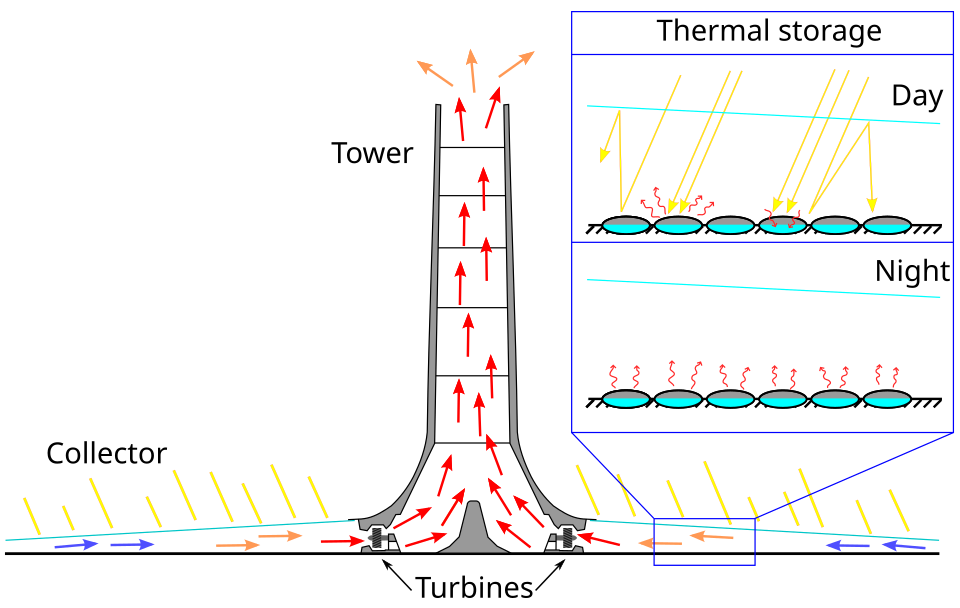
Image credit: Cryonic07 / licensed under CC BY 3.0.
The other one worth mentioning is in China. A solar updraft tower at Jinshawan, in Inner Mongolia, started running in December 2010 and was producing around 200 kW. The bigger plan was to expand the site — something like 277 hectares of desert — up to 27.5 MW, with the greenhouses doubling as a way to cover shifting sand and tamp down sandstorms. There was also a tiny 22 m chimney built in Botswana back in 2005. So all told, the real-world track record of energy towers is short, and it’s entirely on the updraft side. Nobody has put up the descending-air ETSSV at scale yet.
The pros and cons of ETSSV
From the way an ETSSV works, it’s clear these things belong in places where the air is hot and dry and there’s plenty of water around. Locations like that tend to be big, sparsely populated areas — North Africa, Namibia, the Arabian Peninsula, the Negev Desert in Israel, the deserts of the southern United States, the area around the Gulf of California, the northern parts of Chile, Australia, and so on. The catch is that most of these spots are far from major urban centers and transmission line networks, which means you’re looking at extra costs to move the energy where it needs to go. One way around this is to put big industrial plants — basically big electricity consumers — as close to the ETSSV as you can. It also makes sense to build seawater desalination plants nearby, since those use up a ton of energy too.
An ET gets less efficient as humidity and rainfall go up. You can work around this somewhat with a smart design — adding extra wings on the outside to steer the air currents downward can boost how much you get out of the tower. The energy tower runs on natural resources, just air and water. It doesn’t burn fossil fuels and doesn’t produce the CO2 emissions that are reshaping Earth’s climate, and isn’t a polluter. Its efficiency drops when the surrounding air is colder, though, so ETs really aren’t a good fit for countries up in the northern hemisphere.
An ET with a 400 m diameter pushes out an air flow of around 80 km/h (that’s 22 m/sec). It’s humid, salty air, which is bad news for the turbines and all the metal parts of the tower because it causes corrosion. Those moist air currents can also be an environmental headache for nearby settlements, since you end up with a large amount of alkali (the waste salts from desalination) building up during the partial desalination that happens while the ET runs. Another downside of ETSSV is the serious amount of electricity it takes to run the pumps that push water way up to the top. Estimates put it at around 20–25% of the electricity produced going just to those water pumps. To cut down on that during peak hours on the grid, one option is to install extra water tanks at the top of the ET, so during peak load the water-pushing pumps don’t have to run. The pumps can do their thing at night instead, when there’s less demand on the network. Building an extra reservoir up at that height, of course, is yet another headache for the construction designers.
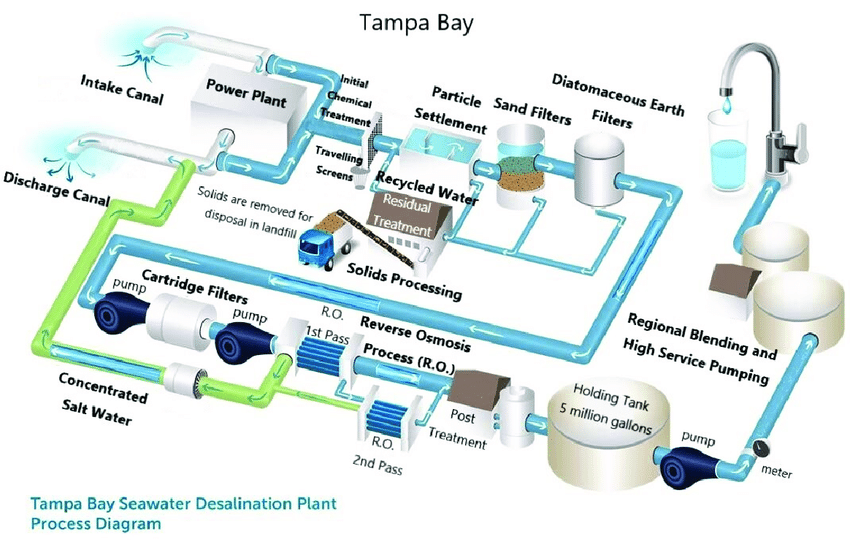
Image credit: Shen Yizhi; Wei Minrui; Hou Bowen / licensed under CC BY 4.0.
There’s an upside on the water side, too. In some parts of the world, the rivers and the water pumped out of artesian wells are getting saltier, so the water used for farming and irrigation is turning brackish. When that water passes through the ET, some of it evaporates and it loses part of its salt content — which actually makes it better for irrigation.
And one more thing in its favor: electricity from an energy tower doesn’t depend on fossil fuel prices bouncing around. That also means you don’t need huge storage facilities. To put it in perspective, a single 390 MW ET cuts coal consumption by 1.27 million tonnes a year.
The water-and-land problem nobody can wave away
If you boil the cons down, two of them really sit at the heart of the whole debate: water and land. The water side is sometimes called the “water-energy nexus,” and it’s a bigger deal now than it was when Carlson first sketched this out. Power plants in general lean hard on water for cooling, and the places that are perfect for an ETSSV — hot, sunny, dry — are exactly the places where water tends to be scarce and droughts are getting worse. Using seawater gets you around the freshwater scarcity, sure, but then you’re hauling salt water up hundreds of meters and dealing with corrosion and salt waste at the other end. It’s a genuine engineering trade-off, not a footnote.
Land is the other one. To match the output of a conventional power station, an energy tower needs a lot of room — which is part of why deserts and other low-value land keep coming up as the obvious sites. That’s not necessarily a dealbreaker, but it does shape where these things could ever realistically go.
It’s worth noting, though, that the basic physics behind the descending-air tower — cooling air with sprayed water so it sinks and moves — isn’t just sitting in a journal somewhere. The same evaporative-cooling-downdraft principle already shows up in the real world at a much smaller scale, in what engineers call passive downdraft evaporative cooling towers, which are used to cool buildings without much (or any) mechanical fanpower. That building-scale version is a modest but actually existing commercial market, mostly in hot, dry regions and in green-building projects across Asia, the Middle East, and the southwestern US. So the principle works and earns its keep at human scale. The leap from cooling a building to powering a city is the hard part.
What’s planned down the road
The American engineering company “Solar Wind Energy Tower” plans to build two towers near the Mexican border, in St. Louis, Arizona. The towers are supposed to come in at around 900 m tall. By their estimate, designing and building the project would take up to 4 years. The final height and diameter will end up depending on local climate conditions — if conditions are favorable, they might be able to make the ETSSV shorter and narrower than planned. The ET is expected to put out a maximum of 1250 MW each, with the estimated average preliminary power working out to about 435 MW over the course of a year.
“Solar Wind Energy Inc” has put together software and a mathematical model for various ETSSV sites that lets them calculate the plant’s power ahead of time, taking the climate and weather into account. A more detailed calculation for the ETSSV at St. Louis shows it could develop a capacity of 610 MW, with 17.5% of that energy going toward its own needs. That leaves a maximum of 503 MW that can be hooked up to the distribution network. The construction side of things is a big challenge in its own right. Early estimates suggest this monster of a structure would need to be built with a reinforced concrete frame.
Meanwhile, Israeli and Indian experts have been suggesting they build one test ET, somewhere in the 6–10 MW range, on Israeli or Indian soil — somewhere the investment could be paid back from the electricity it generates. They figure the project would run about 20 million dollars. For a 50 MW ET, the investment would come in around $136 million, and for a 370 MW ET the estimated cost would be about $850 million. You’d get a more accurate number after a proper feasibility study, of course. As for building one in the European Community, the chances there are pretty slim. That said, putting up an ET in North Africa and connecting it to Europe’s electricity grid would be a win for both sides.
So what actually came of all this?
Now here’s where the story gets a little sobering, because the future these plans were pointing at didn’t quite arrive. The Arizona project — the company’s own town was San Luis, Arizona, which you’ll sometimes see written as St. Louis — got real momentum for a while. Back in April 2014, the San Luis city council unanimously approved a development rights agreement for the tower, and the company even lined up a long-term water supply deal for the site. By 2018, after the design was finalized, the company said the projected annual output had jumped from 3.7 million MWh to 5.9 million MWh, with the total cost pegged at about $1.55 billion. On paper, it kept looking better and better.
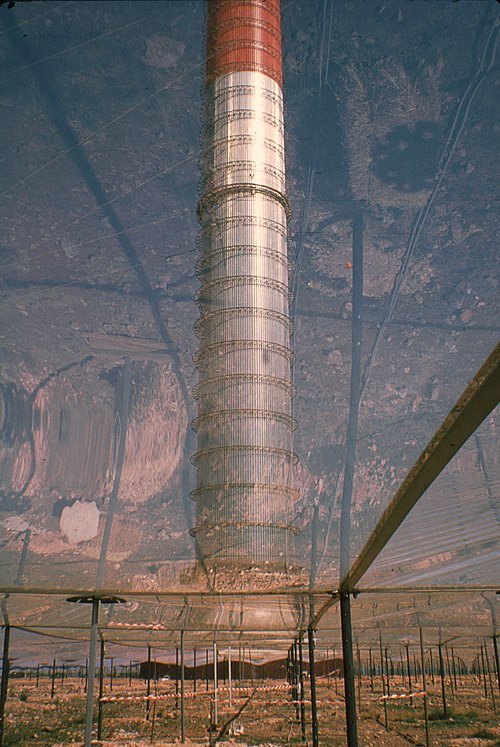
Image credit: Widakora / licensed under CC BY 3.0.
And then it just… didn’t happen. The company never broke ground. Solar Wind Energy Tower, Inc. (which had earlier been called Clean Wind Energy Tower) was eventually marked defunct in January 2021. The single biggest tower the descending-air concept ever came to was a set of press releases, permits, and renderings. The usual culprit was money — these projects need enormous upfront capital, and convincing investors to bankroll the first-ever full-scale energy tower, with no working example to point to, turned out to be a wall nobody could climb.
The updraft side hasn’t fared much better on the “actually built” front. Spain’s proposed Ciudad Real Torre Solar — a planned 750 m chimney with a roughly 3.5 km² collector, aimed at around 40 MW and pitched as the first of its kind in the EU — has been stuck in pre-construction limbo for years; as of 2025 it still hasn’t broken ground, partly because cheaper subsidized wind and solar PV ate its lunch after the 2008 financial crisis. The Australian company EnviroMission, which floated on the stock exchange back in 2001, spent years promoting kilometer-scale updraft towers — first at Buronga in New South Wales, then in Arizona, then in Texas around 2013 — and never built any of them either. Around the same time, an outfit called Hyperion Energy was reported (in late 2011) to be planning a 1 km updraft tower near Meekatharra in Western Australia to power mining operations. Same ending.
Why the idea won’t die
Given that track record, you might expect the whole concept to have quietly faded away. It hasn’t, and that’s the interesting part. Researchers keep circling back to it. A 2024 review in the journal Sustainable Energy Technologies and Assessments specifically took stock of the “market maturity” of both solar updraft towers and cooling downdraft towers — basically asking, honestly, how close any of this is to being commercially real. And as mentioned earlier, the 2025 modeling work by Guetta and Schwartz shows people are still refining the math for the descending-air version. There’s a reason the energy tower keeps drawing engineers back: the appeal is genuinely hard to shake. A structure with almost no moving fuel, no emissions while it runs, the ability to generate power around the clock instead of only when the sun’s up, and a fuel source — air and water — that nobody can put a price hike on. On paper it ticks boxes that wind and solar PV can’t.
The honest answer to the question in the title, then, is “we don’t know yet, and we won’t until somebody builds one.” The physics checks out. The smaller cousins of the technology, like building-scale evaporative cooling, already work. What’s never been proven is whether you can scale it up to a 1000 m tower and have the economics make sense against rivals that have gotten dramatically cheaper over the last couple of decades. Energy towers might end up being a clever idea that history quietly passed by — or they might be one feasibility study, and one brave investor, away from finally getting their shot. For now, they sit in that strange in-between space: too sound to dismiss, too expensive and unproven to build. Utopia or the future? Maybe a bit of both, still waiting on the first shovel in the ground.
References:
- SHPEGS “open source” energy tower concept similar in some ways to the downdraft tower.
- Energy Towers, A complete brochure by Dan Zaslavsky, updated for December 2009
- Prof. Dan Zaslavsky on the Technion faculty page.
- “Solar Wind Energy’s Downdraft Tower generates its own wind all year round”. 19 June 2014. Retrieved 1 April 2021.
- Grose, Thomas K. (17 April 2014). “Solar Chimneys Can Convert Hot Air to Energy, but is Funding a Mirage?”. National Geographic Society. Archived from the original on May 2, 2021.
- Zaslavsky, Dan; Rami Guetta et al. (December 2001). “Energy Towers for Producing Electricity and Desalinated Water without a Collector”

