

Cover image: The Baptism of Constantine, as imagined by students of Raphael – Vatican Museums / public domain
Table of Contents
In the first hundred years after the death of Christ, Christianity swept eastward and northward and gathered tens of thousands of followers, many of whom were subjects of the Roman Empire. Those who ruled the Empire considered these new Christians a nuisance and a threat. Christians rejected the Roman gods and held that there was one God only, whose laws were supreme over the laws of men. They often passively resisted Roman rule, defied the laws that forbade them to meet and worship, and sometimes actively rebelled against Roman officials. As always happens when the new meets the old, and human society and thought is being restructured – there were conflict and opposition. And in the case of the Christians, there was massive and savage persecution.
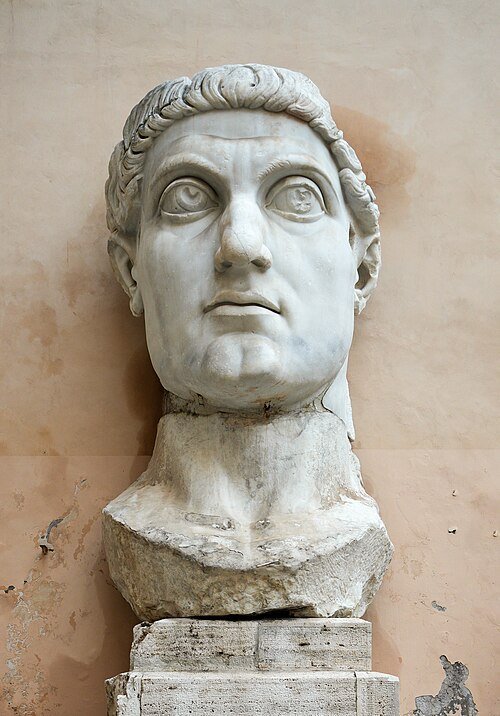
Image credit: Merulana / CC BY-SA 4.0 (via Wikimedia Commons)
Every kind of torture was used to force Christians to recant and deny their God and their religion. In the eastern parts of the Empire, Roman rulers were especially relentless and cruel. Besides the standard crucifixion and beheading, Christians were frequently burned at the stake, some roasted or smoked to death. Others were hacked to pieces, thrown to wild beasts, or drowned. Hot irons, molten lead, bludgeons, flails or whips, and the rack, were all put into service to break the bodies and spirits of those who dared embrace the revolutionary teachings of Jesus Christ. Tongues and eyes were torn out, tendons severed, and bodies mutilated and crippled. Men were packed off to the mines to work as slaves and pious women were forced into brothels to work as prostitutes. There were many Christians who did recant and renounce their religion. But there were many others, with almost unimaginable courage and faith, who were ready to suffer the most excruciating pain and death to remain true to what they believed. Thousands of martyrs followed Christ’s example and faced their deaths calmly and confidently, offering prayers of forgiveness for their tormenters. In the end, victory belonged not to the tormentors but to their victims. The heroism of the Christians gained the admiration of many who witnessed it and Christianity, far from being destroyed, only grew larger. Frustrated, the Roman Emperors doubled their efforts, and persecution too increased. It seemed as if the world was split in two and that the power of tyranny and the power of faith would forever be locked in a gruesome deadly struggle. Then came a young Roman ruler named Flavius Valerius Constantinus — the man history would remember as Constantine the Great.
Today the world knows him as Constantine the Great. It was Constantine the Great who ended the persecution of the Christians, became the first Roman Emperor to adopt the Christian faith, and established a center for Christianity in the splendid city of Constantinople.
Constantine the Great: Early Life and Rise to Power
Constantine the Great was born February 27th, in the year 280 A.D., at Naissus, a town in a part of the Roman Empire that later came to be known as Serbia. His mother was a simple serving maid named Helena but she became so revered by Christians that today she is known as Saint Helena. At the time Constantine was born, the Empire was ruled by a government of four different men, called Caesars, each of whom had control of a different part of the Empire. His father, Constantius, was one of those Caesars, but the most powerful was Diocletian – it was he who set up the tetrarchy or foursome, and it was he who dominated it. Constantius was given control of the western provinces which included Spain, Britain, and Gaul, the area that roughly covers France. But there was a price for this honor. First, Diocletian required him to give up his wife Helena and marry the daughter of a high Roman official. And secondly, Diocletian insisted on keeping his son Constantine the Great hostage at his own court, to guarantee Constantius’ loyalty.
As his father marched off to suppress rebellions in his section of the Empire, young Constantine remained behind in the palace of Diocletian, where everyone assumed he would someday succeed his father. Meanwhile, he pursued his studies, received thorough military training, and traveled with Diocletian through the eastern part of the Empire.
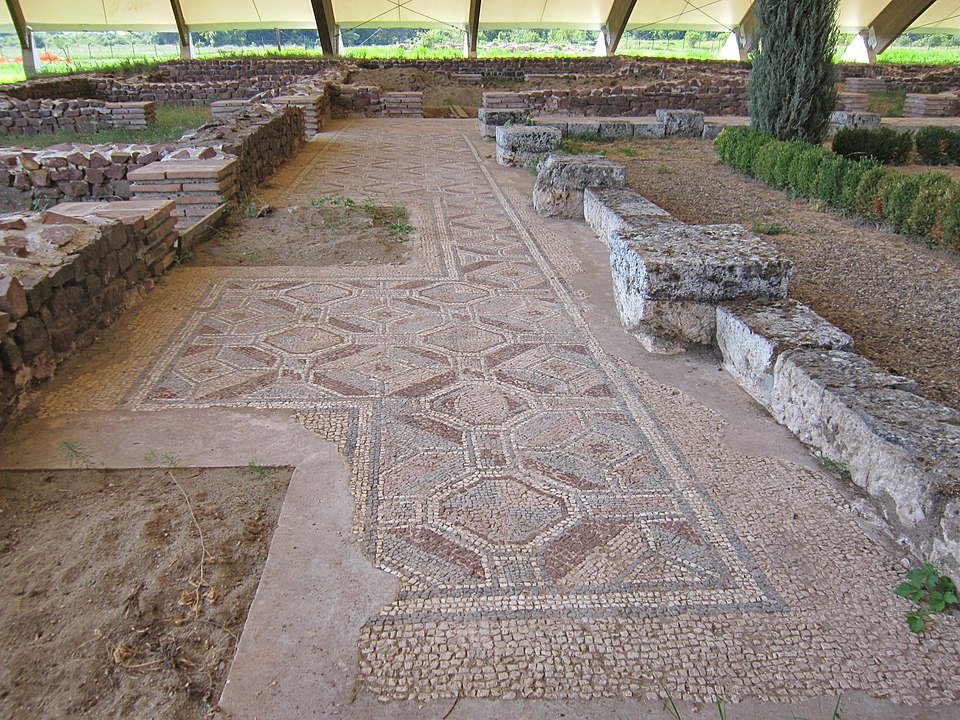
Image credit: Sindjic / CC BY-SA 4.0 (via Wikimedia Commons)
Even as a boy, Constantine the Great impressed everyone who met him. A future biographer who met him in Palestine when the boy was only 15, talked about his noble carriage, his air of authority, and a look that could only be defined as spiritual. Already he was known for his wisdom and his love of literature. He spoke both Latin and Greek, but always used Latin in his writings and later in his speeches.
By the time he was a young man, Constantine had served in the military in Persia, Egypt — by then a Roman province but still steeped in the legacy of the pharaohs, Asia, and on the Danube. This life, in the center of Roman politics, and with its wide travels, gave him a sophisticated knowledge of the Empire. It also made him a witness to the persecution of Christians. From the beginning he was repelled by the cruelty of it, and struck with its wastefulness; to Constantine the Great, such persecutions alienated an increasing number of Roman citizens and deprived the state of the services of some of its most courageous and capable people. He had known many Christians at the palace, among the servants; he knew upper-class Romans who held Christian views, and his own father staunchly refused to persecute them. Constantine knew Christians well and shared none of the prejudices of the Roman rulers.
Early Rule and the Roman Civil Wars
By the early 300’s, when Constantine the Great was in his twenties, Rome was embroiled in yet another vicious power struggle. Diocletian abdicated and another Caesar, named Galerius fought for supreme control. One of his aims was to eliminate young Constantine who had been raised to succeed his father as Caesar of the western Empire. When Constantius sent for his son to help in his western campaigns, Galerius began to plot to have Constantine delayed or even killed along the way. The idea of father and son joining forces was far too threatening. However, he underestimated Constantine’s energy and cleverness. The young man snuck out of the palace in the middle of the night and raced on horseback across the lands Galerius controlled, killing the horses at each post along the way so no one could follow. He met up with his father at Boulogne in the year 306, when he was 26 years old. The reunion was brief.
Constantine the Great joined his father on a campaign against invaders in Britain and then they withdrew to their headquarters in York. Only a few months later Constantius died and his soldiers hailed his son Constantine as their new Caesar.
The news that the western army had proclaimed Constantine the Great a Caesar soon reached Galerius in Rome. He retaliated by promoting one of his own men to the rank of Augustus, a position that had more power than a Caesar. This encouraged rival Caesars to also proclaim themselves Augusti until finally, Rome found itself with four Augusti in the west and two Augusti in the east. It was a big Empire, but it wasn’t big enough for the egos of six Augusti and something had to give. Inevitably, these six men began killing each other off and making alliances with other groups they thought would support them. One of these groups was the Christians. For a brief time, all persecution of Christians ceased, while Roman rulers used them in their power struggles.
One ruler who didn’t survive the struggle was Galerius. He became ill and died, but in his last days, fearing he would be punished for the sins he’d committed against Christians, he publicly called for tolerance of that religion and even asked Christians to pray for him. The calls for tolerance were ignored; whether the request for prayers was ignored, is unknown. We do know that Christians everywhere hailed his death as a blessing from their merciful God.
With Galerius gone and a few others defeated in the battles for power, there were now only three Augusti left. In the fall-out from these struggles, one Augustus named Maximian fled to Gaul and took refuge with Constantine. So pleased was he with Constantine’s hospitality, that he declared him to an Augustus, and also gave him his daughter Fausta as a wife. Later, Maximian decided he didn’t want Constantine the Great to have all that power, after all, so he foolishly tried to involve his daughter Fausta in a plot to murder her own husband – a plot that Constantine discovered. He gave Maximian a choice in the manner of his death and Maximian chose suicide.
Suicide was not the end of Maximian. He left behind in Rome a son named Maxentius who decided to pick up where his father had left off. Maxentius had already appointed himself Caesar and taken control of Italy and Africa. He wanted more. He wanted the western territories under Constantine’s rule.
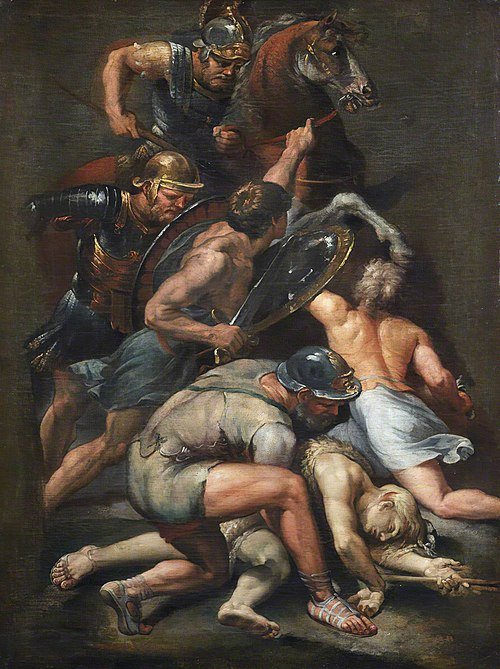
Image credit: Lazzaro Baldi / public domain
When Constantine the Great heard that Maxentius was planning to wage war, it presented an opportunity he had long wanted. Now he had an excuse to march on Rome and attack first.
Constantine the Great was 32 years old during this year that would change the course of western history. He was an imposing-looking man, heavily built with a thick neck, a jutting chin, broad shoulders, aquiline features, and large bright eyes. He was vigorous and robust, intelligent, and clever.
Constantine the Great knew he would have the support of many Italian citizens. As a young man in Rome, he gained a reputation for his bravery and wisdom. His moderation and tolerance as a leader had earned the devotion of his soldiers. Furthermore, the masses had grown weary of the fighting among the Augusti. And of course, the Christians already supported Constantine because he had opposed their persecution. His victory seemed assured.
Constantine the Great crossed the Alps in the year 312 and paraded triumphantly through northern Italy, where everywhere he was hailed as a liberator. The road to Rome, the great Flaminian Way, stood before him.
Constantine the Great was cautious as he approached Rome. It was possible his enemy, Maxentius, had fled, but it was also possible he had stayed and was prepared to fight, relying on the great Aurelian walls around the city to protect him, as they had protected Rome from so many previous invasions. Looking for a sign as to whether he should proceed, Constantine consulted a pagan oracle called the Sibylline books. His eyes settled on the passage: “the enemy of the Romans would perish.” It was not the message he had hoped for, since at the moment he could be considered the enemy. Then again, he could consider Augusti the real enemies of Rome, and himself it’s champion. Constantine needed a clearer omen. Meanwhile, doubtful but undaunted, he headed out for the fateful battle over the Tiber River. Soon he would be joined by an ally: the God of the Christians.
There was no question, even from boyhood, that Constantine the Great was spiritually-minded. He had long been a monotheist – a believer in one God – although at first, he worshipped the sun god. Later he came to believe there was a divine spirit that guided the world and the sun was only a symbol of this. He could not define this spirit – he was a man searching for a God he could call his own, and whom he could regard as his divine patron. Now, on the march to Rome, with the fate of the entire Christian world hanging in the balance, Constantine had two experiences that convinced him he had found that God.
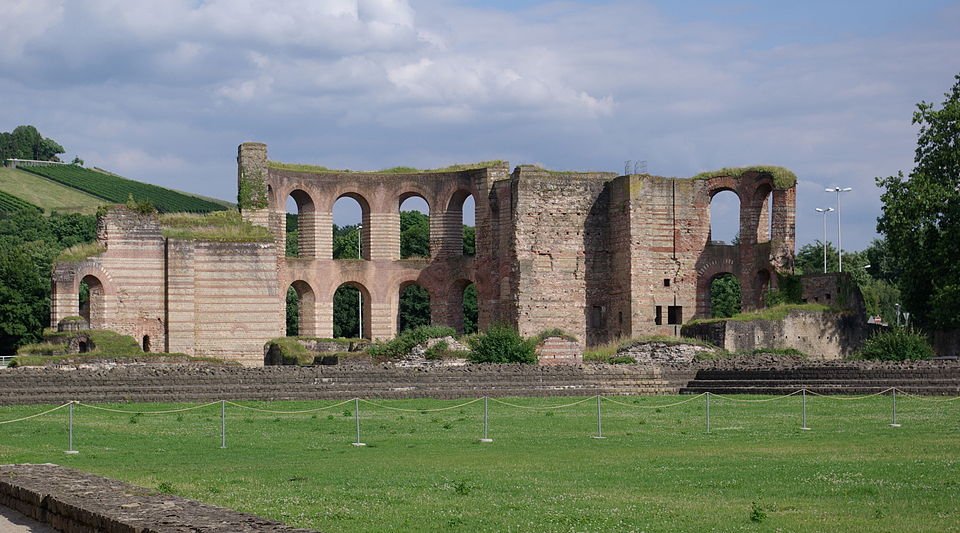
Image credit: Berthold Werner / public domain
Constantine’s Visions and Mystical Experiences
The first experience happened when Constantine the Great was on an expedition in northern Italy before he had started for Rome itself. He began to pray to his father’s god, imploring to know what his mission might be, and pleading for help. What happened next was recorded by his good friend Eusebius, who later wrote Constantine’s biography:
“About noon, when the day was already beginning to decline, he saw with his own eyes the trophy of a cross of light in the heavens, above the sun, and an inscription, BY THIS SIGN, CONQUER, attached to it. At this sight, he was struck with amazement, and his whole army also, which followed him on the expedition, and witnessed the miracle.”
After he saw the cross above the sun, Constantine the Great was filled, not with conviction, but with more doubt. Had the vision been real? And if it was real, what did it mean? What did it portend? As he continued to ponder the cross, Constantine fell asleep, and in his sleep, Christ appeared to him with the sign he had seen in the heavens. He commanded him to make a likeness of the sign and to use it to protect himself against his enemies.
The Battle of Milvian Bridge: A Turning Point in History
This was the first of Constantine’s two mystical experiences while approaching Rome. The second one occurred outside the city as he was camped near the Milvian Bridge, over the river Tiber. It was described in a book written by one of his colleagues six years after the event occurred:
“The anniversary of Maxentius’ accession, the 27th October, was near, and his first five years of rule were drawing to a close. Constantine was directed in a dream to mark the heavenly sign of God on the shields of his soldiers and thus to join the battle. He did as he was ordered, and with the cross-shaped letter X, with its top bent over, he marked Christ on the shields.”
The symbol this book described was derived from the first two letters of the Greek word for Christ. It had long held non-religious significance because the same letters are the first two in the Greek word for “serviceable” or “useful.”
The two visions had rekindled Constantine’s courage and confidence. With his army of soldiers, each holding before them a shield with the Christian symbol, he marched onto the bridge and into battle.
As back up to the ancient stone bridge, which was the gateway to the Flaminian road and to Rome, Maxentius had also constructed a bridge of boats over the Tiber. After Constantine the Great scored a victory on the historic bridge itself, the Romans fled for the boat bridge. As Constantine and his men watched, the entire bridge of boats collapsed and most of the retreating army drowned. Maxentius was dragged down into the river mud by the weight of his own armor and died at the bottom. Even Constantine hadn’t dared expect a victory of such stunning magnitude and such profound implications.
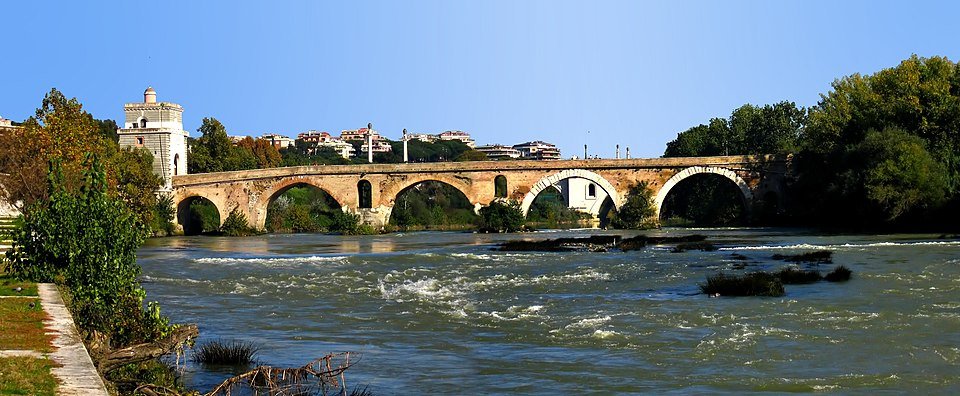
Image credit: Anthony Majanlahti from Rome, Italy / licensed under CC BY 2.0.
Before this dramatic climax, Constantine the Great had proved as shrewd and capable a general as any in history. The army he led towards Rome was much smaller than his enemy’s – but it was fit and well trained, and Constantine made maximum use of the terrain and the possibility of surprise. He had established his headquarters on a cliff about four miles north of the bridge, and stationed his army on a plateau below, where they were out of the enemy’s sight. Once Maxentius made the decision to leave Rome, he had to march his soldiers across two miles of open plain, while Constantine’s look-outs observed their every movement. Constantine then allowed Maxentius and his army to exhaust themselves by crossing the river and scaling the plateau during the full autumn sun. Then, like lightning, Constantine’s troops, fresh and full of energy, burst from their cover. They fought down the slope, forcing the enemy to the bridge below where they died either by the sword or by drowning. Some would argue that it wasn’t God who helped Constantine that day, but his own wit and valor. But that’s not how Constantine saw it. He never once took credit for what was one of the greatest military victories in ancient history. To him, it was a victory of the God of the Christians. He had challenged God to an ordeal by battle, God had promised His support, and He had kept his pledge. Now, Constantine intended to repay him.
There was still another Augustus left in Rome, this one named Licinius. Constantine the Great formed an alliance with him, sealing it with a woman, as was often the case in Roman politics. This time it was Constantine’s sister, whom he promised to Licinius in marriage.
The Edict of Milan and the End of Christian Persecution
The reign of Constantine the Great was the beginning of a new epoch in history. Within a year after his victory at the bridge, he signed the Edict of Milan, encouraging Licinius to sign it also. This edict, which went out to all the governors in the Roman provinces recognized the Christian Church as a legal body and granted complete religious freedom to one and all, Christian or non-Christian. So there would be no misunderstanding and his governors would not interpret it as a concession, Constantine was careful to say that this freedom was given, in his words, “freely and unreservedly.” All property confiscated from Christians was to be restored without delay. The long strife, the tortures, and murders of innocent Christians were coming to an end. Although the Empire was still mostly inhabited by non-Christians, Christians, who were about a third of the population, now shared equal rights and respect. Constantine’s friend Eusebius wrote:
“So then there was taken away from men all fear of those who formerly oppressed them; they celebrated brilliant festivals, all things were filled with light, and men formerly downcast looked at each other with smiling faces and beaming eyes; with dances and hymns in city and country alike they gave honor first of all to God the Universal King, as they had been instructed to do, and then to the pious Emperor.”
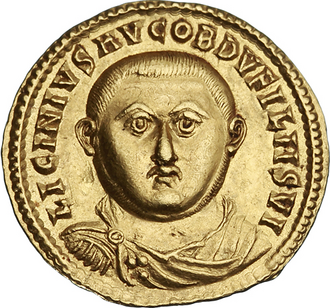
Image credit: Clemchambers / licensed under CC BY 3.0.
In his heart, Constantine the Great was now a convinced and sincere Christian, although he postponed his baptism until his last hours of life. With the tyrants ousted, he turned his attention to new matters – unifying and building the Empire, and protecting his power.
Although persecution of Christians had ceased, the treachery of Roman politics had not. Licinius was all the time harboring thoughts of a coup and installing himself as the sole ruler. He found the support he needed among the non-Christians who resented losing the property they had confiscated from the Christians. They could accept the end of persecution; they could not accept that Christians might now be able to attain wealth and power.
Constantine the Great and Licinius fought their battle for power in Eastern Europe and ended up dividing the Empire in two, with Constantine taking the far larger share of most of Europe, Asia Minor, Syria, and Egypt. For almost nine years this divided empire was peaceful, each side trading with the other. Then in 323, there was one more final clash between Constantine and Licinius, in which Licinius was killed, leaving Constantine, at the age of 43, the sole emperor of the Roman Empire.
During these first years of rulership, Constantine the Great was cautious in religious matters. Rome itself was mostly non-Christian so he kept his personal beliefs to himself. He joined no church and took no baptism, chiefly so he could govern freely without being accountable to the Bishops.
The court of Constantine the Great was modeled after the court of Diocletian, where he’d been raised. There were elaborate ceremonies at which Constantine wore a crown blazing with jewels. Citizens were seldom granted an audience with him and he made public appearances only when it served a particular purpose. Meanwhile, Constantine the Great worked hard to organize and stabilize the government. He created what might be the first cabinet in history, filling it with experts rather than the highborn nobility. The cabinet included ministers of finance, the interior, foreign affairs, and others similar to those we know today. The laws Constantine enacted gave new consideration to widows, orphans, and even slaves.
Because there were many little civil wars and Constantine the Great also had to keep his frontiers intact, he expanded the army, recruiting from the tribes in his territories. To support the army he also had to raise taxes and strictly enforce them. Since the tribesmen were new settlers and not really citizens, they were exempt from the taxes. That meant these people from the territories, or “barbarians” as history calls them, became a stronger and stronger force in both the army and the Empire itself.
Constantine the Great and the Council of Nicaea
Gradually, Constantine’s desire to promote Christianity rose to the surface. He declared Sundays holidays, exempted priests from taxation, increased the power of the church by allowing it to hold its own courts of justice, and tried to mediate differences within the church itself. He built the first great Christian cathedral, the Lateran Basilica in Rome, and he built other famous churches outside of Rome, in Syria, Turkey, and Jerusalem. In the twentieth year of his reign, in 325, he held the famous council at Nicaea, in what is now northern Turkey.
The Nicaea Council was attended by every prominent bishop in the realm, except the Roman Bishop, who was ill at the time. The total group numbered between 250 and 350. The Council of Nicaea was the first great ecumenical or general council of the Christian Church. It was also the first meeting of the church since the days of persecution, and as a consequence, many of the bishops who attended were martyrs who had lost an eye, a hand, or were lamed and scarred by terrible tortures. They included some of the greatest heroes of the 4th century. Christian world. Constantine the Great gave a dinner for the entire assembly, and although he presided over it in his customary silk robes and glittering jewels, his manner reflected nothing but reverence for the fathers of the church.
The purpose of this first council was to consider problems with church members who were teaching doctrines considered heretical. After days of debate and sometimes fierce argument, it was decided the council would write a creed that would define what the church believed about the nature of God. Today we know it as the Nicene Creed. Every bishop present signed the creed except two, and they were banished by the order of Constantine the Great.
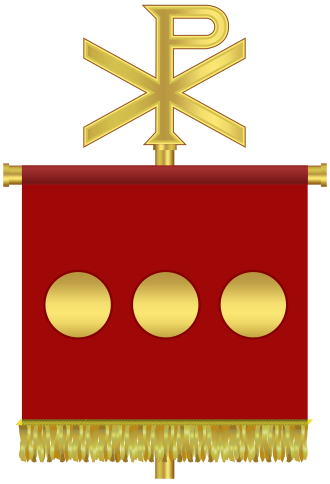
Image credit: TRAJAN 117 / licensed under CC BY 3.0.
When the council had completed its work, Constantine the Great, now 45 years old, returned to Rome, feeling triumphant and looking forward to a year of festivities that had been planned in honor of his twentieth year as emperor. But the atmosphere in Rome had changed while he was away. Romans, still largely non-Christian, was angry at his deference to Christians. There were even riots, with some citizens defacing and pelting his statues with rocks. For his part, Constantine the Great could no longer abide by pagan festivals and rituals. When he refused to attend one such celebration, he angered a large number of non-Christians. Finally, when he discovered a plot against him hatched in his own family, he made plans to leave Rome forever.
Constantine the Great was always a fair and devoted family man. He protected his brothers and sisters; he was especially close to his mother, Helena, whom he’d made an Augusta or Empress; and he treated all his children alike, making each one a Caesar even though some were still quite young. His oldest son Crispus was an excellent soldier and speaker and had already made a name for himself in the Empire. The problem in this happily domestic scenario was Constantine’s wife, Fausta, the daughter of the ambitious Maximian who had plotted against Constantine back in the early days of Gaul and had been forced to commit suicide. Crispus was not Fausta’s son; he was the child of an earlier union between Constantine and a concubine. Therefore, Fausta resented his popularity and feared he stood in the way of her own children’s chances for success. She managed to convince Constantine the Great that Crispus was involved in a conspiracy against him, and the young man was put to death. Shortly after, it was revealed that Fausta had lied, and she too was executed.
Haunted by these events of betrayal and deceit, grieving over the loss of both his wife and son and disgusted with the hatred and paganism of Rome, Constantine the Great left in search of a site for a new capital city. His mother, Helena, left with him but they split ways when she decided to travel to the Holy Land. There, at the age of 80, Helena established magnificent churches and benevolent charities and devoted herself to uncovering relics of the Holy Age. For her achievements, she was later canonized.
The Rise of Constantinople: A New Capital for a New Era
Constantine the Great looked for his capital among several eastern cities until he settled on Byzantium, a city founded 1000 years before by the ancient Greeks, and now in a state of near ruin from a century of wars. But the city was on a beautiful and strategic site. It had two harbors; it made a bridge between Asia and Europe, and it was in a position to control the trade between the Mediterranean and Black Seas. Constantine the Great had found his capital. He renamed it Constantinople, “Constantine’s City,” and for the next six years, he worked energetically to make it the worthiest, most splendid city in the kingdom.
The artistic treasures of Greece were ransacked, as they had been many times before, and shipped to the new capital. A statue of Apollo, supposedly made by the famous Greek sculptor Phidias was chosen to represent Constantine – its head was removed and replaced by one of Constantine. Important officials in the Empire were offered new houses and other rewards to migrate to Constantinople. Two churches were built, one dedicated to Irene, for peace, and one to Saint Sophia, for wisdom. In this capital, there was no amphitheater, as there had been in every other great Roman city, and where, for many years, Romans gathered to watch Christians being executed. But there was a hippodrome for sporting events, especially chariot races. This “new Rome” Constantinople, which we know today as Istanbul, was more than the new capital of the Empire; it was a symbol of Christian triumph. Constantinople itself remained a center of power for over a thousand years. And Christianity, formerly a minority sect, was now the official religion of the Empire. Its wealth and numbers grew so large that it could resist domination by later emperors, such as Julian, who despised it.
Constantine the Great commissioned new copies of the Bible for the expanding congregations in Constantinople, composed a special prayer for his troops, went on military campaigns with a mobile chapel in a tent, and abolished crucifixion as a form of punishment because of its association with Christ and Christians. He accomplished the work of many lifetimes in only one – what he had planned for the future, we can only imagine.
It was on a military campaign in Persia that he fell ill. He made a pilgrimage to his mother’s birthplace, which he had named after her, to pray for his recovery. This time, his prayers were not answered as he’d hoped, and he worsened. When prayer and treatments failed, he tried to make his way back to Constantinople but was strong enough to make it only as far as Nicomedia. Finally, Constantine prepared for the baptism he had delayed for so many years. It had always been his wish to travel to the Holy Land and be baptized in Jordan. Instead, with the time of the essence, the nearest bishop was summoned, and Constantine the Great exchanged his royal purple robes for the white robes of a neophyte. He died on May 22, 337, at the age of 57.
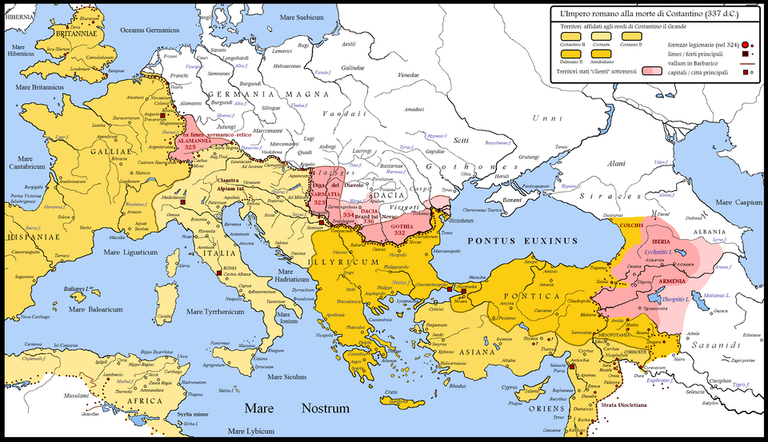
Image credit: Cristiano64 / licensed under CC BY 3.0.
After Constantine the Great died, he was interred as he had planned – in a special mausoleum in the Church of the Apostles, which had been built at his command. He was laid to rest amid twelve other sarcophagi of stone, each one dedicated to an Apostle. Whether he considered himself the thirteenth apostle, as some have guessed, or whether he simply wanted to be among others who had dedicated their lives to Christianity, is a matter of conjecture.
On the foundation Constantine the Great had built and bequeathed, a Byzantine culture arose, and civilization moved forward into its next epoch, the Middle Ages — an era soon shaped by the upheavals of pandemics that reshaped the post-Roman world, including Justinian’s Plague in his successor’s empire.
The Legacy of Constantine the Great
In his influence upon civilization, Constantine the Great stands in the first rank, comparable only to such men as Alexander the Great and Napoleon. He emerged from the complicated and chaotic politics of third-century Rome as sole sovereign, and at the same time became the champion and liberator of Christianity. It’s an achievement almost without parallel in human history. The Milvian Bridge, where Constantine achieved victory over Maxentius, was more than a bridge from one side of the Tiber River to the other. It was a bridge from one era of history into the next. Across that bridge humanity passed from an age of tyranny and persecution into one of religious freedom; from an age of paganism into the age of Christianity. Although there would be persecution again, and there would be other struggles for freedom, there would also be a continuing line of liberators to carry on the spiritual heritage of men like Constantine the Great.
References:
- Alföldi, Andrew. The Conversion of Constantine and Pagan Rome;
- Shahîd, Irfan (1984). “The First Christian Roman Emperor: Philip or Constantine?”
- Barnes, T. D. (1973). “Lactantius and Constantine”. Journal of Roman Studies;
- Barnes, Timothy D. (1982). The New Empire of Diocletian and Constantine;
- Barnes, Timothy (2011). Constantine: Dynasty, Religion and Power in the Later Roman Empire.
- Athanasius of Alexandria. Apologia contra Arianos (Defence against the Arians)
- Doležal, Stanislav (2022). The Reign of Constantine
- MacMullen, Ramsay. Christianizing the Roman Empire A.D. 100–400. New Haven, Connecticut; London: Yale University Press, 1984

