

Cover image: Extravagant displays of electric lights quickly became a feature of public events, as in this picture from the Tennessee Centennial and International Exposition in 1897. Public domain.
Table of Contents
If there is any word that captures the spirit of the American people, particularly in the 19th century, it is the word “inventiveness.” And if there is any man who emerges as the personification of that word, it is Thomas Alva Edison. Edison patented over 1000 inventions in America, more than any person in the nation’s history. He patented thousands more in other countries. Among those patents are some of the greatest contributions to modern life – inventions that helped usher in and define the industrial age. It was Edison, more than any other individual, who laid the foundation for the technological and social revolution of the modern electric world.
Edison’s most famous inventions include the microphone, the phonograph, the electric lamp, and the world’s first electric power plant. He also made contributions to the development of motion pictures, the telegraph and telephone, and the storage battery. Also, Edison advanced his field of science and invention by establishing the very first research laboratory – an achievement considered by many historians to be his greatest of all. Thomas Alva Edison, known in his day as “The Wizard of Menlo Park,” remains the most prominent example of “Yankee Ingenuity” our country has ever produced. It’s an astonishing accomplishment for a man who had only three months of schooling and who suffered from increasing deafness throughout most of his life.
The Early Years of Thomas Alva Edison
Thomas Alva Edison was born on February 11, 1847, in the small town of Milan, Ohio, but his family soon moved to Port Huron, Michigan. His father, Samuel, was a shingle maker and land investor, but he was never very successful. At home, the young Edison displayed his curiosity and inventiveness from an early age. At age five, his parents found him sitting on a batch of geese and chicken eggs, to see if he could hatch them. At age six, he found himself wondering what a bonfire looked like and burned down the family barn. His father marched him to the public square and thrashed him, an incident Edison still talked about sixty years later.
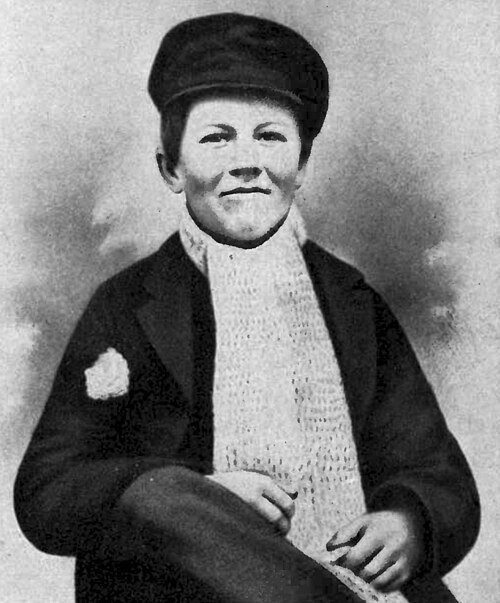
Image credit: Unknown author / public domain
Thomas Edison was enrolled in a local grammar school when he was seven years old, but there were problems from the start. Alva, or Al, as his family called him, was inattentive and easily distracted. He preferred to make sketches or to doodle in his notebook, rather than to listen to the lessons or perform the rote exercises. This behavior was undoubtedly the effect of a lively, curious mind that rebelled against tedium, but it may also have had something to do with dyslexia and with his hearing problems. He had suffered hereditary ear infections from the time he was a toddler, and there was evidence of some deafness when he was still only a boy. To make matters even worse at school, Alva was teased and ridiculed by the other students. Finally, when his teachers pronounced him “dim,” unresponsive, and not teachable, Mrs. Edison pulled her son out of school and resolved to tutor him herself.
Because his three sisters and brothers were far older and mostly out on their own, Alva received the attention of an only child, and he thrived at home. His mother gave him grounding in classic literature, including The History of the Decline and Fall of the Roman Empire, and Shakespeare, whom he would quote throughout his life. He was an insatiable reader, perhaps because books offered a refuge from society, which had been less than kind to him. His favorite book by far was R.G. Parker’s School of Natural Philosophy, which described science experiments that could be done at home. He began experimenting with chemicals and building elaborate models. Two of these models, a working sawmill and a railroad engine, were powered with steam.
As a child, Thomas Edison was mischievous and loved to pull pranks and practical jokes. His favorite occupation, as he approached the age of ten, was to putter around in an amateur chemical laboratory he’d set up in the family basement. But the experiments were expensive. And the Edison family was poor. So at an early age, Thomas Edison began searching for ways to finance his special interests. First, he grew vegetables and sold them in town. Then, at the age of 12, he became a train-boy, selling magazines and candy on the Grand Trunk Railroad that ran between Port Huron and Detroit. He gave his mother a dollar a day, and everything else he earned he spent on books and supplies for his laboratory. The job on the railroads came to an abrupt halt when Edison started a fire in one of the cars where he was conducting experiments. The conductor threw him out, first boxing his ears, and thus giving rise to the legend that this is how he lost his hearing. It’s more likely the incident aggravated an already pre-existing condition.
After the train fiasco, Thomas Edison started a newspaper called The Weekly Herald. By this time his hearing problems were acute. They would continue to worsen until, late in life, he could only hear people if they shouted directly into his ear.
The Telegraph Years That Made Him an Inventor
When he was fifteen, Thomas Edison rescued the son of a telegraph operator from the path of a train and the grateful father offered him a position that brought the first opportunities for his inventive mind to fully express itself. The position was as a telegraph operator at Western Union. It was a glamorous offer for the times – the telegraph had fired the imaginations of boys all across America, and its inventor, Guglielmo Marconi, had become somewhat of a hero. The work also had a special appeal to Edison because his partial deafness wouldn’t be a handicap. Young Edison leaped at the chance and soon became so adept at the codes that he was made manager of the office. He read scientific and telegraph journals, learned as much about the mechanical, electrical, and chemical equipment that he could, and began experimenting with ways to improve them.
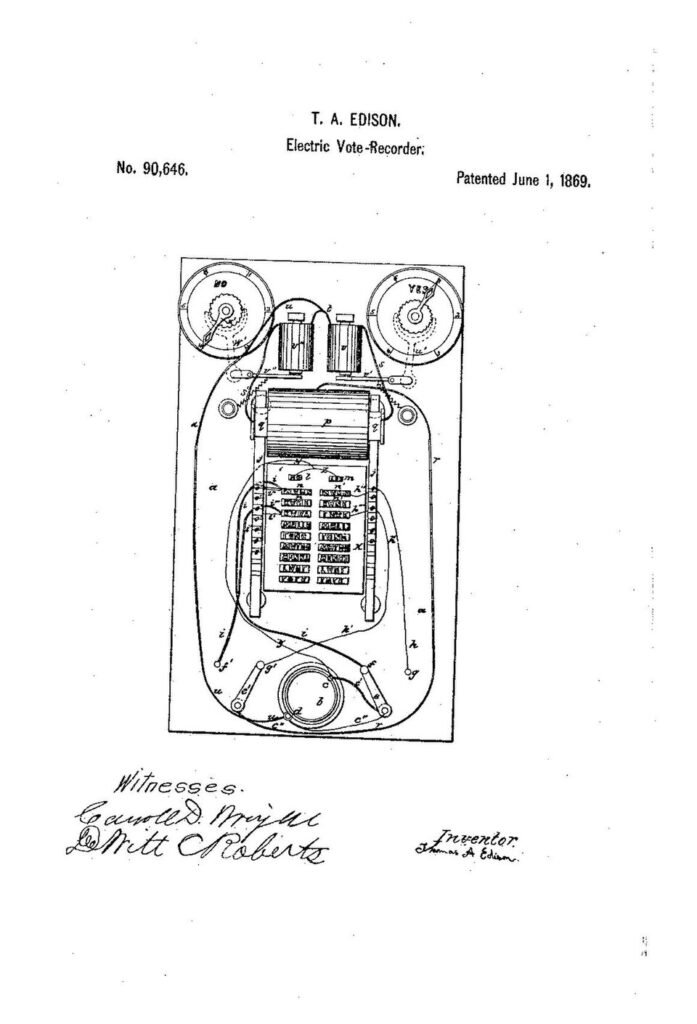
Image credit: Thomas Edison / public domain
In 1868, when he was 21, he transferred to the telegraph office in Boston. Here he came up with his first inventions – a transmitter and receiver for the automatic telegraph. He also made improvements to the town’s fire alarm system. Also, this was the year Edison applied for his first patent, and although this particular invention was never used, it taught Edison a valuable lesson. The patent was for an electric vote recorder, to be used by legislators. At the time, they were still taking votes by the ballot box, a process that Edison found slow and inefficient. But to his surprise, the legislature expressed no interest in his recorder. They preferred a delay in voting because it gave them time to lobby and perhaps affect the outcome. Edison vowed after this experience that before working on any invention, he would first make sure there was a commercial need for the product. It was a vow he kept.
While working in the telegraph office, Thomas Edison came across a book which he later described as “one of the decisive events” of his life. The book was Michael Faraday’s Experimental Researches in Electricity. Edison was struck by the similarities between the English scientist and himself – both had been born to poor families and were self-educated. He found Faraday’s discoveries in the field of electricity to be astounding and resolved then and there that this too would be his field of endeavor.
After the ill-fated vote recorder, Edison produced his first major invention – a stock ticker for printing the latest stock exchange quotes and relaying them to the offices of the brokers. With the money he earned from the new ticker – $40,000 – Edison made a decision that would change the course of his life and the entire future of life in America. He decided to become a freelance inventor. He established a manufacturing shop and a small laboratory in Newark, New Jersey. Channeling his profits into new and bigger ventures would become a pattern in Edison’s life. When the Western Union Company once offered him $100,000 for one of his inventions, he responded: “The money is safer with you. Give me $6,000 a year for seventeen years.”
Although he could have been far wealthier than he was, Thomas Edison chose instead to invest much of his income in new experiments and research, many of which succeeded, some of which failed. Still, even with this policy, Edison didn’t fare badly – he was a millionaire by the time he was 40.
Marriage, Catnaps and a Hundred-Hour Week
On Christmas Day in 1871, when he was 25 years old, Thomas Edison married Mary Stilwell, a 16-year-old employee of one of his companies. Those who knew him suggested he had chosen Christmas as his wedding date because he could be sure it was the one day he wouldn’t be able to get any work done. As it turned out, he left his Mary shortly after the ceremony to take care of something he’d forgotten at the laboratory. At midnight he was still there, having completely forgotten about his new bride.
Throughout his life, Thomas Edison worked extremely long hours, often a hundred hours a week. One of his most famous quotes was: “Genius is 1 percent inspiration and 99 percent perspiration.” He worked through the day and many evenings, earning a reputation as “the man who never slept.” Thomas Edison did in fact sleep, but he was an unconventional sleeper. He catnapped for only short periods, a habit he’d picked up while working on the railroads. He was known for his ability to fall asleep in almost any place or circumstance – on a pile of papers, on a table or roll-top desk, amid a tangle of pipes, or under one of his huge machines. Mary and Thomas Alva Edison had three children, a girl and two boys. Edison nicknamed the first two children “Dot” and “Dash” after the telegraph code.
Menlo Park: Where the Wizard Built His Miracles
After establishing himself in Newark, Thomas Edison decided to give up the manufacturing end of his business and moved the laboratory to suburban Menlo Park. He donned his long white lab coat and his floppy straw hat – the costume that would be his trademark for almost fifty years and took out an advertisement in the local paper. It promised his lab would deliver “a minor invention every ten days and a big thing every six months or so.” He was boasting, as he often did, but as usual, he made good on his promise. It was this location that would produce his most stunning inventions, referred to by the locals as Edison’s “miracles.” They included the incandescent lamp and the phonograph. By the time he was in his 30s, Thomas Edison was said to be the most famous American in the world.
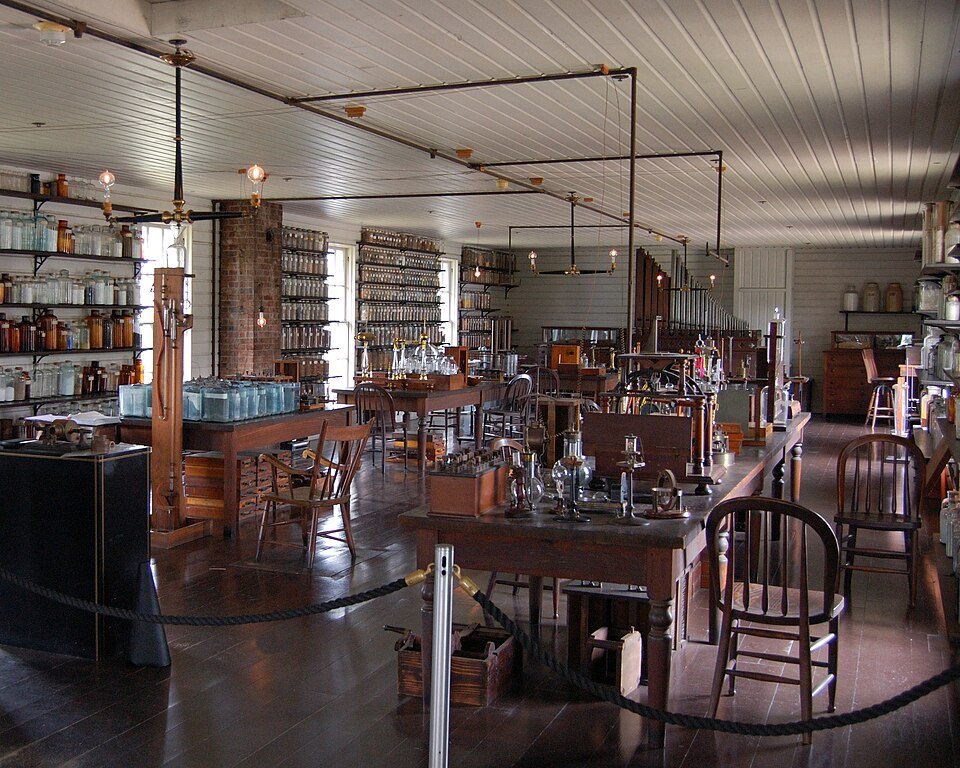
Image credit: Andrew Balet / CC BY-SA 2.5 (via Wikimedia Commons)
In his laboratory, Thomas Edison put groups of experts to work on various projects, in what was to be the forerunner of the modern industrial research laboratory. Before Thomas Edison, inventors had worked alone, sometimes conferring with a colleague or two. The idea of putting together a team of skilled workers to investigate and solve technological problems was his alone, and it contributed greatly to the progress of modern science and research. By the early 1900s, U.S. corporations had seen the success of laboratories like Edison’s and began establishing their own. Edison’s laboratory was later moved to the Henry Ford Museum in Dearborn, Michigan, where it can still be seen today. When Ford, a good friend of Edison’s, first unveiled the lab in the museum, Edison told him it was 99.5 percent accurate. The problem, he said, was: “We never used to keep the place so clean.”
In his lab in Menlo Park, Edison usually worked right along with his assistants. He was always curious about how others approached mechanical, electrical, and chemical problems, and always eager to learn from them. Once, when asked to sign a guest book at a convention that requested name, address, and interests, Edison had written only one word in the “interests” category – “Everything.” At Menlo Park, Edison and his companions created the phonograph and the electric light bulb and made further improvements on telegraph and telephone devices.
Mina Miller and the Family Edison Barely Saw
In 1884 Edison’s wife, Mary, died, after a few years of deteriorating health and periods of mental instability. The cause of death was listed as “congestion of the brain,” which most likely meant a tumor or hemorrhage. The following year, at the age of 38, he remarried. He chose the daughter of a wealthy Ohio industrialist, a young woman only a few years older than his daughter. Her name was Mina Miller, and with her, as with Mary, he would have one girl and two boys – six children in all. None of the children saw very much of their father, and neither did their mother. To fill her time, Mina Edison developed an independent life that revolved around various social activities and charitable causes. Her husband was never interested in social events, always preferring to be in his beloved lab. At one dinner party, when he was planning to escape at the earliest opportunity, the hostess suddenly asked him what he was currently working on. Edison replied: “My exit.”
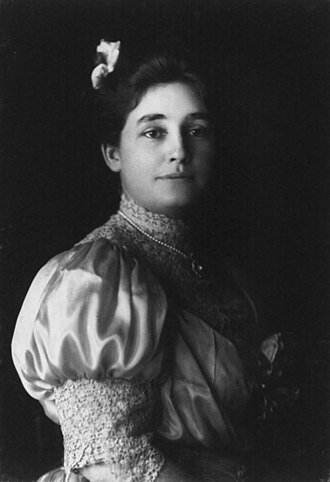
Image credit: Pach Bros. / public domain
Thomas Edison was consumed with his work and was never much of a family man, although in his later years he took special pleasure in grandchildren. Friends and associates often spoke of his detachment, or worse, his indifference, to other people’s feelings and welfare. Even as a child, his parents had been concerned about this detachment, particularly in one tragic incident where one of his childhood friends drowned. Young Alva, about six years old at the time, had been swimming with the boy in a local pond. He saw the child disappear under the water and fail to surface. But he came home and told no one. Later, when a search party was formed, he finally described what had happened. His parents could never understand his behavior, although some have theorized he may have been frightened. In later life, Thomas Edison often seemed cold and removed from people, but many believe this could have been a result of his hearing impairments, which often create feelings of isolation. However, he could also be quite charming, regaling people with stories and entertaining them with his offbeat sense of humor. His co-workers said he could be a tyrant one minute and could charm them off their feet the next.
Thomas Alva Edison did have friends – but his strongest relationships were always among his business associates. His closest friend was Henry Ford. It was Thomas Edison who first encouraged Ford to apply the gasoline engine to the automobile. They liked to take automobile camping trips together, sometimes taking along their friends Harvey Firestone, a leader in the tire and rubber industry, and naturalist John Burroughs. Edison was also always a favorite of newspaper reporters – he was very well informed, as avid readers tend to be, and he had strong opinions and a down-to-earth manner.
West Orange and the War Years
The year after his second marriage, in 1886, Thomas Edison built a new lab, ten times larger than the first, in West Orange, New Jersey. The lab included a three-story office that held thousands of journals and books. It would remain his true home for the rest of his life. In West Orange, Thomas Edison worked on inventions for the motion picture industry, ways to process iron ore, the development of the alkaline battery, manufacturing of cement, and improvement of the phonograph.
When World War I broke out in 1914, Thomas Edison was put in charge of the Naval Consulting Board, a group of inventors and business people who made contributions to the war effort. He was opposed to America’s involvement in the war, but once it became inevitable, he served his country in the best way he could. It was Thomas Edison who suggested and fought for the establishment of the Naval Research Laboratory, located outside Washington, D.C. With uncanny prescience, he also stated during the war years that: “There will one day spring from the brain of science a machine or force so fearful in its potentiality, so absolutely terrifying that even man, the fighter who will dare torture and death to inflict torture and death, will be appalled and will abandon war forever.” When the war was over, he returned to the lab but gave most of the administrative work to his son, Charles. Charles, the best known of Edison’s children, later became a Secretary of the U.S. Navy and then Governor of New Jersey.
Thomas Alva Edison Inventions That Changed Everyday Life
A Transmitter That Made the Telephone Audible
Although Thomas Edison will probably always be best remembered for the electric lamp, the lamp was only one of many contributions he made to American life, over a career that spanned more than sixty years. When he was still in his 30s, after he’d settled into the new laboratory in Menlo Park, Edison began experimenting with the telephone Alexander Graham Bell had patented the year before. In these early days, the telephone was called a “speaking telegraph.” Although this marvelous new device did carry sound, the sound was still muddled, and people had trouble understanding each other. Edison designed a better transmitter, which made the speaker’s voice louder and clearer. His transmitter became the model for all the phones of the next century.
The Phonograph: The Invention He Loved Most
One of Edison’s next inventions was the one of which he was most proud – the phonograph. In 1876, while also working on the telephone, he’d been experimenting with ways to record and playback messages. In 1877, when he was 30 years old, he began to use tin foil and wax cylinders to record sound. He attached a needle to a metal disk that vibrated in response to the sound waves of a voice. He then placed this needle against the rotating tin foil cylinder. When the disk vibrated, the needle made impressions in the foil. To reproduce the sound, Thomas Edison attached another needle to a diaphragm with a funnel-like horn. The needle retraced the impression in the foil. One of his first successful recordings was “Mary Had a Little Lamb.”
How the Wizard of Menlo Park Got His Nickname
Thomas Edison began taking his cylinder phonograph around for demonstrations – at scientific organizations and societies, at magazine offices, even at the White House for President Rutherford B. Hayes. People could scarcely believe what they heard – many thought it was magic or the trick of a ventriloquist. It was at this time that Edison was given the nickname “Wizard of Menlo Park.” At one demonstration of the new phonograph, a journalist asked Edison whose voice, out of all the people in history, he would most like to have heard. Edison instantly replied: “Napoleon.” When the journalist replied, rather piously, that he would have liked to hear “the voice of our Savior,” Edison responded: “Well, you know I like a hustler.”
The phonograph was so unusual and unexpected that at first, no one knew quite what to do with it. Thomas Edison himself envisioned it as a dictating machine, although he also used it to design talking dolls and children’s pianos. It would take a few years before other people came up with the idea of selling musical recordings for the phonograph, and eventually, Thomas Edison began to make his recordings.
The Edison Light Bulb and the Edison Effect
The first Edison invention to gain mass attention and popularity was the amazing electric lamp. He began work on it in 1878, after he’d seen a demonstration of a device that produced extremely bright light by sending electricity across a gap between two carbon terminals. It occurred to him that he might be able to create an incandescent lamp for use in private homes. An incandescent lamp would produce less intense light by passing electricity through a filament or wire to make the filament glow. He set out to find a material that could be electrically heated to incandescence in a vacuum. During his experiments on the incandescent bulb, Thomas Edison stumbled across a phenomenon that soon became famous as THE EDISON EFFECT. He had noticed a flow of electricity from a hot filament across a vacuum to a metal wire, creating a blue glow around the positive pole and a blackening of the wire at the negative pole. Scientists later determined the effect was caused by the thermionic emission of electrons from the hot to the cold electrode. They formally named the effect THERMIONIC EMISSION, but it’s still popularly known as “The Edison Effect.” Later, it became the basis of the electron tube and the foundation of all electronic inventions of the 20th century, including the radio and television.
From Platinum to Bamboo: The Hunt for a Filament
In working on his lamp, Thomas Edison started with platinum wire in glass bulbs at 10 volts. Then he developed a three-wire system with a supply of 220 volts. But this higher voltage was too strong for platinum, so he began searching for new material. The search was lengthy and extensive. But finally, in 1879, he came up with a lamp that contained carbonized or burned sewing thread, and that glowed for 40 hours. Recognizing the potential of his “bright” idea, he founded The Edison Electric Light Company, with financial help from the Vanderbilts and J.P. Morgan, and an advance of $30,000 for his research. This company eventually merged with other companies to form the General Electric Company in 1892. It became one of the largest manufacturing companies in America. A few years later, after discovering the carbonized thread, Edison began using bamboo filaments, which increased the life of the bulbs.
Francis Upton and the Math Thomas Edison Never Learned
For help on his light bulb, Thomas Edison called in 26-year-old Francis Upton, a brilliant Princeton scientist who provided the mathematical and theoretical expertise Edison lacked. Edison was always a practical scientist – that is, he learned everything by experimentation and observation. As he put it: “I do not depend on figures at all. I try an experiment and reason out the result, somehow, by methods which I could not explain.” Some people accused Thomas Edison of certain snobbery towards theoretical scientists, and called him an anti-intellectual. Indeed, he was never able to read a book by Isaac Newton because he found the mathematics tedious. And it’s true he once described mathematicians as people “who put a lot of a’s and b’s on paper and then come up with the wrong answer.” And yes, he once said pure scientists were people who made discoveries they were either too lazy or too ignorant to convert into useful devices. But it’s also true he never hesitated to seek their help and to honor their work in his laboratory. When he spoke about hiring Upton, he said: “At the time I experimented on the incandescent lamp I did not even understand Ohm’s law.”
Pearl Street: The World’s First Power Station
Edison’s light bulb was a product of genius, but it was also almost unusable. At that time, few homes and businesses had the electricity to power a lamp. So Thomas Edison, never deterred by obstacles large or small, made the next logical step. He began designing central power plants that could distribute electricity over wires to businesses and homes. Three years after the lamp, Edison installed the first central power station in the world. It was located on Pearl Street in New York City and provided enough power for 7,200 lamps. The station was a success, and more stations followed.
Motion Pictures: Inventing the Movie Business
After the light bulb came the years at Edison’s new laboratory in West Orange. It was here that he helped to create the motion picture industry. He started by working with a device that looked like his cylinder phonograph, saying: “I am experimenting upon an instrument which does for the eye what the phonograph does for the ear.”
Thomas Edison and his colleagues started recording a series of images on celluloid film. When shown in rapid succession, these images looked like continuous action. Then, in five years, Thomas Edison invented the peephole kinetoscope – the first motion picture device to use a roll of film. It looked like a cabinet with a peephole or eyepiece on top. A customer dropped a coin in a slot and watched through the eyepiece while a short motion picture played, usually of dancers or prizefighters. In 1893, Thomas Edison built his film studio, called Black Maria – it was the very first building designed for the express purpose of making movies. He brought projectors, designed by other inventors, to the Black Maria, and began producing and distributing the first real motion pictures. He joined forces with other inventors and formed the Motion Picture Patents Company, which controlled almost all the production and distribution of motion pictures in the United States. Movie after movie was born in this early studio, including classics like The Great Train Robbery. But in 1917, the Supreme Court upheld a ruling that the company was an illegal monopoly, and many of Edison’s employees deserted.
The Alkaline Battery and 50,000 Things That Won’t Work
At West Orange, Thomas Edison also concentrated on the development of the alkaline storage battery, an idea he began working on when he created the phonograph. At the time, most homes lacked an electrical source, so he was seeking an independent source of power. Now he wanted to create a battery that was lighter, more powerful, and more durable. It would be twenty years before all the problems with the battery were solved, but by 1900, when the new century dawned, he was already marketing his battery to eager customers. When someone once commented on the huge number of failures Edison had experienced while trying to perfect his battery – fifty thousand experiments before he achieved results – Edison responded: “Results? Why, I have gotten a lot of results. I know 50,000 things that won’t work.”
By 1909, Thomas Edison was the principal supplier of batteries for submarines and electric vehicles. Railroads used his batteries to power signals and switches, and they were also used in electric automobiles and as electric starters in gas-powered cars. Henry Ford especially requested them for his new creation, the Model T.
Iron Ore and Cement: The Biggest Loss of His Career
While Thomas Edison was working on establishing a motion picture industry and perfecting his battery, he also became interested in ways to process iron ore for America’s steel mills. He built a plant in New Jersey where iron ore moved continuously on conveyor belts, a system like an assembly line that later made his friend Henry Ford so famous. He used magnetic separators to cull the iron from sand and other ores.
Thomas Edison poured a fortune into his iron ore projects – well over a million dollars. He bought 145 abandoned mines in the east and was sure he could make them profitable again. But although his technology was advanced and efficient, his venture failed, mostly because iron ore discovered in Minnesota was less expensive to process and mine. It was the biggest loss of Edison’s career. Later, he recycled some of the equipment from this project to build one of the largest cement plants in the United States, in western New Jersey. He searched for new uses for cement, introducing the poured concrete house and even designing cement furniture. Cement from Edison’s factory was used to build Yankee Stadium and many other large buildings and factories in New York City.
While all this was going on, Thomas Edison continued to work on and improve his phonograph, exploring materials on which he could record, and then producing the chemicals to manufacture them. He switched from the cylinder to the now-familiar disc format in 1913, because discs were easier to handle and store. But he held on to the cylinder device for his dictating machine called an “Ediphone.”
After World War I, when Thomas Edison was in his 60’s, he became intrigued with the idea of finding domestic sources for rubber. He conducted massive research on hundreds and hundreds of plants to see if any species held a hidden reserve. Finally, he chose a variety of goldenrod and asked his friend Harvey Firestone to make automobile tires out of the new rubber. Firestone presented him with four tires, but the project was later abandoned when it proved unprofitable. Failure, however, never discouraged Edison nor dimmed his confidence in the future. He continued to work even in his 80’s, although his last twenty years never produced anything to match his earlier career. When he died, he had 389 patents for electric light and power; 195 for the phonograph; 150 for the telegraph; 141 for storage batteries; and 34 for the telephone.
How Thomas Alva Edison Actually Worked
Edison’s style of work was aggressive, flexible, and resourceful. When trying to solve a problem, he looked for many different solutions. When working on new or improved devices, he made numerous designs. He would often borrow features from one technology and adapt them to another. He would create not just his inventions but would improve and modify the inventions of others.
Thomas Edison also knew how to market and promote his products – it was always of paramount concern to him that he invented devices people could USE. He invented for necessity. He managed to find financial partners throughout the world, and he created new companies to manufacture and sell his products.
Light’s Golden Jubilee and Edison’s Final Days
In 1929, when Edison was 82 and his health was failing, Henry Ford organized an elaborate international event to honor him. There had been many honors before – the French Legion of Honor in 1878, and a United States Congressional Medal of Honor in 1928, to name just a few. Henry Ford’s celebration was in honor of the fiftieth anniversary of Edison’s invention of the incandescent lamp. Ford called it “Light’s Golden Jubilee.” There was a formal banquet at which President Herbert Hoover gave the principal address, and prominent people from all over the world sent their congratulations.
Edison suffered a variety of illnesses as he grew older, but he continued to work and experiment up until his last days. He died in bed at his home in Llewellyn Park on October 18, 1931, at the age of 84. His last words were a response to his wife, who had asked if he was suffering. “No,” he said. “Just waiting.”
On the evening of his funeral three days later, President Hoover asked all Americans to dim their lights at 10 p.m. for a few moments in tribute. At the White House and in businesses and homes throughout the nation, there was momentary darkness in honor of the man who had brought light to so many.
The Legacy of Thomas Alva Edison
Thomas Edison was among a group of inventors and manufacturing pioneers of the late 1800s that helped make the United States a world industrial power. He transformed the world and the daily life of those who live in it. He had great faith in the future of America and was a believer in progress. He believed that capitalism and mass production offered people better opportunities and higher quality products for less cost. He said that industry and invention offered everyone the chance of personal success and reward, while also benefiting society. Edison personified all the virtues of the American worker – he worked long, hard hours. He knew the value of teamwork, and most of his projects were cooperative ventures that pooled the resources and skills of the best in their fields. Yet he also possessed the typical American independence, working as his boss, and forging ahead on projects more cautious men would have shunned.
He was an example of the classic American rags-to-riches story, proving with sheer work and ingenuity that all things were possible and the question was not “whether” but HOW. He refused to be stymied by obstacles and took failures as challenges. Even his deafness was an asset and became the motivation for many of his inventions. He was willing to change his goals and directions at any moment, based on discoveries in his research and experiments. Whenever he observed some unexpected phenomenon, he didn’t hesitate to stop the work in progress and pursue a new direction. When asked his philosophy of life, Thomas Alva Edison once said: “Work. Bring out the secrets of nature and apply them for the happiness of man. Look on the bright side of everything.”
Thomas Edison was a genius. But equally as important, he had self-confidence, determination, and an irrepressibly positive attitude. With those tools, he was able to overcome numerous technical setbacks and several commercial failures. Today, the very light bulb he invented has become a symbol of the brilliant idea, the inspired thought, and the solution to a challenging problem.
References:
- Baldwin, Neil (2001). Edison: Inventing the Century. University of Chicago Press; Clark, Ronald William (1977). Edison: The man who made the future. London: Macdonald & Jane’s: Macdonald and Jane’s; Davis, L. J. (1998). Fleet Fire: Thomas Edison and the Pioneers of the Electric Revolution; Pretzer, William S. (ed). (1989). Working at Inventing: Thomas A. Edison and the Menlo Park Experience

