

Cover image: SnapMeUp, licensed under CC BY 4.0.
One warm rainy night in June, in the year 1896, Clara Ford heard a terrible hammering noise from the back of her house. Clara was used to loud noises – as were all her neighbors. Ever since Henry and Clara Ford had moved into the house on Bagley Avenue in Detroit two years before, there had been strange noises every night from the little brick shed in their back yard. Hissing noises – banging noises – and sometimes a loud roar. Occasionally they could see sparks or smoke drifting out the windows. The Fords seemed a nice enough couple. They had a baby son named Edsel who was home with his mother all day, while father Henry worked at an electrical power plant in town. But every night when Henry got home, the lights would go on in the shed and the strange noises would start again. Sometimes the lights and noises continued all night long, and sometimes there would-be visitors to the shed – important-looking men who would come out shaking their heads and urgently whispering to each other. It wasn’t long before the neighbors found out what was going on in the shed. Henry Ford was building one of those horseless carriages – useless contraptions! A few other men had built them but they never worked for long, not nearly as reliable as the good old-fashioned horse. The horseless carriage would never be anything more than a toy for grown men with idle time.
The First Quadricycle: Henry Ford’s Early Experiments
Even though Clara Ford was used to the loud noises from the shed, this night was different. It was so loud it sounded as if the building was collapsing. She grabbed an umbrella and hurried out to see what was going on. And then she stopped in her tracks. There was Henry, mallet in hand, swinging away at the brick wall of the shed. Timber was splintering and falling, bricks were flying, and clouds of dust billowed in the doorway. What on earth was he doing this time? Henry saw his wife and ceased hammering for a moment. “It’s finished,” he said. Through the doorway, Clara Ford could see that it was finished. Henry’s horseless carriage had a two-cylinder, chain-driven gasoline engine. The engine was stored right behind the single-seat, which could carry only one person. Henry figured the engine was about three or four horsepower. The carriage had a tiller, like a boat’s, for steering. It had two forward speeds but no reverse. It had an electric doorbell for a horn. He might need a horn because the carriage had no breaks; Henry would stop it simply by turning the engine off. The carriage had four big wire wheels that looked like bicycle wheels, so he called his new creation a Quadricycle. Now, after two years of work, he was ready to test it. The only problem was it wouldn’t fit through the door. Henry assured his wife that he would rebuild the shed. Then he ran back to the carriage and cranked up the engine by hand. He climbed into the seat of the Quadricycle, started it up, and steered his way out onto the cobblestones of the alley and into Grand River Avenue. He’d gone only a short distance when the car sputtered and came to a stop. Henry soon found the problem – a tiny spring that was part of the ignition system had come loose. He replaced it, climbed aboard again, and continued his drive, once around the block, and back to home on Bagley Avenue.
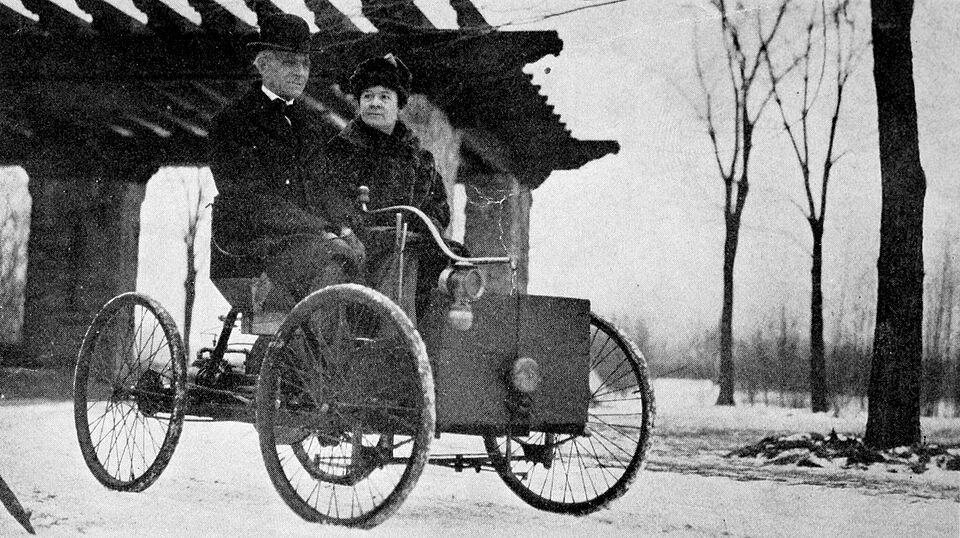
Image credit: The Truth About Henry Ford, by Sarah T. Bushnell. Public domain.
It was only a beginning. But in a few years, Henry Ford would painstakingly design and build more cars until finally, he was able to produce one that was practical, affordable, and accessible to the mass market. Henry Ford’s work would transform the United States into the nation of the automobile. He became the largest automobile producer in the world and the first to use the assembly line to mass-produce standardized cars. There is almost no way to completely assess the impact the automobile had on the world: it changed the very look of our towns, cities, and countryside with roads, bridges, and freeways; it improved emergency services; it enabled people to see more of each other and more of their world; it made it easy to procure food and merchandise; it also affected the congestion of the cities and the quality of our air, and it became a leading cause of injury and death. Positively or negatively, the automobile had more influence on daily life in America than perhaps any other invention of the 20th century. And this influence was largely the work of an uneducated farm boy with a natural genius and a determination to do things his way, no matter what others said.
Henry Ford early years and Mechanical Curiosity
Henry Ford was born on July 30, 1863; the same month the Battle of Gettysburg turned the course of the Civil War towards a Union victory. He was born on a farm outside of Dearborn, Michigan, not far from Detroit. From the beginning, he had almost no interest in farming. He said later: “I have followed many a weary mile behind a plow and I know all the drudgery of it.” He preferred instead to tinker with anything mechanical. He would fix watches, repair tools, take his toys apart, and rebuild them again – anything to help him understand how things worked. Henry’s father was disappointed in his son’s preoccupation with mechanics; he wanted him to be a farmer like he was. But Henry’s mother thought his natural aptitude should be encouraged and she had her husband build him a workbench in his own bedroom. There, when the chores were completed at the end of the day, he would sit with his tools and dismantle every gizmo he could get his hands on. Once he even hammered his mother’s knitting needles into screwdrivers. Henry’s brilliance was natural and unlearned. His formal education amounted to about eight years in a one-room schoolhouse and his grades were mediocre at best. Throughout most of his young and adult life, he had only one single interest – machines.
When he was twelve years old, Henry’s father took him on an errand to Detroit, and on the way, they saw a steam road-engine barreling down a country lane. It was a memorable moment for Henry Ford. It was the first time he’d ever seen a machine that operated by its own power instead of horses. The road-engine had a huge boiler into which the operator shoveled coal, thus building steam to turn the wheels. From that moment on, Ford dreamed of building a smaller self-powered machine, one that could be driven by anyone and that could move faster than anything drawn by a horse. That dream was still on his mind when he finished his schooling.
Apprenticeship and Early Career in Detroit
After he finished school, when he was only sixteen years old, Ford left the farm and found work as an apprentice machinist in Detroit. He made $2.50 a week – not enough to pay his expenses. So he took an additional night job repairing watches in a jeweler’s shop, where he earned an additional fifty cents a night. The jeweler had his work in the back of the shop because he felt his customers might not feel confident seeing a sixteen-year-old working on their watches, even though his work was expert.
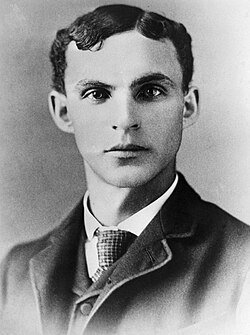
After three years, Ford completed his apprenticeship and returned to the farm to help his father for a while. He discovered one of his father’s neighbors had purchased a steam engine but couldn’t find anyone who knew how to drive it. Ford dashed over and volunteered for the job. Shortly after, the manufacturer of the engine heard about his skill in driving and repairing the machine, and he hired Ford to sell and repair steam engines throughout southern Michigan. He was also sent to Detroit occasionally to repair other machines. On one of these trips, he was introduced to an internal combustion engine. It was love at first sight. Immediately, Henry saw the possibilities. This engine relied on gasoline instead of coal or steam, and it was smaller and lighter than a steam engine. He set to work to find out all he could about the engine – he learned to repair it, to take it apart, even to build one. All along, the question on his mind was whether this engine could someday be the key to his dream of building a horseless carriage. Finally, he decided to build his own internal combustion engine, and try it out.
Marriage to Clara Bryant and Support for His Dream
When he was 24, Henry Ford went to a New Year’s Eve party at an adjoining farmhouse and met Clara Bryant, a friend of his sister’s. Clara had many nice qualities but to Henry, she had one quality that surpassed all others: she was actually interested in his dream about the horseless carriage, and she encouraged him to pursue it. Henry married her and then they moved to Detroit where he could be closer to the tools and resources he would need.
In Detroit, Ford worked for the Edison Illuminating Company. Thomas Edison and Henry Ford were friends throughout their lives, and it’s said Edison was the one who most encouraged Ford to use the combustion engine in the making of a car. Later it was a favorite pastime of the two to hop into Ford’s Model T and go off on picnics in the countryside.
Ford was a tall and slim man, with sharp features, a somewhat gawky body, and a shrewd expression. Although he had a brilliant mind, those who knew him say he worked almost intuitively – he seemed to have an innate sense of how things worked and how they could be improved.
At the time Henry Ford began his work on a horseless carriage, there were already a few gasoline cars puttering around America. But the cars were poorly built, exceedingly expensive, and considered novelties for the very rich. Ford’s dream was different – he wanted to build a car that was sturdy, inexpensive, and useful. He wanted a car for the working class, a dream that almost all other manufacturers considered impractical and unprofitable.
In Detroit, Henry and Clara had their first and only child – a son they named Edsel after Henry’s best childhood friend. Shortly after Edsel was born, Henry rushed into the kitchen one day to show Clara his first one-cylinder gasoline engine. It was the first step in the creation of his horseless carriage.
After the one-cylinder engine, Henry built a two-cylinder engine, and then constructed his famous quadricycle in the shed behind the house. After the trial run, through the expanded wall of the shed, Ford worked on improvements for the car. He invented a radiator to circulate water around the engine and keep it cool. He refined and improved, and modified, and experimented, trying to get his car ready for the public. After three years, a new automobile company in Detroit asked him to design some experimental cars for them. Ford got to work but before his designs were completed, the company had already gone bankrupt. Now he had no backers, no money, and lots of ideas waiting to be born. Finally, he came up with an idea. Auto racing had recently become a popular sport, and it was a good way to make money and gather support. Ford decided to build a racing car, enter it in a race, and hopefully win. If he did, he believed he could convince people to finance the building of his motorcars.
The racecar Ford built had a 26 power engine, and a new carburetor and sparking system called spark plugs. He took it to a racecourse at Grosse Point, near Detroit, where a crowd of 8,000 people had gathered to see the famous Alexander Winston perform. Winston was a former prizewinner, a man who was hard to beat under the best of circumstances. Today no one expected much of a contest – Winston had shown up with his latest design, a sleek racer with a seventy-horsepower engine that had to be unbeatable. Other competitors took one look at Winston and his car and dropped out of the race. But Henry Ford stayed. When the starting gun went off, Winston and Ford were on the track alone. The cars took off, each one with a mechanic hanging from its running board, for balance. Winston took off ahead of Ford and stayed there for several turns around the track. Then suddenly there was smoke rising from the track. Everyone craned their necks to see – was it Winston or Ford? It was Winston! Ford kept going, never taking his eyes from the track ahead of him. He passed Winston and shot through the finish line. The crowd rose to its feet, cheering. The race hadn’t been predictable after all.
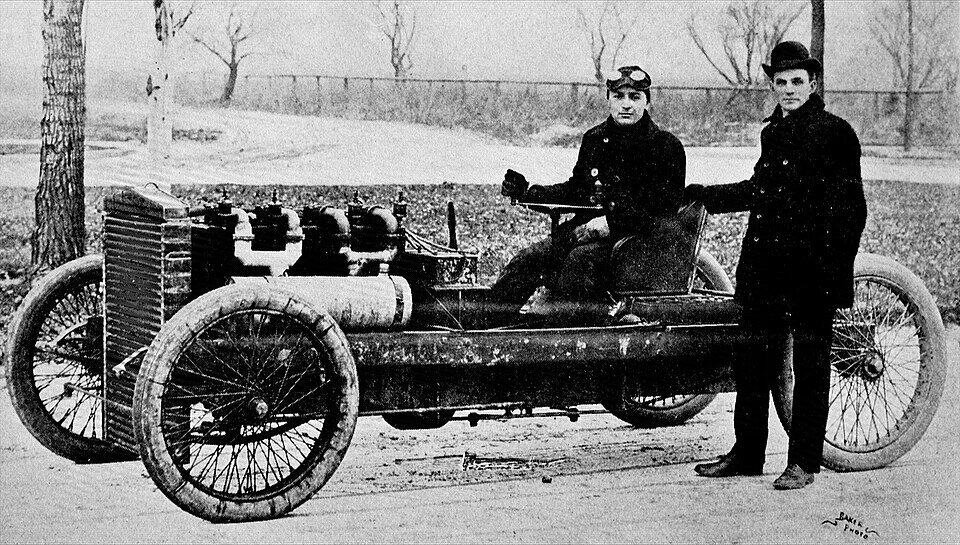
From that day on, racing his cars became one of Ford’s favorite hobbies. Once, to prove the excellence of a new model he’d built, he announced a race, by himself against time, on a frozen lake. A large crowd gathered to watch, sure that no car could race under such hazardous conditions. Ford said later: “I shall never forget that race. The ice was seamed with fissures, and at every fissure, the car leaped into the air. I never knew how it was coming down. When I wasn’t in the air I was skidding; but somehow I stayed top side up and on the course, making a record that went all over the world.”
Ford’s races at Grosse Point and elsewhere did what he hoped they would do – they attracted people who were willing to help him start an automobile company. But as it turned out, the investors didn’t trust Ford’s idea of building a car that was inexpensive and practical for the average consumer. They wanted sleek luxury cars for the privileged classes. After a few years, Ford left the company and started his own – the Ford Motor Company. The year was 1903 and Ford was forty years old.
Ford Motor Company and the Model A
The stockholders in Ford’s company included a few lawyers, a coal dealer, and his accountant, two machinists, a clerk, a man who made windmills, and a man who owned a general store. The total capital they collected was $100,000, only $28,000 of which was in cash. Within only a few months, Ford produced his first low-priced car, which he called the Model A. Orders for the Model A poured in faster than Ford could fill them. He began to design other models, choosing a different letter of the alphabet for each one. Orders poured in for those too. Despite the immediate demand for his inventions, Ford’s investors still didn’t believe that cars were going to have long-lasting popularity. And they didn’t like the way Ford was using profits to expand the company. Frustrated by their skepticism, Ford bought up all the shares in the Ford Motor Company and gained complete control. The company had been so prosperous that one schoolteacher who had invested a hundred dollars fifteen years before now walked away with $355,000.
Now that he had control, Ford set out to try a completely innovative and bold experiment. He built an enormous factory to build one model car, and one model only – he called it the Model T. “The way to make automobiles,” he said, “is to make one automobile-like another automobile.” The Model T changed the world. The Tin Lizzie, as it was affectionately called, marked the end of the horse and buggy. Now, cars were no longer the privilege of the special, wealthy class. Ford made cars for ordinary people, for the working class, for those who had never sat in one before, much less owned one.
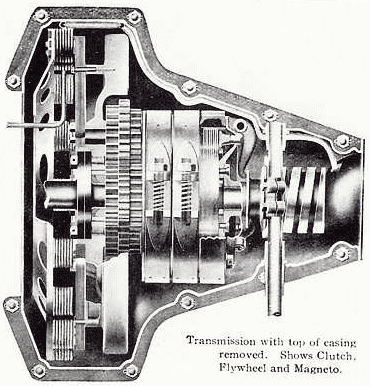
Ford’s Model T was not only affordable; it was less costly than a horse and a wagon. It was light, strong, easy to drive, and easy to repair. Inside each automobile was a little black book entitled: How to Repair Your Model T. Pretty soon everyone wanted one – doctors, farmers, traveling salesmen, preachers, and housewives.
Ford could make his Model T quickly and cheaply because the parts of every car were the same. Even the paint was the same – all Model T’s were painted black, although Ford advised his customers they could repaint the car any color they chose. The first Model T’s to roll out of the factory in 1909 cost $825. But demand was so great and his assembly line improved so, that by 1915 a new Model T was only $440, almost half the original price.
In 1911 Ford was thrown into the first of many public battles, this time with the holders of a patent who claimed they had all rights to the gasoline automobile. The pubic saw it as a fight between the little man, Ford, and a giant monopoly. It took six years for the courts to reach a decision and when they did they decided against Ford. He appealed and two years later was victorious.
In the factory, Ford proved to be a stern and stubborn boss. Early on, his managers and advisors learned that he was to have complete control and his authority was never to be threatened. When the Model T was only three years old and Ford took a vacation to Europe, his workers decided to surprise him with a few improvements on the car. They worked long hours to find a design that was sleeker and faster and they proudly presented it to Ford upon his return to the factory. Ford circled the new car several times. Then he grabbed one door handle and ripped the door off by its hinges. Then he did the same thing to the other door. He smashed the windshield, and then smashed in the roof of the car. He kept swinging until the car was a total wreck, yelling insults and curses the whole time. From then on, no one in a Ford plant ever tampered with one of the cars unless they had permission from Ford himself.
At the same time, Ford had an uncanny ability to recognize and protect men of extraordinary talent who could help further his business. Once he hired an efficiency expert to evaluate the company, and the expert made a favorable report except for one employee. “It’s about the man down the corridor,” he said. “Every time I go by his office, he’s just sitting there with his feet on his desk. He’s wasting your money.” Ford responded: “That man once had an idea that saved us millions of dollars. At the time, I believe his feet were planted right where they are now.”
Innovations in the Assembly Line and Worker Management
Five years after he built his first Model T, Ford had an idea on how to increase his production. It was one of the biggest ideas in the history of American industry – the Assembly Line. Ford installed conveyor belts so that parts could be delivered right to the factory workers. He said: “The work must go to the man, not the man to the work.” As the car moved along the conveyor, some workers put on wheels, some put on doors, and others installed the engines. Each worker handled only one part. The modern assembly line had been born and with it the most cost-effective and efficient means of producing products for mass consumption. In two years, Ford reduced the time it took to assemble one of his automobiles from 12 1/2 hours to 1 1/2 hours. Millions of Model T’s were sold throughout the world. Millions of roads and highways were built to accommodate them. Cities and towns and people were brought closer together, and goods and services flowed across state and national borders in record time. The automobile age had arrived.
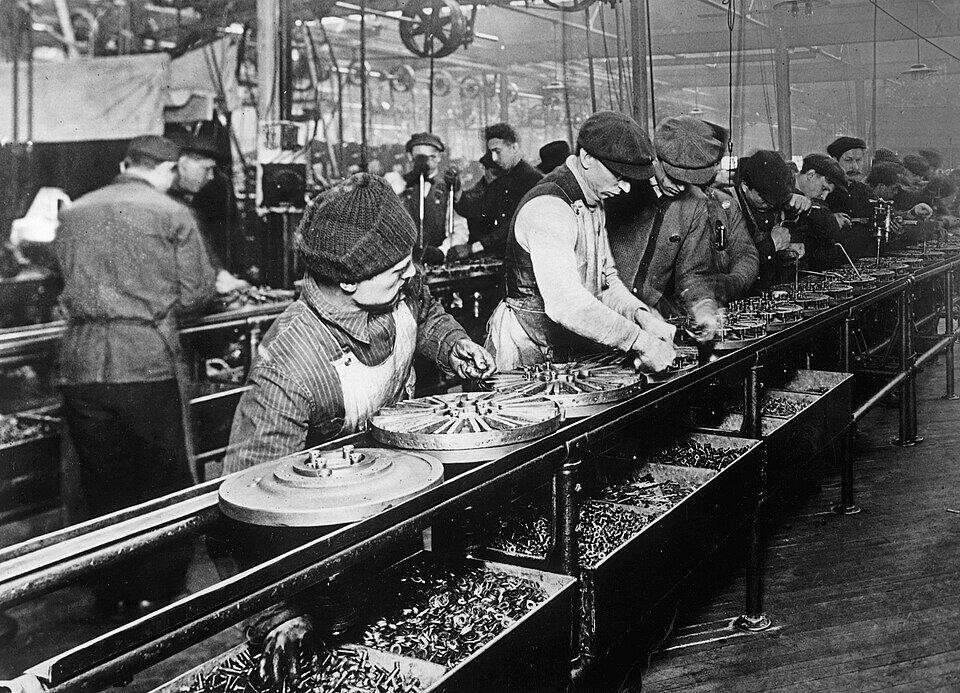
The assembly line was fast and productive. But it had its drawbacks. Ford saw early on that his workers became bored with their repetitive, menial tasks. As they became bored, their work slowed. To keep his workers motivated, he shortened the workday from ten hours to eight. Then he doubled his workers’ salaries. When Ford raised the salary of an eight-hour workday to five dollars a day, it made headlines throughout America. Next, he created a profit-sharing plan that would distribute up to $30 million annually among his employees. People flocked to Ford factories seeking work, and he was able to select those with the greatest skill and potential. As soon as Henry Ford improved the conditions of his workers, other factory owners had to follow suit. The competition to provide better working conditions improved the standard of living for thousands and thousands of workers all across America.
From the beginning, Ford’s decision was based not as much on humanitarian beliefs as on practical business concerns, and he was the first to admit it. He was trying to keep his workers productive and motivated, but he was notorious for his lack of respect and compassion for them. He once commented: “The average man won’t really do a day’s work unless he is caught and can’t get out of it.” Early on, Ford established a system of spying within his organization to assure himself his workers were behaving as they should. He even spied on them in their personal lives. Their homes were watched and their habits were reported. He had strict rules about behavior on and off work that included no gambling, drinking, or smoking, at a time when smoking was still a vastly popular American pastime. One of his top men later reported that every fifth man at the plant was an informer and that employees were followed and watched even in the bathrooms. Ford was just as ruthless as his top managers. Of the four men who worked most closely with him, three were eventually fired when Ford thought they had become too important. One of these men, James Couzens was an organizing genius who had been with Ford from the beginning and was close to being his partner.
Ford bought 2000 acres of land near his boyhood home in Dearborn and built a majestic mansion called Fair Lane. It had a bowling alley, an indoor swimming pool, a skating pond, a golf course, and a man-made lake. It also had its own hydroelectric power plant. When a reporter asked him “What’s the worst thing about being rich?” Ford, responded, “Mrs. Ford doesn’t cook anymore.”
Meanwhile, Ford began to expand his vast empire so he could control every step of the production process. He opened factories in other cities and shipped them supplies so they could manufacture cars locally. He purchased a railroad, 16 coal mines, 700,000 acres of timberland, a sawmill, a fleet of ships to carry ore from his Lake Superior mines, and a glassworks company – all from the profits of the Model T. At the height of his success, his holdings stretched from iron mines in northern Michigan to the jungles of Brazil where he obtained his rubber, to 33 countries around the world. Never before had one man controlled so enormous an industrial empire.
When World War I broke out, Ford again became a controversial figure. This time it was because he took a strong stand against America’s involvement in the war, and against the war in general. He became something of an international pacifist. He chartered a special boat, at his own expense, and sailed to Europe with 170 other anti-war activists, to help arbitrate a peace. His slogan, which became popular throughout the world, was “Get the boys out of the trenches by Christmas.” But on the voyage to Europe, the pacifists quarreled among themselves. When the ship docked, Ford deserted and hurriedly took the next ship home. Later he commented: “I didn’t get much peace, but I learned that Russia is going to be a great market for tractors.”
Shortly after the end of World War I, Ford decided to run for senator from Michigan as a Republican. When the Republicans failed to nominate him, he switched allegiance to the Democratic Party, which did nominate him. When he lost the senate race, he hired agents to find and reveal corruption in his opponent’s campaign and forced the man’s resignation. That done, Ford decided he would run for President instead. An advertisement he took out in a magazine said: “The next President of the United States will be a man who can read a blueprint and who understands the problems of production and how to keep men employed.” Ford gathered huge support for his campaign – both from the public and the press – but just when that support was at a peak, he mysteriously dropped out of the race, saying he was not a politician after all and couldn’t be considered a candidate.
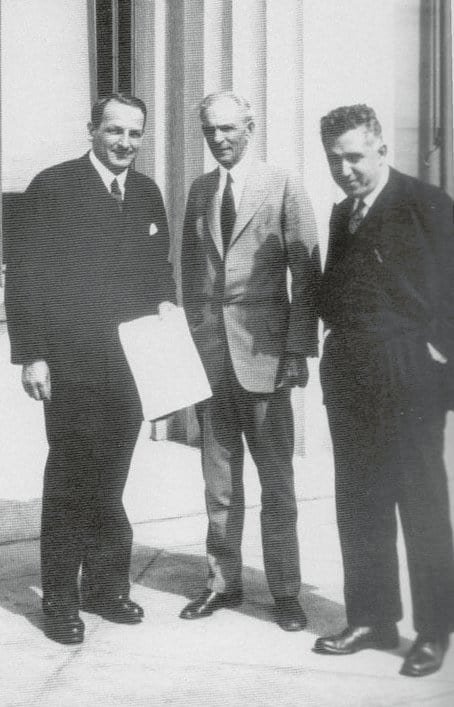
Ford had few cultural or intellectual interests and he rarely read a book. He would not even allow his son, Edsel to go to college. But a year after the war ended, he decided to publish a magazine called the Dearborn Independent, which became notorious for its attacks on the Jewish community. When he was sued for a million dollars by a Chicago attorney, Ford backed down and claimed he’d been too busy to read what was published in the magazine and the anti-Semitism was all the fault of his subordinates. He agreed to abolish the magazine.
The Model T remained popular for several years. In 1927, eighteen years after the first one had premiered, the 15 millionth Tin Lizzie rolled off the assembly line in Detroit, with a price tag of only $380. Meanwhile, the world had changed, and competitors had not been idle. Using Ford’s methods of production, other manufacturers were producing new equally inexpensive models that had fresher lines and greater public appeal. His close advisors began to suggest that Ford consider designing new models. But when one went so far as to write his ideas down in a memo to Ford, he was promptly fired. By the time Ford finally accepted that the days of the Model T were over, and agreed to produce new models, it was too late. His second mass-produced car named the Model A after one of his earlier inventions was a good seller. But Ford had delayed too long and had clung to the Model T when it was past its prime. While he wavered, General Motors took over first place in the industry. The days of Ford’s leadership in the automobile industry were over – from then on it was an open field with dozens of manufacturers vying for the top sales.
Controversies and Public Life
Around this time, Ford found himself back in court again, this time by his own initiative. When the Chicago Tribune called him an ignorant man “incapable of thought”, he sued for a million dollars. The Tribune took the defense that libel is not libel if it’s true. In court, the paper set out to demonstrate that Ford didn’t know when the American Revolution was, didn’t know who Benedict Arnold was, and thought the War of 1812 was a revolution. Ford, uneducated and poorly read, was unable to answer any of their questions. The paper scored a coup when it got Ford to make the widely quoted statement that “All history is bunk.” His complete quote was actually: “History is more or less bunk. It’s a tradition. We don’t want tradition. We want to live in the present and the only history that is worth a tinker’s damn is the history we make today.” Ford eventually won the lawsuit but the unsympathetic jury awarded him exactly six cents in damages. Public opinion about the trial was divided. Some felt Ford was a hard-working, self-made American who had been crucified by a snobby, elitist press. Others felt Ford had demonstrated such prejudice and insensitivity that he deserved a set down.
After the public embarrassment of his trial, Ford seemed to experience a change of heart about history and tradition. Perhaps he was also setting out to prove something to himself and others about his alleged indifference to culture and history. Suddenly, he launched a campaign of artistic and civic awareness. He began a program of dance parties at his factory, in which workers were instructed in the polka, the quadrille, and the mazurka. He went on to assemble one of the largest collections of violins in America, including some made by the masters Amati and Stradivari. He established a museum for all kinds of ancient and contemporary vehicles including chariots, bicycles, buggies, trains, and automobiles. He had a museum made of his friend Thomas Edison’s workshop. He bought and restored the Wayside Inn made famous by Longfellow, did the same thing with the birthplace of Stephen Foster, and bought both a cupboard built by Abraham Lincoln and the chair in which Lincoln was assassinated. Finally, he set up the Ford Foundation, the largest foundation in the world, which gave grants for education, research, and development.
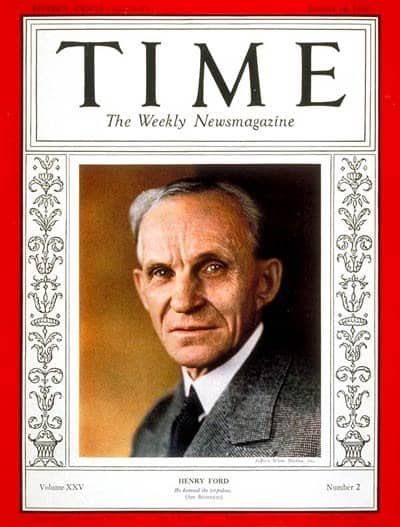
mage credit: Cover credit: Jeffrey White Studios, Inc.. Public domain
All of these activities expressed a growing conflict within Ford about his role in society. He had begun to worry about the consequences of his inventions, just as many other inventors had. The Wright Brothers had worried about the use of their airplanes as instruments of destruction. Einstein had worried about the massive weapons that had been created from his scientific discoveries. And now Ford began to worry about the enormous effects of the automobile. It had played a major part in moving America from a clean, quiet rural society to a congested and noisy urban society. Even though he’d never taken to farming, Ford always loved the country and nature, and he began to feel nostalgic for the old days, days he felt he’d personally helped destroy. He began to spend more and more time in the country and more money and energy in preserving the relics of America’s past way of life. The public and press became increasingly confused about Ford the man, what he was, and what he stood for. A close friend, when asked about Ford’s contradictory behavior, replied: “He’s a genius. There’s no explaining genius.”
In 1941 Ford again made negative headlines when he resisted union organizing at his plant. He fought attempts by the UAW – the United Automobile Workers – to organize his employees. He hired company police and wasn’t against using violence against those who tried to recruit his workers. Photos of his guards beating up a union man were plastered across every paper in the country. Even when the UAW successfully organized his workers, Ford considered shutting down the plant rather than sign a union contract. Eventually, he had no choice but to relent.
In his last years, Ford suffered a series of small strokes. When he was eighty years old, his memory began to fail. His body was healthy and fit, but his mind began to suffer lapses. Once, he even became lost in his own factory. He began to tell people to go get the advice of Charlie, a reference to Charles Sorenson, one of his top men, whom he’d fired many years before. At 82, the family finally convinced Ford to retire and turn the company over to his grandson, Henry Ford II. His son, Edsel, had died years before of stomach cancer. Two years after Henry Ford left his business, in 1947, he died of a stroke at the age of 84. A flood that night had cut off the electric power to Ford’s home and he died by the light of a flickering oil lamp and a few candles – just as life had been in the old days on the farm.
Henry Ford contribution and achievements
Henry Ford was a man of unique qualities and exceptional genius. He had a single-minded dream that he believed in and allowed no obstacle to interfere with it. He never backed down from conflict and he stood up for all his beliefs, no matter how controversial those beliefs might be. He willingly took on corporations in fights over his patents; he took on investors who refused to support his plans; confronted newspapers he felt had libeled him; battled unions that he believed interfered with his rights as a business owner, and even took on international governments when he thought a world war should be stopped. His determination and his refusal to compromise created both enemies and admirers. But Ford was most stubborn and single-minded when it came to his dream of producing basic, inexpensive care for the masses, even when others opposed it. He was an uneducated man who had started with nothing, and with that determination, and a natural intelligence and common sense, he built a vast business empire.
Ford was not so much an inventor nor was he an originator. His genius was in his ability to coordinate the best ideas of other men and reap from them their greatest potential. He took the internal combustion engine which had already been invented; he borrowed the idea of the horseless carriage, which was already on America’s roads; he adapted the idea of the assembly line, already in practice in other factories, and he combined them all into the development of one of the largest industries ever created. That industry permanently changed the economic and social character of the United States. When Ford left his father’s farm in 1879, two out of eight Americans lived in cities. When he died at age 83, five out of eight lived in cities. His automobile was a key part of the transition from a rural, agricultural America to an industrial America. It was a change that many, including Ford himself, would come to question.
It was Will Rogers who perhaps best summed up the contributions of Henry Ford and many other great men when he said to Ford: “It will take a hundred years to tell whether you have helped us or hurt us. But you certainly didn’t leave us as you found us.”
References:
- Watts, Steven (2006). The People’s Tycoon: Henry Ford and the American Century. Random House;
- Ford, Henry (2019). My Life and Work. Columbia.;
- Bak, Richard (2003). Henry and Edsel: The Creation of the Ford Empire;
- Clymer, Floyd (1955).; “Henry’s wonderful Model T, 1908–1927”. New York, NY, U.S.: McGraw-Hill
- “Henry Ford – Visionaries on Innovation – The Henry Ford”. www.thehenryford.org. Archived from the original
- “Henry Ford—Biography, Education, Inventions, & Facts”. Encyclopedia Britannica. Retrieved February 6, 2022.

