

Cover Image: An artists’ impression of the Mariner 10 mission. It used a flyby of the planet Venus to decrease its perihelion. This would allow the spacecraft to meet Mercury on three occasions in 1974 and 1975. NASA / public domain
Table of Contents
Mariner 10 was the last space probe in NASA’s Mariner program. It was launched on November 3, 1973, to measure Mercury’s environment, atmosphere, surface, and body characteristics, and to conduct similar investigations of Venus. The secondary objectives were to conduct experiments in the interplanetary medium. Mariner 10 is the first probe to fly over the planet Mercury (33 years later, the Messenger probe will do the same on January 14, 2008). Mariner 10 visited Mercury three times, on March 29 and September 21, 1974, and March 16, 1975. In total, the space probe mapped between 40% and 45% of the planet, though only the side illuminated by the Sun during flybys. This is the first probe to make use of an interplanetary gravitational slingshot maneuver by using the generated gravitational attraction by the planet Venus to propel itself towards the planet Mercury. This technique has since been frequently used to save the quantity of fuel carried for interplanetary missions.
The Mariner Program and the Path to Mercury
Mariner 10 is the last probe of the Mariner program. Between 1962 and late 1973, NASA’s Jet Propulsion Laboratory designed and built 10 spacecraft named Mariner to explore the inner solar system – visiting the planets Venus, Mars, and Mercury for the first time, and returning to Venus and Mars for additional close observations. This program is followed by the Voyager program, intended for the exploration of the upper planets of the Solar System. The Mariner 10 mission owes its existence to the progress made in the field of space mechanics and, more particularly, in that of gravitational pull. This allows a space probe to change its speed and trajectory without consuming fuel by performing a short flight over a planet. This concept, mentioned in the literature of the 1920s and 1930s, was taken into consideration from the 1950s onwards. Its use was for the first time the subject of a detailed study in the early 1960s by the Jet Propulsion Laboratory (JPL ) for a round trip between Earth and the planet Venus. At the time, JPL was developing mathematical tools to identify trajectories using gravity assist, which was then converted into computer programs. JPL researchers thus revealed the existence of two Earth-Venus-Mercury mission opportunities exploiting gravitational pull in 1970 and 1973. They defined detailed plans and a navigation strategy for the launch window of 1970. At the beginning of 1970, Giuseppe Colombo from the Institute of Applied Mechanics of Padua in Italy, invited to the JPL within the framework of a conference on a possible Earth-Venus-Mercury mission in 1973, observed that the periodicity of the orbit of the spacecraft after its flyover of Mercury is almost exactly double the periodicity of Mercury, which allows a second flyby. This hypothesis is subsequently confirmed by JPL.
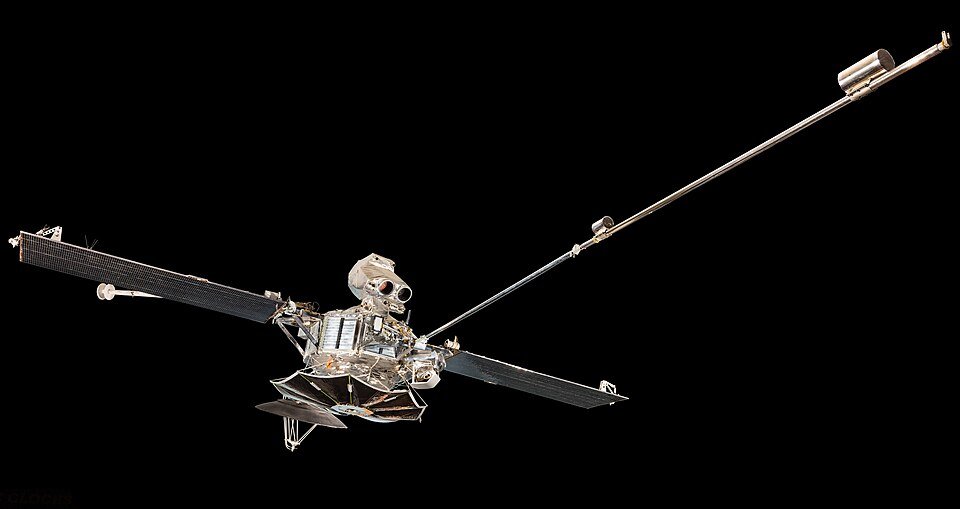
Image credit: National Air and Space Museum / CC0 1.0 Universal Public Domain Dedication
In June 1968, the Office of Space Sciences of the United States National Academy of Sciences provided a report on Solar System Exploration Missions, which recommended sending a mission to Mercury while suggesting some scientific equipment to be on board. NASA takes the conclusions of this report into account and decides in 1969 to program the mission for 1973. They set a committee of scientists to define relevant scientific objectives and select the onboard instruments. The project structure was put in place in January 1970 at JPL. In July 1971, Boeing was selected to design and manufacture two examples of the probe, one of which was to be used for testing.
Spacecraft and Subsystems
Structure and Power
The structure of the spacecraft was octagonal, with magnesium frames and eight compartments for electronics. It measured 1.39m diagonally and 0.457m deep. Two solar panels, each 2.69m long and 0.97m wide, extended from the sides, with a total surface area of 5.1m². Fully deployed, the spacecraft measured 8.0m across the solar panels and 3.7m from the top of the low-gain antenna to the bottom of the heat shield. The total launch mass was 502.9 kg; of this, 29 kg were propellant and attitude control gas. The total mass of the instruments onboard was 79.4 kg.
The engine thrust was 222 newtons, powered by liquid monopropellant hydrazine housed in a spherical tank in the center of the spacecraft. Stabilization of the spacecraft on all three axes was achieved with two sets of three pairs of nitrogen-fed thrusters positioned orthogonally to each other and mounted at the ends of the solar panels. Command and control were the responsibility of the onboard computer, with a 512-word memory augmented by ground commands. Electricity was obtained by 2 solar panels with a total surface area of 5.1m² and generated 540 watts of power that was stored in a nickel-cadmium battery with a capacity of 20 A / hour.
Antennas and Communications
The high-gain dish antenna was 1.37m in diameter and had a honeycomb-shaped structure made of aluminum. It also featured a low-gain antenna mounted at the end of a 2.85m boom extending from the anti-solar face of the spacecraft. The antennas allowed the ship to transmit in S-band and X-band frequencies, and the maximum transmission speed was 117.6 kilobits per second. The spacecraft carried a Canopus star tracker and acquisition sensors on the tips of the solar panels.
Thermal Protection
The flyby past Mercury posed major technical challenges for scientists to overcome. Due to Mercury’s proximity to the Sun, Mariner 10 would have to endure 4.5 times more solar radiation than when it departed Earth; compared to previous Mariner missions, spacecraft parts needed extra shielding against the heat. The interior of the ship was insulated with multiple thermal blankets on the top and bottom. The spacecraft carried a heat shield that was deployed after launch to protect the spacecraft on the side facing the Sun. Five of the eight electronics compartments also had adjustable curtains to control the interior temperature.
Instruments on board the spacecraft measured the surface of the atmosphere and the physical characteristics of Mercury and Venus. The experiments included television photography, magnetic field, plasma, infrared radiometry, ultraviolet spectroscopy, and radio science detectors. An experimental high-frequency X-band transmitter was carried for the first time on this spacecraft.
Mariner 10 instruments
Mariner 10 performed seven experiments on Venus and Mercury. Six of these experiments had a committed scientific instrument for data collection. Research laboratories and educational institutions across the United States designed the experiments and instruments. Out of forty-six applications, JPL selected seven experiments based on maximizing the return of science without exceeding cost guidelines: together, seven scientific experiments cost $12.6 million, about one-eighth of the mission’s total budget.
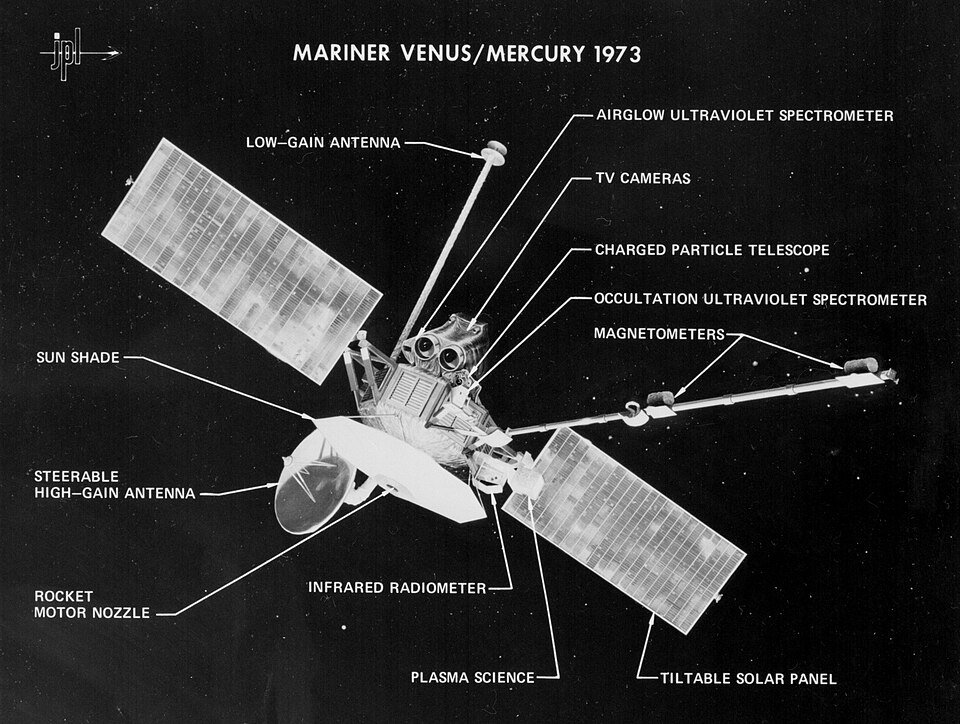
Image credit: NASA / Jet Propulsion Laboratory / public domain
Two-Channel Infrared Radiometer
A Two-Channel Infrared Radiometer is used to measure the surface temperatures of Mercury and the cloud cover of Venus. The instrument is a modified version of a radiometer carried on the Mariner 6, Mariner 7, and Mariner 9 missions of 1969 and 1971. The infrared radiometer uses two channels, 22-39 micrometers (80-500 K) and 10-17 micrometers (200-650 K), to observe the thermal emission of Venus and Mercury in two spectral bands. This Infrared Radiometer measured the infrared thermal emissions from the surface of Mercury between dusk and dawn (local time) and the deviations from the average thermal behavior of the surface. Measurements are also carried out on the brightness temperatures of the cloud cover and the darkening phenomena of the limbo. Data from the instrument is used to correlate unusual temperature variations with photographs and measurements made by other instruments to identify mountains, valleys, volcanoes, and unusual surface material.
Ultraviolet Spectrometers
They included two ultraviolet spectrometers in this experiment, one for measuring UV absorption and the other for UV sensitivity. An occult spectrometer scanned Mercury’s edge as it passed in front of the Sun and found out whether the Sun’s ultraviolet radiation was absorbed in certain wavelengths, which would show the existence of gas particles, and thus the atmosphere. The airglow spectrometer detected extreme ultraviolet radiation emanating from atoms of hydrogen gas, helium, carbon, oxygen, neon, and argon. Unlike the occult spectrometer, it did not need a backlight from the Sun and could move along with a rotating scanning platform on a spacecraft. The crucial goal of the experiment was to determine whether Mercury has an atmosphere, but it would also collect data on Earth and Venus and study interstellar background radiation.
Solar Wind Detector
A solar wind detector (Scanning Electrostatic Analyzer and Electron Spectrometer) is used to measure the speed and distribution of the solar wind near Mercury. The instrumentation of the experiment comprises two electrostatic analyzers oriented towards the Sun (SESA – Sunward-facing Electrostatic Spectrometer Analyzer) and a backward-facing Electron Spectrometer Analyzer (BESA). The instruments could be rotated about 60° to either side. Both SESAs fail to send data to Earth. They should measure cations from 0.08 to 8 keV and electrons from 4 to 400 eV. The BESA has a fan-shaped field of view of ± 3.5 x ± 13.5 °. An electron spectrum was obtained every 6 seconds and comprising flux measurements in fifteen energy channels (delta-E / E channel width = 6.6%) within the energy range of 13, 4 to 690 eV. By gathering data on the solar wind’s movement around Mercury, the plasma experiment could be used to verify the magnetometer’s observations of Mercury’s magnetic field. Using the plasma detectors, Mariner 10 gathered the first in situ solar wind data from inside Venus’ orbit.
Triaxial Fluxgate Magnetometer
A Triaxial Fluxgate Magnetometer – this experiment comprises two triaxial fluxgate magnetometers mounted on a common pole, 2.3m and 5.8m from the space probe, and designed to measure the magnetic field in the vicinity of the planet Mercury and planet Venus and in the interplanetary medium. The data from both magnetometers are analyzed simultaneously to separate the ambient fields from the field of the space probe. Each sensor has two operating ranges of ± 16 nT and ± 128 nT, with scan accuracies of 0.03 nT and 0.26 nT, respectively. The offset capability extends the operating range to ± 3188 nT. During the primary phase of the mission (from November 3, 1973, to March 29, 1974) and during the second and third overflights of Mercury, 25 vectors per second are sampled by the primary magnetometer and transmitted to Earth. At other times, it uses a lower data rate mode, in which it transmits five vectors per second.
Energetic Particles Experiment
Energetic Particles Experiment – this experiment is designed to measure electrons, protons, and alpha particles in the interplanetary medium and around Venus and Mercury. The instrumentation includes the main telescope and a low-energy telescope. The main telescope comprises six sensors, five silicon detectors, and a cesium iodide (CsI) scintillator surrounded by an anti-coincidence plastic scintillator. Pulse height analysis is performed every 0.33 seconds. The counts accumulated in each coincidence / anti-coincidence mode are measured every 0.6 seconds. Particles stopping in the first sensor are protons and alpha particles between 0.62 and 10.3 MeV / nucleon and electrons at about 170 keV. The half-opening angle for this procedure is 47°, and the geometric factors are 14 cm² for electrons and 7.4 cm² for protons and alpha particles. The telescope’s half-opening angle is reduced to 32° for coincidence counts in the first and third sensors. The low-energy telescope, a two-element (more anti-coincidence) detector with a half-opening angle of 38° and a geometric factor of 0.49 cm2, is designed to measure protons from 0.53 to 1.9 MeV and from 1.9 to 8.9 MeV.
Television Photography Cameras
Two Television Photography cameras – the objectives of this experiment are to photograph the upper atmosphere of Venus and the surface of the planet Mercury. For the planet Venus, the specific objectives are to study the properties of clouds in ultraviolet light and get high-resolution imagery of the cloud cover. For the planet Mercury, the specific objectives are to map the main physiographic sites, to determine the orientation of the axis of rotation, to establish a cartographic coordinate system, and to search for Mercury satellites. The equipment comprises two 15 cm diameter Cassegrain telescopes with eight filters, each connected to a 2.54 cm Vidicon GEC camera (150 cm focal length and 0.5° field of view) for photography at a narrow angle. An auxiliary optical system mounted on each camera provides wide-angle photography (62mm focal length, 11 x 14° field of view). The exposure time ranges from 3 milliseconds to 12 seconds, and each camera takes a photo every 42 seconds. The television picture consists of 700 scan lines with 832 picture elements per line, which are digitally encoded into eight-bit words for transmission. There are eight filter positions: (1) wide-angle image; (2) blue filter; (3) ultraviolet polarization; (4) high ultraviolet; (5) clear; (6) ultraviolet; (7) defocus lens (for calibration); (8) yellow. About 7,000 photographs are obtained from Venus and Mercury, with a maximum resolution of 100m for Mercury.
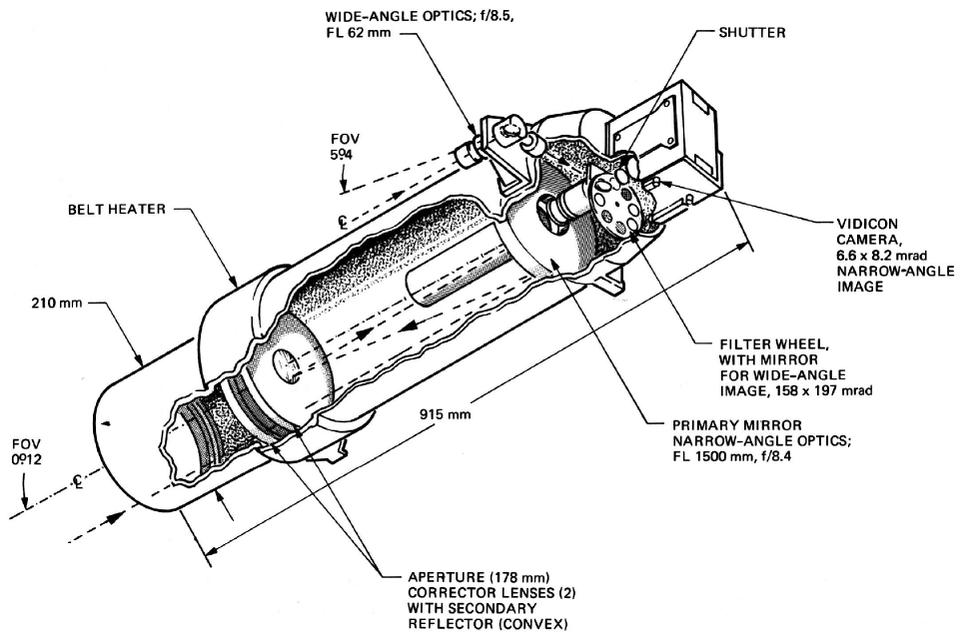
Image credit: Mariner Venus/Mercury 1973 Project Office, JPL, NASA / public domain
Celestial Mechanics and Radio Science
Celestial Mechanics and Radio Science Experiment – this experiment uses the telecommunications system to measure the mass and gravitational field of the planets. This experiment uses X-band (8,400 MHz) and S-band (2,113 MHz) on-board radio communication systems for scientific purposes. Two main approaches are used: one using tracking information, the other taking advantage of radio trajectory variations associated with Land-Mariner 10 signal occultation. Tracking information is analyzed to determine mass characteristics and gravitational (including estimates of internal composition and density) of Venus and Mercury. As the spacecraft passed behind Mercury on the first encounter, there was an opportunity to probe the atmosphere and to measure the radius of the planet.
Mariner 10 Mission Profile
Launch and Early Setbacks
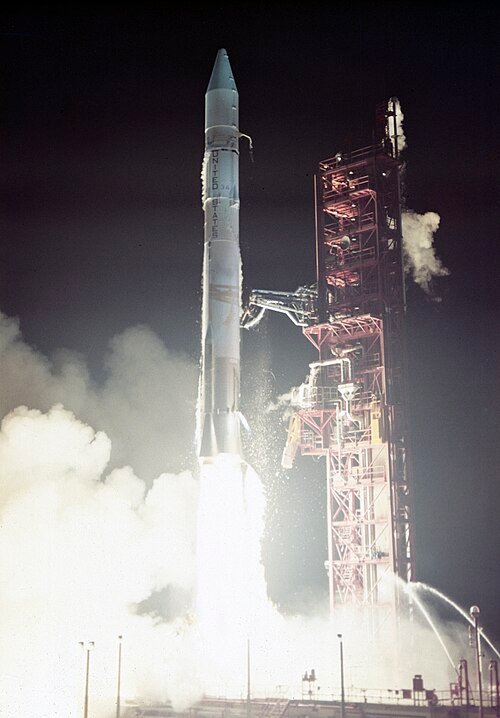
Image credit: NASA / public domain
The Mariner 10 space probe was launched on November 3, 1973, at 05 h 45 UT by the Atlas SLV-3D Centaur-D1A rocket from the LC-36B launch pad at the Cape Canaveral launch base. Mariner 10 (known as Mariner Venus / Mercury 1973) is placed in a parking orbit after launch for approximately 25 minutes, then in a heliocentric orbit, towards the planet Venus. But the protective cover of the electrostatic analyzers facing the Sun does not open fully after launch, and the instruments, which are part of the experiment of the scanning electrostatic analyzer and the electron spectrometer, cannot be used. It is also discovered that the heating of the television cameras has failed. The cameras are therefore left in place to prevent low temperatures from damaging the optics.
Shortly after leaving Earth orbit, the probe sends hundreds of striking photos of the Earth and the Moon. It also took a dozen hours after takeoff to calibrate the instruments as it headed for its first destination, the planet Venus. During its trajectory, many technical problems arise. The on-board computer also experienced unscheduled resets occasionally, which caused reconfiguration of the sequence of the clock and of the subsystems. Then, periodic problems with the high-gain antenna and the attitude control system also occur during the trajectory to the planet Venus. A trajectory correction maneuver was carried out 10 days after launch, on November 13, 1973. Immediately after this maneuver, a chip of paint that had come off the space probe became lodged on the star finder and lost lock on the guide star Canopus. An automated safety protocol allows Canopus to be retrieved, but the paint peeling problem is repeated throughout the mission.
In January 1974, Mariner 10 successfully sent data on ultraviolet observations (without photographs) of comet C / 1973 E1 Kohoutek. It was the first time that a space probe had sent data on a very long-period comet. After another course correction on January 21, 1974, Mariner 10 approached Venus for a gravitational assist maneuver to send it to the planet Mercury.
Flyby of Venus
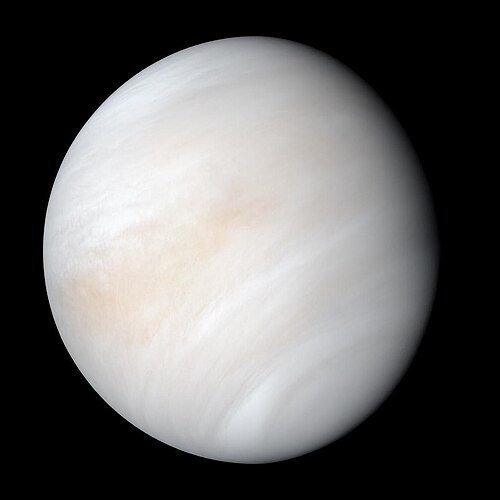
Image credit: NASA/JPL-Caltech / public domain
Far from being an uneventful cruise, Mariner 10’s three-month journey to Venus was fraught with technical malfunctions, which kept mission control on edge. Donna Shirley recounted her team’s frustration: “It seemed as if we were always just patching Mariner 10 together long enough to get it on to the next phase and next crisis”. The Mariner 10 space probe flew over the planet Venus on February 5, 1974, at the closest point of 5,768 km at 5:01 PM UT and sent the first close-up images of Venus. The first image shows the planet’s day-night terminator as a thin bright line. Mariner 10 returns 4,165 photos of Venus and collects important scientific data during its encounter. It is also the first time that a probe has used the gravity assist of one planet to help it reach another. The mission revealed the composition and meteorological nature of the atmosphere of Venus. Data from the radio science experiment measured the extent to which radio waves passing through the atmosphere were refracted, which was used to calculate the density, pressure, and temperature of the atmosphere at any given altitude. The gravity assist was also a success, coming well within the acceptable margin for error. In the four hours between 16:00 and 20:00 UTC on 5 February 1974, Mariner 10’s heliocentric velocity dropped from 37.008 km/s (82,785 mph) to 32.283 km/s (72,215 mph). This changed the shape of the spacecraft’s elliptical orbit around the Sun so that the perihelion now coincided with the orbit of Mercury.
During its transit between the planets, the probe studies the interplanetary medium by taking measurements on the solar wind and magnetic fields. Then, the space probe heads towards Mercury. On the way to Mercury, an anomaly in the attitude control system occurs for the second time, using up attitude control gas. Some new procedures were used from that point on to orient the spacecraft, including Sun-line maneuvers and the use of solar wind on the solar panels to orient the spacecraft.
First Flyby of Mercury
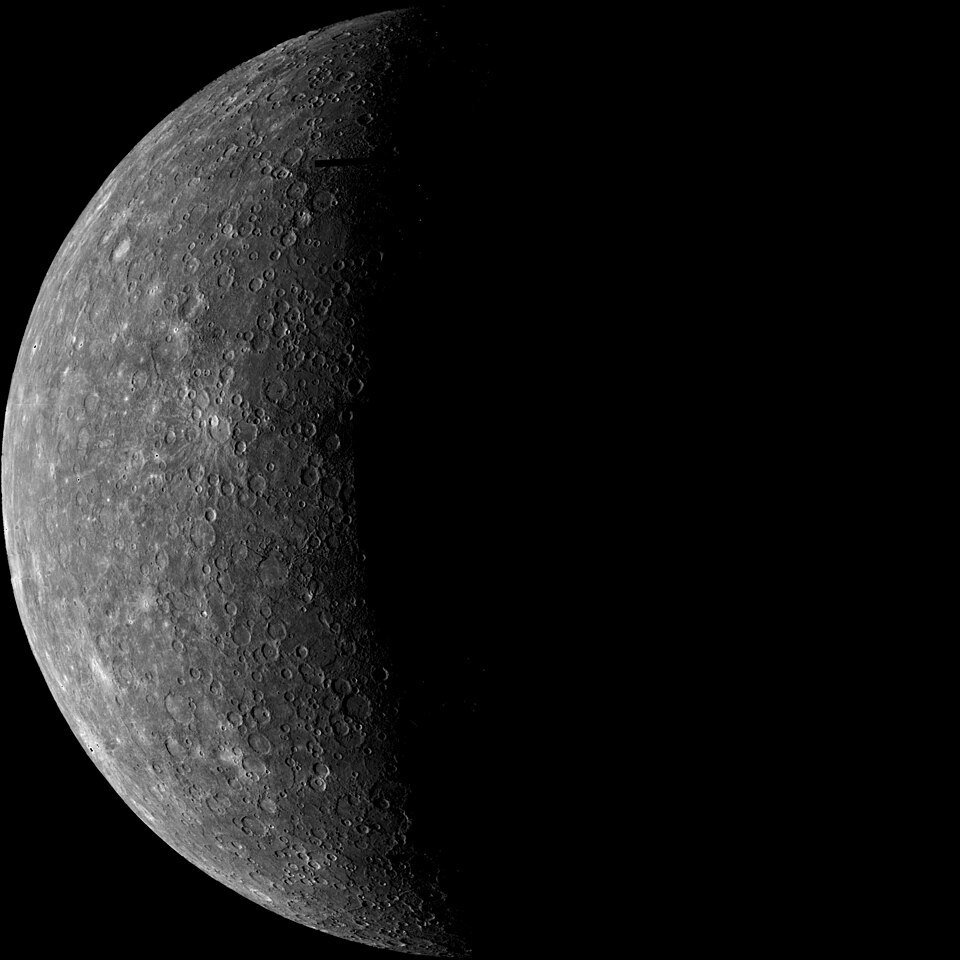
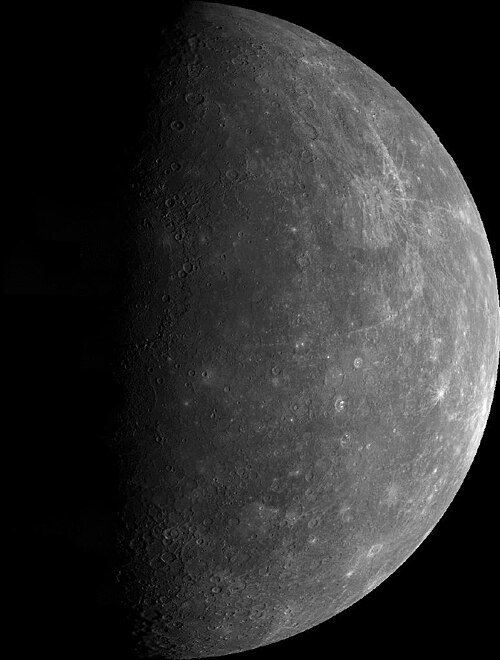
The spacecraft flew past Mercury three times. The first Mercury encounter took place at 20:47 UTC on 29 March 1974, at a range of 703 kilometers (437 mi), passing on the shadow side. The Mariner 10’s magnetometers show a weak magnetic field (scientists believed that it did not exist and that it had a very thin atmosphere). Radiometer readings show nighttime temperatures of -183° C and daytime highs of 187 ° C. They also notice the low density of the crust. The first detailed photographs of the surface that are taken reveal a surface covered with craters, looking very similar to that of the Moon. The 2,300 photos in medium resolution (3-20 km/pixel) and high resolution (less than 1 km/pixel) are taken during this first pass. A blackout experience as the vehicle drives behind the far side of the planet shows a lack of atmosphere or ionosphere.
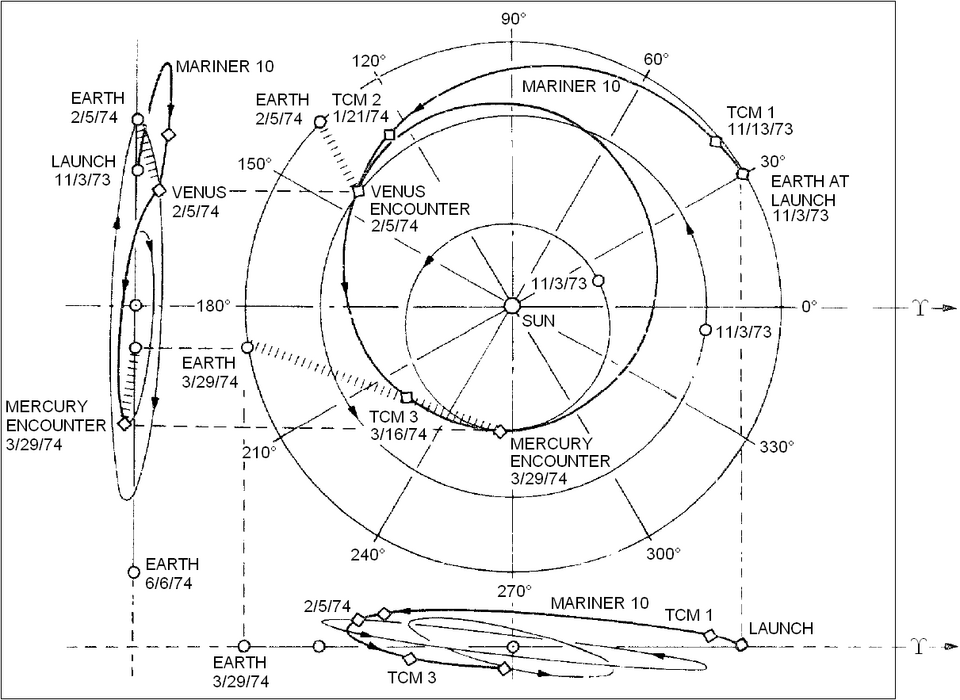
Image credit: JPL, NASA / public domain
Second and Third Flybys
Abandoning Mercury, Mariner 10 loops around the Sun and regains its target, aided by the course corrections made on May 9, May 10, and July 2, 1974. The second flyby, on September 21, 1974, at 9:59 p.m. UT, was carried out at a further distance at 48,069 km altitude, adding images of the South Pole region. This flyby makes it possible to map approximately 45% of the surface of the planet. It takes only 750 new photos of the planet, because of a technical problem with the onboard recorder. Unfortunately, the illuminated hemisphere is almost identical to that of the first flyby, so much of the planet has remained without an image. The probe uses solar pressure on solar panels and a high-gain antenna for attitude control. Mariner 10 once again moves away from Mercury before a final and third encounter with Mercury, made possible by three-course corrections on October 30, 1974, February 13, 1975, and March 7, 1975, the last to avoid any impact with the planet.
The last flight, on March 16, 1975, at 10:39 p.m. UT at an altitude of 327 km, was the closest to the planet Mercury. Because of a tape recorder failure and data reception rate restrictions, only the middle quarter of each of the 300 high-resolution images is received during this encounter. This overview studies in detail the magnetic field of Mercury. Scientists find that this is not a consequence of the solar wind but is generated by the planet itself. The origin of this field remains, at the end of this mission, a major question that must be decided by future space missions to the planet Mercury. This last flyby allows the taking of 450 photos.
Engineering testing continued until March 24, 1975, when the hydrazine supply for attitude control was exhausted. The last contact with Mariner 10 was on March 24, 1975, at 12:21 p.m. UT. Mariner 10 took over 2,700 photographs during its three overflights, covering nearly half of the planet’s surface. Some images show details with an accuracy of 100 meters. Perhaps the most impressive surface feature is the Caloris Basin, a crater characterized by a set of concentric rings and ridges and about 1.550 kilometers in diameter. This mission was the last visit to Mercury by a space probe for over 30 years, until Messenger flew past the planet on 14 January 2008 and entered orbit around it on 18 March 2011. The scientists then decided to close the mission. Only 45% of the surface of Mercury is mapped because, in each of the three flyovers, Mercury presents the same face to the Sun.
Discoveries
The Mariner 10 space probe made an outstanding contribution to our knowledge of the part of the Solar System occupied by the inner planets (Earth, Venus, Mercury). When the probe is launched, the space program has already enabled significant advances in the field: the Apollo program, by bringing back lunar rocks, makes it possible to date planetary material before what is discovered on Earth; Mariner 9 carried out a complete survey of the planet Mars and discovered with its predecessors surprising geological formations as well as a surface made up partly of original materials and partially shaped by volcanism; many Soviet and American probes have studied the planet Venus and have made it possible to gain a good general knowledge of its topography and its atmosphere while leaving in the shade the characteristics of its internal structure and its geological history. At the time of the launch of Mariner 10, no precise data was available on the topography and characteristics of the planet Mercury.
Images credit: NASA/JPL/USGS / public domain
What Mariner 10 Revealed About Venus
Mariner 10’s contribution to the study of Venus is small but significant. The probe shows, using its ultraviolet spectrometer, that the upper layer of the atmosphere of Venus circles the planet in 4 days, i.e., much faster than the planet itself. Mariner 10 reveals a Hadley-like circulation in the atmosphere of Venus and shows that Venus has a weak magnetic field at best and that the ionosphere interacts with the solar wind to form a shock wave.
The Mysteries of Mercury
But the main contribution of Mariner 10 concerns the planet, Mercury. One of the crucial discoveries relates to the identification of the magnetic field of Mercury. Its existence is completely unexpected because we associate the presence of a magnetic field with a fast rotational speed and a liquid core. However, Mercury has a slow speed of rotation and its surface, which looks very lunar and therefore very old, does not give the impression of an active core, which generally results in periodic volcanic effusions on the surface. Mercury has no atmosphere, a surface with craters similar to that of the Moon, and a core relatively rich in iron. The photographs of the surface of Mercury also make it possible to develop theories on the process of formation of the inner planets.
Total research, development, launch, and support costs for the Mariner series of spacecraft (Mariners 1 through 10) were approximately $554 million. The total cost of the Mariner 10 mission was roughly $100 million.
References:
- Giberson, W. Eugene; Cunningham, N. William (4 February 1975). “Mariner 10 Mission to Venus and Mercury”. Acta Astronautica.
- Dunne, James A.; Burgess, Eric (1978). The Voyage of Mariner 10: Mission to Venus and Mercury (NASA SP-424)
- Murray, Bruce; Burgess, Eric (1977). Flight to Mercury. New York: Columbia University Press.
- Strom, Robert G.; Sprague, Ann L. (2003). Exploring Mercury: The Iron Planet. Chichester: Praxis Publishing Ltd.
- Clark, Pamela Elizabeth (2007). Dynamic Planet: Mercury in the Context of its Environment.
- “Mariner 10”. nssdc.gsfc.nasa.gov. NASA. Archived from the original on 8 September 2018. Retrieved 2 November 2019.
- “Mariner 10 – NASA Science”. science.nasa.gov. NASA.

