

Cover image: Franklin in London in 1767, wearing a powdered wig and blue suit with elaborate gold braid and buttons, a far cry from the simple dress he affected at the French court in later years – David Martin (1737–1797), The White House Historical Association / public domain
Table of Contents
When Benjamin Franklin arrived in Paris in the fall of 1776, no one knew quite what to think of him. He was not at all the glamorous, elegantly dressed statesman they’d expected. He wore plain brown cotton clothes and, instead of the usual powdered wig, a loose fur hat pulled down over his forehead. Here, in the most fashionable country in the world, he never once wore a wig, or carried a sword, or draped himself in silk or velvet, or put on diamond pins and rings. Even when he visited the King, he appeared in his usual everyday cotton clothing and practical buckled shoes. And despite it all – or because of it – he was a sensation.
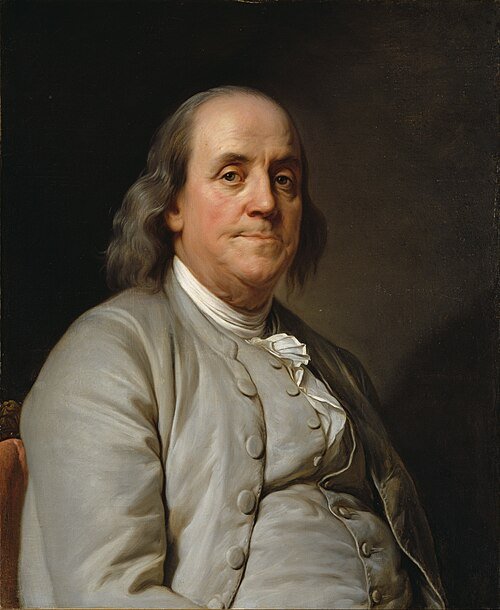
Image credit: Joseph-Siffred Duplessis (1725–1802) / public domain
Only a month after his arrival, Ben Franklin was France’s national hero. The French ladies called him “papa” and wore his picture in their rings. They gathered around him at social functions to hear his funny anecdotes and stories about life in the colonies. Many French homes carried his portrait over their mantels. There were busts, boxes, prints, and paintings made of him, and people wrote poetry and music in his honor. Some women began sporting wigs shaped like his fur cap, which they called wigs à la Franklin. Benjamin Franklin explained science to Marie Antoinette, played chess with a Duchess, and proposed marriage to a beautiful noblewoman. When he walked through the streets of Paris, people stepped aside to let him pass. Franklin wrote to his daughter that in France, his face was “as well known as that of the moon.”
Franklin’s popularity with the French people was enormous. But he wasn’t in France simply to entertain the public, and his social success, as phenomenal as it was, was not his great achievement in France. For while he was playing chess and telling stories and dancing with royalty, he was also, in secret, arranging for guns, ammunition, and provisions to be sent to the revolutionary army in America. He was arranging for French volunteers to cross the ocean and join the revolutionary army. He was meeting with French officials and carefully building French support for the American cause of independence. And by 1778, he’d arranged a treaty between France and the United States that guaranteed its help in the war against Britain. With that help, the revolutionary army won a decisive victory in Yorktown and went on to win the war. The American Revolution would probably never have succeeded without the help of the French, and the help of the French would never have been attained without the work of Benjamin Franklin, the first minister or ambassador from the newly formed United States.
Who was Benjamin Franklin?
Benjamin Franklin was a man with no political ambition. He never once campaigned for or aspired to an office. Yet he remains today one of the greatest statesmen in the history of America and the man who single-handedly may have guaranteed the success of the American Revolution. It was only one of the dozens of achievements – Franklin was also a gifted inventor, scientist, writer, printer and publisher, civic leader, philosopher, and philanthropist. Like his friend, Thomas Jefferson, he was one of America’s true Renaissance men, a man of diverse interests and talents who contributed to the welfare and progress of American life in so many different ways that it’s almost impossible to include them in a short biography. And looming behind and above all these achievements was Franklin the man – a person of such enormous wit, inventiveness, wisdom, and industry that his character has become almost synonymous with the character of the country he helped create.
Benjamin Franklin’s early life in Boston
There were signs of Franklin’s uniqueness almost from the start. His father thought he was special because he was born the youngest son of the youngest son of the youngest son of the youngest son, going all the way back to his great-grandfather. It was no small matter being the youngest son in Ben Franklin’s family – his parents had fifteen children and ten of them were boys.
Benjamin Franklin was born on January 17, 1706, in the city of Boston, which was then the largest city in the colonies. It had 10,000 residents and one hundred streets and alleys, most of which were still unnamed. Franklin was born on one of the streets that did have a name – Milk Street.

Image credit: Swampyank / CC BY-SA 3.0 (via Wikimedia Commons)
Benjamin’s father became even more convinced his last son was special when the child taught himself to read almost as soon as he could talk. His father, whose name was Josiah, was what people called a “leather apron man,” which means he worked at a trade. Josiah’s trade was soap and candle making. He trained three of Benjamin’s brothers to continue in that trade; one other brother was a blacksmith, and still another was a printer. The remaining four brothers died young – one ran away to sea and was drowned, and another drowned at home in his father’s vat of soapsuds when he was only 16 months old.
Josiah Franklin, whom Benjamin always described as a very practical and just man, decided that Benjamin was too quick and curious a child to follow a trade, so he sent him to Latin School when he was seven, to prepare him to become a preacher. Since it was proper to give one-tenth of your income to the church, Josiah considered it a tithe to send his tenth son into the ministry. There were some problems with this plan. First of all, Benjamin was not particularly devout. He once suggested to his father that instead of saying Grace every night at dinner, they should just bless the whole food storage in the basement and be done with it in one fell swoop. Furthermore, Mr. Franklin began to notice that preachers were having a hard time finding work and that the work they did find didn’t pay well. So he took Benjamin out of Latin School and put him in a regular writing and arithmetic school. Then, when Benjamin was ten, his father realized he didn’t have the money to pay for school after all, and he put Benjamin to work in his soap and candle business.
Benjamin Franklin hated the soap and candle factory. He found the fumes from the lye and grease unbearable. So his father decided they would go on a tour of Boston’s different shops, and Benjamin could choose his own trade. They visited cutlers who made knives, coopers who made barrels, hatters who made hats, bricklayers, cabinetmakers, roofers, and brass makers. Benjamin wasn’t drawn to any of the trades, but he did pick up a lot of useful tips on how to do fix-it chores at home.
During these early years when Benjamin and his father were trying to settle on his future, the boy spent his free time reading and conducting experiments. One time, he invented paddles for his feet and hands so he could swim faster. Swimming was one of his favorite pastimes. He also invented a method by which a kite could carry him across the river to the other side. He read every book he could find, but books were scarce in Boston. When he ran out, he read the volumes of the local minister’s sermons.
Finally, Benjamin’s father decided the best idea was to apprentice Benjamin to his older brother James, who was a printer. It was an unhappy relationship from the start. James was strict with Benjamin and worked him fourteen hours a day, boxing his ears if he made errors. Benjamin learned the printing business quickly but wasn’t allowed greater responsibility. To fulfill his passion for learning, he used his lunch money to buy books and sat and read by himself on his breaks. His favorites were Pilgrim’s Progress, by John Bunyan, Plutarch’s Lives, Robinson Crusoe, by Daniel Defoe, and the works of Cotton Mather. He began writing and developed his own method for improving his style and vocabulary. He would read an essay, turn it into poetry, wait a few weeks, and then rewrite the poetry back into prose. Finally, he began to write secret letters to his brother’s newspaper, which he signed “Silence Dogood.” Silence Dogood was a widow he created who made comments about social and political trends. She proposed, among other things, that women be educated and that there be insurance to help poor widows. The letters from Silence Dogood were a big hit with the readers, but when Benjamin’s brother discovered the real author, he refused to print any more.
Finally, when he was 17, Benjamin had had enough of his brother’s tyranny. He snuck away and boarded a ship to New York, where he hoped to get work in another printing shop. When he found there was no work in New York, he headed for Philadelphia, the city that would be his home for the rest of his life.
A fresh start in Philadelphia
Benjamin Franklin’s arrival in Philadelphia was something he delighted in describing for years after. He arrived on Sunday when everybody else was dressed up in their finest clothes. He, however, was dressed in plain work clothes, his pockets stuffed with extra shirts and stockings. He was tired, unkempt, hungry, and broke. He had exactly one dollar to his name. He got directions to the nearest bakery, where he asked for three pennies’ worth of bread. Benjamin Franklin was happily surprised to see that bread was cheaper in Philadelphia than in Boston – three pennies bought him three big, round, puffy loaves. He put one under each arm and marched up Market Street, gobbling down the third. As he walked, people stared at this amusing stranger with his loaves of bread and his worn-out clothes bulging with extra socks. One of those who stared was Deborah Read, a young woman who would have been horrified to know that this awkward-looking vagabond would someday be her husband. Benjamin gave away his two extra loaves of bread to a woman and a child who were waiting by the water to board a boat. Then he found a print shop, hired himself on as an assistant, and went out to find lodgings. He found them in a boarding house owned by Deborah Read’s parents.
The Junto and the thirteen virtues
Benjamin Franklin did well in the print shop, and he soon made many friends in Philadelphia. He formed a club of other young men who liked to read and discuss ideas and called it The Leather Apron Club. Later, they changed the name to Junto. The Junto met once a week to argue about such questions as: “If a country has an unjust law, should a citizen obey it?” and “Can a poor man stay honest and still be successful in the world?”
Benjamin Franklin also made a chart of thirteen virtues he wanted to practice and develop. Every week, he checked the list to see how he’d progressed. The list included: temperance, silence, order, resolution, frugality, industry, sincerity, justice, moderation, cleanliness, tranquility, chastity, and humility. Every time he thought he had failed in a category, he put a black spot in the chart. He always considered himself full of faults, but he did write once that he “had the satisfaction of seeing them diminish.”
One category he had trouble with early on was clearly the category of chastity. As he confessed later, he had some trouble controlling his youthful passions and took to hanging out with women he described as “lower sorts.” One of those women had a baby. Around the same time, when he was 24 years old, Franklin married Deborah Read and opened his own print shop. Franklin and Deborah had no church wedding; in fact, they had no wedding at all. They simply began living together in a common-law marriage, but it was a devoted marriage and lasted 44 years until Deborah died in 1774. Franklin once wrote: “She proved a good and faithful helpmate, assisted me much by attending the shop; we throve together, and we have mutually endeavored to make each other happy.” When they married, they adopted Franklin’s illegitimate child, whom he named William, and later they had two children of their own. Francis, their son, died when he was four years old of smallpox. Although vaccinations were new at the time and considered too dangerous, Benjamin Franklin always regretted not having Francis inoculated. Sarah, their daughter, lived to adulthood and had a large family of her own. William later grew up to become governor of New Jersey, but he was a loyalist, and one of the greatest disappointments of Benjamin Franklin’s life was that during the American Revolution, his own son sided with the British.
Poor Richard’s Almanac
Benjamin Franklin worked hard at his own print shop. He labored day and night, and his only recreation was an occasional book. “I spent no time in taverns,” he said later. Even then, he refused to let the public see him reading. He wanted them to see him working. People of Philadelphia would comment on how the light was on in his shop when they went to bed, and it was on again when they arose in the morning. He used the best paper and ink, paid his bills promptly, and showed he wasn’t above any menial labor by pushing his own wheelbarrow piled high with paper through the streets of the city. Soon, he was the chief printer for the Pennsylvania government. He also bought a newspaper called the Philadelphia Gazette and filled it with news of politics, fires, accidents, and his own eloquent essays. Then in 1732, when he was 26, he ran an advertisement in his paper announcing a new almanac – Poor Richard’s Almanac, written by Richard Saunders. He told the readers that Saunders was an astrologer who had written the almanac because his wife had become angry over his idleness. But like Silence Dogood ten years before, Richard Saunders was only an alias for the anything-but-idle Benjamin Franklin.
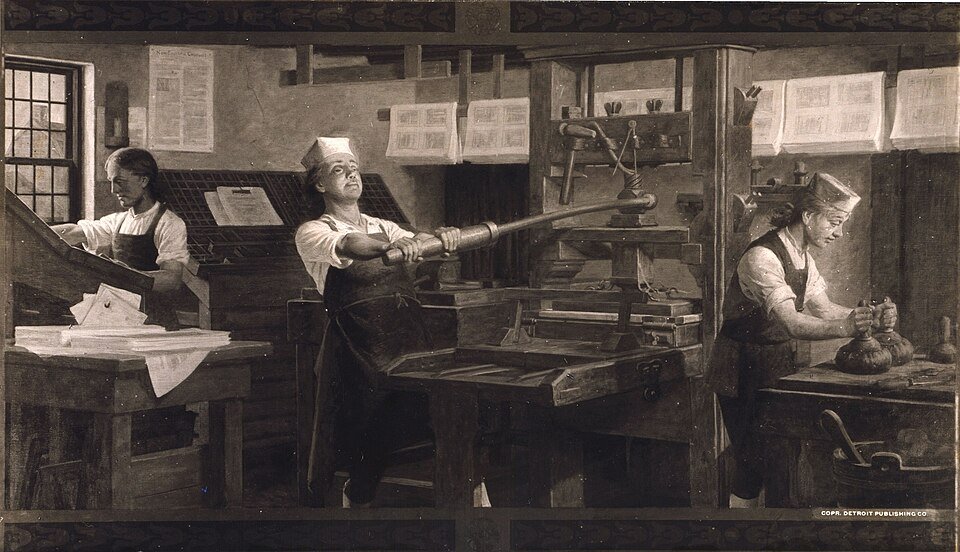
Image credit: Charles E. Mills – Library of Congress / public domain
Benjamin Franklin published his almanac once a year for the next 25 years. It was chock full of useful information and words of wisdom created by Franklin himself. There were weather forecasts, a schedule of tides and holidays, dates for the full moon, advice on what to plant and when, housekeeping and repair tips, jokes, and endless proverbs written by Franklin that have become a famous part of American folklore. “Eat to live; don’t live to eat;” “A penny saved is a penny earned;” “Fish and visitors smell in three days;” “Early to bed and early to rise, makes a man healthy, wealthy, and wise;” “The sleeping fox catches no poultry;” “Beware of little expenses; A small leak will sink a great ship;” and “He who falls in love with himself will have no rivals.” Pretty soon, the almanac was selling 10,000 copies a year, and Franklin, with the royalties and the proceeds from his successful business, was a wealthy man.
Benjamin Franklin’s inventions and scientific discoveries
During his years in the print shop, Benjamin Franklin always managed to find time for his numerous inventions, ideas, and civic improvement plans. He wrote about comets and the direction of hurricanes; experimented with ants to prove they could communicate with each other; formed the first public library in America; organized Philadelphia’s fire department; found a way to light the city streets at night, and created a system to dispose of the city’s garbage. As a result of his efforts, Philadelphia became the most advanced city in the colonies. At home, he was no less innovative. He rigged a cord up to his bed so he could lock his door without getting up at night. He invented a stepladder and a rocking chair with a fan that kept flies away. He built a pole for removing books from the top shelves of his library. He cut a hole in his kitchen wall and installed a windmill that turned his meat roaster. Perhaps one of his greatest inventions in these early days was the Franklin stove. Franklin had noticed that fireplaces were inefficient and heated only a small corner of the room. He built a stove that could be inserted into the fireplace to produce more heat. It was so effective that similar models are still in use today. Franklin always refused to take out a patent on his stove – or anything else he invented. He said he didn’t feel right making a profit from helping people and willingly sketched out all his inventions so people could imitate them.
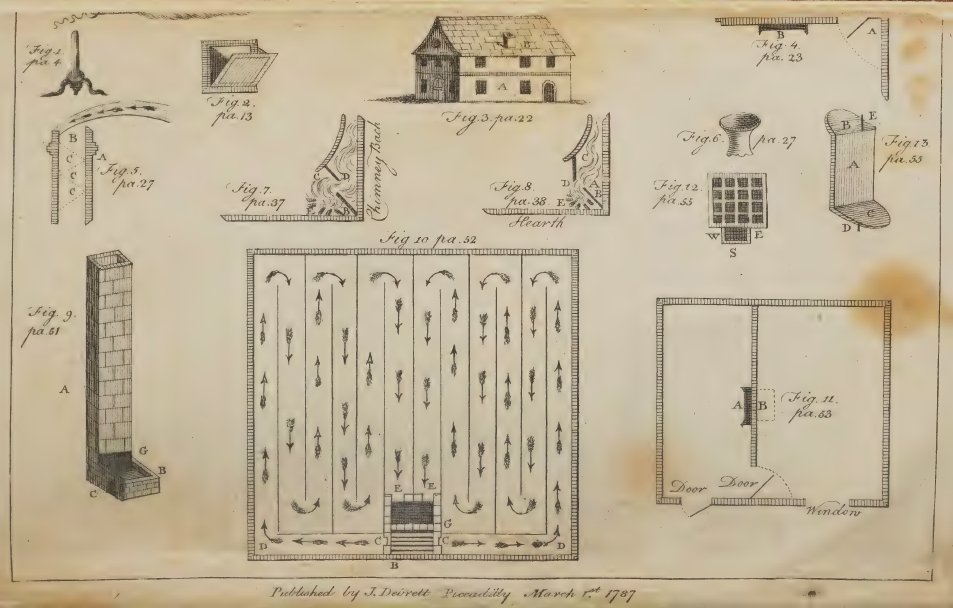
Image credit: Benjamin Franklin / public domain
Around this time, Benjamin Franklin was also made postmaster of Philadelphia; later, he would serve as Postmaster General of the thirteen colonies. As postmaster, he impressed everyone by inventing a new delivery system that reduced the time for a letter traveling from Boston to Philadelphia from 6 weeks to 3 weeks. Then he cut it to six days.
When he was in his early forties, Benjamin Franklin retired from the business so he could devote himself to his experiments and inventions, and his civic responsibilities. One of his most fervent new interests was electricity.
Taming lightning with electricity
Electricity was then becoming a popular fad, especially in Europe, where people conducted little parlor tricks with sparks. Benjamin Franklin decided to give a picnic in which he would kill a turkey with an electrical shock, and roast it in a container connected to electrical circuits, on fire lit by an electrical bottle. He became careless during the experiment and ended up taking the electrical shock through his body, which knocked him unconscious. When he came to, he said, rather embarrassed, “I meant to kill a turkey – instead I almost killed a goose.”
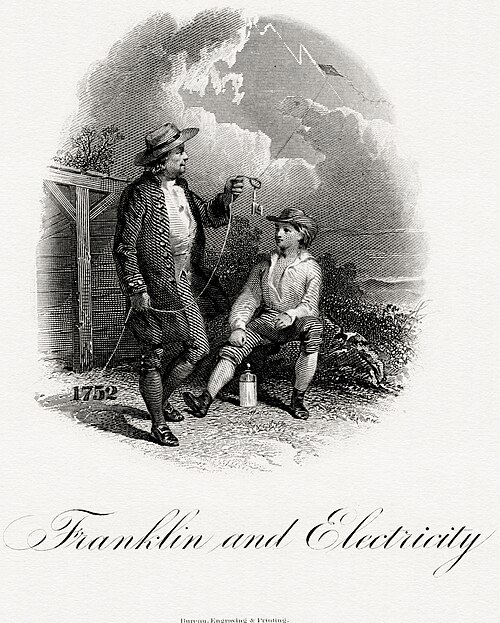
Image credit: Alfred Jones, for the Bureau of Engraving and Printing / CC BY-SA 3.0 (via Wikimedia Commons)
But Franklin’s most important idea and experiment, and the one for which he’s famous, was his theory that lightning was really electricity. He was 46 when he came up with this idea, and no one believed him. They all thought electricity was a mystery of the heavens that could and never would be solved. So Benjamin Franklin wrote to scientists in Europe and suggested they put a sentry box on top of a high tower. On the box, they should put a metal rod, and in the box, they should stand during a storm. If lightning was attracted to the rod, which Franklin knew was a conductor of electricity, then lightning must be electricity. The only reason Franklin didn’t try this experiment himself was that there were no hills high enough in Philadelphia. Three scientists in Europe agreed to try Franklin’s experiment, and they all proved his theory. Meanwhile, however, Franklin had come up with a way to prove his idea himself. He attached a metal tip to a kite and then tied a metal key to the string of the kite, near his hand. In the middle of a storm, he raised his kite in the air and felt an electric shock come through the key. To Franklin’s amazement, his discovery of electricity in lightning made him world-famous. Overnight, he was the most celebrated man in America. The King of France sent him congratulations; the Royal Society of England presented him with a medal; universities gave him honors, and people began calling him “Dr. Franklin.” Because Franklin’s main motivation in life was to be useful, he searched for a way to translate his discovery into something with a practical purpose. He found it in the lightning rod – a pointed iron rod on the roof of a house or barn that attracts lightning and leads it through a wire into the ground, thus protecting the house from being struck. To his own lightning rod, Franklin rigged a contraption that rang a bell in the house whenever lightning hit.
The University of Pennsylvania, bifocals, and the armonica
In 1751, when he was 45, Benjamin Franklin set up an academy that later became the University of Pennsylvania. He also organized a hospital and an expedition to find the Northwest Passage. In his free time, he served on various civic committees, invented bifocals, and built a new instrument called the armonica, which consisted of little glass discs that gave out different tones when rubbed with the hands.
The road to revolution: London and the fight over taxes
In 1754, when Benjamin Franklin was 48 years old, war broke out between the British and the French over unclaimed land in the American territories. It was the fourth war in America between these two countries, but this one was called the French and Indian War because Indians joined in, some on the side of the French, some on the side of the British. It was during this war that Franklin drew his now-famous cartoon of a snake cut into eight pieces, with the words JOIN OR DIE printed beneath it. He was urging the colonies to join together and help fight against the French. The cartoon is famous because it’s one of the first proposals that the colonies should unite, in Franklin’s words, “for defense and other general purposes.”
Because Benjamin Franklin was so dedicated to the welfare of Philadelphia and Pennsylvania, he was sent in 1757 to London to represent the interests of the colony in a complicated tax matter. Except for two years back in America, Franklin would spend the next eighteen years of his life in London, between the ages of 51 and 69.
As soon as he arrived in London, Benjamin Franklin decided to adopt the customs and fashions of England. He bought new shoes and shirts, wigs, two pairs of silver shoe buckles, a new watch, and a carriage. He ordered new spectacles because he’d left his favorites at home on the dining room table. He rented four rooms in a large house, where he regularly received shipments from Deborah of his favorite foods – cornmeal, venison, cranberries, and bacon. In exchange, he sent Deborah many gifts, including a crimson coat and an apple corer. It was a fresh new lifestyle for the normally frugal Franklin. He and Deborah had always lived simply, with what he called the “cheapest of furniture” and no servants. He had sworn himself to frugality ever since the day, as a young child, he’d spent all his allowance on a whistle. The whistle was overpriced, and it annoyed everyone who heard it. He had vowed then never to spend money unwisely, and it was a vow he kept. But in England, he enjoyed himself.
While Benjamin Franklin was living in England, King George III ascended the throne. At first, Americans liked the monarch. Newspapers wrote about his simple, modest ways and his devotion to his mother. The King lit his own lamp, dressed, and had a crust of bread with water for dinner. Benjamin Franklin referred to him as “our virtuous young king” and felt hopeful the new monarch would be kind and fair to the colonies. But instead, King George began levying heavy taxes on the American people. Franklin did his best to negotiate the repeal of these taxes and to keep relationships between England and America peaceful. He argued, pleaded, and cajoled, all to no avail. There were only more taxes, higher than the first ones.
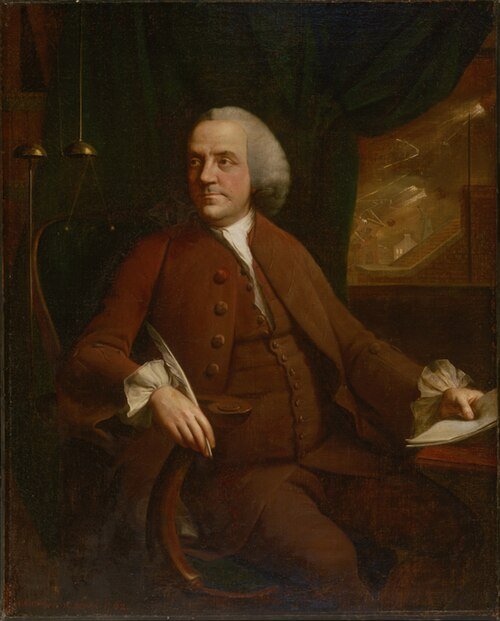
Image credit: Mason Chamberlin (1727–1787) / public domain
Benjamin Franklin returned to America for two years between 1762 and 1764. While he was home, there was a revolt by Native Americans called Pontiac’s Conspiracy, in which several natives overtook some British forts east of the Mississippi River. In retaliation, some Pennsylvania settlers, calling themselves The Paxton Boys, attacked and killed a group of Native Americans, including women, children, and the elderly. After the attack, the Paxton Boys headed towards Philadelphia to kill the Native Americans living there. Benjamin Franklin gathered soldiers and guns and marched out to meet them. He managed to convince them to leave without any violence. Shortly after, Franklin wrote about the massacre of the Indians and the prejudice against them. He said: “If an Indian injures me, does it follow that I may revenge that Injury on all Indians?… The only crime of these poor wretches seems to have been that they had a reddish-brown skin and black hair.”
Franklin returned to England just in time for the passage of the notorious Stamp Act. This act required colonists to buy stamps and affix them on all printed matter – newspapers, almanacs, deeds, even playing cards. The money from the stamps went to England, allegedly to pay for the defense of the colonies. But to the colonists, it was taxation without representation. Franklin spoke out against the tax and managed to get it repealed, but it was followed by taxes on lead, paper, and tea. When the colonists responded by dumping a few hundred chests of English tea into Boston harbor, the King, among other things, removed Franklin from his post of postmaster general. Finally, in 1774, he was called before the English government to defend his pro-colony stance. He was insulted, shouted at, and condemned. Benjamin Franklin, white with rage, said nothing in his defense. That same year, he received word that his wife Deborah had died. A few months later, sad, exasperated, and indignant, he boarded a ship for home. He was at sea when the Battle of Lexington broke out, and the war for independence began.
Founding Father: the Declaration of Independence
When he landed in America, Benjamin Franklin was immediately put in the Continental Congress, with positions on ten different committees. Then he was given back his position as Postmaster General. He donated his salary to help wounded soldiers. Next, he was asked to help in the writing of the Declaration of Independence. Although his colleague Thomas Jefferson did almost all the writing, Benjamin Franklin made a few edits. It was he who took Jefferson’s truths that were “sacred and undeniable” and made them “self-evident truths.” When the Declaration was signed, legend has it that John Hancock warned: “We must be unanimous; we must all hang together.” And Franklin replied: “We must indeed all hang together, or assuredly we shall all hang separately.” Shortly after the eloquent and stirring Declaration had been completed, Franklin was sent to France to convince the French to enter the war on America’s behalf. George Washington would manage the war at home – Franklin would manage it in Europe.
Benjamin Franklin the diplomat in France
The trip to France was a rough one. The weather was freezing, and the seas were turbulent. Franklin, who was 70, suffered from boils on his body, gout in his legs, and a painful case of eczema. It was because of eczema on his scalp that he donned the fur hat that so caught the fancy of French women. Benjamin Franklin accomplished his task and persuaded France to take up the cause against England. Meanwhile, he found time to pursue more of his inventions and interests. He was there on the spot when the Montgolfier brothers had the first successful balloon flight in France. When cynical onlookers looked at the balloon and said, “What good is it?” Franklin responded: “What good is a newborn baby?”
When the War of Independence ended in 1783, Benjamin Franklin helped write the peace treaty. When Europeans expressed curiosity about this new land of the United States, Benjamin Franklin said: “The truth is, that though there are in that country few people so miserable as the poor in Europe, there are also very few that in Europe would be called rich…America is the land of the laborer. Our country offers to strangers nothing but a good climate, fertile soil, wholesome air, free government, wise laws, liberty, good people to live among, and a hearty welcome.”
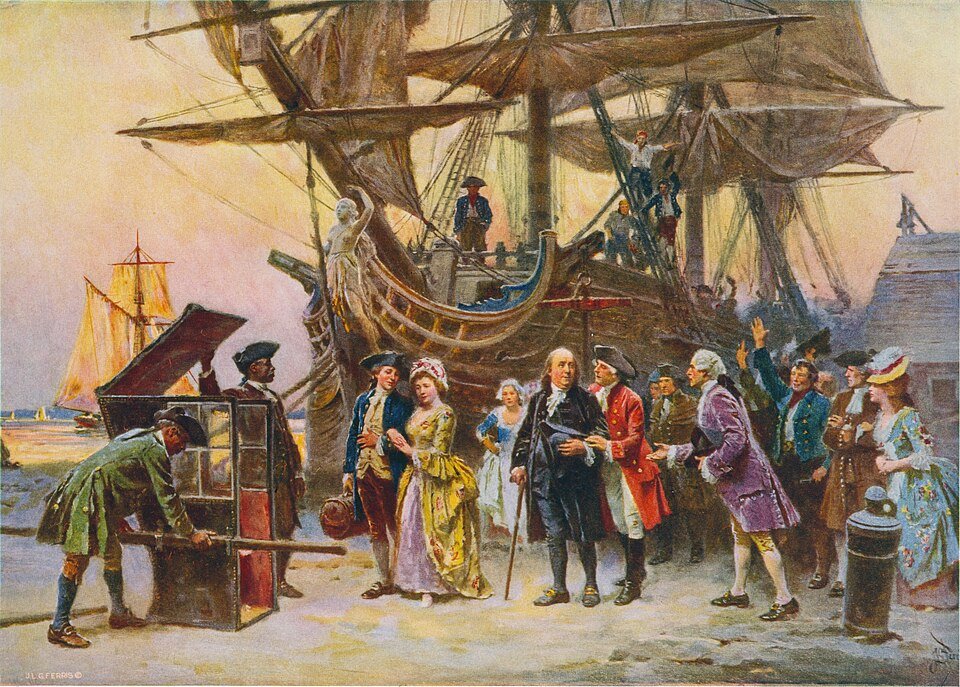
Image credit: Jean Leon Gerome Ferris (1863–1930) / public domain
It was far more than a “hearty welcome” that Benjamin Franklin received when he returned to America nine years later, at the age of 79. At the pier in Philadelphia, thousands came out to greet him. They fired cannons, rang church bells, paraded through the streets, and made grand speeches. Then they put him back to work.
Writing the U.S. Constitution
Benjamin Franklin served as the first Governor of Pennsylvania and was re-elected three years in a row. Then he was drafted to help write the Constitution of the United States. For four months, he attended the meetings of the Constitutional Convention as the wise old patriarch of the American states. He was the oldest revolutionary among our country’s forefathers – Washington was 56, Adams was 53, and Jefferson was only 45 when the Constitution was written. Franklin, 82 and suffering from painful bladder stones, often dozed off during the lengthy arguments at the convention. He was frequently distressed by the endless disagreements and the inability to reach a consensus. But it was Franklin, always calm and always reasonable, who often helped defuse tempers and steer the discussions back on course. It was also Benjamin Franklin who suggested they begin each meeting with prayer. He was never a church-going man, but he always believed deeply in God and Providence. In the end, Franklin was satisfied with the Constitution – he felt that, given the variety of opinions and feelings, it was the best they could have accomplished. When he signed his name on it, he became the only man in history to have his name on the four most important documents of the period that gave birth to the United States of America: the Declaration of Independence, the Treaty of Alliance with France, the Peace Treaty with Great Britain, and the Constitution.
Franklin’s fight against slavery
While he worked on the Constitution, Benjamin Franklin was also elected president of the first anti-slavery society in America, called the Pennsylvania Society for Promoting the Abolition of Slavery and the Relief of Negroes Unlawfully Held in Bondage. Many years earlier, Franklin had actually owned a few slaves, but he gave them up and began to speak against it as early as 1751 when he was only 45 years old. During his final years, he wrote many essays and letters to newspapers attacking slavery and the crime of “the traffic in the persons of our fellow men.”
With the Constitution completed, Benjamin Franklin retired from public life. He would live two more years, but most of those years were spent in bed. He continued to read and write, and every day he listened to his granddaughter’s spelling lesson. If she did well, he gave her a spoonful of jelly from a jar he kept by his bed.
On April 17, 1790, Benjamin Franklin asked his daughter to change his sheets, saying he wished to die “in a decent manner.” When he had difficulty breathing, a friend suggested he rest on a different side so the breathing would be easier, but he responded: “A dying man can do nothing easy.” They were his last words. He died at 11:00 that night at the age of 84. He had written his own epitaph sixty years before, at the age of 22, when he was suffering from an illness and thought he might not survive. It read:
“The Body of
B. Franklin Printer
(Like the cover of an old book
Its contents wore out
And the script of its lettering and Gilding)
Lies here, Food for Worms.
But the work shall not be lost,
For it will (as he believed) appear once more
In a new and more elegant Edition
Revised and corrected
By the Author.”
Twenty thousand people attended Benjamin Franklin’s funeral in Philadelphia. Yet his will began with the modest words: “I Benjamin Franklin, printer….” He left part of his fortune to the cities of Boston and Philadelphia to be used in public works.
Benjamin Franklin’s legacy
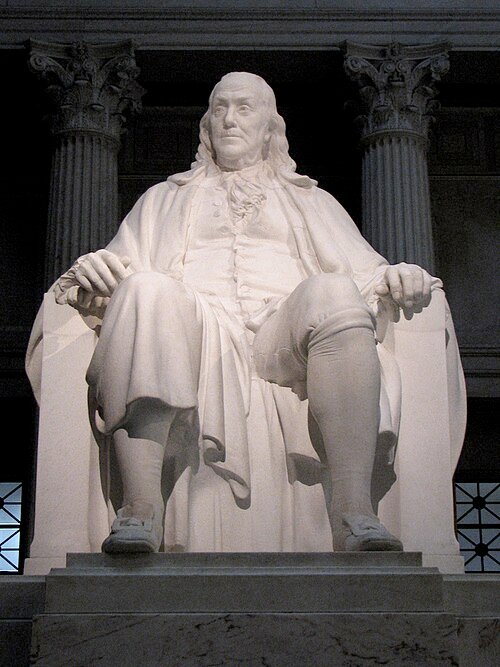
Image credit: Photo by Michael Parker – James Earle Fraser, sculptor / CC BY-SA 3.0 (via Wikimedia Commons)
Benjamin Franklin has forever remained one of the most admired and best-loved of all Americans. His portrait has appeared on stamps, coins, and paper bills. Streets, schools, museums, and towns have been named after him. Even two presidents were named after him – Franklin Pierce and Franklin Delano Roosevelt. His sayings and proverbs have become part of our everyday language, and many of his inventions are still part of our daily life. In his long and productive life, Franklin was known as many things: writer, scientist, inventor, and statesman. But above all else, he is the personification of the American character. Benjamin Franklin embodied all the Puritan ethics and New England character traits that helped create and build our country. Good sense. Hard work. Thrift. Honesty. Self-improvement. Yet he also embodied all those traits that came to symbolize what’s unique about America. Tolerance. Brotherhood. Devotion to liberty. Defense of minorities and rejection of prejudice. And a deep faith in self-government. In many ways, he was the living definition of both America’s roots and America’s future.
George Washington once wrote to Franklin: “If to be venerated for benevolence, if to be admired for talents, if to be esteemed for patriotism, if to be beloved for philanthropy, can gratify the human mind, you must have the pleasing consolation to know that you have not lived in vain.”
He did not live in vain, and he remains today one of the strongest and most inspiring models of what it means to be and live as an American.
References:
- Becker, Carl Lotus. “Benjamin Franklin”, Dictionary of American Biography (1931) – vol 3;
- Brands, H. W. (2000). The First American: The Life and Times of Benjamin Franklin. New York: Knopf Doubleday Publishing.;
- Franklin, Benjamin. The Autobiography of Benjamin Franklin; Benjamin Franklin papers, M.S. Coll. 900, University of Pennsylvania, Philadelphia
- Crane, Vernon W. (1954). Benjamin Franklin and a Rising People. Boston: Little, Brown and Company.
- Ketcham, Ralph L. (1966). Benjamin Franklin. New York: Washington Square Press.
- Anderson, Douglas (1997). The Radical Enlightenments of Benjamin Franklin. Baltimore: Johns Hopkins University Press.
- Cohen, I. Bernard (1990). Benjamin Franklin’s Science. Cambridge, MA: Harvard University Press.

