

Cover image: Martin Luther King Jr. at the 1963 Civil Rights March in Washington, D.C. Rowland Scherman / Creative Commons CC0 1.0 Universal Public Domain Dedication
Table of Contents
It all started on a train ride when Martin Luther King Jr. was just a child. He was sitting with his family in the dining car, preparing for lunch, when suddenly the porter entered and drew down a curtain. The curtain was to separate black diners from white diners, and to prevent the whites from even having to look at “the negroes.” The memory of this day stayed with King his entire life. He said later: “I felt just as if a curtain had come down across my whole life. The insult of it I will never forget.”
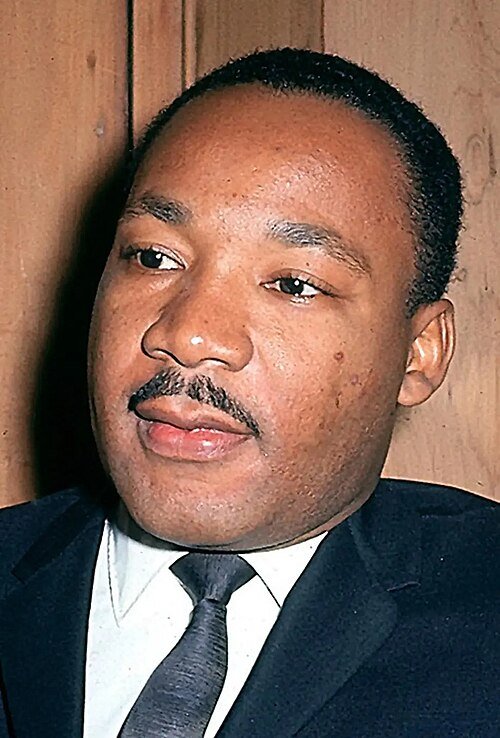
Image credit: Associated Press / public domain
Martin Luther King Jr. dedicated his life to tearing down curtains – curtains that separated and restricted the black race throughout America, and especially in the South. These curtains deprived blacks of equal educational and legal rights, of social privileges, career opportunities, and their basic dignity as human beings. In a courageous campaign that was cut short after thirteen years, King used his eloquence and passive resistance to achieve civil rights for the poor, disadvantaged, and racially oppressed in the United States, and to restore moral integrity to all its citizens, any color or class. He was one of the greatest defenders of human rights in the history of the world.
The train ride he took as a little boy was the first time Martin Luther King Jr. fully realized that he was a second-class citizen in his country, simply because of the color of his skin. But there would be many more experiences to follow. He had an even more vivid memory of a bus ride taken when he was a teenager in Georgia. He and his teacher were traveling from Macon to Atlanta when the bus driver suddenly stopped and ordered them to give up their seats to white passengers who had just boarded. “When we didn’t move right away,” said King, “the driver started cursing us out. I decided not to move at all, but my teacher pointed out that we must obey the law. So we got up and stood in the aisle the whole ninety miles. It was a night I’ll never forget. I don’t think I have ever been so deeply angry in my life.”
The Montgomery Bus Boycott (1955–1956)
It was not this bus ride, however, but another bus ride in December of 1955 that would change King’s life, and the course of American history.
Rosa Parks Refuses to Give Up Her Seat
Mrs. Rosa Parks, a seamstress in Montgomery, Alabama, had put in a full day of work and followed it up with some Christmas shopping. It had been a long day. She paid her fare, climbed into a big orange bus, and collapsed into her seat with a sigh of relief. At the next stop, four white passengers boarded and noticed there were no more empty seats. Rosa Parks was black – and the law in Alabama stated that black passengers must give up their seats to whites if so directed by the bus driver. First, the driver ordered three other black passengers to give up their seats. They obliged; this sort of thing happened all the time, and they were used to it. But when the driver ordered Mrs. Parks to stand, she did the unthinkable. She refused. She had paid the same fare as the white people, she said, why should she have to stand? It wasn’t simply an act of exhaustion, as the story is often told – Mrs. Parks, who served as secretary of the local NAACP chapter, said later that she wasn’t physically tired at all. What she was tired of was giving in. The bus driver called a policeman, who took Parks to the city jail, where she was fingerprinted, photographed in a mug shot, and fined ten dollars. The trial would come later.
This little bus incident, not even the first of its kind, sparked anger and rebellion among blacks throughout the city. It represented to them hundreds of years of prejudice and oppression. It had been almost a century since the Civil War, and still, blacks in America didn’t share the rights of white people. In the South, they ate at separate restaurants, went to different schools, drank from separate water fountains, and even swore oaths in court on a separate “Negro” Bible. Few of them voted because they were first required to pass a difficult reading test and pay a poll tax, which many couldn’t afford. They could not obtain decent educations, jobs, or housing. The Rosa Parks incident meant a great deal more than the arrest of one black woman who refused to give up her bus seat. It symbolized the pervasive tyranny of whites over blacks in the entire country.
A 27-Year-Old Minister Takes the Lead
At the time Mrs. Parks was carted off to the city jail, Martin Luther King Jr. was a 27-year-old minister of the Dexter Avenue Baptist Church in Montgomery. He was known only to his congregation, but soon he would be known to the world.
The night of the Parks arrest, Martin Luther King Jr. and other ministers, among them the Reverend Ralph Abernathy and E. D. Nixon, met to decide a course of action. They agreed that for one day, they would call on all blacks in the city to boycott the bus system, as a demonstration of protest. Since blacks made up three-fourths of the city’s passengers, the plan had the potential to seriously damage the company’s business. But King was unsure how many blacks would respond to the boycott – his hope was that at least half would participate. Quickly the group of ministers, who had named themselves the Montgomery Improvement Association, began to print and distribute leaflets. The leaflets said: “Don’t ride the bus to work, to town, to school, or any place on Monday, December 5.”
On that morning, Martin Luther King Jr. and his wife Coretta rose early, eager to see how many people would participate. King watched as three buses passed his house – the first one was empty, and the second and thirds were almost empty. He ran out, jumped into his car, and began driving around Montgomery. Everywhere, he saw empty buses. He also saw black people walking, sharing cars, and even riding horses and mules. Anything, but riding buses. The boycott had been ninety percent effective.
382 Days Without Riding the Bus
The boycott of buses in Montgomery, Alabama didn’t last one day or even one week; it continued for 382 days, well over a year. During that time King and the other ministers held meetings in their churches, where they urged people to be peaceful, remain calm, but not to pay a cent in bus fare until the company agreed to give blacks equal seating rights to whites. In his first speech as leader of the boycott, King said: “First and foremost, we are American citizens. We are not here advocating violence. The only weapon we have is the weapon of protest…the great glory of American democracy is the right to protest for right.”
The owners of the bus company, like many white citizens in the South, were furious. They didn’t like losing money and they didn’t like the idea that blacks were standing up for their rights. Some of them threw rocks at cars with black passengers, others yelled curses or spat on blacks as they walked to work.
The story of the Montgomery bus strike, which was bringing the bus company to the verge of bankruptcy, was being publicized throughout the world. Soon donations poured in from Latin America, Asia, Europe, and from many parts of the United States, to help in the non-violent protest. In only a few months, Martin Luther King Jr. had become an internationally known figure.
The Bombing of King’s Home
And then one evening, someone threw a bomb at his house.
Although Martin Luther King Jr. and his family were uninjured, and the house was only partly damaged, the bomb brought the civil rights movement to a critical turning point and was the first test of King’s nonviolent ideals and his influence with his followers. A crowd of over a thousand blacks gathered at his home, many carrying rocks, knives, broken bottles, and guns, angrily chanting for revenge. Neither the police chief nor the mayor of Montgomery could quiet them. Nothing, it seemed, would prevent an all-out riot. Nothing but their leader, Martin Luther King Jr.
Martin Luther King Jr. stepped out on the smoking ruins of his front porch that evening, raised his arms, and began to speak. What he spoke about were peace and love. He asked his followers to lay their weapons down, to not give in to panic, and to return their enemies’ hate with love. And he concluded his speech by telling all of America: “Even if I am stopped this movement will not stop, our work will not stop, for what we are doing is right. What we are doing is just. And God is with us.”
Slowly, the mob began to disperse and return home. There had been no violence, no riot, and no need for police intervention. The following day, King’s speech was repeated on televisions and in newspapers across the country, and the public fully realized that his commitment to non-violence was genuine and persuasive.
Victory at the Supreme Court
The bus boycott continued until 1956 when the United States Supreme Court finally ruled that segregation of blacks and whites on public vehicles was unconstitutional. The boycott had been victorious – but Martin Luther King Jr. cautioned his followers not to boast about it, or to see it as a victory “over white people.” Instead, he wanted blacks and whites to work together for the improvement of Montgomery, as partners and not adversaries. He would continue to plead for cooperation and non-violence in the many battles that lay ahead.
The non-violence that King embraced throughout his life and career was partly a result of his devout Christian upbringing, and part of his personal studies of the teachings of Henry David Thoreau and Mahatma Gandhi.
Early Life and Education of Martin Luther King Jr.
Martin Luther King Jr. was born January 15, 1929, in Atlanta Georgia, the second of three children of Reverend Michael King and Alberta Williams King. His father, like his grandfather before him, was pastor of the Ebenezer Baptist Church in Atlanta.
In high school, Martin Luther King Jr. was such an excellent student that he skipped both 9th and 12th grades. He entered Morehouse College in Atlanta when he was only 15, as part of a special program for gifted students. There he became an admirer of the college president Benjamin E. Mays, a well-known scholar of black religion. Although King first showed an interest in either medicine or law, it was Mays who encouraged him to follow in the footsteps of his father and grandfather and become a minister. He was ordained right before graduation when he was 19 and then went on for a divinity degree at a theological seminary in Pennsylvania, where he was one of only six black students.
Gandhi, Thoreau, and the Roots of Nonviolent Resistance
It was while studying in Pennsylvania that Martin Luther King Jr. first became acquainted with Gandhi’s philosophy of non-violence and with Thoreau’s theory of civil disobedience. Both believed that an unjust law should not be obeyed, even if that disobedience resulted in imprisonment. They also believed that a man lowered himself by hating his enemy and that there should be no retaliation or revenge for evil acts. King was especially interested in Gandhi’s doctrine of Satyagraha, which literally means “holding to the truth” but which came to represent steadfastness in adhering to nonviolence. King always said that his “regulating Christian ideals” were from his family and “from Gandhi I learned my operational techniques.”
King was elected president of the student body at the seminary and graduated with the highest honors in his class. After that, he went on for his Ph.D. in theology from Boston University.
Marriage to Coretta Scott
While studying in Boston, King met Coretta Scott, a music student and talented soprano from Marion, Alabama. They were married in 1953 when he was 24. The Kings had four children – Yolanda, Dexter, Martin, and Bernice. Coretta King was always actively involved in the civil rights movement her husband founded and continued with that work after his death.
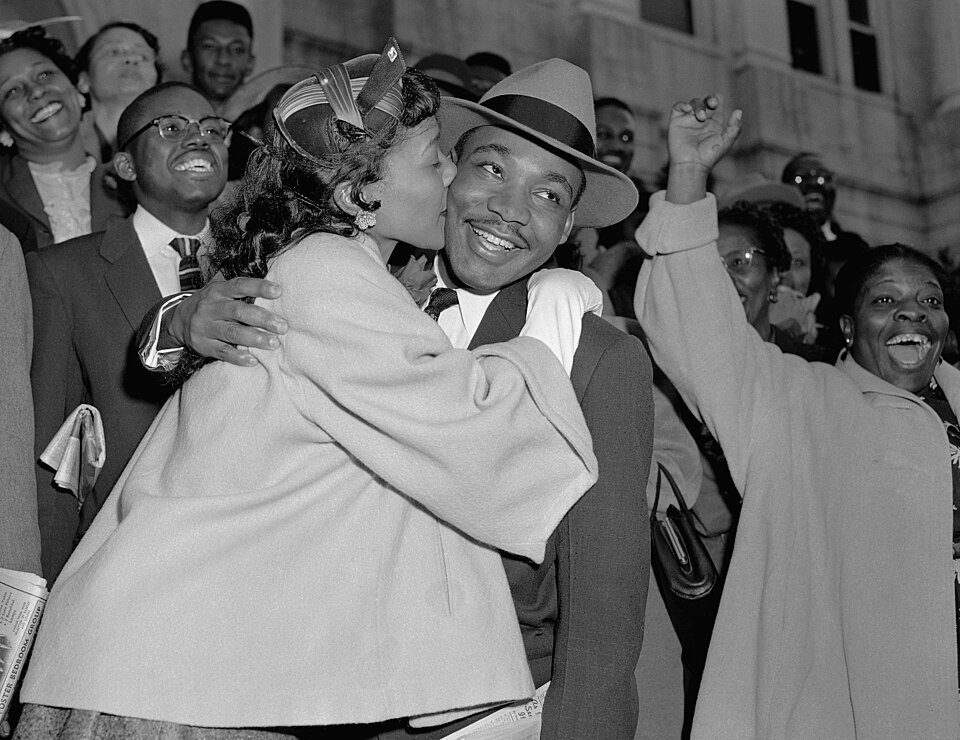
Image credit: Gene Herrick (1926–2024) / public domain
When he was 25, King accepted his first pastorate at the Dexter Avenue Baptist Church in Montgomery, where he was serving when he helped begin the bus boycott that followed the arrest of Rosa Parks. At the time, he’d been a resident of the city for less than a year. One of the reasons his fellow ministers suggested he take leadership of the boycott was that he hadn’t been in town long enough to make too many white enemies.
Martin Luther King Jr. and the Civil Rights Movement
After the bus boycott, King and his associates established the Southern Christian Leadership Conference, or the SCLC, as a base for non-violent marches, protests, and demonstrations for civil rights. They unanimously named King president. In 1958, when he was 29, he wrote his book, Stride Toward Freedom, the first of numerous books that described his work and ideas and offered questions and solutions to the problems of the civil rights movement.
After the SCLC had been launched, King moved from Montgomery to Atlanta, where he felt he could devote more effort to his work, and became co-pastor, with his father, of the Ebenezer Baptist Church.
King traveled and spoke extensively and put the energy of the SCLC into voter-registration drives throughout the South. He visited India, where he met with Prime Minister Nehru and other followers of Gandhi and came back more convinced than ever that nonviolent resistance was the strongest weapon against oppression.
Sit-Ins and the 1960 Arrest
Under his leadership and inspiration, by 1960 the movement for civil rights had spread to hundreds of cities and into the very fabric of American society. Blacks across the South began sitting at segregated lunch counters and entering other facilities that had been denied them. King himself was arrested, along with 33 young people protesting segregation at a lunch counter in an Atlanta department store. Even though the charges were dropped, he was sentenced to prison on the pretext he had violated probation on a minor traffic offense. There was national outrage at this disregard for the due legal process, and anger at President Eisenhower for failing to intervene. The man who finally did intervene was the Democratic presidential candidate John F. Kennedy. His act was so widely publicized in the black community that it’s believed it contributed substantially to his slender election victory only eight days later.
The Birmingham Campaign of 1963
Although Martin Luther King Jr. and Kennedy were always friends, in the early sixties King became frustrated with what he saw as President Kennedy’s lack of effort for civil rights. With his associates in the SCLC, he decided to launch massive demonstrations to protest racial discrimination in Birmingham, Alabama, one of the most segregated cities in the South. King planned his campaign in Birmingham carefully. He enlisted two hundred people who were prepared to go to jail for their cause and held several meetings with black leaders in the city to discuss strategy. In the spring of 1963, the protest was ready to begin.
Black men, women, and children marched up and down the city’s streets of Birmingham in a peaceful protest against racial discrimination. Police used dogs and powerful fire hoses to drive back the unarmed protestors, including the women and children. Water gushing at full pressure from the hoses washed protestors down entire city blocks and pinned them against walls. All over America, citizens watched on their television screens as innocent blacks were pummeled, forced to the ground, cornered by snarling, fanged police dogs, chased by armored cars, and beaten. And they saw that none of the protestors – not one – fought back. When they raised their arms it was only to cover and protect their faces. Because of the heavy news coverage, there was a national outcry against segregation and police tactics against protestors, and Martin Luther King Jr. began to emerge as a national hero. Soon afterward, President Kennedy proposed his wide-ranging civil rights bill to Congress.
Letter from Birmingham Jail
In the Birmingham march, Martin Luther King Jr. was arrested and imprisoned, along with 3300 other demonstrators, including hundreds of schoolchildren. From his prison cell, he wrote his famous Letter from Birmingham Jail, a response to white clergy who had criticized his use of demonstrations. He wrote, in part: “You may well ask: Why direct action? Why sit-ins, marches, and so forth? Isn’t negotiation a better path? You are quite right in calling for negotiation. Indeed, this is the very purpose of direct action. Nonviolent direct action seeks to create such a crisis and foster such tension that a community, which has constantly refused to negotiate, is forced to confront the issue. It seeks to so dramatize the issue that it can no longer be ignored. We know through painful experience that freedom is never voluntarily given by the oppressor; it must be demanded by the oppressed.”
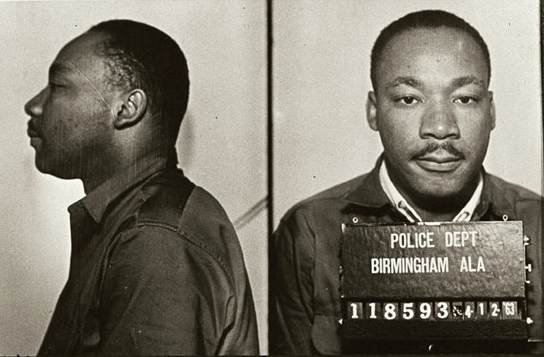
Image credit: Birmingham AL police dept / public domain
After Birmingham, the legions of civil rights workers swelled by thousands. Ministers, priests, and rabbis joined the struggle. There were over 1800 demonstrations between May and October of 1963, in forty different states and the District of Columbia. Student groups sprang up across the country, and whites of every class volunteered their time and money for the cause.
Threats, Violence, and Unbroken Resolve
That cause required more and more courage as the civil rights movement gained momentum. King’s dignity was constantly challenged and his safety was always in doubt. Whites cursed him and spat on him, threw rocks and tomatoes, kicked and hit him, sent threats against his life and the lives of his wife and children, and burned crosses on his front lawn. He was once stabbed in the chest, and physically assaulted on three other occasions. In a motel room in Florida, three shots were fired into his room. Fifteen times he was thrown into jail. His home was bombed three times. Despite it all, he continued his fight for civil rights. “I just don’t worry about things like this,” he said. “If I did, I just couldn’t get anything done.” He taught his followers the techniques of passive resistance – how to remain immobile when being beaten or arrested and how to remain calm when mobs called them names or threw things at them. He led peaceful marches against the all-white school, restaurants, movie theaters, and other public facilities that discriminated against blacks. Arm-in-arm with the blacks and whites who joined his marches, he sang the anthem of the civil rights movement, We Shall Overcome.
The March on Washington and the I Have a Dream Speech
After he’d been released from prison in Birmingham, King began thinking about a plan for drawing together the many different forces struggling for peaceful change, and a way to dramatize to the nation the importance of solving the racial problem. His solution was a march – one of the most memorable marches in human history.
The March on Washington in 1963 was intended, on a practical level, to urge Congress to pass Kennedy’s civil rights bill. The response was unlike anything in history. Over 250,000 Americans, many of them white, gathered at the Lincoln Memorial on August 28 to hear King’s stirring I Have a Dream speech which so eloquently defined the moral basis and the hopes of the civil rights movement. They came from every part of the country, on foot, in buses, in planes, and on trains. The mall between the Washington Monument and the Lincoln Memorial was so crowded that people couldn’t even move. At home, millions of other citizens watched a spectacular event on television.
In his speech that day, King demanded equal justice for all citizens under the law and emphasized his faith that someday, all men would be brothers. “I have a dream,” he said, “that one day this nation will rise up and live out the true meaning of all men are created equal. I have a dream that one day on the red hills of Georgia, the sons of former slaves and the sons of former slave owners will be able to sit down together at the table of brotherhood.” The speech was one of the most moving, and poetic speeches of modern times – the language was almost biblical; the rhythm almost musical, and the message evoked the very principles on which America had been founded. At the conclusion, King exclaimed: “Let freedom ring. Let it ring until the day when all of God’s children, black men, and white men, Jews, and Gentiles, Protestants, and Catholics, will be able to join hands and sing in the words of that old Negro spiritual: Free at last! Free at last! Thank God almighty, we are free at last.”
By the end of the speech, that day in 1963 at the Lincoln Memorial, men and women were weeping openly. President Kennedy remarked: “The nation can properly be proud of the demonstration that has occurred here today.” The rally was completed with absolute order and without one single act of violence or conflict.
King’s speech was repeated the next day on radio, television, and in newspapers throughout the country and even the world.
When Time Magazine named King its “Man of the Year” for 1963 it stated that he had become “the unchallenged voice of the Negro people and the disquieting conscience of the white.”
30-second sample from “I Have a Dream” speech by Martin Luther King Jr. at the March on Washington for Jobs and Freedom on August 28, 1963
The Civil Rights Act of 1964 and the Nobel Peace Prize
President Kennedy was assassinated only three months after the March on Washington but his successor, Lyndon Johnson, pushed the civil rights bill through Congress as a tribute, and a major victory of the movement had been won. The bill prohibited racial discrimination in public places and called for equal opportunity in employment and education. It had survived long weeks of filibustering, organized by Southern segregationists. But on the seventy-fifth day of that filibuster, the Senate voted to end the filibuster itself, a power it hadn’t successfully exercised since 1927. The bill was finally signed into law, one hundred and one years after President Lincoln’s Emancipation Proclamation.
The Youngest Nobel Peace Prize Laureate of His Time
Shortly after the Civil Rights Bill of 1964 was passed, Martin Luther King Jr. was awarded the Nobel Peace Prize – at age 35, the youngest recipient at the time. According to the Nobel committee, the award is given to the person who “has done most for the furtherance of brotherhood among men and to the abolishment or reduction of standing armies and for the extension of these purposes.” In accepting the award, King suggested it belonged, not to him, but all the people, black and white, courageously working towards an era of nonviolence and love. He donated all of the tax-free $54,000 that accompanies the award to the civil rights movement.
Selma and the Voting Rights Act
Even with the passage of the civil rights bill, there was still much work to do. In 1965, King helped organize protests in Selma, Alabama, when white officials there tried to deny black citizens the chance to register and vote. Several hundred protesters attempted a march from Selma to Montgomery, the state capital, but were assaulted by police in one of the most violent encounters in the history of the movement. Officers used tear gas and nightsticks to break up the group. The bloody attack was broadcast nationwide, shocking the public, and once again, as in Birmingham, gaining only greater support for civil rights. All across the nation, there were marches and sit-ins in sympathy for the demonstrators in Selma. President Johnson went before Congress to request a bill that would end all barriers to voting for Southern blacks. Congress responded and passed the Voting Rights Act within only a few months.
Beyond the South: Poverty, Vietnam, and Chicago
After a tour of northern cities in 1965, Martin Luther King Jr. began to broaden his goals and strategies. He focused on the deeper connections of economics and poverty to racism and called now for “a reconstruction of the entire society, a revolution of values.” His demands for stronger civil and voting rights were now accompanied by demands for anti-poverty programs. He spoke out against the controversial war in Vietnam, chiefly because it took funds away from economic programs, but also because he felt the South Vietnamese government was corrupt. “Injustice anywhere,” he had once said, “is a threat to justice everywhere.”
The Chicago Campaign
In Chicago, Martin Luther King Jr. launched his first major effort outside the South, organizing black inner-city residents who suffered from unemployment, inadequate housing, and poor schools. Leaders of the Chicago group then protested real estate practices that kept blacks from living in many neighborhoods and suburbs. To King, these practices played a major role in keeping blacks confined to urban ghettos. Along with local leaders, he led marches through white neighborhoods in Chicago, where residents threw rocks and bottles at the demonstrators. Soon after, Chicago officials promised to encourage fair housing in the city, if King in turn would promise to halt the protests. He accepted the offer and the Chicago campaign was ended successfully.
Black Power and a Divided Movement
As the violence against black protestors escalated, new black spokespeople emerged, who promoted more militant and even violent means for social change. Pacifism, they said, was too slow. And meanwhile, defenseless civil rights workers were being beaten and even murdered. In Birmingham, four young girls were killed when whites bombed a black church, and two more black children were killed in the city that same day. In Mississippi, black civil rights worker Medgar Evers was shot in the driveway of his own home. Also in Mississippi, three young men working to register blacks to vote had been beaten and shot to death, their bodies found several weeks later buried under a dam. Especially in the slums of northern cities, King’s philosophy of nonviolence and his Christian attitude towards his enemies was increasingly questioned. Members of the Student Nonviolent Coordinating Committee began to use the slogan “Black Power,” a phrase that troubled Martin Luther King Jr. deeply and alienated many white supporters of racial equality. The religious, pacifist, civil disobedience orientation of civil rights began to shift dramatically. The rioting in the Watts district of Los Angeles, in 1965, revealed the depth of the urban race problem, and the inability of King to influence the entire black community towards peaceful resistance. Watts was followed by riots in Cleveland, Chicago, Detroit, New York, and Newark. Buildings were burned, stores looted, and whites and blacks took to the streets in open warfare with guns and knives. By 1968, it seemed as if America was on the verge of another Civil War.
Meanwhile, Martin Luther King Jr. was being publicly challenged and even derided by militant voices – earlier by Malcolm X, and later by young black power enthusiasts like Stokely Carmichael and H. Rapp Brown. Such new leaders promoted armed resistance or the formation of separate black states. Although King repeated his commitment to nonviolence, it became clear that by the mid to late sixties, he no longer spoke for the entire civil rights movement.
The Poor People’s Campaign
In response, Martin Luther King Jr. decided to broaden his base and to address himself more and more to larger issues like the Vietnam War and poverty. He became increasingly critical of the very structure of American society and stated that true justice would require a redistribution of wealth from the rich to the poor. In support of that, he began to plan a Poor People’s Campaign that would unite the poor of all races in a struggle for economic opportunity. As part of that campaign, he demanded a federal guaranteed income for poor people and other major anti-poverty laws.
The Assassination of Martin Luther King Jr.
Early in 1968, Martin Luther King Jr. began to plan a multi-racial poor people’s march on Washington to demand an end to all forms of discrimination, and to promote the funding of a 12 billion dollars “Economic Bill of Rights.” In the middle of these plans, he flew to Memphis, Tennessee to lend his support to striking black sanitation workers. On April 4, 1968, as he was standing on the balcony of his hotel, he was shot and killed by a white escaped convict named James Earl Ray. Whether Ray acted alone or as a paid agent of a conspiracy is still a matter of controversy. Ten years later a special congressional committee reported “a likelihood” that Ray was aided by others. When he was killed Martin Luther King Jr. was only 39 years old, a leader who had only just expanded his goals and dreams, and who had never compromised on his dedication to nonviolence and brotherhood between the races.
A Nation in Mourning
People throughout the world mourned the death of King, while in the ghettos of America, rage overcame grief. Blacks rioted in more than 100 cities. In Washington D.C, smoke and flames rose high in the sky, visible from the White House. Soldiers armed with machine guns guarded the steps to the nation’s Capitol. The man who had never wavered in his insistence on nonviolence, forgiveness, and brotherhood, was mourned with one of the greatest outbursts of violence in many years. But he was mourned in other ways too – ways which were a tribute to his work and beliefs. A few months after King died, Congress passed the Civil Rights Act of 1968, which prohibited racial discrimination in the sale and rental of most housing in the nation.
Martin Luther King Jr. was first buried in a cemetery in Atlanta but his body was later moved near Ebenezer Baptist Church, where his grandfather, father, and he had served as minister. On his tombstone are the famous words from his speech at the Lincoln memorial: “Free at last, free at last, thank God almighty, I’m free at last.”
The Legacy of Martin Luther King Jr.
Martin Luther King Jr. was the very foundation of the Civil Rights movement through its most tumultuous and effective years, during the 1950s and 1960s. At a time when it was desperately needed, he offered Americans a fresh voice, an inspiring personality, and a new doctrine for the struggle for human rights. He achieved the enormous task of turning isolated protests into a national crusade and won the support of millions of people, black and white, all over the country. Under his leadership, the civil rights movement not only won mass support but was able to abolish many laws against integration in the Southern states and laws affecting discrimination in northern states. He accomplished all this, in part, because of his magnificent speaking ability, which enabled him to powerfully express the demands of black Americans for social justice. He accomplished it too by serving as a constant role model of what he preached – nonviolence, brotherhood, and courage in the face of constant danger and threat of death. He was, beyond everything else, a man of impressive moral presence and a reminder and symbol of America’s conscience – a conscience that had been inactive and unheeded for far too long. In awakening that conscience Martin Luther King Jr. served not only black Americans but all Americans. Few leaders have contributed so greatly to the advancement of human freedom.
References:
- Boyd, Herb (1996). Martin Luther King, Jr. Baronet Books;
- Fleming, Alice (2008). Martin Luther King Jr.: A Dream of Hope;
- Jackson, Thomas F. (2006). From Civil Rights to Human Rights: Martin Luther King Jr. and the Struggle for Economic Justice;
- King, Martin Luther Jr. (1998). Carson, Clayborne (ed.). Autobiography

