

Cover image: Château de Falaise in Falaise, Lower Normandy, France; William the Conqueror was born in an earlier building here – Ollamh / public domain
Table of Contents
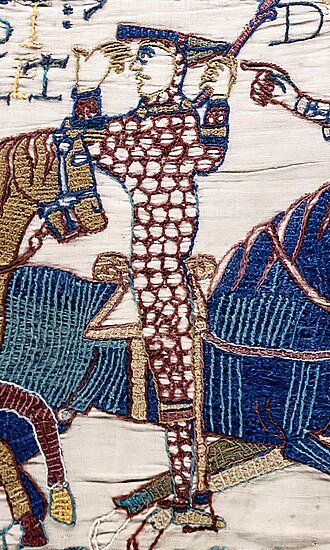
Image credit: Myrabella / public domain
In 1066, a Norman duke of illegitimate birth crossed the English Channel and changed the course of English history forever. William the Conqueror won a kingdom in a single day at the Battle of Hastings, then spent twenty-one years rebuilding it — with castles, feudal law, and a ruthlessness his enemies never forgot.
William, Duke of Normandy, was in one of his rare but infamous rages. He slammed his fists on the table and roared out threats and curses that echoed off the castle walls, leaving even his bravest knights quaking. “The Saxon dog,” he bellowed, “has broken his oath!” Then he arose, and by the fire in his eyes, all who knew him could tell that William already had a plan. William always had a plan. And he didn’t accept defeat easily.
“The Saxon dog” who had so enraged him this day in 1066 was Harold of England, brother-in-law of King Edward. The news that had crossed the channel and just reached the ears of William was that Edward had died and Harold had been crowned the new king of England in a ceremony at Westminster Abbey. It was a crown William had wanted. It was a crown he fully believed had been promised to him. And now, as his servants and knights watched him, raising his fist upward and exclaiming over Harold’s betrayal, they knew it was a crown he was going to fight for.
Who was William the Conqueror?
To most people, it would seem an unlikely idea that a French duke with only the slimmest royal connections could ever sit on the throne of England. But William wasn’t most people – he was one of the strongest-willed, skilled, and clever leaders Europe had ever known. Besides that, he seemed to be one of the luckiest. From childhood on, circumstances had always arranged themselves to William’s advantage. His father was the Duke of Normandy, Robert the Magnificent or, as he was called behind his back, Robert the Devil. Robert was strong-willed, arrogant, and sometimes cruel. Even as a child, he had stabbed a tutor who chided him for his laziness. Like all Dukes of Normandy, he was descended from the Vikings – in fact, the word Norman came from the original word “Northman.” At one time he had taken a fancy to the daughter of a tanner, a beautiful but common young woman named Arletta, not suitable enough for marriage to a Duke, but suitable enough to bear his child. That child, named William, was born in 1027, in a castle on a steep hill that still stands today near the French town of Falaise.
William the Conqueror’s early life in Normandy
He was a handsome child with dark hair and gray eyes, who seemed to have inherited much of his father’s personality. Later, people said he showed his strength even as a newborn by the way he would clutch at the straw on the floor of the nursery where he lay. By the age of five, he was already dominating all his little friends.
We can guess what William’s upbringing was like because there is a letter from another Duke of the time, who described his aspirations for his own son: “He must be noble among nobles, scholarly among scholars, steady in the saddle, swift in the field. He must know all the lore of the countryside, the bends of the rivers, the boundaries of meadow and woodland. He must know how to fly his falcon, cast a net, throw a javelin, slip a hound, and slay a deer.” In his later life, William demonstrated that he had achieved all these skills, with only one exception – he was clearly not a scholar nor a man of cultural graces, although he was keenly intelligent.
Richard the Devil had no other sons besides William, so when the father died on a pilgrimage to the Holy Land, his kingdom fell to his eight-year-old heir. For years, he was kept in hiding to protect him from assassins.

Image credit: Agricolae at English Wikipedia / CC BY-SA 3.0 (via Wikimedia Commons)
Normandy was a world of its own. It lay along the northern coast of France, its cliffs peering across the English Channel to similar cliffs that peered back from Britain. To the east was Flanders and to the west was Brittany, each with its own separate rulers. Normandy was a land of woods, fields, and orchards, sprinkled with some villages and many castles. Although the King of France was considered its supreme ruler, the Normans paid him little heed.
After William’s father died, his mother married a knight and had three more children, one of them a boy named Odo, who would become a lifelong friend and assistant to William. William spent much of his time as a child with Odo, but also with his cousin Edward. Edward was the exiled heir to the English throne, a gentle and pious lad who, when he reclaimed the throne, was dubbed Edward the Confessor. Since Edward was raised in France, he grew up with a deep respect for French ways and an affection for his hardy cousins, all of which played a part in the future history of England and Normandy. Edward returned to England to accept the crown when he was fourteen, and William turned his attention to managing Normandy.
Murder plots and the battle of Val-es-dunes
There were three guardians to help William rule his kingdom, and every one of them was murdered by devious barons who hoped to usurp the boy’s power. His tutor was also murdered. Through all this, his mother managed to protect him, but it left William with an abhorrence of lawlessness. Early on, he learned to be suspicious and always prepared for danger. The most dangerous moment occurred when he reached the age of twenty and assumed the full powers of the duke. Immediately, a group of conspirators rose from the shadows and hatched a plot to end his life, under the leadership of William’s cousin, Guy of Burgundy. The plan was to surround William at his hunting lodge and assassinate him. But William narrowly escaped and rode like the wind to the King of France, where he was offered troops to help defeat the traitors. What followed was William’s first and famous battle at Val-es-dunes, immortalized in a poem by Hilaire Belloc. Although he could never have been victorious without the aid of the king, he had lots of opportunities later to prove he could do it on his own.
William and Matilda of Flanders
William was a tall, handsome man, with high temples, a penetrating glance, and stern features that could be softened by a rather charming smile. He was given to moods and long silences, and although he could explode into sudden rages, he was generally very patient. He was not patient, however, when it came to winning the hand of his neighbor’s daughter, Matilda.
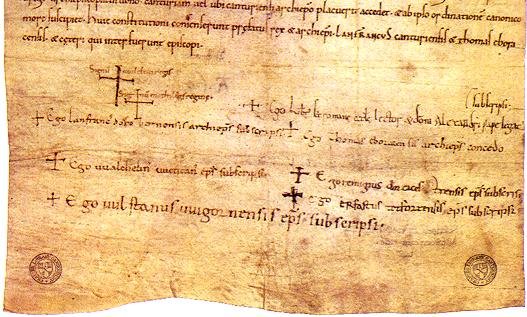
Image credit: Dean and Chapter of Canterbury Site / public domain
Matilda was a beautiful seventeen-year-old, a cultured student of art and poetry, who had hoped to marry an English aristocrat. It was inconceivable to her that she could accept the proposal of the illegitimate grandson of a tanner, be he a duke or not. When her comments about his lineage reached William the Conqueror, he lost all control. The issue of his low birth would haunt and enrage him throughout his life. His nickname was Le Batard, or “the Bastard,” and even after he was on the throne of England, people used that nickname as often as they used “King William.” Once, when he was warring with some rebels in Normandy, they made the mistake of hanging skins from their battlements and yelling “Hides for the tanner!” As a result, most of them lost their own hides.
When Matilda’s contempt became known to him, William the Conqueror mounted his horse, galloped to her house, burst into her room, and grabbed her by her braids. He knocked her around, hurled her to the floor, and departed without a word. That was the end of Matilda’s defiance. Four years later, after they overcame resistance from the church because they were distantly related, the two were wed.
The promise of the English crown
Right before William married, he made a visit to England to see his boyhood friend and cousin, Edward, who was now the king. Edward had never lost his admiration for Normandy and, to the distress of many of his subjects, had appointed Normans to high British offices, including the Bishop of London. But Edward’s admiration of Normandy paled in comparison to the admiration William the Conqueror would develop for England during this visit.
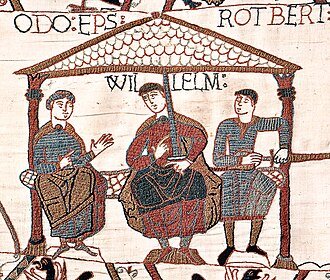
Image credit: Lucien Musset’s The Bayeux Tapestry / public domain
Most Normans who saw England for the first time were astounded by its wealth and civilization, and William was no exception. In size, it was many times larger than Normandy. It was well developed agriculturally, with many farms and some vineyards in the southern areas. There were numerous towns and seaports, which engaged in active commerce with other countries. English art was far more advanced than that of the Normans – in fact, Matilda later valued a dress made by the English so dearly, that she mentioned it in her will. Even the coins during Edward’s reign were exceptionally beautiful. All of this, William the Conqueror noticed. And he began to ponder the future.
Edward had no son, and his next heir was an unknown far away in Hungary. The Danes might try to take the throne – they had not given up entirely on trying to add the English Isles to Scandinavia. But the biggest threat would probably be Godwin of Essex, the most powerful earl in England, and the father of Edward’s wife. William the Conqueror decided to take no chances. While still in England, he extracted a promise from Edward to name him successor to the throne, as his nearest adult heir.
Fourteen years passed. William and Matilda had several children. William the Conqueror strengthened his control over Normandy and enlarged it by taking over new territories to the south. The title “Conqueror” was bestowed on him before he marched into England. In the years since his visit to England, Godwin of Essex died, and his son Harold became the most likely person to rise to the throne after Edward’s death. And then, as luck would have it – and William always seemed to have an inordinate amount of luck – fate landed Harold right into William’s lap.
Invasion of England
It happened in 1064 when Harold was sailing the Channel and was shipwrecked on the French coast. He was seized there and held for ransom, a fairly common practice of the day. Before the ransom could even be negotiated, William the Conqueror paid it himself and received Harold at his court as an honored and grateful guest. In reality, he was a prisoner.
No one has ever been sure what happened during that visit. The Normans claim that in homage to William the Conqueror, Harold promised him the crown of England when Edward died. The English said no one – Harold or Edward himself – could make such a promise because only the council could choose a new monarch. It was an elected office, not one passed down by whim or fancy. There were also stories that even if Harold had made the promise, he’d been tricked into it. Probably he was afraid William wouldn’t release him until he did promise. It’s said that William had him swear on a box, and didn’t inform Harold until later that this box held the bones of a saint. This meant that if Harold broke his promise, there would be a curse on him. Since he had been deceived, said the English, the promise wouldn’t hold anyway.
Whatever happened that day in William’s castle, Harold soon returned to England, where he was desperately needed to help suppress a rebellion in the north. That Christmas, King Edward fell ill, and during the first week of the new year, he died. It was 1066 – a fateful year in the history of world events.
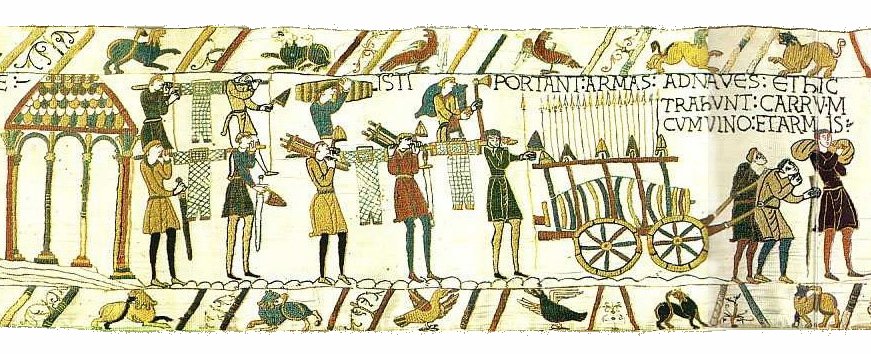
Image credit: Image on web site of Ulrich Harsh / public domain
William’s wrath when he heard that Harold accepted the crown soon settled into a hard determination. Quietly, he began to assess the situation and his chances for taking the throne on his own. For a hundred and fifty years, ever since the time of Alfred the Great, the English people had been fighting each other and rebelling against their monarchs. It was a strong country, but it was a country divided. And although Harold had many friends, he also had many enemies.
It was winter now, and the Channel was impassable. This gave Harold time to organize his supporters and strengthen his position. Furthermore, the English had many good ships that could meet invaders in the sea before they even had a chance to land. If they did manage to land, there were hordes of English soldiers – bigger than the average Norman and practiced in open warfare. The Normans were accustomed to fighting from castles. The English preferred to battle one-on-one in the fields, swinging their ferocious Danish axes that cut through chain mail as if it were parchment. On the surface, the odds seemed against William. But he knew his strengths too – Normandy, unlike England, was a united country. If he could increase his army, and enlist the aid of Harold’s enemies, he might have a chance. To William the Conqueror, “just a chance” was all it took.
Building an army and winning the Pope’s blessing
The recruitment campaign began in earnest. Far and wide, William spread the word that England, through Harold, had given its word, and broken it. Then he sent his favorite monk, a man named Lanfranc, to appeal his case to the Pope. The Pope, when told that Harold had broken a vow made on sacred relics, blessed William’s cause, thus turning it into almost a crusade.
Now, from all over France and Italy, men poured into Normandy to offer their services in William’s army. He promised them lands and riches beyond their imagination. Soon the line of volunteers stretched down every road leading to Normandy. Blacksmiths and metal workers were ordered to work day and night producing weapons and armor. From the vast forests of Normandy came the lumber to build a great fleet of ships. William the Conqueror was an exceptional organizer. He kept this army together and made sure it was well fed and provided for until the time was right for invasion. That time came in the summer, but not when William had planned.
Halley’s Comet and the crossing of the Channel
His plan had been to set sail in August, but the winds were against him, and he was forced to delay until September. The late summer gales destroyed many of the French ships before they could even sail, and William’s soldiers began to fear that fortune had turned against them. But as always, fate intervened to save William the Conqueror. Just at that moment of low morale, a bright new star with a fiery tail whizzed across the sky, which his followers interpreted as a heavenly sign of their impending victory. It was the same comet later identified by astronomer Edmund Halley and known today as Halley’s Comet.
The delay in crossing the channel turned out to be a blessing in disguise. By September, the English soldiers waiting on the coast had exhausted their food supplies and were forced to disband. That same month, Norway invaded the north of England. Harold, forced to choose between two invasions, one underway and one on the way, sent his armies north to battle the Norwegians.
Conspiring with the Norwegians was Harold’s own brother, Tostig, with whom he’d been quarreling for many years. William and Tostig had already formed an alliance, and Tostig was doing his part to make sure William could land in the south unchallenged.
Just as the English were celebrating their victory over the Norwegians and Tostig, the wind changed, and William the Conqueror sailed with his hundreds of ships and tens of thousands of men onto the empty coast of southern England. The few watchmen left behind on the cliffs frantically sent a messenger by horseback to bring the news to Harold that the Normans had landed.
As the first Norman ship touched the shore, William the Conqueror sprang exultantly to land, only to stumble and fall upon his face. His knights gasped, for they immediately saw the fall as a bad omen. But William was a quick thinker. He jumped to his feet, held up two fists full of sand, and proclaimed: “I have seized England with my two hands.” The men cheered and set themselves to work with renewed vigor. After they unloaded the horses and provisions, William the Conqueror ordered them to burn or sink their ships. “We will win England or die,” he said. “We will not return to Normandy in disgrace.”
The Battle of Hastings, 1066
Two hundred miles away in Yorkshire, Harold heard the news that the Normans had landed on his unprotected coast. He set out immediately, riding at full speed, his soldiers struggling to keep up with him. Within a week he was in London, where he gathered what new forces he could. They set out like lightning and seventy miles later they came upon the Normans in Hastings.
The Battle of Hastings lasted only one day, but it was a day in which years seemed to come and go. William the Conqueror and Harold started out with about the same number of men – 10,000 each – but English reinforcements trickled in from the countryside, hour by hour. The Normans were fresh and anxious for battle. They included the finest knights William had been able to find. The English soldiers ranged from the elite royal guard to the barely trained recruits of the locals. Most of them were weary from their march down the length of England, and they hadn’t rested since the long, hard battle with the Norwegians.
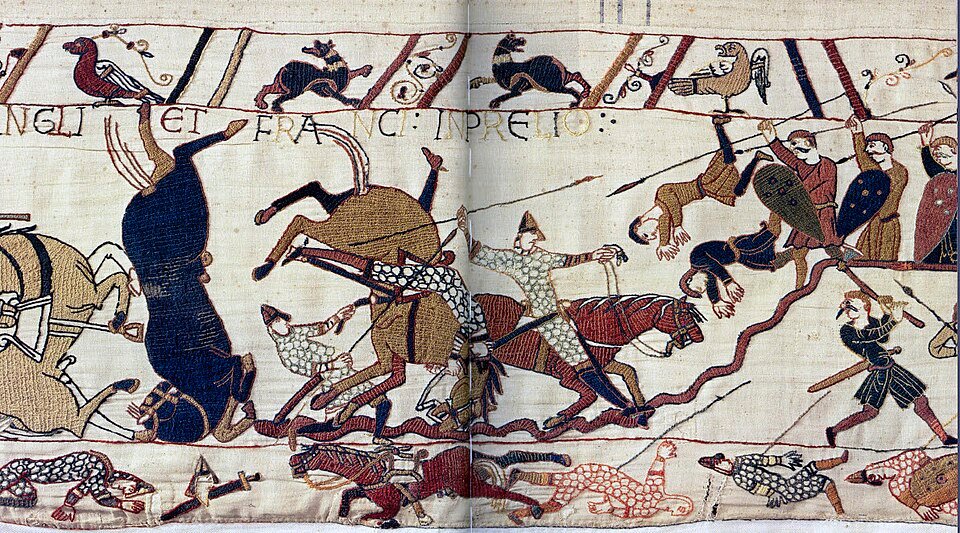
Image credit: Bayeux Tapestry designer and seamstresses / public domain
All day the battle raged on. The Norman archers fired thousands of arrows, and the Saxons held up their mighty shields in an almost impenetrable wall. William’s horse was killed from under him, and a cry went up that he too had been killed. The Normans, feeling all was lost without their leader, turned and prepared to flee. But William the Conqueror removed his helmet so they could see his face, mounted another horse, and yelled: “I am alive. Back into the fight!” and back they went.
There is a story about a clever strategy William the Conqueror used at Hastings that remains controversial to this day. It’s said that he ordered his men to charge once more, then pretend to run away. When the English broke ranks to chase them, the Normans then turned around and attacked. Some have always maintained that the flight of the Normans was genuine and not planned. If it was, they nevertheless took full advantage of it. The Saxons, thinking the battle was won, forgot Harold’s order to stand firm and chased the enemy downhill. The Normans wheeled around and cut them to pieces with their swords. Norman horse soldiers plowed through the gaps between shields and men. And from a ledge above, Norman archers fired arrows high into the air, at the order of William. One of those arrows, guided by the lucky star that always seemed to watch over William, struck King Harold full in the eye. It was a mortal wound, but Harold pulled the arrow out and kept fighting until the end. The Norman knights burst through his bodyguards and killed him with their swords. When the fighting was over, no one could recognize the dead king of England. They had to call in a close female friend, and she alone was able to identify Harold’s body.
Their leader is gone, and most of his best soldiers with him; the English finally retreated.
The crowning of William I at Westminster Abbey
After the Battle of Hastings, William the Conqueror began his march of triumph through England, burning and killing as he went. Nowhere did he meet strong resistance. No man in England had the strength and leadership to unite its people. At last, a delegation of bishops and nobles came to his camp and offered William the throne. On Christmas Day, 1066, he was crowned William I of England in Westminster Abbey. When the crown was placed on his head, the nobles let up such a cheer that Norman soldiers outside made the dreadful mistake of thinking a riot had broken out. Many people were killed before the order was restored.
William the Conqueror as King of England
William the Conqueror was 31 years old when he became King of England. He was above average in height, robust, and thick-set in body, always sparing in his food and drink. He was moderate in his habits and seemed, by the standards of his time, to be a moral person. William had a rough bass voice and was a strong and willing speaker. There was nothing timid about him in either spirit or manner. Physically, he was strong and vigorous, a true outdoorsman, with a passion for hunting and riding, and a reputation as a fierce soldier. He was uneducated, but he was shrewd, and his rivals soon learned to fear and respect him.
Castles, the Tower of London, and securing the kingdom
Once he had his kingdom, William made sure it was secure. He gave English land to his followers, keeping a large part aside for both the church and himself. He made every knight and baron kneel before him and vow their allegiance. He had castles built so he would have a stronghold in every area of the country. In each shire, or county, peasants were busy digging moats and erecting wooden towers and stone keeps. It was William the Conqueror who was responsible for the first castles at Windsor, Nottingham, and many other key locations, and it was William who built the first part of the famous Tower of London. Its purpose was to protect London, but more importantly, to William, it was to serve as his safe house if the people of London rose against him. The section he constructed is called the White Tower because of the whiteness of the stone, which he had shipped over from Normandy.
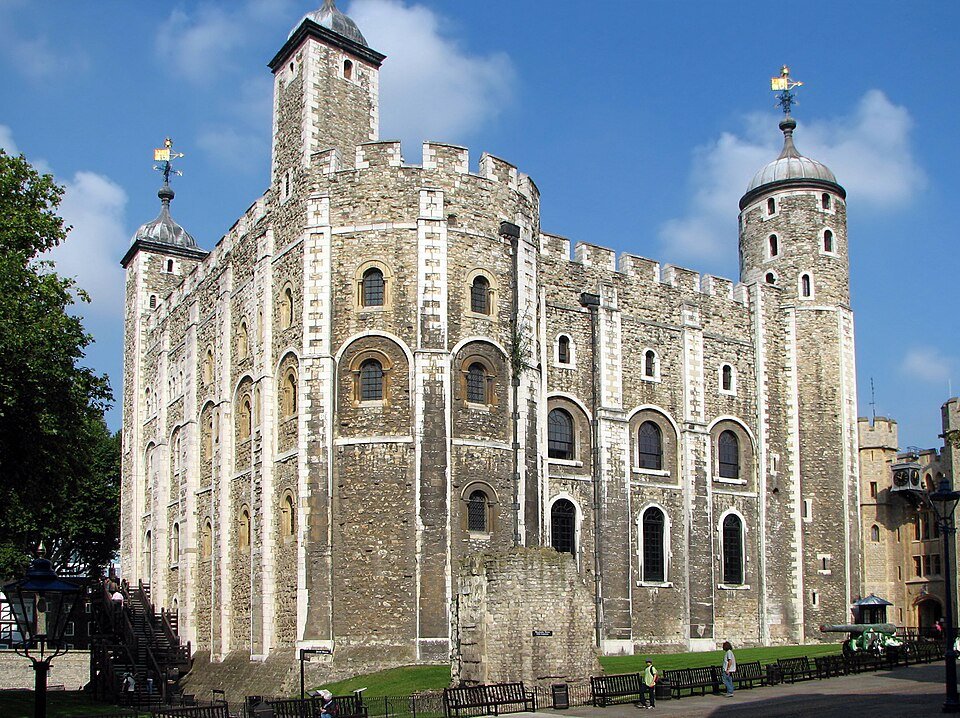
Image credit: Bernard Gagnon / CC BY-SA 3.0 (via Wikimedia Commons)
It took three to four years before William attained complete control of England. There was a campaign against him in the west, spearheaded by Harold’s mother. There was also a revolt in the north and at one time an invasion of Danes, who gave assistance to the rebels. There was further resistance in Chester and after that another one in the Fens. But William’s enemies were never able to defeat him because they never joined forces. And he did everything he could to make sure they never would.
William the Conqueror always insisted he was king of England not by force, but by law. Though he was privately determined to put as many Normans as possible in prominent positions, he was also careful to make it look like he didn’t favor outsiders over Englishmen. No Saxon has ever put off his lands just because he was a Saxon; it was because he had rebelled against the lawful king. But of course, it was only Saxons who rebelled, so it was only Saxons who lost land.
When it came to the English church, William the Conqueror bided his time. He knew if he replaced English bishops with Normans, he would have a rebellion on his hands. So instead he waited patiently, and as each bishop died, he was replaced with the most qualified man for the post, who always happened to be a Norman. By the end of his reign, there wasn’t a single English bishop remaining.
Gradually, and as quietly as possible, William the Conqueror steadily transformed England into the land of the Normans. There were no sudden announcements or laws that would provoke people to revolt. Instead, he showed the utmost respect for English law. He often acted as a judge in the courts, and he made a special effort to study and understand the legal system and the needs of the people. His punishments were often harsh, but he also amended many laws that he found unjust. He tried to learn English himself but failing at that, he made sure his son Henry learned it.
Henry was born in England, two years after the Battle of Hastings. Matilda and the other children had joined William as soon as it was safe. Now there were five children: Robert, the eldest boy; William Rufus, the red-head; the three girls, Constance, Adela, and Agatha; and the youngest boy, Henry. William would later become William II of England, and Henry would later become King Henry I.
Feudalism and the harrying of the North
As his reign progressed, William the Conqueror steadily built England into an organized, unified nation, despite struggles with his enemies. He arranged it so all major landowners were scattered in different regions, making it difficult for them to form alliances. Every landowner swore personal loyalty directly to the king, so they could never excuse disloyalty on the grounds of obeying an intermediary. It was William who introduced Feudalism to England, a structure in which nobles were given land in exchange for service in the royal army. He changed the face of the land in other ways too – literally. He laid waste a large area of northern England, where dissension was particularly strong. Every house and field was burned and thousands left homeless. This “harrying of the North,” as it was called, left the region a wilderness for fifty years, and so weakened it that it didn’t fully recover until the modern age of coal and iron.
Those who resisted William the Conqueror, or who openly rebelled, were maimed; they were either blinded or had a limb cut off. It was a common punishment of the time and considered more merciful than execution. William took special pride in the fact that he was responsible for very few deaths outside of the battlefield.
The Domesday Book
Twenty years into his reign, William the Conqueror announced he was going to conduct a systematic survey and census of the entire country and its wealth – every town, village, and acre. He was motivated partly by the desire to make sure he was receiving the taxes due to him. But in the process, he formulated a book that has proven invaluable to historians. The records from William’s survey were compiled in what he called the Domesday Book, the most complete record of its kind from all of medieval Europe. Scholars have been grateful to him ever since.
Norman architecture and church reform
Throughout his years as king, William the Conqueror continued to build and strengthen England.
Many new churches began to rise, larger and grander than earlier ones. He rebuilt the Cathedral at Canterbury and installed as its Archbishop his friend Lanfranc, who had gained the Pope’s blessing on the invasion of England. Since all the best architects were monks, William the Conqueror imported them from all over France and Italy. Soon the distinctive features of Norman architecture could be seen everywhere – the round arch supported by massive columns, plain at the base and top, and simple plastered walls. William had been a dedicated reformer of the church in Normandy, and he continued with that work in England. He made the archbishop of Canterbury the leader of the English Church, held councils to discuss issues of reform, which he attended, and placed bishops among his closest advisors and officials. His vision was a church completely free of corruption, but always subordinate to him.
The New Forest and the borders of Britain
Hunting had always been William’s favorite pastime, so he set out to enlarge the hunting grounds of his new homeland, which were rich in wild deer and boar. He uprooted the peasants in an area a hundred miles round to create his own private game reserve. Then he sent his men to raze the houses, churches, and villages. He created the New Forest, a forest in which his son Rufus would later die from a mysterious arrow, and a forest that still stands today in the County of Hampshire.
During the first half of his reign, which lasted 21 years, William the Conqueror invaded Scotland and Wales to secure the frontiers of England and installed defenses along their borders. He was more benevolent with Ireland. There was an active slave trade at this time, between Ireland and the ports of western England, and William made determined efforts to end it.
Through all this, he divided his time almost equally between England and Normandy, but in the last years of his life was more often than not in Normandy. For a period of five and possibly seven years, he never even visited his kingdom. He turned control of the government over to his half-brother Odo, who later betrayed him, and to the bishops he’d appointed and could trust, especially Lanfranc. Matilda spent only the first few years in England and then settled permanently in Normandy. In her later years, she and her ladies embroidered a famous tapestry called the Bayeux Tapestry that tells the story of William’s conquest. It’s 220 feet long and twenty inches wide.
William the Conqueror’s final years and death
Despite his great achievements and the fulfillment of his fondest dream, William’s later years were unhappy. He was preoccupied with the frontiers of Normandy, which were continually threatened by his French neighbors. He fought constantly with his older son Robert, whom he planned to make Duke of Normandy, but not King of England. Matilda frequently took her son’s side, causing the first rift in their marriage. Eventually, Robert left Normandy and conspired with his father’s enemies, breaking William’s heart. Shortly after, Matilda died, and William the Conqueror was left alone.
He was not yet sixty, but in some ways, he looked much older. He was almost bald, and his once athletic body had become fat and weak. Still, he continued to ride and hunt and to fight battles against unruly subjects or French invaders into Normandy. In 1087, one of these raids took him to the town of Mantes, near the edge of Normandy. He quelled the rebellion and then took his revenge on the town, leaving it a smoldering ruin. It was what he always did, and he considered it just punishment for disloyalty. Suddenly, that day, his horse stumbled, and William the Conqueror was thrown against the pommel, or knob, of his saddle, suffering internal injuries. His men carried him to a nearby abbey, where he lingered for five weeks.
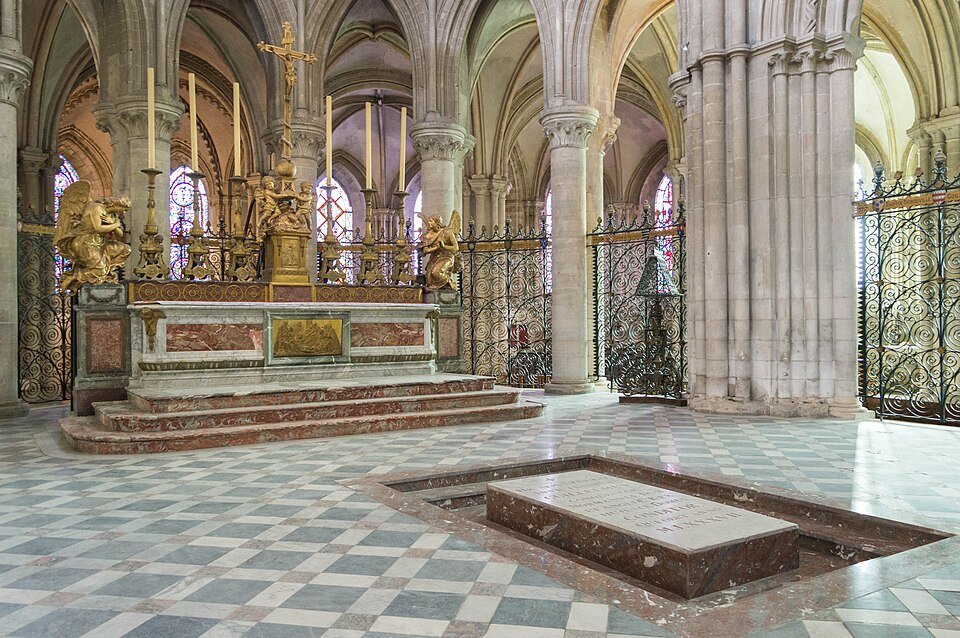
Image credit: Supercarwaar / CC BY-SA 4.0 (via Wikimedia Commons)
As he was dying, his son, William the Red, snatched the great royal ring off his father’s finger and hurried off to England to be crowned. William the Conqueror was left alone with a priest.
He was a man who had been both stern and cruel with the people of England, and fair and beneficent. During his final moments, he chose to remember his sins. He confessed his responsibility in killing thousands of fine people, both young and old, either by sword or hunger. He asked God’s forgiveness and died shortly after, on September 9, 1087, at the age of 52. The doctors fled in panic, in fear they would be blamed. The nobles, expecting an uprising, rode off to prepare their castles. The servants seized the opportunity of a deserted building to steal everything in sight. They took even the dead king’s robes and bed linens. In the end, William lay abandoned and almost naked, on the floor of the abbey.
William the Conqueror’s legacy
William the Conqueror was the first real king of England. After more than 600 years of disorder, he established unity, structure, and stability in the land. Although capable of savagery, he was no more savage than his times and far more visionary. He revolutionized the social, political, and military structures of the nation and laid the groundwork for its emergence as a major nation. He was able to accomplish all this partly because of luck and coincidence, but mostly through his own character and force of will. He was steadfastly firm in his purpose and faithful to his goals. Early on, he decided what he wanted and set out with clarity and determination to attain it, never deterred by obstacles or what sometimes seemed like overwhelming odds against him. He was always willing to take calculated risks, and never afraid to fight. As a result, he became one of the greatest soldiers and rulers of the Middle Ages and a man who personifies what it once truly meant to be a King of England.
References:
- Bates, David (2001). William the Conqueror. Kings and Queens of Medieval England; Clanchy, M. T. (2006). England and its Rulers: 1066–1307. Blackwell Classic Histories of England; Douglas, David C. (1964). William the Conqueror: The Norman Impact Upon England; Given-Wilson, Chris; Curteis, Alice (1995). The Royal Bastards of Medieval England;

