

Cover image: A multiple exposure picture of Tesla sitting next to his “magnifying transmitter” generating millions of volts. Photographer: Dickenson V. Alley / CC BY-SA 4.0 (via Wikimedia Commons)
Table of Contents
Prof. Dr. Igor Rudan, a Croatian-British scientist, is the first researcher to take the strange symptoms and health problems that Nikola Tesla described in detail in his autobiography “My Inventions” a century ago, and actually explain them using what modern medicine and neuroscience know today.
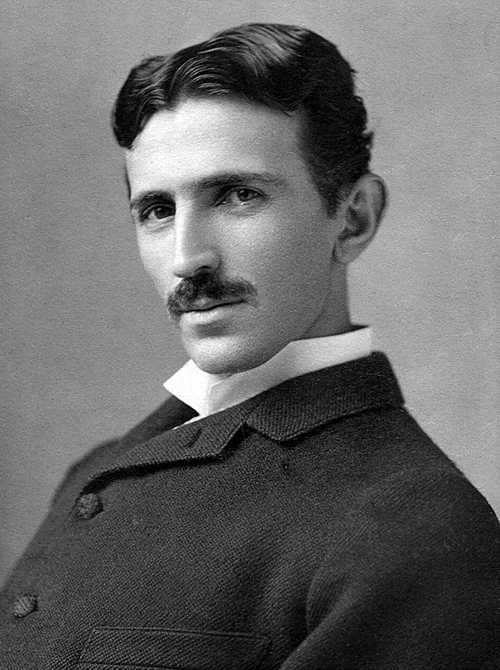
Image credit: Napoleon Sarony (1821–1896) / public domain
The Nikola Tesla health problems described in his own autobiography stayed unexplained for about a hundred years. Back in 1919, Nikola Tesla published that autobiography for the first time. It ran in six installments in a magazine called “Electric Experimenter,” which was pretty popular at the time. It later came out as a book and got translated into a lot of languages, and it’s still one of the best sources we have on Tesla’s family, his childhood, his schooling, his first discoveries, and all those odd little details around how he came up with the rotating magnetic field in Budapest. He also laid out these almost sci-fi visions of remote control and a worldwide telecommunications system, decades before anybody else was seriously talking about that stuff.
Without Tesla’s own memories — and he wrote them down vividly — we’d have lost a huge amount of what we know about the life and work of one of the greatest minds in human history.
But there’s one part of that book that stayed a puzzle for about a hundred years. Nikola Tesla devoted a lot of pages, and some really precise descriptions, to the various symptoms and health problems that followed him around basically his entire life. Most people who know anything about Tesla know about his phobias and his obsessive-compulsive habits. Those got talked about plenty. The rest of it, though — and some of it was genuinely serious — never really got explained.
That’s where Dr. Igor Rudan comes in. He’s a Croatian-British scientist with an international reputation, and as he tells it, he more or less stumbled onto the English edition of “My Inventions” by accident. What grabbed him was how exact Nikola Tesla was. The man wrote about his symptoms the way an engineer writes a spec sheet. And you can feel the frustration in it, too — these things scared him, they seemed unique to him, and the medicine of his day couldn’t explain any of it, let alone treat it.
So Dr. Rudan went through all of it, syndrome by syndrome, using current knowledge from medicine and neuroscience. What follows is his analysis. A hundred years after “My Inventions” first appeared, we finally get a picture of what Tesla was actually dealing with — and it explains a surprising number of his quirks and some of his stranger reactions along the way.
Savant Syndrome and the Roots of Tesla’s Genius
“Today, 100 years after the publication of Tesla’s autobiography,” Dr. Rudan says, “we can understand far better what Nikola Tesla himself may have understood here.”
Here’s the short version of how the brain part works. The left hemisphere handles more of the logic, the analysis, the mathematical reasoning — and it also sort of keeps the right side in check. The right hemisphere leans more toward creativity and art. What’s interesting is what happens when the left side gets damaged. Injuries from traffic accidents, war wounds, strokes, the development of dementia — any of these can, in a manner of speaking, release the right hemisphere from the rational, logical control the left side normally imposes on it.
And then some strange things start happening.
People with left-side brain damage can turn obsessively creative in ways they never were before. They start drawing and painting constantly, and they’re good at it — sometimes extremely good. Their spatial ability jumps. They can hold and rotate complicated three-dimensional objects in their heads. Musical memory goes through the roof, and sometimes their hearing seems to sharpen along with it. Some of them pick up other abilities that honestly sound superhuman: remembering the details of entire cities or neighborhoods they walked through, or even flew over in a helicopter, and then drawing them out.
How Stephen Wiltshire Draws an Entire City From Memory
That last one isn’t hypothetical. Dr. Igor Rudan brings up Stephen Wiltshire, who was born in 1974 and is probably the most famous person with this particular set of traits. He first caught the public’s attention as a twelve-year-old, when he drew a precise sketch of a bus station from memory on a TV show. He got the building exactly right — and the clock in his drawing read 11:20, which was the exact time a few hours earlier when he’d seen the place for the first time.
Stephen is autistic. His memory and his drawing ability are both remarkable, and buildings are what stick with him most. In 2001 he demonstrated what he could do on a show: after a helicopter ride over London, he drew an area of four square miles. Twelve landmarks and 200 other buildings, all in detail.
“Sometimes,” Dr. Rudan explains, “these people can gain such abilities that, for example, in a split second they can connect the day of the week with a certain calendar date in the entire century, and sometimes in the entire millennium.” They basically become human calendars.
What Synesthesia Actually Feels Like
In these situations — where the left hemisphere loses its grip on the right — you can also get a perceptual phenomenon called synesthesia. That word sounds more complicated than the thing itself. Synesthesia is when stimulating one sensory pathway automatically triggers an experience in a different sensory pathway, and you can’t switch it off by choice. So a person might see the numbers 0, 7 and 9, and each one shows up in its own color. Or the months of the year feel like they’re arranged in space, some closer, some farther away. Somebody hears a word and immediately sees a picture in front of them.
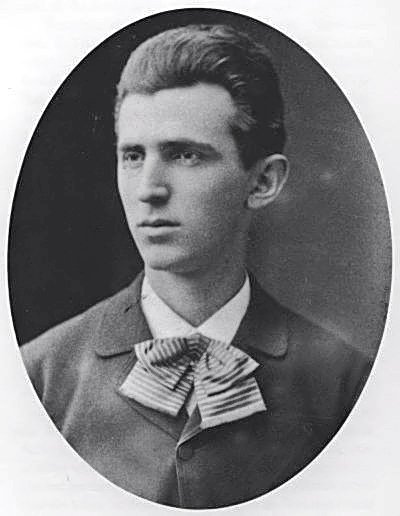
Image credit: Unknown author / public domain
Anyone who’s watched a person like this in action — with these abilities that look flat-out superhuman, produced by the right hemisphere getting loose from the left — ends up asking the obvious question. How can they do that, and we can’t?
And when a genius like Nikola Tesla, or Leonardo da Vinci, or Michael Faraday shows up, we ask something similar. How do they see all of this? How is it obvious to them a hundred years before the rest of us can even follow along?
There’s one mechanism behind these abilities that’s especially interesting, and it’s called savant syndrome. The word savant, in French or English, translates to something like expert, specialist, scientist, authority.
“It is believed,” Dr. Igor Rudan explains, “that a certain part of the occurrence of autism in children is caused by a similar mechanism.” Meaning: the left side of the brain loses control over the right, sometimes because of genetic mutations, sometimes because of minor brain injuries during pregnancy. The right side takes over from the left, and what looks like a superhuman ability develops out of that.
The current thinking is that somewhere between one in three and one in ten children with a certain form of autism also has savant syndrome — some kind of special ability attached. And cases like that turn up at a rate of roughly one in a million.
Savants, Calendars, and Copying Without Imagination
People with savant syndrome, the ones Dr. Igor Rudan is talking about, are individuals with various mental or physical disabilities who also happen to possess incredible talents. Savant syndrome can be congenital, or it can be acquired after an injury or illness. Savants generally don’t have the ability to think abstractly, but in certain specific tasks their brains leave the average human brain in the dust.
Here’s a detail I found kind of fascinating. As Dr. Igor Rudan explains it, savants can tell you which day of the week any date from the past or even the future will fall on — but they often don’t know how to count. And artistic savants usually produce their work without imagination or creativity in the usual sense. They’re copying what they saw and heard, down to the last detail.
Hereditary Factors in Tesla’s Immediate Family
Another thing worth noting: children with some form of autism and savant syndrome often have relatives — immediate or extended family — who are also autistic, with or without special abilities of their own.
Which led Dr. Igor Rudan to the question that drives this whole investigation. Was Nikola Tesla someone with a form of autism? And did that mean he experienced the world in a way the rest of us simply can’t?
Tesla left behind a lot of testimony about his own perceptual experiences, and Dr. Igor Rudanwent through it in light of what neuroscience has figured out since.
The Horse, the Accident, and the Death of Brother Dane
He starts with Tesla’s memories of his brother Dane.
“I had a brother,” Tesla writes in the first installment of his autobiography, “who was extremely talented — one of that rare intelligence for whom biological research has failed to answer. His untimely death brought inconsolable pain to my parents. We had a horse given to us by a dear friend. It was a beautiful animal, of Arabian breed, which seemed to have human intelligence, and the whole family looked after it and took care of it because on one occasion it saved my father’s life under strange circumstances… That same horse was responsible for injuries to my brother from which he died. I witnessed that tragic event and, although 56 years have passed since then, the visual impression that that scene left on me has lost nothing of its power. The memory of the successes that my brother achieved overshadowed all my efforts.”
And because of everything their parents had expected from their older son Dane, Nikola Tesla added this: “the parents created an even more painful sense of loss. That’s how I grew up, almost without a bit of self-confidence.”
What caught Dr. Rudan’s attention here is a genetics question. Does Dane’s unusual talent suggest that these traits ran in the family?
Digging into the Nikola Tesla family tree, Dr. Igor Rudan goes back to Tesla’s paternal grandfather, who was an officer in Napoleon’s army and had two sons — Milutin and Josif. Tesla’s uncle, Josif Tesla, taught mathematics at the Austrian Military School, which was the most prestigious educational institution around at the time.
Tesla’s father Milutin also completed military training, same as his brother Josif, but he changed course and went into the priesthood instead. He became a highly respected scholar in that role. Nikola Tesla described him as a true philosopher of nature, a poet and a writer whose sermons had a rare eloquence to them.
Nikola Tesla said his father had a miraculous memory. He’d recite long passages from classical works, in several languages. He used to say he could reconstruct entire literary works without a single error if they were ever lost for good. Tesla also wrote about how funny his father could be — and about his odd habit of talking to himself, where he’d work himself into a heated argument, switching the tone of his voice back and forth so convincingly that anyone listening from outside would swear there were several people in that room.
“For anyone who has seriously engaged in genetic research,” Dr. Igor Rudan concludes, “this Tesla story is becoming extremely interesting.”
Four Men, One Family, and a Pattern
Look at what you’ve got. Four very close family members: the father Milutin, his brother Josif, and Milutin’s two sons, Dane and Nikola. One of them was a professor of mathematics at the Military Academy in Vienna. Another could recite classical literature in multiple languages. Brother Dane was an unusually gifted young man who, by Tesla’s own account, was much better than he was. And then there’s Nikola Tesla himself, who spent his life demonstrating exactly how exceptional his own genius was.
The first valuable clue in understanding Tesla’s genius, Dr. Igor Rudan argues, is the uncle’s job as a mathematics professor. Here’s why that matters. We now know that some of the team members at the Mathematical Olympiads — often most of them — have what’s called Asperger’s syndrome.
Nikola Tesla Asperger Syndrome: The Missing Diagnosis
Asperger’s was first described in 1944, one year after Nikola Tesla died. It’s a very mild form of autism spectrum disorder, and experts didn’t actually agree on the diagnostic criteria until the 1990s.
“If Tesla had Asperger’s syndrome,” says Dr. Rudan, “and I will show you he most likely did. He could not have known that because it was first described immediately after his death.”
The syndrome shows up much more often in men. People who have it see, hear and feel the world differently than everybody else. There are probably around 40 million people alive today with this high-functioning form of autism.
Along with an incredible capacity for mathematical thinking, Asperger’s comes with a set of other traits: difficulty with social interaction, a lack of empathy, extreme pedantry in speech, a certain physical awkwardness, repetitive obsessive-compulsive behaviors, and — maybe the most important one — long-term, intense preoccupation with one very narrow interest. A lot of people with the syndrome also describe unusual sensory and perceptual details, along with unusual skills and sensory experiences.
Reading through Tesla’s memories, you also hit some interesting details about his father, who drilled him in critical thinking basically every day. He’d have young Nikola repeat long sentences back to him, do arithmetic in his head, guess what other people were thinking, or hunt for logical errors in stories.
“This is,” Dr. Rudan says, “certainly able to significantly contribute to the development of the genius of the future scientist and inventor.”
Tesla’s Power to Visualize Complex Three-Dimensional Objects
In his autobiography, Nikola Tesla lays out the problems that dogged him for his whole life — problems nobody could explain to him, even though he asked the doctors and psychologists of the day to look into it.
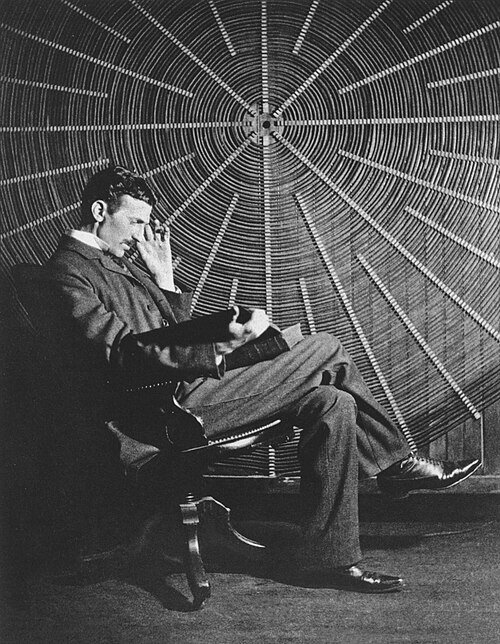
Image credit: Unknown author / public domain
“As a boy, I suffered from a painful condition,” Tesla writes, “which I fell into when scenes appeared before my eyes, often accompanied by light, which would make my objects blur in reality and disturb my thoughts and actions. They were scenes of things and events that I had really seen before — not the ones I imagined in my imagination. When I heard a word, the image of the object that the word signifies would appear before my eyes, and sometimes I could not determine at all if what I saw was tangible. This made me feel very uncomfortable and worried. None of the psychology or physiology students I consulted could give any satisfactory explanation for these phenomena. They seemed to be unique, although I probably had that predisposition since I know that my brother also suffered from a similar ailment. According to the theory I came up with, these were images that arose from the reflection of brain activity on the retina, caused by a powerful stimulus. These were certainly not hallucinations caused by illness or a tormented mind, because I was normal and composed in every other way.
“To give some idea of my troubles, let’s say I attended a funeral or a scene that shook a person completely. Then, in the silence of the night, a living image of the scene would inevitably appear before my eyes, and it would remain there despite all efforts to remove it. Sometimes it would even stay stiff in space, even though I would run my hand right through it. If my explanation is correct, it should be possible to project an image of any object that a person imagines on the screen and make it visible. Such progress would cause a revolution in all human relations. I am convinced that we can accomplish this miracle and that we will do it in the future; I must add that I have devoted a lot of thought to solving this problem.
“To get rid of those scenes that were bothering me, I tried to focus on something else I had seen, and that would often bring me temporary relief; but to get to it, I had to constantly invoke new scenes. I soon discovered that I had exhausted all the scenes over which I had power; my ‘tape’ seemed to have leaked because I had seen little of the world by then — only objects in my home and immediate surroundings. To repeat these mental actions for the second or third time, to drive away the scenes in front of my eyes, this medicine gradually weakened. Then, instinctively, I started going on trips outside the borders of the small world I knew and I saw new scenes there. They were very blurry and vague at first and would disappear as soon as I tried to focus on them, but over time I managed to keep them; they became more and more pronounced and clear, and finally took on the tangibility of the world of reality. I soon discovered that it was easiest for me when I explored the vision more and more, drawing new impressions all the time, so I started to travel — of course, in my mind.”
“Tesla could not know what it was,” Dr. Rudan concludes, “but here he perfectly describes the synesthetic problem which is described in savant syndrome” — that is, in severe forms of autism that come packaged with extraordinary abilities — “but also in Asperger’s syndrome, a milder form of autism. All this is consistent with hereditary factors that affect the occurrence of both syndromes, but also with the frequency in the male population, which we know today.”
So what came out of all this unwanted trouble Nikola Tesla was dealing with?
The Method He Built Out of His Own Torment
When he was 17 and starting to invent things, Nikola Tesla realized that if he refined the technique, it gave him an advantage nobody else had. Here’s how he put it:
“To my joy, I saw that I could visualize things with the greatest ease. I didn’t need any models, drawings, or experiments. I could see them all in my mind. So I was unconsciously led to developing something that I consider an alternative method of materializing inventive thoughts and ideas, which is the opposite of the purely experimental one, and incomparably faster and more efficient. When a person constructs a device to implement a raw idea, he immediately finds himself preoccupied with the details and shortcomings of his device. Continuing to work on improvements and reconstruction, his strength of concentration weakens and he loses sight of the great principle that underlies his idea. Results can be achieved, but always with a sacrifice of quality.”
“My method is different,” Tesla points out. “I am not in a hurry with a specific job. When I get an idea, I immediately start working it out in my imagination. In my head, I change the construction, make improvements, and manage the device. It is absolutely irrelevant to me whether the turbine works in my mind or I examine it in a workshop. I even notice if it has moved out of balance. There is no difference at all, the results are the same. In this way, I can quickly develop and perfect the idea without touching anything. When I go so far as to bring into the invention every improvement that comes to my mind and see no flaws in it, I give that final product of my mind a bodily form. My device works as I imagined, and the experiment turns out exactly as I planned. There have been no exceptions for the last twenty years. And why would it be any different? Engineering, electrical and mechanical, is concrete in its results. There are almost no subjects that cannot be mathematically processed, nor actions that cannot be calculated or results that cannot be previously determined based on available theoretical and practical data. I claim that turning a raw idea into action in the way it is generally done is nothing but a waste of energy, money, and time.”
“The painful condition from which I suffered from my early youth,” Tesla concludes, “brought me, however, another reward. Through constant mental effort, I developed the powers of observation, which enabled me to discover one truth of great importance. I noticed that, before the scenes appeared before my eyes, I always really saw those scenes first under strange and mostly special circumstances, and each time I felt the need to determine where that original motive came from. After a while, this effort became almost automatic for me and I connected cause and effect with great ease.”
Dr. Rudan finds all of this fascinating, and for good reason. He thinks Nikola Tesla was describing phenomena here that science wouldn’t get around to studying for another few decades.
“Nikola Tesla experienced the features of a part of the spectrum of autistic disorders, synesthetic phenomena. The word he would hear would turn into a reluctantly presented image in his field of vision, drawn from his memory. And then he would turn that reluctant image by calming methods into an image acceptable to him that he would imagine and make real. It means that Tesla has developed another well-described phenomenon in the autism spectrum that people have,” Dr. Rudan concludes, “and that is that he can mentally manipulate complicated three-dimensional objects. When he dedicated himself to the invention, he realized that it was a powerful skill that would provide him with an unattainable advantage throughout his life over other experimenters who built their devices physically, in stages, by trial and error, often with injuries, suffering, and with great material and financial damage.”
What Elon Musk’s Design Software Does Today
To show just how big of an edge that was at the start of the 20th century, Dr. Rudan brings up something from our own era. The team at Elon Musk’s company Tesla Motors — best known for the “Tesla” electric cars, and Musk is also behind the futuristic projects coming out of SpaceX — released a video presentation a few years back showing off the key software they use for designing rockets and other devices.
The program displays the most complicated rocket components in three dimensions. You can rotate them, shrink them, blow them up, add parts, swap parts out. It’s not unlike what the long-established AutoCAD program does for architects and designers. And once everything’s finished, you can print the final shape on a 3D printer.
At the end of the presentation, Musk says this program, combined with the powerful computers he works on, has caused a genuine revolution in 21st century production design.
Which is a little wild when you think about it. One of the richest and most successful investors in new technology alive today is showing off something that Nikola Tesla was doing in his head more than 100 years earlier.
Light Flashes: One of the Strangest Nikola Tesla Health Problems
Beyond the synesthetic problems and the ability to rotate three-dimensional objects in his mind, Dr. Rudan points to a third symptom. This one Nikola Tesla called the strangest and hardest to explain of everything he went through personally: unusual flashes of light in his field of vision.
He wrote that unlike the projected images, he never had any control over these flashes at all. They’d show up when he found himself in danger or in some unpleasant situation, or when he got extremely excited about something. At their worst, he’d see a beam of light that turned into burning, flaming tongues.
The intensity of these fiery tongues grew over the years and hit its peak when Nikola Tesla was 25. Even in his early sixties, though, when he sat down to write his autobiography, Tesla said the fiery flashes still turned up in his field of vision — usually when a new and exciting idea hit him — but they were nowhere near as intense as before.
Why Retinal Migraine Fits the Description
Dr. Igor Rudan went through the medical literature on flashes and flickers in the visual field and ruled out everything that’s typical of a much older population, or that comes from dysfunctions Tesla couldn’t possibly have had at 25. What he landed on as the most serious candidate is retinal or ocular migraine.
“These are short-term attacks of flashes or even blindness,” Dr. Rudan says, “which can be frightening for the person to whom it happens. Fortunately, these attacks are harmless and vision is returning. It is a migraine without a headache, and the cause of these flashes is the collection of small blood vessels, just behind the eye or in the retina which blood supply to the optic nerve at that place. Nikola Tesla described that these flashes occur to him when he feels some excitement, because of danger or some new idea. The concentration of adrenaline in his blood most likely increased, which would lead to contraction and narrowing of blood vessels, especially peripheral ones.”
The Adrenaline Timeline That Matches Perfectly
The timing lines up too, and that’s the part I think is most convincing.
“Enhancing the effect of adrenaline on blood vessels is something that is expected until the end of growth and development,” Dr. Igor Rudan explains. Tesla said the effect intensified until he was 25. After that, as a person ages, the secretion of that hormone drops off — which fits everything Nikola Tesla wrote down so precisely for us to read and eventually understand.
Tesla had no way of knowing about adrenaline. It had been discovered about twenty years earlier, but the information wasn’t publicly available or medically defined yet. Ocular manifestations of migraine only started getting mentioned and analyzed after the Second World War — again, after Nikola Tesla was already gone. And the concept of retinal migraine as its own distinct phenomenon has only appeared in the medical literature since 1970.
“So, Tesla died without learning about this syndrome, which tormented and frightened him all his life,” Dr. Rudan concludes.
Nikola Tesla OCD Symptoms: Phobias and Compulsive Rituals
After all of that, Dr. Igor Rudan gets to a fourth symptom Tesla described in detail — and this one is far more common among people generally. These are specific phobias and obsessive-compulsive actions.
Tesla wrote that he could trace some of them back to earlier experiences and make sense of them. Others, no. They just were what they were.
Pearls, Peaches, and Everything Divisible by Three
He had an exceptional aversion to women’s earrings, for instance, and it got much worse if they were pearls, because he couldn’t stand pearls at all. Brooches and bracelets, on the other hand, he found beautiful. And the glitter of crystals didn’t bother him one bit. He wondered about it himself — why one thing set him off and another didn’t. What seemed to matter was that those objects had sharp edges and flat surfaces. Unlike pearls, they were bearable.
Nikola Tesla also claimed he couldn’t touch anybody’s hair unless somebody pointed a revolver at him. He was terrified of peaches and camphor, and he said either one could leave him upset or even running a fever. These aversions stayed with him into old age.
When he dropped square pieces of paper into a container of liquid, he’d always get a strange, disgusting taste in his mouth. He counted his steps as he walked. He never passed up the chance to calculate the volume of whatever was in front of him — the soup plates he ate from, the coffee cups, even individual pieces of food.
And here’s the part that ties it together: everything he did repeatedly had to be divisible by three. If something didn’t come out divisible by that number, he’d go right back to the start and repeat whatever action was involved until he got the result he wanted. Even if it took hours.
“All this Tesla’s forced actions fit perfectly into the theory of Asperger’s syndrome,” Dr. Igor Rudan claims.
The Edison Reward That Never Came
He also brings up the fact that people with Asperger’s don’t pick up on sarcasm, and he connects that to one of the most famous stories in the whole Tesla legend — the one that supposedly happened after Nikola Tesla arrived in America in 1884 and went to work at Edison’s company.
At the start, Tesla was given simple jobs. He moved up quickly and started solving the most complicated problems the company had. When he proposed some alternative solutions, Thomas Alva Edison offered him a reward of fifty thousand dollars if he could successfully perfect the DC generators the company was producing.
Over the following months Nikola Tesla worked day and night on new designs and handed Edison’s company several patents that went on to make it an incredible amount of money.
Then, with the job done, he asked Edison about the promised reward.
Edison’s answer: “Tesla, you don’t understand the American sense of humor.” And that was that. Promise broken.
Edison did agree to bump Tesla’s salary by $10 a week as a sort of compromise, which — do the math — means Tesla would’ve needed to work for 100 years to earn the money he’d originally been promised. He resigned immediately and before long founded his first company in America.
For Dr. Igor Rudan, this legendary clash between Nikola Tesla and Edison is one more piece of evidence for Asperger’s syndrome in Nikola Tesla. The key to the whole historic conflict between these two inventors, who became great rivals afterward, comes down to a misunderstanding of jokes and sarcasm.
There’s one more trait, according to Dr. Igor Rudan, that all people with Asperger’s syndrome share, and it’s a strongly pronounced one: the pursuit of the common good and the solving of people’s problems. If you look at the biographies of modern heroes of our time — Steve Jobs, Bill Gates, Mark Zuckerberg, Elon Musk — you can assume every one of them could have a mild form of Asperger’s syndrome.
And in that drive to solve problems and push constantly forward, Nikola Tesla was about as clear an example of the type as you could ask for. The man was almost obsessed with working for the common good and the progress of all humanity.
Sensory Hypersensitivity and Total Sensory Overload
In “My Inventions,” Tesla writes that some of the things he experienced go past the limits of the probable. His words, more or less.
He says that as a child he always had better eyesight and hearing than the other kids, and that he could always make out objects at distances where nobody else could see a thing. He saved his neighbors several times, because while they were asleep he heard the crackling of a fire and raised the alarm.
Much later — he was 43 at the time, during a nearly eight-month stay at his laboratory in Colorado Springs — Tesla says he could hear thunder from a distance of 900 kilometers. His assistants could only pick it up at 250.
The Budapest Breakdown of 1882
But according to Nikola Tesla, none of that compares to what happened to him in Budapest in 1882, the same place where he’d make his lifelong discovery of the rotating magnetic field.
There he had a complete breakdown.
He could hear a wristwatch ticking three rooms away. A fly landing on the table made a thump in his ear. A carriage passing three streets over shook his entire body. The whistle of a locomotive a few kilometers off would set his whole body vibrating while he sat in a chair. He had to put his bed on rubber pillows just to sleep, because anyone walking underneath left him shaking constantly.
And the noise — whether it came from far away or from right nearby — got mixed up with spoken words, which frightened him, because he couldn’t tell where any of it was coming from.
When he walked under a bridge, he felt an enormous pressure in his head. In the dark, he felt like a bat: he could sense an object in front of him from around 4 meters away, through some strange sensation on his forehead. His pulse swung from very slow all the way up to 260 beats per minute, and it came with tremors through his whole body.
The doctor treated him with bromide and potassium, but wrote his illness off as unique and incurable.
Nikola Tesla wrote that he’d always regret not being in the hands of scientists who could have actually investigated what was happening to him at the time. What pulled him through it all, he said, was the will to live — though he didn’t really expect to come out the other side.
What Modern Science Calls Tesla Sensory Overload
“From the point of view of modern science,” Dr. Rudan explains, “it is the so-called sensory overload.”
Sensory overload happens when a person takes in more input from their five senses than the brain can handle and process. Several conversations going on in one room, flashing lights overhead, loud entertainment — any of that can produce sensory overload symptoms. Anybody can experience it, and the triggers are different from person to person.
Sensory overload has also been linked to a number of other health conditions, including autism, sensory processing disorder, post-traumatic stress disorder, fibromyalgia, and multiple sclerosis.
“It is also a well-described phenomenon,” Dr. Igor Rudan says, wrapping up his account of this symptom that followed Nikola Tesla his whole life, “characteristic of the autistic spectrum where there is an overload of sensory inputs, i.e. an overload of the senses.”
Put all these new interpretations together and a different picture of Nikola Tesla comes into focus. He wasn’t only unique for the discoveries that reshaped the technological world around us. He was unique for a whole run of mysterious symptoms and health problems that are finally getting their explanations, thanks to what modern medical science has since found out.
The medicine of his own time couldn’t help him. It couldn’t explain any of it and it couldn’t cure any of it.
And yet — through what has to be described as incredible control and sheer strength of mind — Nikola Tesla didn’t just push through most of it. He turned a good deal of it into an advantage nobody else had, and used that advantage to build the work that defined the modern age of our civilization.
References: My Inventions: The Autobiography of Nikola Tesla

