

Cover image: A Sumerian inscription in monumental archaic style, c. 26th century BC / Unknown author, public domain
Table of Contents
The story of cuneiform decipherment is one of the great detective tales in the history of scholarship — a puzzle solved by many hands across two centuries. Along with Egyptian hieroglyphs, cuneiform is among the oldest known scripts. It preceded the still unknown Minoan, so-called “linear A” script. Champollion deciphered Egyptian hieroglyphs, while the Phoenician script is still a riddle. Emerging from oblivion, cuneiform became a subject of great interest throughout the world in the seventeenth century, so we cannot say that cuneiform was deciphered by one person. It was a feat of many people who did not even know each other.
The Origins of Cuneiform: From Sumerians to Persians
The cuneiform script originated from the Sumerians, one of the oldest highly developed cultures of mankind, which is believed to have existed around the 4th millennium BC. They left their achievements written on a huge number of clay tablets — millennia before the invention of the printing press would once again transform how humanity recorded and shared knowledge. They developed a way of writing that was used by other people from this area after the disappearance of their civilization. The Assyrians and Babylonians accepted the Sumerian script, and it is a witness to their time today. The last in a series of many people to use the Sumerian script were the Persians. They accepted it in the VI century BC and adapted it to their language. The cuneiform texts filled the walls of the royal palaces in monumental Persepolis, the center of the Persian Empire. All that remains of Persepolis are the ruins that testify to a once-powerful kingdom that stretched from India to the Nile. The inscriptions on the walls of the ruins, written in an unusual script in an unknown language, could speak of its past glory, but no one understood them.
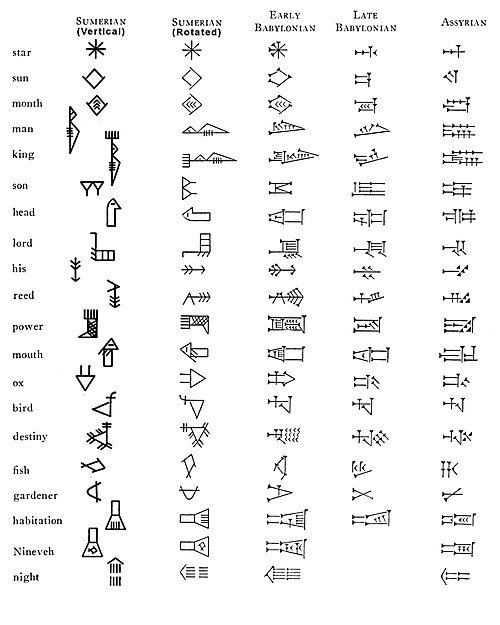
Image credit: Mason, William Albert, 1855-1923 / public domain
First European Encounters with Cuneiform Writing
The first to deal with these records in recent times was the seventeenth-century Italian travel writer Pietro Della Valle. Although his transcript was not sufficiently accurate to initiate any research work, it sparked the interest of many scholars and future cuneiform researchers. Della Valle is also credited with bringing back the first inscribed clay bricks from the ruins of Babylon and Ur, the first physical examples of cuneiform writing ever to reach Europe. For most of the seventeenth century, however, scholars regarded these wedge-shaped marks as little more than mysterious decoration; it was only in 1700 that the English orientalist Thomas Hyde first applied the Latin term “cuneiform” to them, giving the script the name by which it is still known today. Subsequently, in 1711, Jean Chardin (later Sir John Chardin)—the extraordinarily educated son of a French jeweler and himself the chief jeweler at the British court—carefully and accurately transcribed, in his Travelogue from Persia, a small record he found in the ruins of Persepolis.
Carsten Niebuhr and the Copies from Persepolis
Since the parts of that text were of varying levels of complexity, it could be concluded that the record contained texts written in different languages, but in the same cuneiform script. It was established that the three languages were Old Persian, Elamite, and Babylonian. However, there was a long way to go before the script was deciphered. It is almost impossible to decipher a text if we do not know the language or script in which it was written, as was the case here. Old Persian, and even earlier Elamite and Babylonian, were long-forgotten languages, while cuneiform was a real conundrum. Deciphering the script required rewriting and publishing all available material. This task fell to German surveyor Carsten Niebuhr, who was a member of a scientific expedition sent to the Middle East by King Frederick V of Denmark, a great protector of culture and science. In 1761, Carsten embarked on the expedition, which lasted nearly seven years as he traveled throughout the Middle East, Egypt, Arabia, and Syria, measuring, collecting data, and drawing. After collecting a wealth of data, malaria struck, killing Carsten’s associates one by one over the course of a year. Carsten himself became seriously ill but recovered and, in March 1765, visited Persepolis. In three and a half weeks, he copied the entire text from the palace walls so accurately that very few corrections have been needed since.
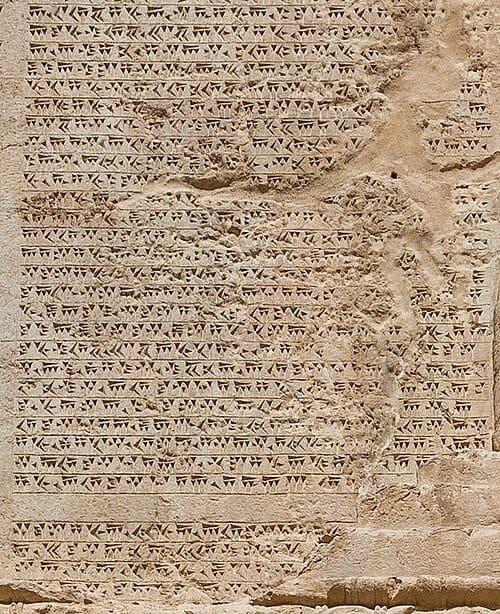
Image credit: Diego Delso / CC BY-SA 4.0 (via Wikimedia Commons)
Upon his return to Denmark, Niebuhr undertook a careful study of the records. He noticed that these were three unique records and that they were all always different. He divided the texts into three groups according to the way they were written, calling them groups I, II, and III. The strain of these long hours bent over the inscriptions eventually cost him his eyesight, a quiet sacrifice that mirrored those of his fellow expedition members and underscored just how high the human price of this work could be. Niebuhr could not penetrate beyond that. When he published his work in 1778, the two researchers began work on the problem independently of each other. They were Oluf Tychsen from Rostock in Germany and Friedrich Münter from Copenhagen. Oluf Tychsen noticed that the sign in the form of a diagonally placed wedge was frequently repeated in the text and assumed that it was a word-separation sign. Münter came to the same conclusion on his own. This discovery was very significant because it represented a step further in putting together a mosaic of an unknown letter. Tychsen could correctly read the characters for the letters A, D, U, and I, and Münter the character for the letter B. Tychsen’s effort to interpret the whole text failed, due to a wrong historical link: the text dates back to the Parthian dynasty (247 BC – AD 224), instead of during the Achaemenid dynasty (c. 550–330 BC) as Münter did. However, they did not come much closer to the desired goal of deciphering any part of the record. There was a serious setback in the entire case. An alternative method was needed, a fresh researcher, one who can use the power of combinatorics, with a sense of history and archeology.
Grotefend’s Bet: Cracking the Old Persian Cuneiform
In 1802, the librarian of the University of Göttingen persuaded Georg Friedrich Grotefend to accept this task. According to a story that has become famous, the entire enterprise began over drinks: Grotefend, then a young assistant teacher of just twenty-seven, wagered with friends at a tavern that he could find the key to deciphering an unknown script using nothing but logic and the patterns within the text itself. This German teacher was a gifted linguist and extremely adept at solving language puzzles. He had already published works on two ancient Italian dialects (Tuscan and Umbrian), but did not know Oriental languages. He started from the assumption that these are three languages and that the first of them is Old Persian, a language from the time of the Achaemenids who built the mentioned palaces and had engraved records on the walls. To begin with, he selected two of these Old Persian records and placed them side by side. Frequent repetition of the same sign in them showed that they were similarly content. He used a very simple but reliable method and, as he progressed step by step, the possibility of error was tiny. In all Persian texts, Münter noticed a word that appeared in two forms: long and short. That same word also appeared in two of Grotefend’s texts in a long and short form. Münter suggested that the word means king in short form and kings in long form, and when these two forms of words appear together, then they mean the king of kings. Grotefend discovered a phrase that he assumed meant a great king, the king of kings. Namely, in Sassanid records, the first word was always the king’s name, followed by the words great king ” or ” king of kings. At Herodotus, he found a list of Persian kings, and from that list, he selected three rulers who fit into the existing framework: Hystaspes, Darius, and Xerxes. According to his hypothesis, the name at the beginning of the group I was Darius. He translated some parts of the text as follows:
Darius, the great king, the king of all kings… son of Hystaspes… Xerxes, the great king, the king of all kings… son of King Darius…
D-a-r-h-e-u-sh, the shape he arbitrarily chose for Darius (correctly Daryavush) allowed him to unravel the letters D, A, R, SH. It was a remarkable discovery because there lay the key to deciphering the three ancient languages. Only a few people have made significant discoveries in history and philology. Yet he was not destined to translate the entire text or come to the meaning of words he was only speculating about. The Göttingen Academy of Sciences refused to publish his findings, and his work was largely ignored for nearly a generation. Final vindication came in 1823, when Champollion, fresh from his own triumph with Egyptian hieroglyphs, read the Egyptian inscription on the so-called Caylus vase as belonging to Xerxes I, exactly matching the cuneiform name that Grotefend had identified two decades earlier.
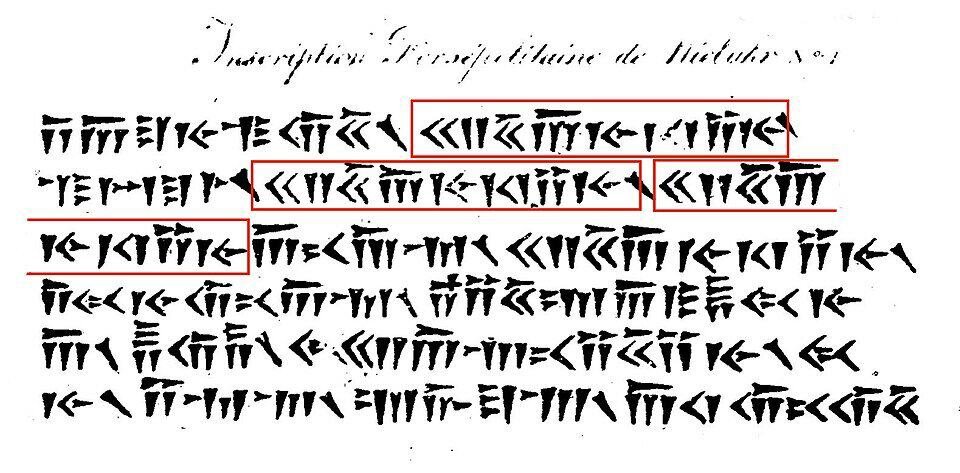
Image credit: M.S. Saint-Martin / public domain
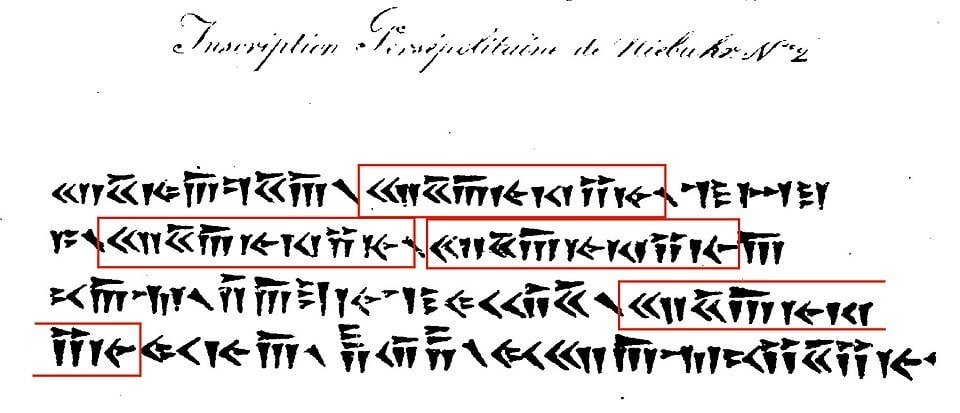
Image credit: M.S. Saint-Martin / public domain
From Rask to Burnouf and Lassen: Building on Grotefend
Rasmus Christian Rask, a Danish professor of Oriental studies and a linguist who perfected 25 languages and dialects, continued his work and studied approximately as many. Rask discovered plural suffixes in Persian.
Eugene Burnouf, a French Orientalist and professor of Sanskrit who introduced Europe to the religion and the ancient Iranian language of the Avesta, contributed significantly to the mosaic arrangement. Thanks to his research on the liturgical text of Yasna of the Avesta and the study of the list of Persian geographical names found in Naksh-i-Rustam, he revealed all the signs of the Persian alphabet almost at the same time.
At the same time as Burnouf, the eminent Norwegian Sanskrit expert Christian Lassen discovered that by strictly adhering to Grotefend’s system, some words would be almost completely without vowels, making them impossible to pronounce. This led Lassen to discover that the Old Persian characters were not entirely alphabetical (e.g., “b”), but that they were at least partially syllabic (e.g., “bu”). Lassen and Burnouf were lifelong friends and frequent correspondents who had even co-authored an early study of Pali in 1826, and the close exchange between Bonn and Paris turned what had been the work of isolated individuals into a genuinely European collaborative effort.
During the thirty years of deciphering the letter, from Grotefend’s first essay published in 1802 to the publication of Lassen’s book in 1836, there were more skeptics than those who believed in the results of the decipherment. Once again, there was a need for the researcher with an alternative point of view to conclude the case of deciphering the cuneiform. When the results of Lassen’s research were published, Sir Henry Rawlinson tackled the problem.
Henry Rawlinson and the Behistun Inscription
Sir Henry Rawlinson, at a very young age, went into the service of the East India Company in India. There he learned several Indian spoken languages, and he also knew Persian. In 1833, he went to Persia, where he worked on the reorganization of the Persian army. During a military exercise, he was near some old Persian records in Hamadan (Ecbatana). He was drawn to the unusual text he transcribed and later deciphered. It is not known when he came to know about Grotefend’s work, but it is undeniable that he worked independently for some time. His method was remarkably similar to Grotefend’s. He transcribed two trilingual records and immediately realized that he had three languages in front of him. In 1839, he said the following about his method:
“When I compared and wrote these two texts (or rather Persian paragraphs), I found that the signs, except in some places, matched perfectly. The only reasonable conclusion that would explain the pop-up and mismatch of individual parts is that they represent personal names. I have noticed that only three such groups of characters appear in the first two texts. The characters that appear elsewhere in one script coincide with the characters that appear first in another script. This leads to the conclusion that they bring the name of the father of the king, who is celebrated here. This serves not only to connect these two texts but, if we accept that they are proper names, signifies a genealogical sequence. The conclusion that naturally follows is that having obtained these three names, I have obtained the names of three successive generations of the Persian monarchy. So it coincided that the three names Hystaspes, Darius, and Xerxes, which I randomly first tried to assign to these three groups of characters, corresponded perfectly, and were the correct choice. (Henry Rawlinson, Memoirs)”
Henry Rawlinson next engagement was to transcribe a large inscription on a rock near Behistun, near the present-day Iranian city of Kermanshah. He first saw the Behistun rock in 1835, but as the record itself was some 100 meters above the ground and almost inaccessible, he studied it with binoculars. The central place on the Behistun rock is occupied by a relief depicting the king in supremacy over his captives. A trilingual text, 15 meters high and 25 meters wide, is carved around the relief.
Attracted by the inscription on the rock, he focused on discovering its meaning, regardless of the difficulties and dangers associated with the climb…
“Although the French Commission for Antiquities in Persia declared a few years ago that it was impossible to copy the Behistun inscription, I would not say that the ascent to the place where the inscription appears is a glorious thing. When I lived in Kermanshah fifteen years ago and was more active than I am today, I often climbed a rock three or four times a day without the help of a rope or ladder, with no help, with nothing. During my later visits, however, I used ropes to ascend and descend. (Henry Rawlinson, Archaeologia, 1853)”
The Behistun rock, containing a record of Persian history, as later discovered, is, for cuneiform, like the Rosette Plate for hieroglyphs because its decipherment was an important key to uncovering cuneiform.
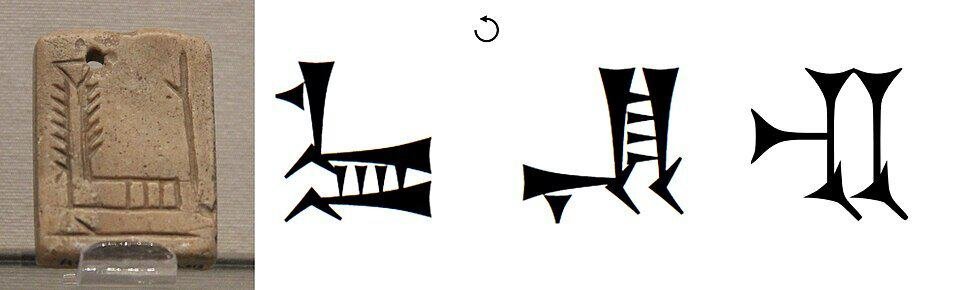
Image credit: Gary Todd / CC0 1.0 Universal Public Domain Dedication
Deciphering Elamite and Babylonian Cuneiform
In 1838, Henry Rawlinson sent a translation of the first two paragraphs of the Persian text to the Royal Asiatic Society in London, citing Darius’ name, title, and genealogy. It was quite a tedious job because it came about without knowing the old languages that were known to previous European researchers. The translation caused a real sensation in London. Many hurried to send him copies of everything published on the subject in Europe. The works of Burnouf, Niebuhr, and others came into his hands. Thanks to this help, rapid progress followed, so in the winter of 1838/1839, his alphabet of the Old Persian language was almost complete. In 1839, his work was written and ready for publication, but he waited and hoped to shed light on the ambiguities, revising character by character with infinite patience. He planned to publish his work in the spring of 1840, but was transferred to Afghanistan by the sudden work of a political agent. He returned to research in 1843 after returning to Baghdad. There, he received Westergaard’s corrections of the translation of the Persepolis record and then went to Behistun to correct his own copies of the text. Finally, after many delays and indecisions, in 1846, he published his work on Old Persian records in which, for the first time, he gave an almost complete translation of the Persian text from the Behistun rock. Thus, a mysterious script emerged from the darkness for a long time and brought us a piece of history:
“I am the great king Darius, the king of kings, the king of Persia, the king of the lands, the son of Hystaspes, the grandson of Arsham, the Achaemenid.
King Darius says: My father is Hystaspes [Vištâspa]; the father of Hystaspes was Arsames [Aršâma]; the father of Arsames was Ariaramnes [Ariyâramna]; the father of Ariaramnes was Teispes [Cišpiš]; the father of Teispes was Achaemenes [Haxâmaniš].
King Darius says: That is why we are called Achaemenids; from antiquity, we have been noble; from antiquity, our dynasty has been royal. King Darius says: Eight of my dynasty were kings before me; I am the ninth. Nine in succession, we have been kings.
King Darius says: These are the lands that have belonged to me; by the grace of Ahuramazda I became their king: Persia, Susa, Babylon, Assyria, Arabia, Egypt, (countries) at sea, Sparda, Ionia, Media, Armenia, Cappadocia, Parthia, Drangiana, Aria, Korazmia, Bactria, Sogdiana, Ga (n) Dara, Scythia, Satagidia, Arachosia, Maca; twenty-three lands in all.”
So says Darius I the Great, and describes the history of his reign, citing all the rebellions he quelled in a year, and the reason for placing that inscription: testimony and admonition. Namely, in ancient times, this Behistun inscription was located on the caravan road that led from Ecbatana, the capital of ancient Media, to Babylon — part of the vast network of overland trade routes that would, centuries later, evolve into the Silk Road traveled by Marco Polo.
Henry Rawlinson, who in his thirties deciphered the text from the Behistun rock, achieved lasting fame in oriental research. The fact that Grotefend and Henry Rawlinson, two researchers of quite different types and educations, came to the same results, confirmed in the eyes of the public the truth of the decipherment of that letter.
Work on deciphering the Old Persian text was practically completed. However, in 1846, the work of the Rev. Edward Hincks appeared at the Royal Academy of Ireland, whose shrewd critique of Lassen’s work and his original contribution to the definitive determination of syllabic values can be seen as closing the case of deciphering the Persian cuneiform. The other two texts were translations of the first. Niels Ludvig Westergaard and Edwin Norris worked on the text written in Elamite, the language of the city of Susa. By comparing the texts, they concluded that this language is also partly phonetic and partly syllabic. It comprises 96 syllables, 16 alphabetic characters, and 5 determinatives. The text itself is quite readable, although some parts are still unclear.
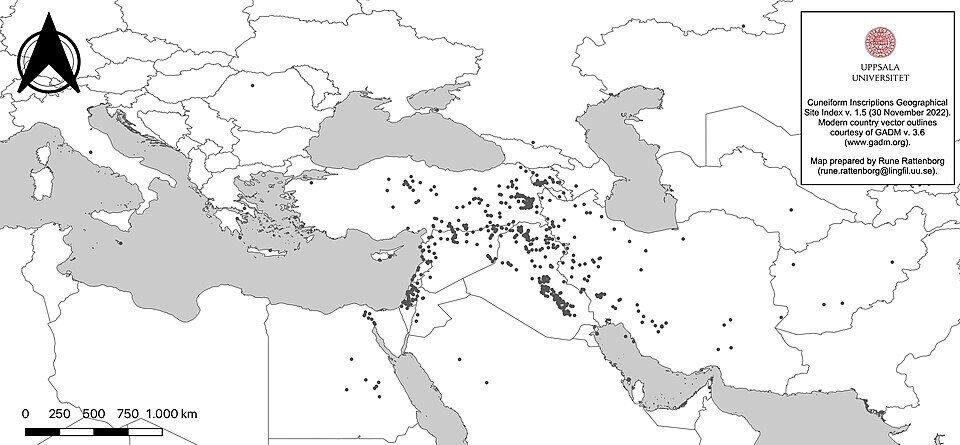
Image credit: Cuneiform Inscriptions Geographical Site Index / CC BY-SA 4.0 (via Wikimedia Commons)
The Legacy of Cuneiform Decipherment
The third version is written in the Babylonian language. Isidore Löwenstern contributed to its decipherment by discovering the signs for the words great king and the suffix for the plural of nouns. The Babylonian language was finally deciphered by the joint effort of Orientalists Jules Oppert and Edward Hincks, archaeologists Louis-Félicien de Saulcy, and Henry Rawlinson. The relief in this case was the similarity of the Babylonian language with many well-known Semitic languages. The final, public confirmation came in 1857, when the Royal Asiatic Society in London staged a remarkable test: it asked Henry Rawlinson, Hincks, Oppert, and the gifted amateur William Henry Fox Talbot to translate, separately and in sealed envelopes, a newly discovered Assyrian inscription. When the four versions were opened and compared, they agreed in all essentials, settling any remaining doubts that the Mesopotamian script had at last been read. Thanks to the selfless work of many people in various parts of the world, the cuneiform script has been deciphered, thus opening the door to part of our history. In this way, we are provided with new learning, but more importantly, this venture is just one of many examples that show that victory is not reserved only for experts, but that overcoming the boundaries of knowledge and overcoming problems can contribute to every man of heart and mind.
References:
- Cuneiform: Irving Finkel & Jonathan Taylor bring ancient inscriptions to life. The British Museum. June 4, 2014.
- Adkins, Lesley, Empires of the Plain: Henry Rawlinson and the Lost Languages of Babylon, New York, St. Martin’s Press (2003)
- Cammarosano, M. (2017–2018) “Cuneiform Writing Techniques”, cuneiform.neocities.org (with further bibliography)
- Dahl, J. L., “The early development of the cuneiform writing system, and its regional adaptation”, in National Museum of World Writing Academic Series, National Museum of World Writing
- Torrance, Nancy (2009). The Cambridge Handbook of Literacy. Cambridge University Press.
- “The origins of writing”. The British Museum. Archived from the original
- For the original inscription: Rawlinson, H. C. Cuneiform inscriptions of Western Asia

