

Cover image: The blue ice covering Lake Fryxell, in the Transantarctic Mountains, comes from glacial meltwater from the Canada Glacier and other smaller glaciers – Antarctic Photo Library, National Science Foundation / public domain
Table of Contents
Put Arctic vs Antarctic side by side and the difference that jumps out first is simple: the Arctic is an ocean ringed by land, and Antarctica is land ringed by ocean. Almost everything else follows from that one geographic accident — the temperatures, the wildlife, the fact that four million people live at one pole and nobody permanently lives at the other.
So the Arctic isn’t a continent. It’s a region, defined by a line of latitude. Antarctica is a continent, and a big one.
Ocean vs continent: the difference between Arctic and Antarctic geography
The Arctic sits at the North Pole, Antarctica at the South. The North Pole is roughly 700 km from the nearest land, which is the northern tip of Greenland. The South Pole is about 1,300 km (800 miles) from the nearest open water. But the real gap between them is vertical. The North Pole is floating sea ice, basically at sea level. The South Pole sits at 2,835 meters — higher than most European ski resorts.
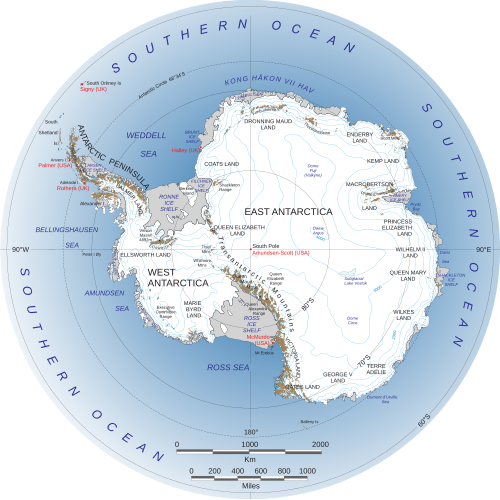
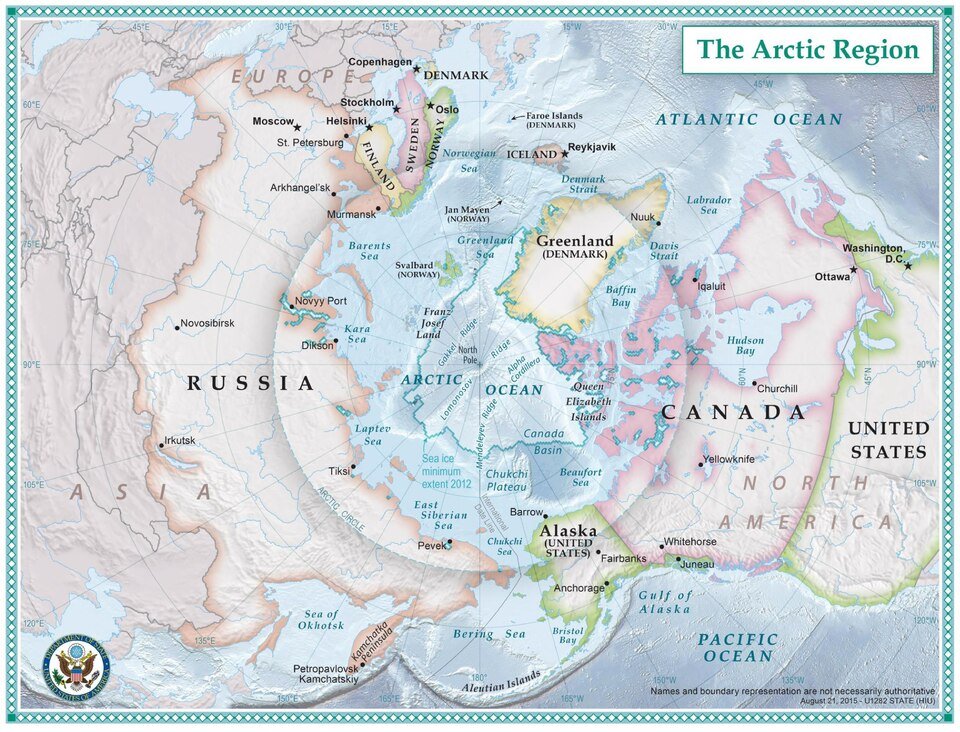
Image credit: Left – Landsat Image Mosaic of Antarctica team, Right U.S. State Department / public domain
The calendars run backwards from each other, too. On June 21, the North Pole is in the middle of its summer and the sun doesn’t set. That same day at the South Pole is midwinter, with 24 hours of darkness. Flip it on December 21 and you get the reverse.
Underneath the North Pole, the Arctic Ocean runs about 4,261 meters deep. The ice on top is in constant motion, drifting with wind and current — sometimes barely creeping along, sometimes moving about as fast as a person walking.
The pole that has to be moved every year
At the South Pole, there’s roughly 2,700 meters of ice sitting on bedrock that’s near sea level. All that weight actually presses the rock down into the Earth’s crust. And because the ice sheet slides about ten meters a year, the marker for the true geographic pole has to be dug up and repositioned every January 1. The ceremonial pole — that mirrored silver ball surrounded by the flags of the Antarctic Treaty nations, the one everybody photographs — stays put. It’s a photo op, not a survey marker.
Both poles get roughly five months of daylight, a month of twilight, five months of night, and another month of twilight. At the North Pole the sun stays above the horizon from the spring equinox to the fall equinox, then drops below it for the rest of the year. At the South Pole, it’s the opposite.
Water and land: ice, rivers, and bare rock
The Arctic landscape is genuinely varied — plains, mountains, rivers, lakes, hills, tundra, the ragged northern edge of the taiga. The sea itself is mostly frozen, hemmed in by the surrounding continents.
Why Arctic sea ice isn’t what the textbooks describe
The ice on that sea is thinner than it used to be, and this is one place where the old numbers really do mislead. Older sources describe a pack three to four meters thick that survives for years. That Arctic is mostly gone. Average winter Arctic sea ice now runs closer to a meter and a half or two meters, and the multiyear ice — the thick, hard stuff that makes it through summer after summer — has shrunk to a small fraction of the pack.
Greenland has the largest ice cap in the Arctic and the second largest on Earth after Antarctica’s, which is why what happens to it matters for sea level rise everywhere else. Permanent ice isn’t unique to Greenland up there, though. Svalbard, the Canadian Arctic islands, and Novaya Zemlya all carry ice caps of their own.
The continent under two percent bare rock
Antarctica is a different world. Roughly 98 percent of it is buried under ice, leaving only about two percent of bare rock exposed — and depending on how strictly you define “ice-free,” some estimates put that figure well under one percent. The landscape is glaciers, ice sheets, and icebergs. There are no major rivers, and none that flow year-round. The lakes are small and mostly frozen solid. Vegetation is nearly nonexistent: no pastures, no shrubs, no trees. There’s a bit of tundra on the Antarctic Peninsula and on the sub-Antarctic islands, but nothing remotely like the vast Arctic expanses.
Every winter the sea around Antarctica freezes over, and the frozen area roughly doubles the continent’s footprint. Come summer, that ice breaks up and drifts north to melt, so most of it only lasts a season. Enormous slabs calve off the ice shelves and float away — some of them covering hundreds of square kilometers.
Arctic vs Antarctic climate: why the south is far colder
Both polar regions run on the same basic schedule: long, brutal winters and short, cold summers, with spring and fall squeezed into a few weeks. But the Arctic is the warmer of the two, and there are two main reasons why.
First, the ocean. Seawater doesn’t drop below about -1.8°C before it freezes, so even under a lid of ice, that water acts as a giant radiator keeping the whole region relatively mild. Antarctica doesn’t have anything like that under its interior — just rock and a couple of kilometers of ice.
Second, altitude. Antarctica averages around 2,300 meters above sea level, which makes it far and away the highest continent, roughly twice the average elevation of Asia. Air cools as you climb (about 0.65°C per 100 meters on average), so being a continent-sized plateau costs Antarctica a lot of degrees.
There’s a third factor worth mentioning: circulation. The circumpolar westerlies and the Southern Ocean current wrap all the way around Antarctica and effectively seal it off, keeping warmer air and water at arm’s length. The Arctic has no such wall. Weather flows freely between the Arctic and the mid-latitudes, in both directions, which is also why a disrupted polar vortex can dump Arctic air on Chicago in January.
The coldest temperature on Earth
The numbers back all this up. In January, the North Pole typically sits between -25°C and -43°C. Midwinter at the South Pole runs -55°C to -62°C. The coldest temperature on Earth ever reliably recorded was -89.2°C, measured at Russia’s Vostok Station in Antarctica on July 21, 1983. Satellites have since detected surface ice temperatures near -98°C on the East Antarctic plateau, but that’s a reading of the ice itself, not an official air temperature record.
Record highs, and the numbers people get wrong
One clarification on the warm end, because this is where a lot of articles go sideways. The highest temperature recorded at the North Pole is around +5°C, and at the South Pole around -13.5°C. Those are point measurements at the poles themselves, though — not the regions. The Arctic as a whole gets far hotter. The World Meteorological Organization recognized 38°C at Verkhoyansk, Siberia, on June 20, 2020. The Antarctic mainland record is 18.3°C, set at Argentina’s Esperanza Base on February 6, 2020.
Living through the long polar night
Cold is the obvious problem at the poles. It’s not the one that gets people, though.
The thing that wears down winter crews is the darkness, plus the isolation that comes with it. From roughly February to October, no aircraft flies in or out of the South Pole station — it’s too cold for fuel and hydraulics to behave, and a rescue simply isn’t an option. Whoever is there in March is still there in September. That’s it.
Researchers have been documenting the effects for decades. There’s a loose cluster of symptoms that shows up so reliably it has a name, “winter-over syndrome”: trouble sleeping, irritability, difficulty concentrating, mild depression, and a spacey, unfocused state that people at the stations call “the long-eye” or “toast.” Some of it is behavioral. Some of it seems to be physiological — long stays in extreme cold shift how the body handles thyroid hormones, an effect known as polar T3 syndrome.
Modern stations fight back with bright light therapy, structured routines, movie nights, gyms, and a lot of deliberately scheduled socializing. Midwinter dinner on June 21 is a genuine tradition across the continent, with stations swapping greetings. The first people to go through an Antarctic winter had none of that, and it showed. More on them shortly.
Arctic vs Antarctic wildlife: land animals versus sea animals
The Arctic has a real, functioning land ecosystem: reindeer, muskoxen, lemmings, Arctic hares, snowy owls, Arctic ground squirrels, Arctic foxes, polar bears. Because the Arctic is stitched onto the landmasses of Europe, Asia, and North America, a lot of these animals migrate south in winter and come back in summer. That escape route doesn’t exist at the other pole. The seas are busy too — walruses, seals, narwhals, whales.
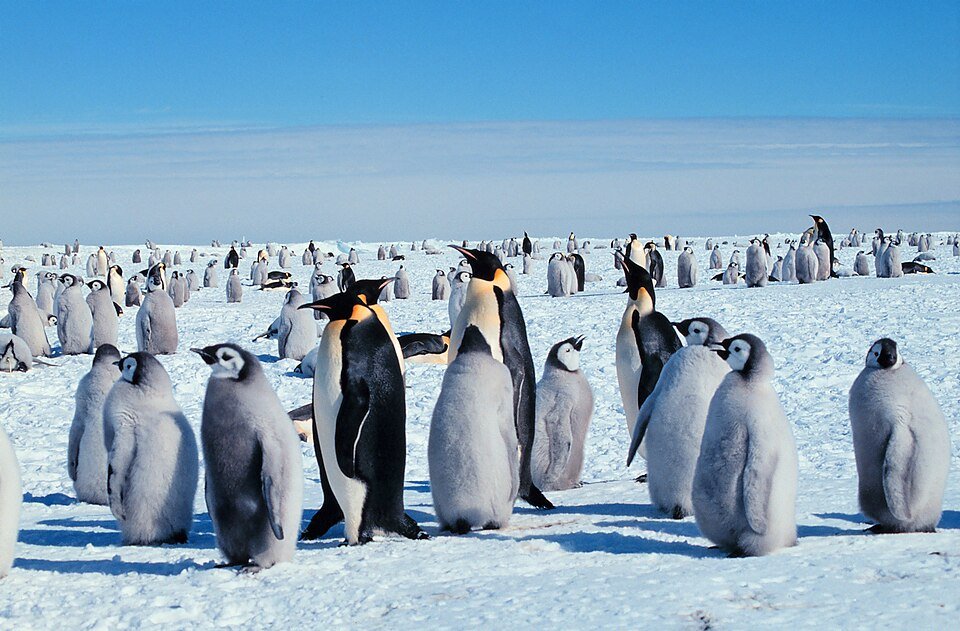
Image credit: Michael Van Woert, NOAA NESDIS, ORA / public domain
Antarctica’s animals live in the water or right at its edge. Several penguin species, several seal species, and a lot of seabirds. The standout is the crabeater seal, which despite the name eats krill, not crabs. There are somewhere in the neighborhood of ten to fifteen million of them, which makes the crabeater the most abundant large mammal on the planet after humans.
Krill: the engine of the Southern Ocean
The whole Southern Ocean food web basically runs on krill — small shrimp-like crustaceans that swarm in numbers hard to picture. Penguins eat them, seals eat them, and baleen whales strain them out of the water by the ton. No krill, no ecosystem. That’s why krill fishing quotas get argued over so intensely.
Plants, mosses, and life inside rock
Arctic plant life is surprisingly rich, and most of it grows in the tundra — a treeless belt covering roughly 11.5 million square kilometers, sitting on permafrost. You’ll find low shrubs, sedges, grasses, mosses, liverworts, a whole range of alpine flowers, and lichens. All told, about 1,700 plant species.
Growth is slow, though, and that’s the part people underestimate. A lichen patch the size of your palm can be a century old. Tire tracks left on the tundra in the 1950s are still visible today. There’s just not enough warmth or season length for anything to bounce back quickly.
Antarctica is far more austere, and the Arctic vs Antarctic gap in plant life is probably the widest gap in this whole comparison. With so little ice-free ground, only the toughest species get a foothold, and they cling to exposed rock. There are exactly two native flowering plants: Antarctic hair grass (Deschampsia antarctica) and Antarctic pearlwort (Colobanthus quitensis). Beyond those two, there are around 100 species of moss, about 25 species of liverwort, and several hundred lichens.
And then there’s the genuinely weird stuff. At the harshest sites, algae and lichens live inside the rock, colonizing tiny pores just under the surface where the mineral grains buy them a few degrees of warmth and some shelter from the wind. Biologists call them endolithic communities, and they’re one of the standard reference points when people argue about what life on Mars might look like.
People: four million in the north, nobody at home in the south
This is where the two poles part ways completely, and it’s the sharpest Arctic vs Antarctic difference of all.
Indigenous peoples have lived around the Arctic for thousands of years: Inuit, Chukchi, Sami, Yupik, Iñupiat, and many others. Some are hunters and fishers; some, like Sami reindeer herders, built entire economies around Arctic animals. About four million people live in the Arctic today, including in real cities with apartment blocks and bus routes. Murmansk, the largest, has roughly 265,000 residents, though it’s been shrinking steadily for decades — at the end of the Soviet period it was well over 400,000.
Who first saw Antarctica, and who first landed
Antarctica has never had a native population. Nobody even saw the continent until 1820, though James Cook’s voyages came close nearly fifty years earlier — he crossed the Antarctic Circle in January 1773 and pushed to 71°10′ S the following year, close enough to be certain something was down there.
When the sighting finally happened, it happened three times in a few months: Bellingshausen and Lazarev (January 28), Edward Bransfield (January 30), and the American sealer Nathaniel Palmer that November. The first claimed landing came a year later: Captain John Davis of the sealer Cecilia, at Hughes Bay on February 7, 1821. Historians still argue about that one, since his logbook is ambiguous about whether Davis himself went ashore or just sent a boat crew. The first undisputed landing didn’t happen for another 74 years, at Cape Adare in January 1895.
The first winters
The first people to survive an Antarctic winter did it by accident. The Belgica, under Adrien de Gerlache, got locked into the pack ice in March 1898 and had no choice but to sit through the polar night. It went badly — scurvy, depression, one crewman who reportedly announced he was walking home to Belgium. The ship’s American doctor, Frederick Cook, insisted everyone eat raw seal and penguin meat, which nobody enjoyed but which happened to supply the vitamin C they were missing. The first deliberate wintering on land came the following year, when Carsten Borchgrevink’s Southern Cross expedition built a prefabricated hut at Cape Adare.
Today Antarctica is all research stations, where specialists rotate through for a season or two. The largest is the American base McMurdo, with about 1,000 people in summer and around 250 who stay through the winter. Across the whole continent, roughly 4,000 to 5,000 people work there in summer, and only about a quarter of them stay on.
Babies born in Antarctica
There’s one widespread claim that needs correcting: people have been born in Antarctica. Emilio Marcos Palma arrived at Argentina’s Esperanza Base on January 7, 1978, flown in late in his mother’s pregnancy as a deliberate move in Argentina’s territorial claim. Chile responded by sending a married couple to its own base. Around eleven children have been born on the continent — eight at Esperanza, three at Chile’s Presidente Eduardo Frei Montalva base. Esperanza even has families and a school. None of it establishes sovereignty, since the Antarctic Treaty freezes all claims. But the babies are real.
Tourism today
Tourism has exploded, and the old figure of 40,000 visitors a year is badly out of date. The International Association of Antarctica Tour Operators counted 122,072 visitors in the 2023–24 season and estimated about 107,270 for 2024–25. Most of it is concentrated on the Antarctic Peninsula, under strict rules: only one ship at a landing site at a time, no more than 100 people ashore at once, and ships carrying more than 500 passengers can’t land anyone at all.
Where the names come from
A quick word on the names, since they explain more than you’d think. “Arctic” comes from the Greek arktikos, from arktos, meaning bear — a reference to the constellations Ursa Major and Ursa Minor, which wheel around the northern sky. “Antarctic” comes from antarktikos: opposite the bear, opposite the north. The Greeks named the south pole by reasoning that a symmetrical Earth ought to have one, centuries before anybody laid eyes on it.
The race to the South Pole: Amundsen and Scott
The most famous thing that ever happened in Antarctica took place over about a month in the summer of 1911–12.
Roald Amundsen’s South Pole expedition set up its base, Framheim, at the Bay of Whales — an inlet in the Ross Ice Shelf that no longer exists, since it calved away in the 1980s. Amundsen was a professional, and he planned like one: skis, sled dogs, depots laid in advance, and a route nobody had tried. He and four companions reached the South Pole on December 14, 1911, spent a few days confirming their position, left a tent and a letter, and skied home without losing a man.
Robert Falcon Scott’s British party got there on January 17, 1912, and found the Norwegian tent waiting for them. Scott’s diary entry from that day is one of the bleakest things in exploration literature. His group had hauled their own sledges for much of the trip, ran short of food and fuel on the way back, and all five died on the ice. A search party found the tent with three bodies and Scott’s journals in November 1912.
The two expeditions get compared endlessly, usually as a story about preparation versus improvisation, and there’s something to that. Amundsen used dogs; Scott’s mix of ponies, motor sledges, and man-hauling failed him in different ways. Weather played a part too. But the comparison holds up mostly because Amundsen treated the trip as a logistics problem, and Scott treated it as an expedition with a scientific program attached.
Who owns Antarctica
Short answer: nobody, and that’s on purpose.
Seven countries have formal territorial claims — Argentina, Australia, Chile, France, New Zealand, Norway, and the United Kingdom — and some of those overlap. A wedge called Marie Byrd Land is claimed by no one at all, which makes it the largest unclaimed territory on Earth. The United States and Russia don’t claim anything, but both have reserved the right to.
The Antarctic Treaty was signed in Washington on December 1, 1959, by twelve countries, and came into force on June 23, 1961. It says the continent is for peaceful purposes only, guarantees freedom of scientific research, bans military activity and nuclear testing, and — the clever part — Article IV freezes every existing claim in place. Nothing anyone does while the treaty is running counts for or against a claim. That’s why Emilio Palma’s birth was politically pointless, even though it made headlines.
The treaty has held up remarkably well, which is unusual for anything signed in 1959 by both Cold War superpowers. Membership has grown to around 58 countries. And in 1991 the parties added the Protocol on Environmental Protection, usually called the Madrid Protocol, which came into force in 1998 and bans mineral resource activity outright. Mining is off the table. The earliest anyone can formally push to reopen the question is 2048, and even then it would take a large majority to change anything.
Keep that in mind for the last section of this article, because the Arctic vs Antarctic contrast on this point could not be sharper.
What the ice remembers: 1.2 million years of trapped air
Here’s the part of Antarctica that justifies the whole expensive apparatus of stations and flights and winter crews.
When snow falls on the plateau, it doesn’t melt. It gets buried, compressed, and eventually turns to ice — and as it does, it traps tiny bubbles of the air that was there when it fell. Drill down far enough and you’re pulling up direct samples of ancient atmosphere. Not a proxy, not a model. The actual air.
The old EPICA core from Dome C gave scientists a continuous record going back about 800,000 years. Then, in January 2025, the Beyond EPICA project drilled through 2,800 meters at a site called Little Dome C, about 35 km from the French-Italian Concordia Station, and hit bedrock. The core they brought up covers at least 1.2 million years. The team worked four Antarctic summers at 3,200 meters, in average summer temperatures around -35°C, to get it.
The compression down there is hard to wrap your head around. In the deepest usable stretch, roughly 13,000 years of climate history are squeezed into a single meter of ice. The cores were shipped back to Europe aboard the icebreaker Laura Bassi, kept at -50°C the entire way, which was its own logistical headache.
What scientists want from it is an answer to a specific puzzle: about a million years ago, Earth’s ice age cycles switched from roughly 41,000-year rhythms to roughly 100,000-year ones, and nobody is sure why. The air trapped in that ice should say something about the role carbon dioxide played. Greenland cores do similar work in the north, though they only go back around 130,000 years, since the ice sheet there is younger and messier.
Both poles are changing, and not in the same way
The Arctic is warming somewhere around three to four times faster than the global average — a finding from a 2022 study that surprised even people who follow this closely. Arctic sea ice has been shrinking in all four seasons, and the last several winters have produced the weakest ice buildups in the satellite record, with 2025 and 2026 essentially tied for the lowest winter maximum ever measured.
Antarctica was the confusing one for a long time. Sea ice there actually crept upward slightly through about 2014, which climate skeptics cited constantly. Then it fell off a cliff. February 2023 brought the lowest Antarctic sea ice extent in the satellite record, and the years since haven’t recovered. In February 2025, the combined sea ice at both poles hit an all-time global minimum.
Why the reversal happened is still being worked out. Southern Ocean circulation, wind patterns, warmer water reaching the ice shelves from below, and shifts in tropical drivers like El Niño are all in the mix. The honest position is that Antarctic sea ice is more variable and less understood than Arctic sea ice, and that a decade ago most projections did not see this coming.
The Arctic: a treasury under the ice
The Arctic runs from the North Pole down to the Arctic Circle at 66°34′ N, taking in roughly 21 million square kilometers of frozen sea and bare land. And unlike Antarctica, most of it falls under national jurisdiction. Canada, Norway, Denmark, the United States, and Russia all hold Arctic territory, and all of them have staked claims to portions of the seabed beyond their coasts.
In May 2008, those five countries met in Ilulissat, Greenland, and signed a declaration committing themselves to the existing legal framework — the Law of the Sea — for settling overlapping claims, rather than negotiating some new Arctic treaty. It’s the opposite approach from Antarctica, and it reflects the basic fact that people already live there.
Oil, gas, and minerals
That same year, the U.S. Geological Survey published the first comprehensive estimate of what’s actually up there. The verdict: about 13 percent of the world’s undiscovered conventional oil (roughly 90 billion barrels), 30 percent of undiscovered natural gas (about 1,670 trillion cubic feet), and 20 percent of undiscovered natural gas liquids. Around 84 percent of it lies offshore, and most of the gas sits in Russian waters.
Oil and gas aren’t the whole story, either. Coal, diamonds, uranium, phosphates, nickel, platinum, and other valuable minerals lie under Arctic ground. Morten Smelror, then director of the Geological Survey of Norway, described the Arctic as one of the last places on Earth where mineral resources remain genuinely unexplored — comparable, in that sense, to the deep ocean.
Shipping routes over the top of the world
Shipping is the other prize. As summer ice retreats, the Northern Sea Route along the Russian coast and the Northwest Passage through the Canadian Arctic become usable for longer stretches each year. A container ship going from Yokohama to Rotterdam over the top of Russia saves thousands of miles compared with the Suez route — which is itself the modern descendant of the sea route to India that Portuguese navigators opened in the 1490s. The catch is that “usable” isn’t the same as “reliable.” Ice conditions swing wildly year to year, insurance is expensive, and there’s very little search-and-rescue infrastructure if something goes wrong.
The legal fight over Arctic drilling
The politics have been churning the whole time. In December 2016, President Obama used the Outer Continental Shelf Lands Act to withdraw the Chukchi Sea and most of the Beaufort Sea from offshore leasing. In April 2017, President Trump signed an executive order attempting to undo that. A federal judge in Alaska struck the reversal down in 2019, ruling that a president can withdraw areas from leasing but can’t put them back.
That legal question never went away. As of 2026, the Interior Department is again proposing Arctic lease sales — in the Beaufort, the Chukchi, and a newly designated “High Arctic” area — and again facing lawsuits over whether it has the authority to do it. Given how fast this file moves, it’s worth checking the current status before treating any of it as settled.
Which is a fitting note to end on, really. The Arctic vs Antarctic story finishes where it started: two places that are the least populated on Earth, and that somehow generate a steady stream of legal, scientific, and political arguments anyway. One of them is frozen in place by treaty. The other is very much up for grabs.
References:
- Ainsworth, William Harrison, ed. (1847). “The Antarctic Voyage of Discovery”.
- Anderson, John B. (2010). Antarctic Marine Geology
- Day, David (2013). Antarctica: A Biography
- “Arctic”. Dictionary.com Unabridged (v 1.1). Random House
- Dodds, Klaus; Woodward, Jamie C. (2021). The Arctic: a very short introduction. Oxford: Oxford University Press
- McCannon, John. A History of the Arctic: Nature, Exploration and Exploitation. Reaktion Books and University of Chicago Press

