

Cover Image: Defense Advanced Research Projects Agency (DARPA) / public domain
Table of Contents
The Limits of Chemical Rockets and the Case for Nuclear Propulsion
Space flight stands as one of humanity’s most impressive technological achievements of the 20th century. Yet even today, the vast majority of spacecraft rely on the same fundamental propulsion technology developed seven decades ago: chemical reactions between solid or liquid fuels and oxidizers inside a rocket engine, which produce exhaust gases that exit through a nozzle and generate thrust. The specific impulse of these systems typically ranges between 300 and 450 seconds — a figure that has seen only modest improvement over the decades, primarily through the development of larger rockets, greater numbers of engines, higher propellant loads, and more energetic fuel-oxidizer combinations such as liquid hydrogen and liquid oxygen. Overcoming these limitations is precisely why nuclear thermal propulsion has attracted serious scientific attention for decades.
While chemical-powered rockets have successfully lifted cargo and people into orbit, their fundamental limitations make them inadequate for longer, more ambitious missions. The most critical indicator of rocket engine efficiency is the specific impulse (Isp), which is equivalent to the exhaust velocity of the working fluid from the nozzle. With the development of chemical-powered rocket engines, the ejection speed has approached its physical limit: using liquid hydrogen and oxygen, this ceiling stands at approximately 4,400 m/s. More exotic — and expensive — propellant combinations, such as liquid hydrogen and fluorine, can push this boundary to around 5,000 m/s. Beyond that threshold, no further increase is physically achievable through chemical energy alone.
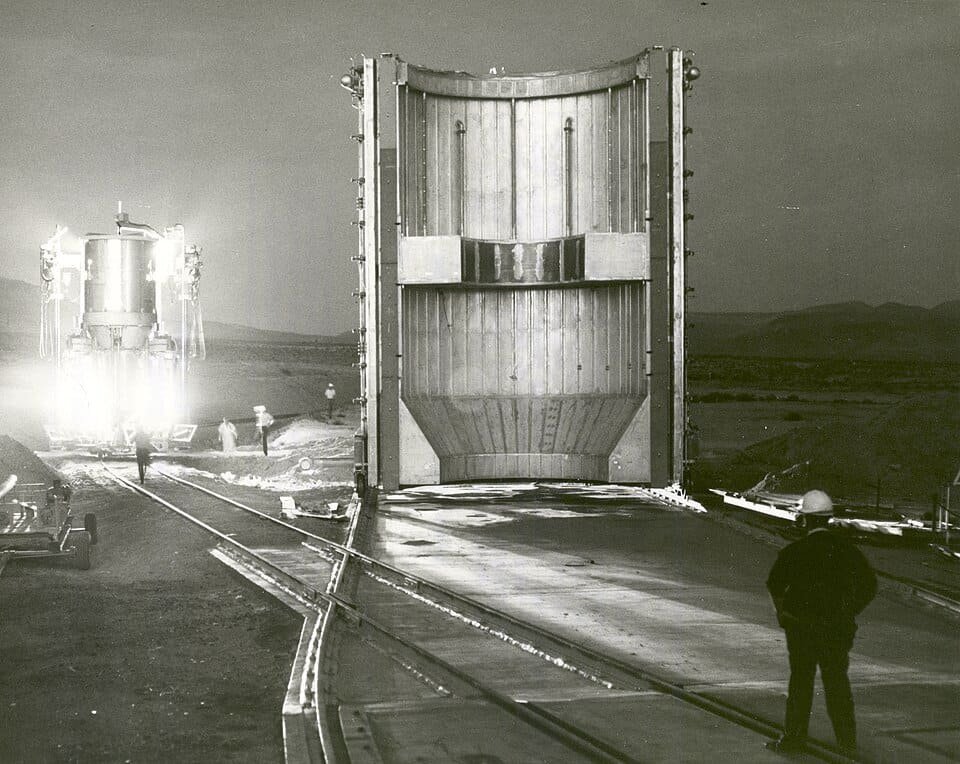
Image credit: AEC-NASA / public domain
According to the current level of scientific and technological development, higher ejection speeds can be achieved either by using a nuclear energy source carried aboard the spacecraft itself, or by transmitting energy from distant external sources — for example, high-power lasers. Of all the options currently being explored, nuclear thermal rocket engines are closest to practical realization. Real progress in interplanetary travel will only become possible through a technological leap toward such propulsion systems. In a nuclear-powered rocket, the energy released by nuclear fission replaces the energy derived from chemical combustion. The output energy from nuclear fuel is up to one hundred million times greater than that produced by an equivalent mass of chemical reactants. This extraordinary energy density means that a small amount of nuclear fuel could replace the enormous quantities of chemical propellant required by today’s rockets, making nuclear propulsion especially attractive for long-duration missions, interplanetary travel, and deep space exploration.
Two Approaches to Nuclear Rocket Propulsion
In nuclear-powered rocket designs developed so far, thrust is not obtained directly from the radiation or heat generated by the fission process itself. Instead, that radiation is converted into another form of energy within the nuclear reactor. The principle of operation is similar to existing chemical rocket engines — thermal energy is converted into the kinetic energy of the exhaust jet. The functional parts are analogous: a chamber into which pumps feed the working fluid, and a nozzle. The key difference is that in chemical engines, heat comes from combustion, whereas in nuclear engines it comes from fission occurring in a reactor located in a chamber analogous to the combustion chamber. Two distinct propulsion systems have been developed around this principle.
Nuclear Thermal Propulsion (NTR)
The first and most developed system is nuclear thermal propulsion (NTR). In this approach, heat released from nuclear fission is used to directly heat a propellant — preferably liquid hydrogen, stored at cryogenic temperatures. The hydrogen is heated to approximately 2,500°C inside the nuclear reactor and expelled in gaseous form through a nozzle, where it expands and generates thrust. This results in exhaust efficiencies and specific impulses roughly twice those achievable with the best chemical engines using a liquid hydrogen/oxygen ratio. This enables a significant reduction in the total gross mass of a rocket — approximately half that of a chemically-powered equivalent. When used as the upper stage of a launch vehicle, a nuclear thermal propulsion system can double or even triple the payload delivered to orbit.
Nuclear-Electric Propulsion (NEP)
The second system is nuclear-electric propulsion (NEP). Here, nuclear energy is converted into electricity via a thermo-emission reactor and converter. This electricity powers an electromagnetic device that accelerates ions — typically xenon gas — to very high velocities, which is why these are also known as nuclear ion engines. As the accelerated ions pass through a neutralizer in the nozzle, they produce a jet of neutral atoms that generates a small but continuous thrust over extended periods. Because of their low thrust levels, NEP systems cannot launch rockets from planetary surfaces, but they excel in space — used to change orbits, adjust altitude (especially in the lower atmosphere), maintain the precise positioning of satellites, and power interplanetary missions. Since the first launch of such a system in 1971, more than 240 spacecraft have been equipped with this type of propulsion, with a 100% success rate.
Nuclear Thermal Rocket Designs and Performance
Nuclear thermal rockets can be classified according to the phase (aggregate state) of their nuclear fuel and the reactor design — ranging from already-realized solid-core reactors to extra-complex but more efficient gas-core reactors, which are still being developed. Across all configurations, the specific impulse is proportional to the square root of the temperature at which the working fluid is heated, meaning the most efficient design is always the one that can achieve the highest possible temperature.
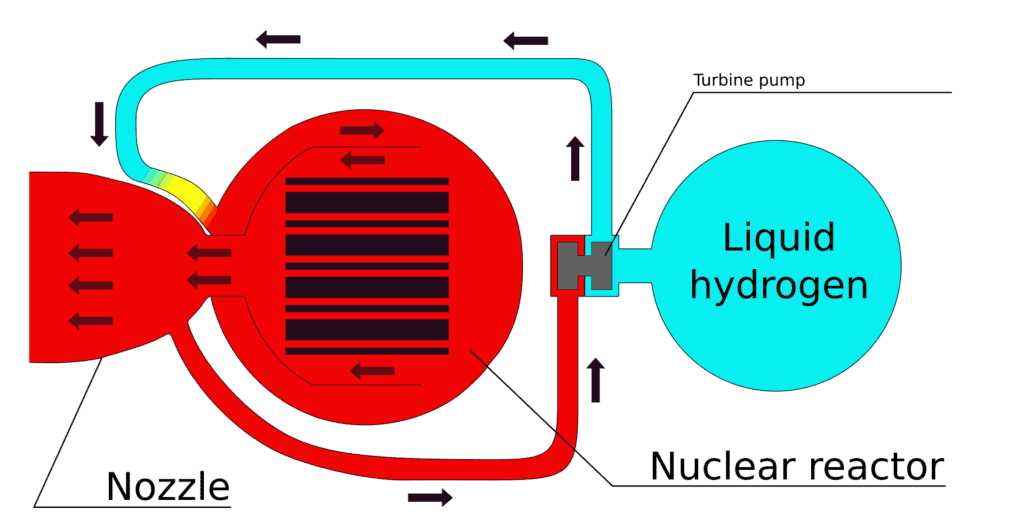
Image credit:Tokino, licensed under CC BY 3.0.
Solid-Core Reactors
The most mature and well-tested design uses a conventional, lightweight nuclear reactor with a solid core operating at high temperatures, which heats the working fluid passing through the reactor core. The core must be fabricated from materials capable of withstanding the extreme temperatures at which the nuclear reaction takes place. Most materials cannot survive these conditions, so the choice of materials is limited — and with it, the performance of the reactor. Despite this constraint, a solid-core engine using hydrogen as propellant can achieve a specific impulse in the range of 850–1,000 seconds, which is approximately twice that of the primary engine on the Space Shuttle.
Pulsating Nuclear Thermal Rockets
A notable sub-variant of the solid-core concept is the pulsating nuclear thermal rocket — not to be confused with nuclear pulse propulsion. This system achieves higher thrust and specific impulse compared to a conventional solid-core NTR. In this concept, the solid-core NTR can operate in both stationary mode (constant nominal power, as in a conventional nuclear thermal propulsion) and pulsating mode (as in TRIGA reactors). In pulsating mode, the oscillation of the nuclear core produces a neutron flux which, like kinetic energy, is directly transferred to the propellant, heating it to temperatures that can exceed that of the core itself. The resulting energy increase raises the mass flow of propellant through the nozzle, increasing the velocity of the exhaust gases and thus the thrust.
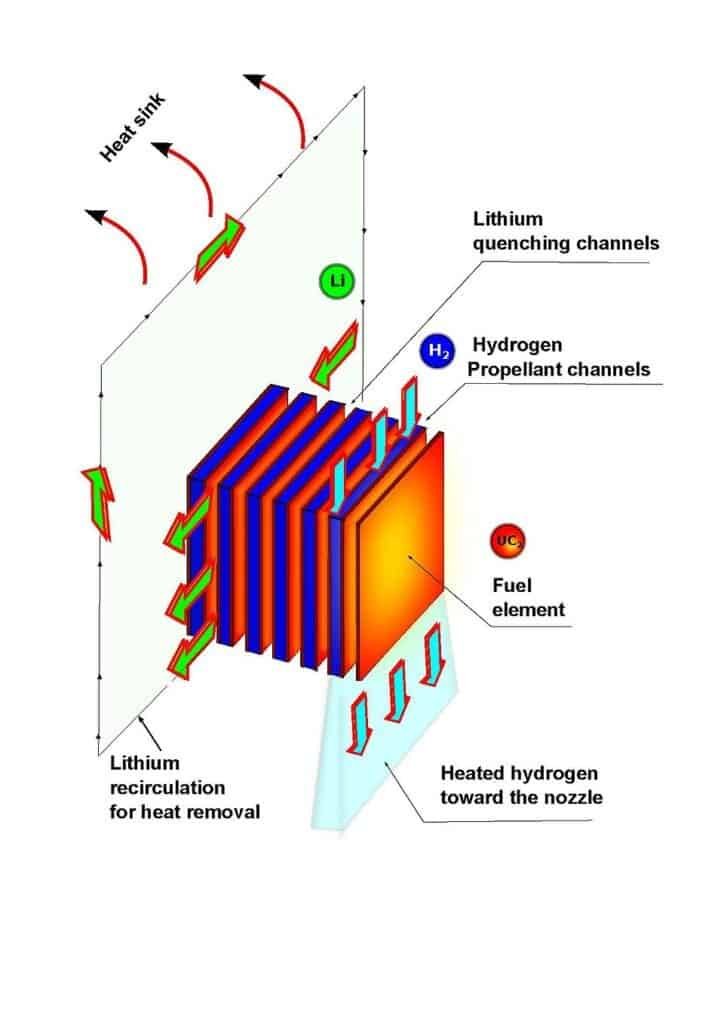
Image credit: Albapatera / CC BY-SA 4.0 (via Wikimedia Commons)
Liquid-Core Reactors
Greater performance improvement is theoretically possible by mixing nuclear fuel and working fluid (hydrogen), allowing the nuclear reaction to take place within the liquid mixture itself — this is a reactor (and engine) with a liquid core. Since the reaction time of nuclear fuel is much longer than the heating time of the working fluid in such a configuration, a method must be found to retain the propellant inside the engine while simultaneously allowing the working fluid to escape through the nozzle. Since the reactor shell (neutron reflector) is actively cooled by hydrogen, it can operate at higher temperatures than a conventional solid-core reactor. These engines are expected to achieve a specific impulse of 1,300–1,500 seconds. They have not yet been practically realized due to their complexity.
Gas-Core Reactors and the Nuclear Light Bulb
A gas-core engine is a modification of the liquid-core design that uses fast fluid circulation to create a toroidal pocket of gaseous uranium fuel surrounded by hydrogen in the middle of the reactor. In the basic configuration, the nuclear propellant does not touch the reactor wall (“open cycle”). The temperature in the reactor could rise to several tens of thousands of degrees, which would allow specific impulses of 3,000–5,000 seconds. However, it is difficult to control the loss of nuclear fuel in this open-cycle configuration.
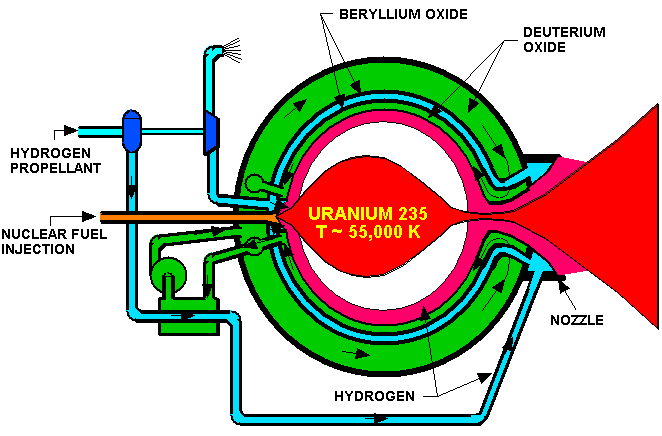
Image credit: NASA / public domain
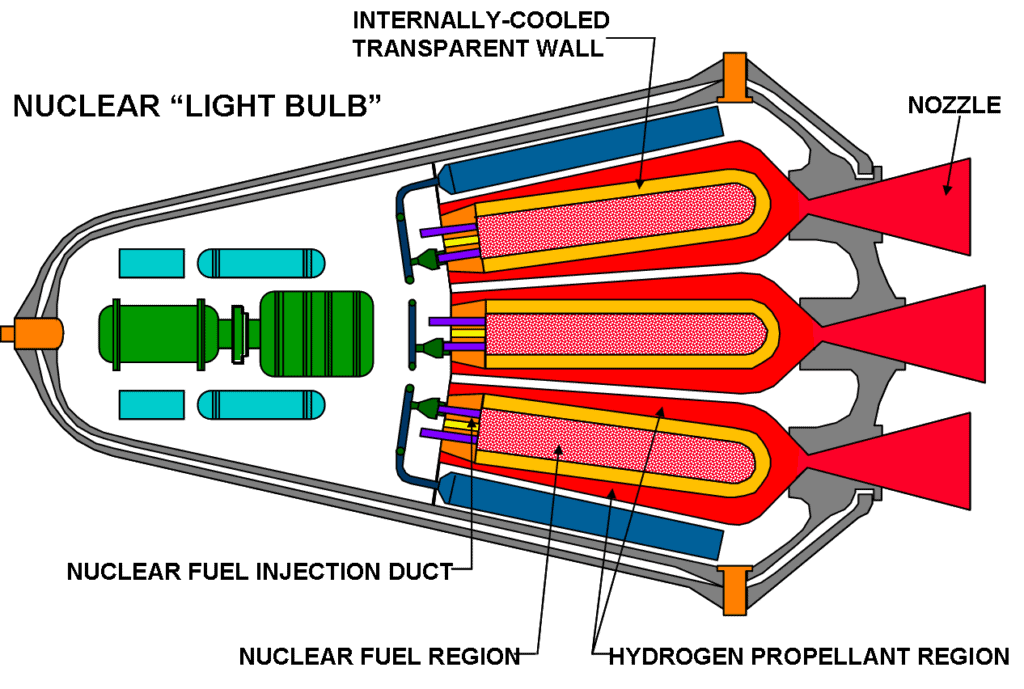
Image credit: NASA / public domain
For this reason, a “closed cycle” variant known as the Nuclear Light Bulb (NLB) engine is being studied. In this design, the gaseous nuclear propellant is retained inside a super-high-temperature quartz container, around which hydrogen flows. The limitation in closed-cycle engines is tied to the critical temperature of the quartz container — which is nonetheless higher than that of the materials used in solid-core reactors. Although less efficient than the open-cycle design, the closed-cycle configuration is expected to produce a specific impulse of approximately 1,500–2,000 seconds.
Project NERVA: The American Nuclear Rocket Program
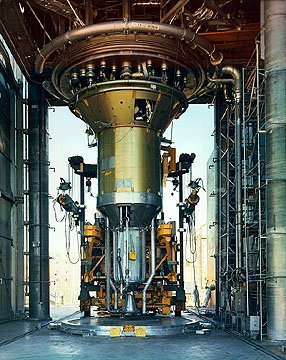
Image credit: Federal Government of the United States / public domain
With the intensive development of nuclear energy in the second half of the 20th century, projects for nuclear thermal rocket engines were ambitiously launched with the goal of achieving propulsion capable of enabling crewed interplanetary missions. In the period 1955–1972, the United States began development of nuclear rocket engines under the “Rover” project. The first experimental static nuclear engine, named “Kiwi,” was tested extensively until 1964. It featured a compact nuclear reactor using U235 carbide in a graphite housing, through which hydrogen was passed, heated to approximately 2,000°C, and then expanded in a jet directed upward. Testing was conducted at a facility in the Nevada desert.
This was followed by the larger “Phoebus” project, which produced three nuclear rocket engines of that type. The program then advanced to project NERVA — the Nuclear Engine for Rocket Vehicle Application — intended to produce a nuclear rocket stage to serve as the third stage of the Saturn V rocket. Based on the Kiwi B4 engine, the project NERVA design specified a vacuum thrust of 330 kN and an exhaust velocity of 8,100 m/s. The program was led jointly by NASA and the Atomic Energy Commission (AEC), with the engine and reactor developed by Rocketdyne and Westinghouse. The experimental “NERVA XE” engine, operated in a downward-facing configuration, completed 28 test runs totaling 118 minutes of operational time. Official assessments confirmed that a nuclear thermal engine was fully feasible and applicable as a rocket upper stage.
Building on these results, the follow-on “NERVA 1” was projected to achieve 340 kN of thrust, while “NERVA 2” was designed to reach an exhaust velocity of 8,500 m/s and a thrust of 907 to 1,140 kN — intended to propel a large third stage for the Saturn 5N rocket. This stage would have been 43 meters long, 10 meters in diameter, with a total mass of 178 tonnes (of which 144 tonnes was liquid hydrogen propellant). It was capable of delivering twice the payload to the Moon compared to the standard Saturn V. Plans included a crewed Mars mission in 1978 and the establishment of a permanent lunar settlement by 1982.
In 1972, the U.S. Congress — seeking to reduce budget spending — halted lunar missions, discontinued Saturn V production, stopped further experiments with nuclear rocket engines, and suspended the project NERVA program as well, despite the fact that $7.7 billion had already been spent on it.
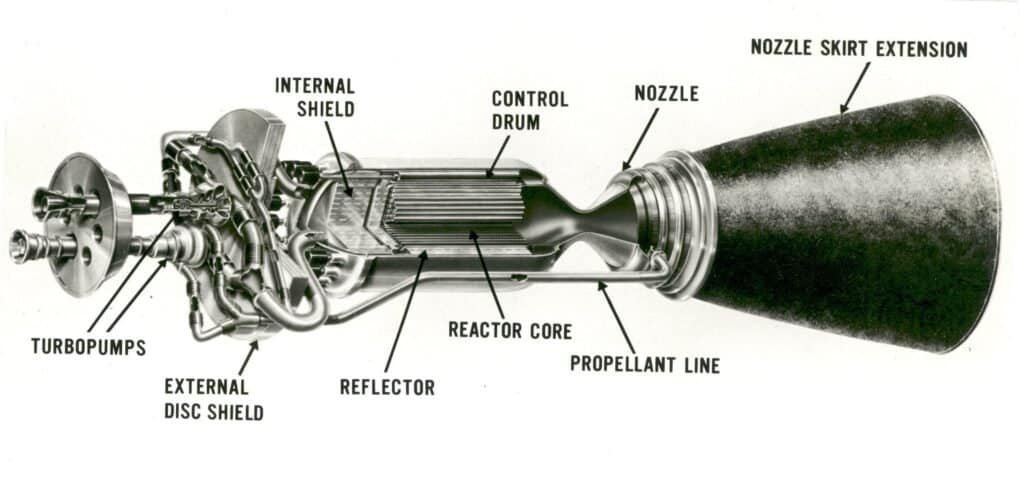
Image credit: NASA / public domain
Soviet Nuclear Rocket Engines: RD-0410 and Beyond
From the very beginning of the space era, the Soviet space program considered various projects for nuclear thermal engines. Plans were drawn up to use them for the second and third stages of the giant H1 rocket and for cosmonaut missions to the Moon and Mars. Soviet designers wanted to skip the use of liquid hydrogen and oxygen entirely and transition directly to nuclear thermal propulsion — more than twice as efficient.
In the period 1970–1988, Russian engineers constructed and tested a prototype of a smaller nuclear rocket engine designated RD-0410. Several institutes participated: the Kurchatov Institute led work on the nuclear reactor, while the rocket engine was developed by the Kosberg design bureau, which produced upper-stage rocket engines. The prototype was first tested without a nuclear reactor, with the working fluid heated by electric current. Since that part of the test was successfully completed, experimental ignition with a live nuclear reactor began in 1979 at the Semipalatinsk test site.
By applying alternative engineering solutions, the engine demonstrated better characteristics than the American counterparts in the Rover-NERVA program. The nuclear fuel was 90%-pure U235, in the form of uranium carbide combined with zirconium and niobium carbide and graphite. The fuel rods were shaped like helically twisted strips, providing 2.6 times more efficient heat transfer to the working fluid (hydrogen and hexane). The moderators were zirconium and lithium hydrides. The engine reached a temperature of 3,100 K and could operate for one hour at full power, or four hours at 2,000 K. It produced a thrust of 35 kN from a reactor rated at 196 MW, with a projected exhaust velocity in vacuum of 9,100 m/s. The engine’s total mass was 2 tonnes. A significantly larger follow-on engine, the RD-0411, was planned with a thrust of 392 kN.
The RD-0410 was scheduled for an in-space test launch in 1985, but the rocket stage it was to propel had a greater mass than the Proton rocket could carry, and the Energia rocket was not yet ready. The project was suspended in 1988. This was followed by the collapse of the USSR and the cessation of all major development programs — including the Energia rocket and the Buran shuttle — and this successful nuclear rocket engine became part of the sad history of unfulfilled cosmonautics.
Russia’s 21st-Century Nuclear Propulsion Program
In 2013, Russian state institutions announced the start of work on a new nuclear rocket propulsion system capable of enabling many times higher flight speeds through space. According to the plans that have been made public, the nuclear reactor would not directly heat the rocket propulsion fluid. Instead, it would generate electricity through a dynamic closed-cycle process — using the energy of expansion of its own working fluid (helium or xenon) through a turbine and an electric generator. The electrical output is projected to exceed 1 MW and would be used to heat the rocket propellant (hydrogen) in a thermal chamber, most likely through electrical discharge.
This separate procedure achieves better control over both the nuclear and reactive processes, though the degree of efficiency will be lower than with direct nuclear thermal rocket engines. The advantage is that it will be possible to adjust the ratio of fluid flow to heat input and thereby regulate the exhaust velocity, which could exceed 9,000 m/s. If hydrogen were atomized at temperatures above 4,500°C, an exhaust velocity of over 20 km/s could be achieved. Furthermore, the electricity generated by the nuclear reactor could power a fundamentally different drive — an ionic one — which achieves exhaust speeds of over 50 km/s.
This project opens up great possibilities for space travel: faster arrival of larger probes to distant outer planets, shorter flight times for astronauts to Mars, and more. Russia has committed $544 million to the development of this hybrid nuclear engine. The nuclear reactor is being developed by the Keldysh Research Center and the rocket engine by NPO Energiya. First launches are planned for after 2025.
Nuclear Pulse Propulsion and Project Orion
The only way that nuclear fission could be used directly to propel rockets in space is through a nuclear explosion. Nuclear pulsed propulsion — also known as external pulsed plasma propulsion — is a hypothetical method of spacecraft propulsion that would use successive explosions of a series of nuclear bombs behind the spacecraft, riding the shock waves generated by each detonation. The idea emerged in the late 1940s, and the development of nuclear weapons in the United States — through over a thousand experimental nuclear bomb detonations — led some physicist-participants in those programs to seriously consider the concept. Project Orion was created, first envisioned by Freeman Dyson and Ted Taylor in 1958.
The project had several variants. The most modest would be based on low-power fission nuclear explosions, used for travel within the solar system. The most extreme envisioned interstellar spacecraft of hundreds of thousands of tons of initial mass, propelled by thermonuclear bombs in the 1 megaton range. Due to the high radiation and enormous contamination from fission products, such spacecraft would need to be constructed in Earth orbit. The concept was tested in 1959 using conventional chemical explosives, which produced directional blasts behind a massive steel thrust plate attached to a model spacecraft together with shock absorbers.
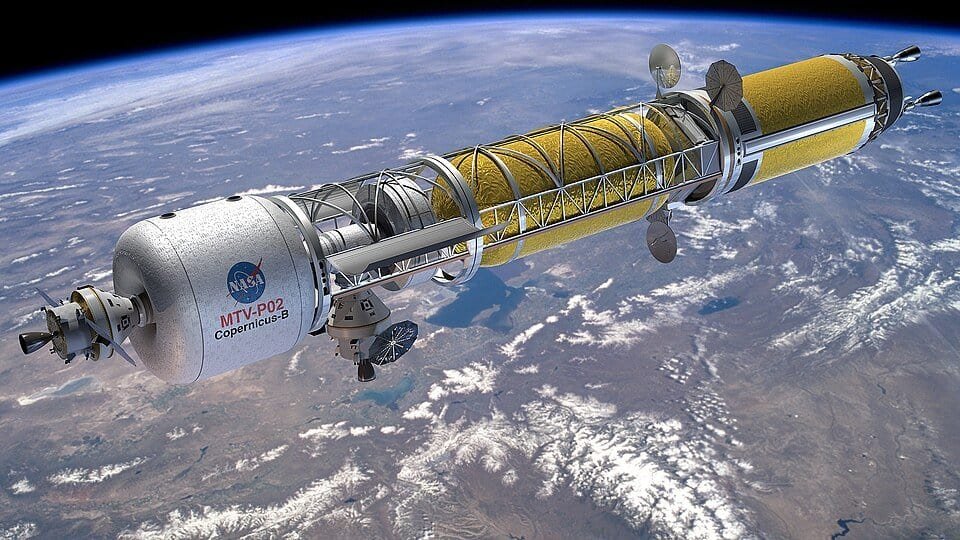
Image credit: NASA / public domain
The shock wave caused by the explosion would hit the underside of the thrust plate, giving a strong thrust that would accelerate the spacecraft with a specific impulse of approximately 6,000 seconds — about twelve times that of the Space Shuttle’s main engine. Calculations showed that, with nuclear explosions, this concept could reach a theoretical specific impulse of 100,000 seconds, and that — using materials available at the time — spacecraft of several thousand tonnes could be built. Such a vehicle could travel from Earth to Mars and back in 4 weeks, reach Saturn in 7 months (compared to the current 12 months, or 9 years for chemical-powered spacecraft). The system was considered fully operational when the project was suspended in 1965, following the signing of the Partial Test Ban Treaty (PTBT).
Even with the weakest available nuclear bombs, the impact impulse on the thrust plate — despite shock-absorption systems — would cause an acceleration of at least 10G. An explosion would release energy approximately one million times greater than that of the strongest chemical reaction, equivalent to roughly 10,000 tons of conventional explosive. Even a space probe capable of withstanding accelerations of several tens of G would need to have a mass of several thousand tonnes.
The basic idea of Orion was never entirely forgotten, and subsequent projects attempted to bring it closer to realization — for example, “Mag Orion,” in which nuclear explosions would take place within a magnetic field. The fundamental engineering problem remains how to achieve micro-scale nuclear explosions with a mass below the critical threshold. The critical mass of high-purity Pu239 is approximately 10 kg; below that mass, no spontaneous chain reaction and nuclear explosion will occur.
One proposed approach involves accelerating a tritium nucleus in a particle accelerator to impact a subcritical Pu239 target, creating enough neutrons to initiate a nuclear chain reaction. If this could be achieved with a mass at least a hundred times smaller than the critical one, a pulse drive with tolerable acceleration and sufficiently small dimensions to be economically viable could be realized. Although such a drive remains far from realization, the idea of using nuclear explosions to power spacecraft has not been abandoned.
Safety Constraints and the Future of Nuclear Space Travel
Although experts believe that nuclear-powered spacecraft are currently the best solution for long-distance interplanetary travel and deep space flights, the possibility of radioactive contamination means that such rockets must not be used for launching from Earth’s surface — only for flights outside the Earth’s atmosphere. This fundamental constraint shapes all current development: nuclear propulsion is confined to deep space operations, precisely the domain where its performance advantages are most decisive.
Because of this shortcoming, further development is moving toward nuclear rocket engines that would use fusion instead of fission to heat propellant. Fusion promises even greater energy densities and reduced radioactive byproducts, but the technology remains at an early stage. Operational fusion-powered spacecraft are not expected before 2050.
For now, nuclear fission propulsion — in its thermal, electric, and hybrid forms — remains the most credible near-to-medium-term technology for enabling the next era of human and robotic exploration: from crewed missions to Mars to the first probes capable of reaching the outer solar system within a human lifetime.
References:
- Cain, Fraser (3 July 2019). “Earth To Mars in 100 Days? The Power of Nuclear Rockets”. Universal Sci. Retrieved 24 August 2019.
- “NASA, DARPA Will Test Nuclear Engine for Future Mars Missions – NASA”
- Schreiber, R.E. (1956). LASL nuclear rocket propulsion program
- Serber, R. (5 July 1946). The Use of Atomic Power for Rockets. Douglas Aircraft Company.
- Schreiber, R. E. (1956). The LASL nuclear rocket propulsion program
- Borowski, S. K. (18–22 July 1987). Nuclear Propulsion – A Vital Technology for the Exploration of Mars and the Planets Beyond
- Bussard, Robert (1953). Nuclear Energy for Rocket Propulsion (Report). Oak Ridge National Laboratory.

