

Table of Contents
Shortly after settling in the plains of Mesopotamia, the Sumerians began to enjoy the benefits of very fertile land. A similar rise in early civilization occurred in Egypt. There, in the valley of the Nile River, on fertile riverbanks, many different peoples gathered as early as around 5000 BC. Among them were Libyans, Semites from Asia, and Nubians from the warmer parts of Africa. This mixed population settled in two separate areas: in the valley below Aswan, known as Upper Egypt, and in the region of Fayum, in Lower Egypt. These peoples remained separate until 3400 BC, when (according to legend) the king of Upper Egypt, Menes, conquered the northern kingdom. From that point on, Egypt existed as a united state under one ruler — and the Land of the Pharaohs was born.
How Did Civilization First Rise in the Land of the Pharaohs?
Around 3500 BC, Semitic tribes from the Gulf region invaded Upper Egypt. However, they quickly merged with the Egyptians. This proved to be very beneficial for Egypt since the Semites were at a higher cultural level than the indigenous people and maintained strong ties with the Sumerians. They had learned from them how to use bronze and how to make pottery. In addition, they were also familiar with cuneiform writing. This situation allowed the people of Upper Egypt to develop faster than the people of Lower Egypt, and over time, more and more Semites moved to Upper Egypt. By the time Menes occupied the land, the Egyptians and Semites had become so mixed that they used one language.
Unlike the Sumerians, the Egyptians didn’t initially build large cities. There were villages scattered across the plains with only a few large trading centers where goods could be exchanged. The only major city at any given time was the ruler’s capital, and its location depended on the preferences of the ruling dynasty.
Menes was the first king of all Egypt. He and his heirs created the first dynasty. After Menes’ death, his successors ruled for years. Although there is some information about Menes and some of his successors, particularly Djoser (who lived about 500 years later), the period between these two rulers is completely unknown. Such gaps in knowledge occur throughout Egypt’s history—and, in fact, in the history of all early civilizations. The records from this early period of Egypt indicate that Menes was a very worthy and wise pharaoh, as the Egyptians called their rulers. One of his greatest achievements was establishing order in land cultivation. He introduced the Nilometer, a device that recorded the level of the Nile River at various points along the coast. At these points, observers stood watch, monitoring the river level and alerting villagers to approaching floods. This allowed the peasants to use the water effectively and irrigate their fields.
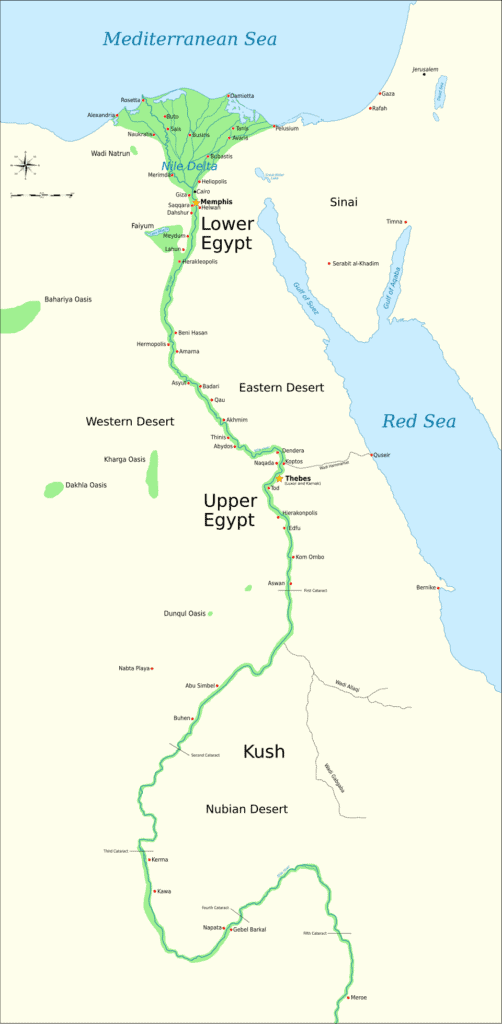
Jeff Dahl / CC BY-SA 4.0 (via Wikimedia Commons)
The Nile: Lifeline of the Pharaohs
The Nile Valley was then—and still is—very prone to flooding every year from mid-August to mid-October. This allowed farmers to plan their sowing and harvesting. The water would rise soon after harvest, soaking the hard, sun-dried soil and covering it with a layer of very fertile silt. The water would recede in October, which was exactly the right time for sowing. The freshly fertilized soil would produce a rich crop. In such conditions, any farmer could produce much more food than his family needed and sell the surplus. But there came a time when the population grew so much that only the flooded, irrigated land along the riverbanks could no longer provide enough harvest. It became necessary to plant new fields away from the river and irrigate them—in an area that received very little rain.
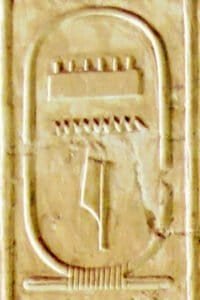
Olaf Tausch / CC BY-SA 3.0 (via Wikimedia Commons)
The Egyptians invented a method of irrigating land distant from the Nile. From the riverbank, through the fields, they dug channels. The floodwaters would burst through breaks in the shore and then flow through the channels. When no more irrigation was needed, one channel would be closed and a new one opened downstream. In this way, the entire Nile Valley was irrigated using this system, which allowed agricultural communities to thrive. Menes introduced the “canal digging” ceremony, and his successors continued to maintain it. Before the ceremony itself, the canals were dug, but a small layer of earth was left to separate the canal from the river. When the water rose to the edge, the pharaoh would throw several shovelfuls of earth from one canal, and the water would flow in. Then the pharaoh would travel downriver to perform the same ceremony on the next estate.
Menes built a large city not far from Memphis, declared it the capital of Egypt, and stationed his officials there to perform various duties. For example, an inventory of arable land was established—basically, a list of all landowners and their properties. This was very important because when the Nile flooded, the silt often covered and erased the boundaries between neighboring estates, resulting in fierce disputes among landowners. The people worshiped Menes as a god. Probably both he and his heirs encouraged this worship, so we know that by the reign of Djoser (around 2900 BC), the Egyptians believed that their pharaohs were gods who came down from heaven to rule them. During Menes’ time, the entire structure of priestly authority was designed to develop the people’s deep respect for the pharaoh.
The priests were the wisest and most learned men in the pharaoh’s service. Skillfully using speech and writing, they were able to convince common people that the pharaoh was a supernatural being. They invented legends and stories about him and his ancestors while overseeing the performance of religious ceremonies. There’s no doubt that during that process, the priests themselves worshiped the pharaoh.
Religion and Beliefs in the Land of the Pharaohs
Two very important deities that were especially emphasized by the priests—and which came from an even more primitive religion—were Isis and Osiris. There were many other Egyptian gods and goddesses as well, but the Egyptians worshiped Ra and Osiris and the goddess Isis most of all. According to the legend of the origin of the gods, Ra, the sun god, was the first being in the universe. He had four children named Geb, Shu, Tefnut, and Nut. Shu and Tefnut stood on Geb when he was a boy and lifted Nut, a girl, to the heavens. Thus Geb became the god of the Earth, and Nut became the goddess of Heaven.
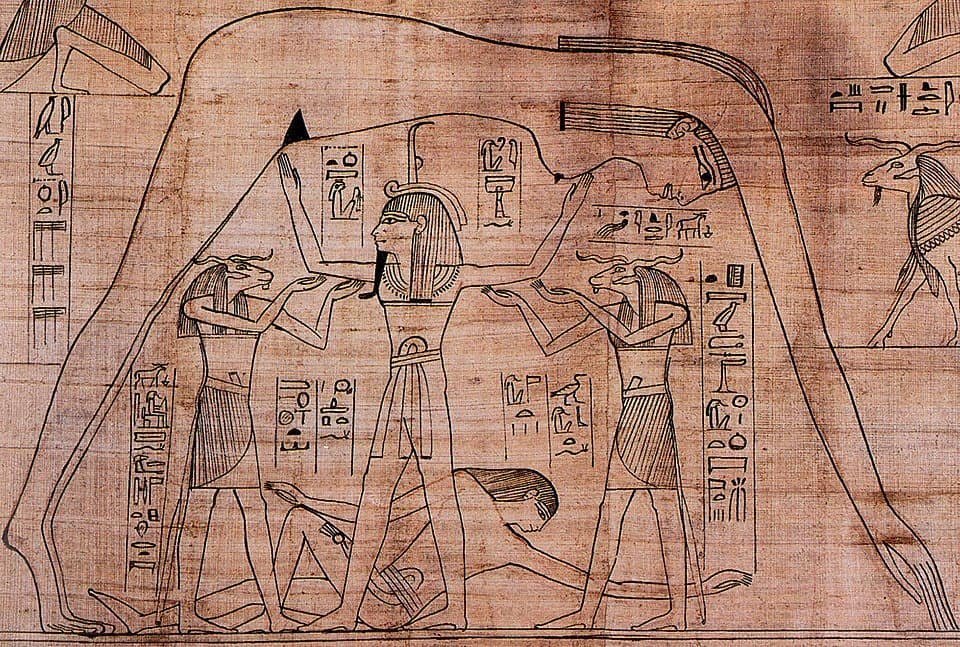
Image credit: Photographed by the British Museum; original artist unknown, public domain
Geb and Nut also had four children: Osiris and Seth, boys, and Isis and Nephthys, girls. Osiris succeeded Geb on the throne and ruled the world wisely with the help of his sister Isis, whom he later married. However, Seth was jealous of Osiris. He brutally killed him and cut his body into pieces, which he buried in various parts of Egypt. He buried his head in Abydos. Isis was devastated and collected the parts of her husband’s body. With the help of the god Anubis, she revived Osiris, but he wasn’t allowed to return to Earth. So he went to the underworld, where he became the god of the dead. Eventually, his son Horus defeated Seth in a great battle. Ra then chased Seth into the desert, and Horus continued to rule in his father’s place.
The sun god Ra was the main Egyptian deity—the giver of light and life—but Osiris was also worshiped for centuries, and his tomb in Abydos became a place of pilgrimage. Isis was also a very important deity, and from the time of the Middle Kingdom onward, her cult (which was later merged with the cult of the goddess Bastet, also called Pakhet, meaning “she who scratches”) became very widespread.
Pyramids and Monumental Architecture
The Egyptians believed in the afterlife. When a pharaoh died, they thought his soul would return to heaven, where he would take his place among the other gods. But how was that possible if his body rotted in the ground? The Egyptians found the answer: pharaohs had to be embalmed as soon as they died and placed in a spacious coffin made of solid material. Belief in the afterlife can also explain the origin of the great Egyptian pyramids. Djoser was the first pharaoh to order a pyramid to be built on the banks of the Nile near Saqqara. It was named the Step Pyramid. Djoser hired the architect Imhotep, whose skill was so renowned that later generations of Egyptians worshiped him as a deity. Imhotep’s pyramid (which is about 60 meters high) still stands today, even though almost 5,000 years have passed since it was built.
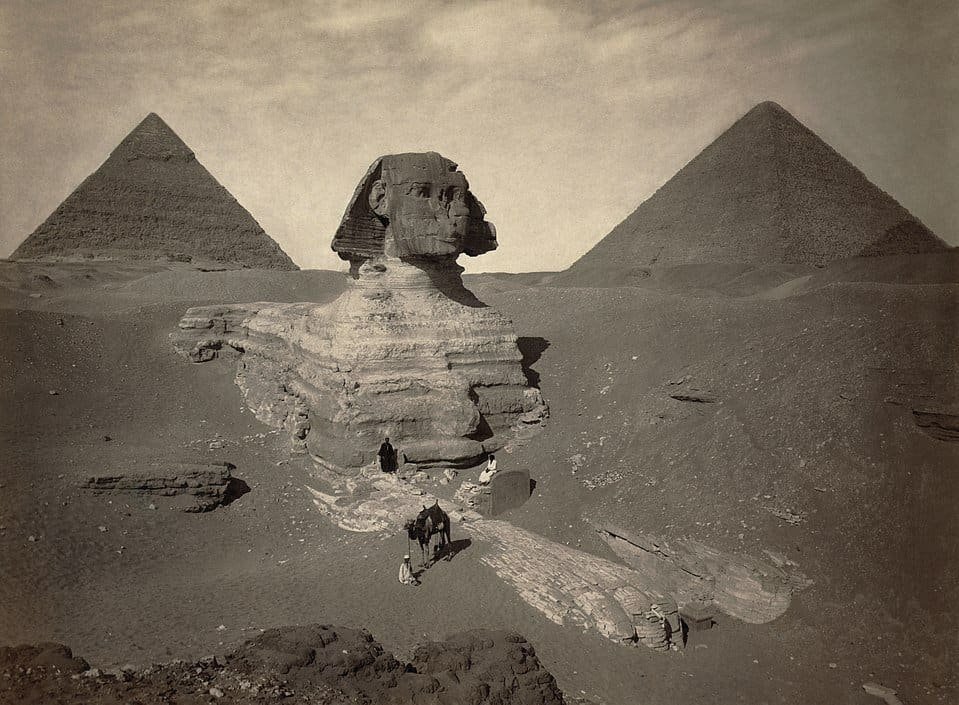
There are several other pyramids in Egypt that were built after Djoser’s and before the pyramids of pharaohs from the Tenth Dynasty (which ruled between 2200-2100 BC). The largest and most famous is the Great Pyramid near Giza, built for Pharaoh Khufu (also known as Cheops) around 2500 BC. This enormous structure was 147 meters high, and each side of its square base was 230 meters long. Despite the fact that time has eroded it for centuries, its proportions have remained almost the same. The Pyramid of Khufu is made of about 2.3 million blocks of cut stone, each weighing an average of two and a half tons. Some of the larger stone blocks above the inner burial chamber weigh up to fifty tons each.
With the pharaohs whose graves are located in these pyramids, many valuable items that belonged to them were buried: chests full of priceless jewelry, fine pottery, and richly decorated clothing. Soon after the end of the Tenth Dynasty, gangs of tomb robbers—who apparently knew how the pyramids were built—broke into some of them and looted the valuables, leaving the mummified pharaohs lying in their graves without any jewelry. The pyramids aren’t the only significant legacy of the Egyptians. Since religion played a major role in their lives, a significant number of early Egyptian manuscripts were devoted to religious topics and religious legends and stories.
Writing, Knowledge, and Hieroglyphs
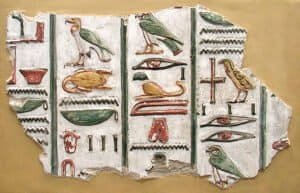
The early Egyptians wrote in a script composed of picture-symbols called hieroglyphs. In written language, they used images not to show the object itself but to represent the sound qualities of that object. These symbols were very complex and took a long time to carve or write. And so, soon after, the Egyptians developed a faster, shorter, and much simpler hieroglyphic script for everyday use. Hieroglyphic inscriptions were initially carved on pottery, tablets, and tombs. They were later written on papyrus scrolls. Writing was greatly aided by the discovery of papyrus, after which paper was named. Papyrus is made from reeds that grew abundantly in the Nile Valley. Strips from the plant are laid side by side lengthwise. Other strips are placed over them at right angles. This double layer is dried and pressed to finally obtain a sheet of papyrus, which can be written on with a reed pen and ink. Papyrus could be any desired length, and rolls of 7 to 10 meters in length represented what we would call a book today. Some manuscripts longer than 30 meters have even been found.
Although Egypt remained an agricultural country, its civilization continued to develop, achieving increasing success in the fields of architecture, art, and science. The first Egyptian mathematicians, for example, invented a calendar that survives, with some modifications, to this day. The Egyptians soon realized that the regular floods of the Nile were related to the seasons, and they noticed that the moon was full every 28 days. So they put together a calendar that relied on these natural phenomena, which proved to be very useful not only for farmers in the Nile Valley but for everyone else as well.
Famous Pharaohs and Historical Figures
At the end of the reign of the Twelfth Dynasty (around 2000-1790 BC), Pharaoh Amenemhat III led an army, invaded Syria, and managed to conquer the country from Gaza in the south to Ugarit in the north. He established himself as the supreme ruler in Syria, but that would have severe consequences for Egypt. This conquest brought Egypt into conflict—it seems for the first time—with other countries in the Middle East. Amenemhat’s victory was short-lived. Around 1700 BC, a fierce wave of Semites, whom the Egyptians called the Hyksos (meaning “rulers of foreign lands”), drove the Egyptians out of Syria and Palestine. The Hyksos overran the Nile Delta and occupied Egyptian cities and shrines. For their capital, they built the city of Avaris in the eastern part of the delta and surrounded it with a solid wall.
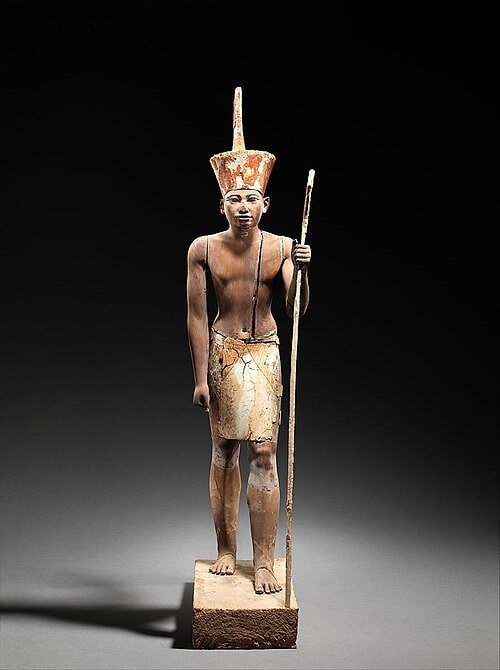
Image credit: The Metropolitan Museum CC 1.0 (via Wikimedia Commons)
The Hyksos had two advantages over the Egyptians. First, they had war chariots drawn by horses, and the Egyptians had never seen horses or chariots until then. Second, they very skillfully used bronze (an alloy of copper and tin) to make weapons. They may have even had iron weapons. The Hyksos moved slowly along the Nile Valley and gradually managed to conquer all of Egypt, which they ruled for about two centuries. From this conquest, Egypt gained one benefit: the Hyksos taught the Egyptians many things, one of the most significant being new methods of warfare. They introduced the idea of establishing a standing army led by commanders and training Egyptians to use war chariots.
Around 1567 BC, Ahmose I (c. 1575-1550 BC), the founder of the Eighteenth Dynasty, carefully assembled an army of people eager to restore the old rule of the pharaohs. The Egyptians attacked the Hyksos in the Nile Delta and managed to expel them. In this war, the Egyptians used horse-drawn chariots, weapons they had learned to handle from their former masters. Ahmose pursued the Hyksos all the way to Palestine, and his successors expanded Egyptian rule even into Syria. After the victory over the Hyksos, Ahmose and his successors undertook wars of conquest and managed to create a vast empire. The reign of the pharaohs of the Eighteenth Dynasty represents the brightest period of Egyptian history. At that time, the Egyptian Empire reached its peak: it stretched from modern-day Sudan in the south, across the west coast of the Red Sea, Palestine, and Syria, all the way to the Euphrates River.
Thutmose I (c. 1530-1500 BC) defeated the Assyrians and Babylonians in Mesopotamia. As a conqueror, an inscription was carved in his honor on the wall of a large temple dedicated to the god Osiris at Abydos: “I have surpassed the achievements of the kings who ruled before me. The gods are given proper respect, and the temples are decorated. I extended the borders of Egypt even to the sun, and Egypt became greater than any other country.” Thutmose I was succeeded by Thutmose II, who married his half-sister Hatshepsut. He consolidated his father’s possessions and prepared for new conquests. When he died in 1490 BC and the queen took power over the country, there was a change in Egyptian politics.
Hatshepsut was a ruler of exceptional ability. She immediately invested all her energy in improving conditions in the country. Many of the captives enslaved by her predecessors were sent to major construction projects—to build palaces, temples, houses, and roads. Huge treasures gained during the conquests were used to beautify the cities of Egypt and build a large merchant fleet. Merchants, craftsmen, and farmers all benefited greatly from this influx of money and goods. Living conditions in Egypt improved dramatically. Of the many architectural works preserved from that time, the most glorious are the tombs which, by order of Hatshepsut, were carved into the rock in the Valley of the Kings near Thebes in memory of her father. At the same time, a tomb was made in which she would rest. Some of Queen Hatshepsut’s successors also ordered tombs to be built for them in that part of the Nile Valley, with secret entrances, in the hope that tomb robbers wouldn’t find where their tombs were located.
Queen Hatshepsut’s policy of maintaining peaceful relations with her neighbors was abandoned by Thutmose III immediately after he became pharaoh. Thutmose III, who ruled from about 1480 BC to 1450 BC, was one of the most powerful pharaohs of the Eighteenth Dynasty. He undertook seventeen campaigns in Palestine and Syria and managed to strengthen Egyptian control there permanently by establishing permanent military garrisons and opening local administrative institutions in the conquered cities. He also appointed trusted officials, Egyptians by birth, to leadership positions.
The next pharaoh whose reign was of special importance was Amenhotep IV. When he came to power around 1375 BC, he inherited a rich and powerful kingdom and empire that had developed uninterrupted for almost eighty years. Amenhotep himself was interested in religion and social reforms.
The Egyptian Empire, plagued by internal conflicts, began to decline. Syria and Palestine—semi-independent states under the rule of Egyptian-born officials—soon became prey to the Hittites, who had been expanding their territory north of the Fertile Crescent for some time. It didn’t take long before the Hittites overran these two areas and conquered them.
Amenhotep focused his efforts on weakening the power of the clergy, especially the priests of the god Amun. That’s why he decided to worship another god, Aten, a very gentle pastoral deity, for whom he introduced new rituals. Aten became the supreme deity, and his symbol was the sun. In order to protect this new religion from the priests of the god Amun, he moved his court from the capital in Thebes to El-Amarna and built a temple to Aten there.
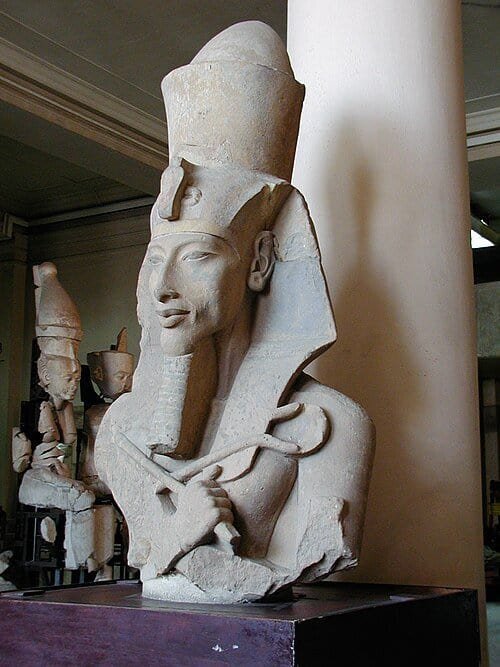
Image credit: Antiquité égyptienne, Akhénaton Musée égyptien du Caire / (via Wikimedia Commons)
The pharaoh also issued an order for people to worship the god Aten. He even changed his name to Akhenaten, which roughly translates to “one who pleases Aten.” Then Akhenaten appointed a new circle of priests. At the heart of this reform lay certain socio-economic causes. Akhenaten is credited with being the first to establish a civil service in Egypt. He appointed governors in various regions of Egypt and ordered them to keep written records of all events at council meetings.
Akhenaten was married to the beautiful Queen Nefertiti (c. 1370 – c. 1330 BC). Under Akhenaten, art deviated from the usual stylistic conventions of the Egyptians, and people were painted quite naturally for the first time. When Akhenaten died in 1360 BC, he was succeeded by his son-in-law Tutankhamun, who was still a boy. The priests of the old Amun religion managed to regain their power, and it’s clear from the pharaoh’s very name that they managed to re-establish the cult of the god Amun with its original devotion. Even Akhenaten’s capital at Amarna was abandoned.
Tutankhamun ruled for only a few years. He died when he was only 17-18 years old. His tomb, which became the most famous archaeological discovery, was opened in 1922 by Howard Carter. Inside was an extraordinary treasure, carelessly piled up in the antechamber in front of the burial chamber where the ruler was entombed. One of the objects found is the oldest chair in the world. Tutankhamun’s body was found in the tomb, mummified and perfectly preserved.
After Tutankhamun, Horemheb ascended the pharaonic throne. He’s considered the founder of the Nineteenth Dynasty. He sought to regain Egypt’s power over Syria and Palestine. He made very little progress in that regard, and his successor Ramesses I was no luckier. Ramesses I was succeeded by his son Seti I, who was pharaoh from 1304 to about 1292 BC. Seti proved to be a strong ruler and a good military commander. He replaced corrupt officials and appointed others. He tried to bring some order to the country’s administration and sought to improve the judicial system. He then set to work to regain Palestine. He also fought wars in Syria, defeated the Libyan tribesmen, and conquered the Phoenician port of Tyre.
After him, his son Ramesses II came to the throne. He ruled as pharaoh from 1292 to 1225 BC. He’s often called Ramesses the Great. His fame rests on a long epic poem about his reign in which he’s highly praised. Shortly after coming to power, Ramesses II entered Palestine with his army and clashed with the Hittites in the great Battle of Kadesh. Both armies fought fiercely all day, and by sunset, both sides had suffered huge losses. The Hittites withdrew, and Ramesses II considered it his great victory. He returned to Egypt in all its glory and celebrated that success.
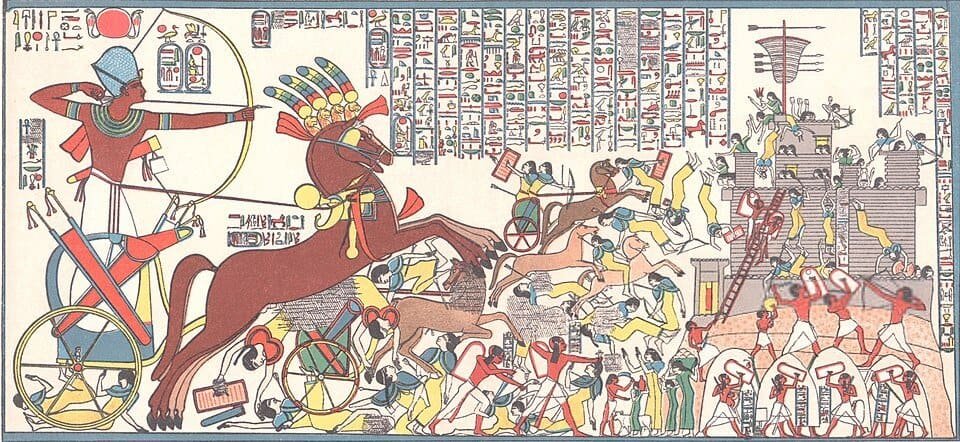
The Egyptians may have greeted their pharaoh with joyful cheers and congratulations, but it soon became quite clear who actually won the war. The Hittites, after retreating briefly to regroup their troops, marched south again and soon overran Palestine all the way to Jerusalem. Moreover, they kept the conquered lands and forced Ramesses to acknowledge it by treaty.
But Ramesses’ troubles weren’t limited to Palestine. Even in Egypt itself, his subjects were on the brink of rebellion. They demanded that taxes be collected fairly, that justice be served, and that all local government affairs be conducted properly. However, the pharaoh devoted an unusual amount of time and effort to erecting monuments to himself. For example, he ordered that a huge temple be built at Abu Simbel on the cliffs in the Nile Valley and that four statues of himself, each 20 meters high, be carved into the cliffs. These statues were cut from the cliff face a few decades ago and raised about 70 meters in elevation so that the project of the Great Aswan Dam in modern Egypt could be completed.
Another monument to Ramesses is located in the hall of the temple at Karnak. This large building, which is considered a masterpiece of architecture, was built in stages by many pharaohs. Its main feature is a huge hall about 100 meters long, with a roof over 23 meters high.
While Ramesses II was engaged in these grand construction projects, nothing was done to solve the internal problems, so the great Egyptian civilization had already begun to decline during his long reign. Even before the end of the 12th century BC, Egypt was invaded by the Libyans and Indo-Europeans—the same peoples who accelerated the collapse of the Hittite, Mycenaean, and early Indian civilizations.
As a great and powerful empire, Egypt lost its influence after that, but Egyptian culture influenced later civilizations, especially Assyria and Greece.
References:
- Billard, Jules B. (1978). Ancient Egypt, Discovering Its Splendors. National Geographic Society
- Grimal, Nicolas (1994) [1988]. A History of Ancient Egypt. Wiley.
- Van de Mieroop, Marc (2011). A History of Ancient Egypt. Wiley-Blackwell.

