

Table of Contents
In her crude laboratory in a rough old shed that was steaming in summer and freezing in winter, Marie Curie had become entranced by a luminous glow that radiated from certain minerals on her working table. She was so tormented by this elusive radiance that she could barely think of anything else. For long hours she labored, night and day, missing sleep, sometimes scarcely eating, and often becoming weak and ill under the strain – all to uncover the secret of its source and strength. When she did discover it, she found an element with unprecedented power to both destroy and heal. Curie called it radium.
Marie Curie: Early Life in Russian-Occupied Poland
Those who knew her as a child could have predicted that some day Marie Curie would make a great contribution to humanity. For even when she was young she demonstrated not only brilliance, but also a humble desire to serve and help others. She was born Mariya Sklodovski, November 7, 1867 in Warsaw, Poland, the youngest of five children. It was a terrible time for the Polish people. Their country was under the control of the Russian Tsar, who made every attempt to eradicate Polish culture and history. All school classes were taught in Russian from Russian texts; the Polish accent was ridiculed; and Poles were expected to be subservient to their conquerors. Mariya was a feisty and patriotic little girl who grew up with an abhorrence of tyranny and often rebelled.
Mariya had one brother and four sisters, all of them beautiful. The girls had delicate features, blonde hair, steel-gray eyes, and luminous complexions. Marie Curie was a beautiful woman all her life, even though in later years she developed a somewhat stern expression that concealed her gentleness. Brains and talent were natural in the Sklodovski family. Mariya’s father was a scholar who taught physics and math in a Warsaw high school. Her mother was a musician and former principal of a girl’s academy. She sacrificed her career to raise her five children. As a child, Mariya wondered why her mother never kissed her, but patted her hair affectionately instead. It was because Mrs. Sklodovski had tuberculosis and was afraid her children would catch it. She kept her disease secret for many years so as not to worry them.
Mariya’s father, who was rebellious like his daughter, got into trouble with Russian authorities at the high school in which he worked, when they decided he wasn’t subservient enough. His salary was cut severely and the family had to take in boarders to make ends meet. At one time there were as many as ten people living in the already crowded house, with Mrs. Sklodovski attending to all of them. The family was so poor that Mariya’s mother even made her children’s shoes. One day, when her older sister Bronya was having trouble reading, four-year-old Mariya picked up the book and began to read out loud. Her parents looked so astonished that Mariya began to cry, thinking she had done something wrong. When she started school, her teachers were equally as astonished by her intelligence. She was so fluent in Russian that when inspectors visited the class, it was always Mariya who was asked to rise from her chair and read from the Russian text. Then, as soon as the inspectors were out the door, the teachers would secretly bring out the Polish textbooks and teach their students about their own language and country. Mariya was two years younger than her classmates but she was the top student in languages, math, history and literature. At home, she liked to sit and stare into the glass case that held all the wonders of her father’s work. Inside were tubes, scales, and minerals. When she asked him to explain the objects she was satisfied with his two-word response: “physics apparatus.” But in her mind the simple description seemed to promise marvelous adventures and discoveries.
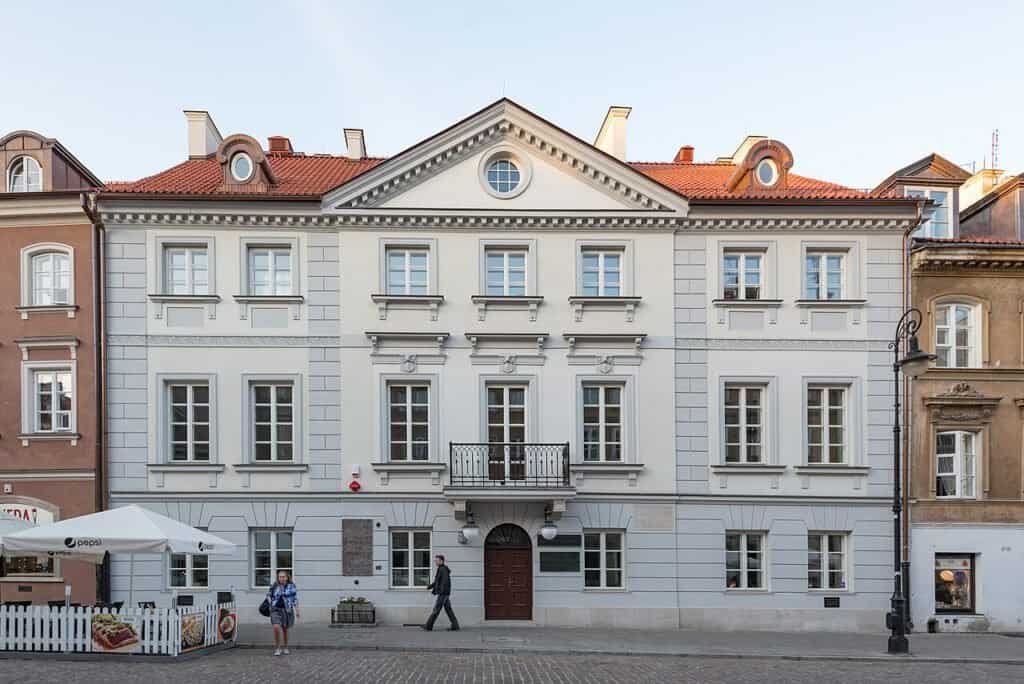
Tilman2007 / CC BY-SA 4.0 (via Wikimedia Commons)
Mariya was a happy child, in spite of her poverty, until she reached the age of nine and had her first experience with loss. Her sixteen-year-old sister, Zosia, caught typhus from one of the boarders and died. Her sister Bronya caught it too, but after a long convalescence she recovered. Mariya was still mourning Zosia when two years later her mother finally died of tuberculosis. For the eleven-year-old Mariya, it was a crisis of faith. Although she always remained a Catholic, from the time she lost her sister and mother, Mariya was filled with doubt about God’s benevolence. Years later her own daughter Eve wrote of that time: “She no longer invoked with the same love that God who had unjustly inflicted such terrible blows, who had slain what was gay or fanciful or sweet around her.”
Education and the Dream of Science
Her tragedies made her less devout, but no less spirited. As an adolescent, Mariya was still an exceptional student, earning awards and medals for her studies in Russian. But on her way to school each day she always took the time to spit on the monuments erected by Russians to the Poles who had betrayed their homeland. When she graduated high school, Mariya’s father decided she should have a year off as a reward for her hard work and accomplishments. It was a delightful time in her life, in which she healed from the loss of her mother and sister, and developed a love for the country and nature that never left her. She hunted for wild strawberries, went swimming, fished, climbed in the mountains, and went to balls. She wrote to a friend: “I have no schedule. I get up sometimes at ten o’clock, sometimes at four or five in the morning. I read no serious books, only harmless and absurd little novels. Thus, in spite of the diploma conferring on me the dignity and maturity of a person who has finished her studies, I feel incredibly stupid. Sometimes I laugh all by myself, and I contemplate my state of total stupidity with genuine satisfaction.”
The Secret University and Political Activism
But stupidity was neither her nature nor her destiny. Back from vacation, Mariya joined up with a group of young political activists in Warsaw who met in secret to talk about underground political movements, read pamphlets, and discuss possibilities of reform. They believed the best way to improve society was to build the intellect and educate the poor, who had deliberately been kept ignorant. Personally, she felt science was the most promising path to freedom. Mariya was only seventeen years old at the time, and the group was probably very naive itself, but years later she still championed its ideals. She said: “The means of action were poor and the results obtained could not be considerable, yet I persist in believing that the ideas that guided us then are the only ones which can lead to true social progress. We cannot hope to build a better world without improving the individual. Towards this end, each of us must work toward his own highest development, accepting at the same time his share of responsibility in the general life of humanity.” While meeting with the young reformers, Mariya was also attending a secret university where exceptional Polish students were taught science, sociology, and other subjects, and asked to pass their knowledge on to others.
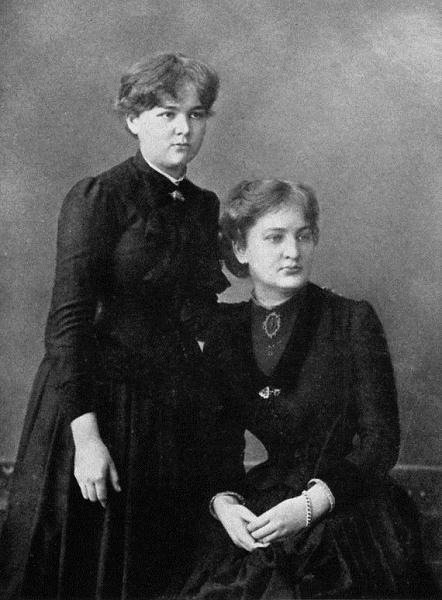
At home, Mr. Sklodovski was finding it more difficult to take care of the boarders, and his income had shrunk to almost nothing. It soon became necessary for the children to make their own way in life. Mariya’s brother, Joseph had already enrolled at the University of Warsaw, where he was studying medicine. Mariya’s sister, Bronya, equally as good a student as Joseph, had been forced to enroll in medical school in Paris – the Tsar’s universities refused to accept women. Mariya, now eighteen, came up with a plan to help her father and sister. She took a job as a governess so she could support herself and help pay for Bronya’s schooling. She sent part of her salary to her sister every month, even though Bronya tearfully protested that the sacrifice was too great. Mariya ignored her protests. Someday, she said, she too would move to Paris and attend university. But for now, it was Bronya’s turn.
Mariya could barely endure her post as governess. She had nothing but contempt for her wealthy employers whom she considered crass and pretentious. She said: “It is one of those rich houses where they speak French when there is company – a chimney sweeper’s French -where they don’t pay their bills for six months, and where they fling money out of the window, even though they economize niggardly on oil for lamps. They have five servants. They pose as liberals and, in reality, are sunk in the darkest stupidity.” She soon left this unenviable position and took another with the much more pleasant family of an agriculturalist who lived in the country. Life there would have been perfect if not for one complication – Mariya fell in love with their oldest son. The parents had respect and affection for her but the idea of their son marrying a penniless governess was out of the question. They sent him off to college, leaving Mariya behind to suffer the tortures of hurt pride and unfulfilled love. Although she wanted to quit, Mariya knew that both her father and Bronya depended on her income. Eventually she found another position, but she remained a governess for five years. She was 24 years old before she could persuade herself to leave her father and younger sister Hela, and join Bronya in Paris, and she did so only after she first found Hela a job. When she boarded a fourth-class railway carriage for the trip to France, she was embarking on the most important journey of her life.
Marie Curie at the Sorbonne
Once in Paris, Mariya settled in with Bronya and her new husband, a Polish revolutionary and fellow science student. One of the first things she did was change her name from Mariya to Marie. The next thing she did was register under that name for science courses at the Sorbonne. Marie was joyful to be in Paris – here it was a free republic, where people could speak their own language, think what they wanted to think, and find all the books and classes they needed to improve their minds. She was happy living with Bronya and her husband but soon she had to move. Bronya was expecting a baby and Marie had found the one-hour trip from Bronya’s house to the Sorbonne too long and expensive. The year after she arrived in Paris she moved to a dismal little flat in the Latin Quarter. She climbed six floors to her apartment, which was always dark except for a dim glimmer from a skylight. She lived on forty francs – about ten dollars – a month, subsisting on tea and bread, half starving herself as she studied, often unable to afford fuel for her little stove. When she fainted once in class, her brother-in-law forced her to admit that all she’d eaten in 24 hours was a bunch of radishes and a few cherries. None of this deprivation bothered her – in fact she took satisfaction in it. It gave her a sense of camaraderie with scientists of the past who, like her, were shut into little rooms, removed from the world around them. Marie Curie thought only of calculus, chemicals, and her upcoming exams.
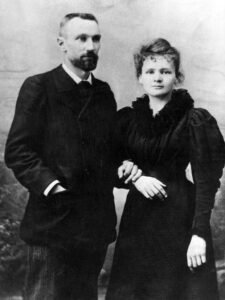
At 26, she passed first in her class in the Master’s exam in physics; a few months later she passed second in the Master’s exam in mathematics. She was rewarded with a substantial scholarship, but continued to live as frugally as possible. Later, when she was successful, she paid the scholarship back so another poor and worthy student could benefit from it. In the middle of this four-year period of poverty and intensive study, when the only thing on her mind was her studies, and the farthest thing from it was romance, Marie Curie met Pierre Curie. Their marriage would become one of the most famous and important partnerships in the history of science. She was 27 years old when she met Pierre, a tall bearded French physicist whose already brilliant discoveries in science had gone virtually unnoticed. A friend brought them together with the thought that Pierre might be able to help Marie with some research questions she couldn’t solve. She wrote a description of her first impressions of her future husband: “When I came in, Pierre Curie was standing in the window recess near a door leading to the balcony. He seemed very young to me, although he was aged thirty-five. I was struck by the impression of his clear gaze and by a slight appearance of carelessness in his lofty stature. His rather slow, reflective words, his simplicity, and his smile, inspired confidence. A conversation began between us and grew friendly.”
Pierre was a modest and humble man who later would refuse almost all the decorations and awards offered him for his notable work. He was fascinated with this young Polish woman who didn’t flirt, but instead wanted to talk about quartz and crystals, his research specialty. He approached the relationship cautiously. A few months after meeting her, he asked if he could visit. Many more visits followed. Pierre’s first gift to her was a book – not a slim volume of poetry, as some men might have offered, but a publication entitled On Symmetry in Physical Phenomena: Symmetry of an Electric Field and of a Magnetic Field.
Marie Curie marriage with Pierre
Meanwhile, Marie weighed the symmetry and possible asymmetry of a relationship with Pierre. At first, she wasn’t interested. She had been in love once already and the experience had been painful. Furthermore, she wanted to focus on her work. Pierre, however, wasn’t inclined to give up. He took her for a visit to his parent’s house in the town of Sceaux, knowing how comfortable she would feel with his family. Still, she suggested they forego marriage and remain good friends. He offered to leave France and return to Poland with her. Still, she refused. Then he recruited her sister Bronya to plead his case. Finally, after ten months Marie Curie realized she was hopelessly in love and had no choice but to accept it. She wrote to a friend saying: “When you receive this I will have changed my name. I am about to marry the man I told you about last year in Warsaw. It is a sorrow for me to have to stay forever in Paris, but what am I to do? Fate has made us deeply attached to each other and we cannot endure the idea of separating.”
Because both were freethinking individualists, they had a civil ceremony – without rings. When a relative offered to buy Marie a white wedding dress, she wrote in response: “If you are going to be kind enough to give me one, let it be practical and dark, so I can wear it afterwards to go to the laboratory.”
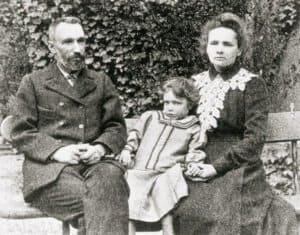
Since they both loved bicycles, Marie and Pierre Curie spent their honeymoon bicycling around France, stopping to explore and picnic in the woods. Even after they became famous, the bicycle remained their favorite means of transportation. When they returned to Paris they rented a little flat and Marie, who had never once cooked a meal, took to the kitchen like it was a laboratory. She studied recipes, experimented, and soon became a first class cook. The Curies seldom went out or visited friends during their married life – they were completely content with each other and with their mutual work. During the second year of their marriage they had a baby girl named Irene delivered by Pierre’s father, a doctor. Years later, Irene would win a Nobel Prize in chemistry for her own work on radioactive elements. Seven years after the birth of Irene, the Curies had a second daughter, named Eve, who wrote a biography of her mother.
The Discovery of Radioactivity and Radium
While the couple was still honeymooning, two scientists made two different discoveries that would play pivotal roles in the future of the Curies. One man, Wilhelm Roentgen, discovered x-rays. The other man, Henri Becquerel, discovered that uranium salts emitted some unknown ray, even when they weren’t exposed to light. These rays, just like Roentgen’s X-rays, could penetrate metal and leave an impression on a photographic plate, even when that plate was wrapped in thick black paper. Not only that, but air struck by the rays became electrified. This was the first discovery of radioactivity – named by Marie Curie some years later – which would play such an important role in medical diagnosis and treatment. The news of Becquerel’s mysterious rays was so exciting to Marie Curie that Pierre gave up all his other research to help in her work. Her all-consuming goal now was to study, isolate, and identify the substance, which had such an extraordinary power of penetration. She decided this study would be her doctoral thesis and set to work with all the enthusiasm and skill of a veteran scientist, but without any of the advantages. The Curies worked with minimal equipment and materials in a shed that had been abandoned by the School of Physics. The room was so damp that water dripped from the ceiling. In summer it was wretchedly hot – in winter it was just above the freezing point, and once it plummeted to six degrees. None of this interfered with the passionate work of the Curie team.
They began by examining all known pure chemicals and chemical compounds and found that uranium was not the only element that emitted rays. There was also thorium and a few others. Marie Curie proceeded to study hundreds of minerals. She felt these rays came from the nucleus of the atom. It wasn’t until nine years later that Einstein’s work enabled scientists to understand the real process, in which mass was converted to energy. As she studied elements and minerals, Marie Curie made her first big discovery. She found that pitchblende, an ore of uranium, produced much more powerful radiation than could be explained by the amount of uranium present. She checked and re-checked her results until she came to the inevitable conclusion: there must be an entirely new element – an element of unbelievable strength. She was on her way to discovering radium. For eight years Marie and Pierre collaborated in the dismal little shed a few blocks from the Sorbonne. And for eight years they made discovery after discovery. The first important one was the discovery of a new element – not the one they were searching for but a different one. Pierre gave Marie the privilege of naming it and she chose the name polonium, which was the ancient form of Poland. They knew, however that there was still a much stronger element than polonium hidden in the pitchblende, and so on they worked.
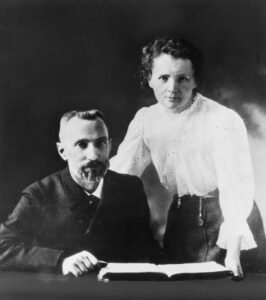
Image credit: Smithsonian Institution
The constant challenge of their work was to obtain enough pitchblende to pursue their research. They needed tons of the ore for their work, yet it was highly expensive. Finally, they arranged to have the residue from mines sent to them, at only the cost of transportation. Marie’s tasks during the years in the shed were laborious and exhausting. She treated tons of pitchblende residue, pound by pound, mixing the boiling matter in a smelter. There was no chimney in the shed to carry out the vile fumes, and the extreme temperatures left her either sweating or shivering for weeks at a time. “And yet,” she wrote, “it was in this miserable old shed that the best and happiest years of our life were spent entirely consecrated to work. I sometimes passed the whole day stirring a mass in ebullition, with an iron rod nearly as big as myself. In the evening I was broken with fatigue.”
Working in the Shed: Eight Years of Research
Marie Curie was a working mother – and like millions of women in the century that followed her, she tried her best to balance both responsibilities. She took breaks from the lab to prepare appetizing meals, and home made jams, and as soon as her daughter was old enough, she began to educate her herself. Unlike the great men scientists who proceeded and followed her, she accomplished her work while also running a home. It was only her dedication and passion that kept her from collapsing. The Curies gave a name to the new powerful element they knew existed, even before they isolated it. They announced in a published paper that they would call it radium, from the Latin radius, which means, “ray.” It took almost four years more before Marie Curie was able to produce just a decigram of pure radium and determine its atomic weight. The weight was 225. The power of its radioactivity was almost two million times greater than that of uranium. She made her discovery in 1902 when she was 35 years old. One night as they headed for the laboratory in the shed, Marie asked Pierre not to light the lamps. He had once expressed his hope that radium, when they found it, would be a beautiful color. Now, as they peered at it in the darkness, they saw that it was more than beautiful in color – it was luminous and gleaming, almost magical in the blackness.
Between 1899 and 1902, the Curies published more than thirty scientific papers on their work in the shed. They established that radium, which looked like common kitchen salt, also produced radioactive gases; that it gave off heat; and that it made impressions on photographic plates. It also could make air and clothes radioactive. They discovered that radium could cause dangerous burns and that it could be effective in treating certain diseases. What they didn’t know yet, was that radioactivity could work in subtle and deadly ways. Becquerel had been the first to notice that it burned his skin and he had rushed to tell the Curies. Pierre’s response was to dab some radium on his skin and take delight in the lesion that resulted. No one yet had a clue of the damage it could do inside the body. But they did know of the benefits.
The Curies were always willing to publish and share their findings and to collaborate with others in the hopes of finding a humanitarian use for their discovery. As a result, they found that radium destroyed infected cells and harmful growths and even arrested some forms of cancer, particularly of the head, neck, and tongue. This method of therapy first became known as Curie therapy. It changed the future of medicine and created an entirely new industry, the radium industry. The industry proceeded slowly at first – just a gram of radium, a mere pinch of it, was worth $150,000. It was one of the most expensive items in the world. The Curies could have been multi-millionaires from their discovery – yet they never took out a patent and never once considered making a profit. Though they had struggled for years in poverty they both said that making a profit of their work would be “contrary to the scientific spirit.” The gift of radium belonged to no one individual but to the world.
The years they worked on discovering radium were very hard years for the Curies. Pierre was repeatedly turned down for positions that would have allowed them to live and work in more comfortable conditions. In 1898 there was an opening for the chair of physical chemistry, but the job went to a less capable man. He was paid 10,000 francs a year; Pierre lived on 500 francs. Both Marie and Pierre took small teaching jobs to supplement their incomes. Then, in 1902 Pierre failed to receive a well-deserved appointment to the Academy of Science. After their discoveries became known and Pierre was finally nominated for the Legion of Honor, he wrote instead: “Please be so kind as to thank the minister and to inform him that I do not feel the slightest need of being decorated, but I am in the greatest need of a laboratory.”
Nobel Prize and Global Recognition
It was the following year that the Curies finally received the recognition and support they had so well earned. On November 13, 1903, they shared the Nobel Prize with Henri Becquerel for the discovery of radioactivity. The Nobel Prize money allowed Pierre to give up his teaching and devote himself entirely to research, but he continued to refuse other honors and to avoid all publicity. It wasn’t easy to do – for with the discovery of radioactivity, the Curies had become national celebrities. Reporters and photographers waited outside their home and they were deluged with visits and correspondence from strangers. Every day in the mail came requests for endorsements, invitations to social engagements and lecture tours, and even admiring poetry. Marie Curie told her brother: “Yesterday, an American wrote to ask me if I would allow him to baptize a race horse with my name!” Even while they were vacationing, an American reporter tracked the Curies down in a little cottage in Brittany. He found a rather plainly dressed woman sitting outside the door and asked “Are you the housekeeper?” “Yes,” said Marie. “Will your mistress be back soon?” “No,” she said. The reporter took a seat, leaned over, and whispered: “Can you tell me something confidential about your mistress?” Marie answered: “Madame Curie has only one message that she likes to be given to reporters. That is: Be less curious about people and more curious about ideas.” In spite of the unwanted attention, life after the Nobel Prize took a notable swing upward. Pierre was finally invited to join the Academy of Science, “without,” he said, “having desired to be there and without the Academy’s desire to have me.” He was also made a full professor at the Sorbonne but was encouraged to spend his time on his research. And a wealthy patron offered to build a modern laboratory for the Curies. Then, on one rainy night in April of 1906, it all came to an end.
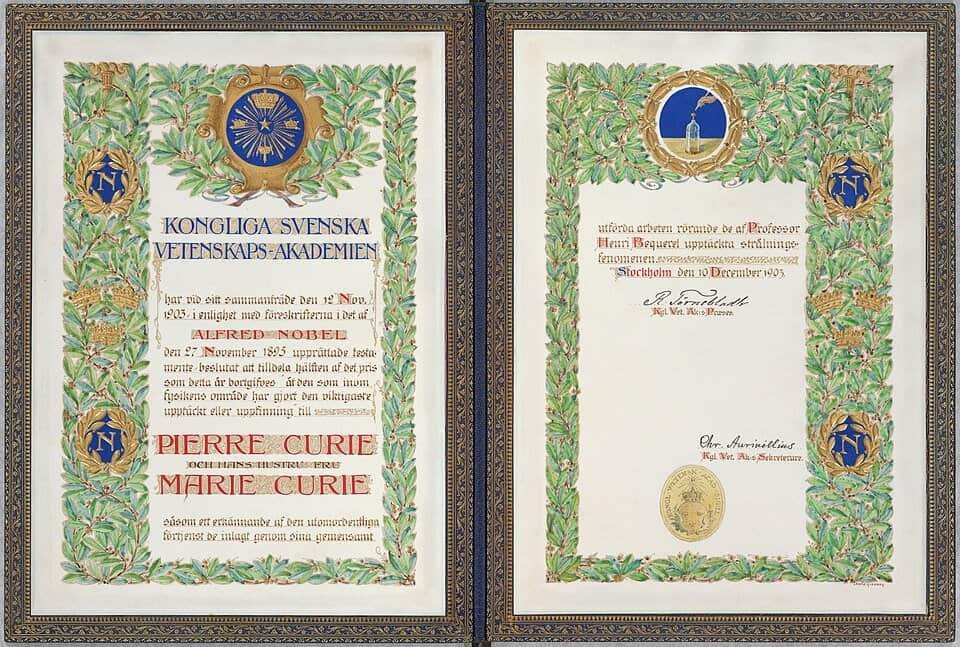
Image credit: Sofia Gisberg, public domain
Life After Pierre Curie
Pierre left the house that day to go visit his publisher. The streets were busy and slippery from the rain. While he was crossing, he failed to see a wagon drawn by two horses. The horses reared; Pierre tried to hang on to one of them, and was knocked to the ground. For a moment it seemed as if he was all right. But although he escaped the horses’ hooves, the wheels of the wagon rolled forward, crushing his skull. Pierre died instantly. Marie Curie was emotionally destroyed. When Pierre’s body was brought home she refused to be separated from it. In her diary she wrote over and over of her grief and longing. “Pierre, my Pierre,” she wrote after the funeral. “You are there, calm as a poor wounded man resting in sleep, with his head bandaged. Your face is sweet and serene; it is still you, lost in a dream…Your coffin was closed and I could see you no more…it is the end of everything, everything, everything.” Marie Curie had lost her husband, the father of her children, her collaborator, and her dearest friend, all in one moment. She was 39 now, her hair turning gray, and there was much work that still needed to be accomplished. But she was alone and the heart had gone out of her. “In the street I walk as if hypnotized,” she said. “I do not desire suicide. But among all those vehicles, is there not one to make me share the fate of my beloved?”
After a while, Marie’s grief began to transform into commitment – commitment to finish the work that was his and theirs. She accepted his post at the Sorbonne, the first time in France a woman was offered a position in higher education. And she returned to the research, vowing to live the rest of Pierre’s life for him. During the day she worked on tables and classifications of radioactive elements, and every night she took to her dairy to pour her heart out to her husband. “My Pierre, I think of you without end. The beauty of the countryside hurts me, and I put my veil down so as to see everything through crepe. I want to tell you that the laburnum is in flower, the wisteria, the hawthorn and the iris are beginning – you would have loved all that.”
Marie Curie in World War I
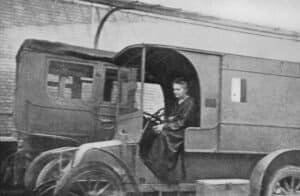
Marie Curie never fully recovered from her husband’s death and she never married again. But she went on to achieve a great deal more in the field of science. In 1911 she was awarded a second Nobel Prize for her work in isolating pure radium. It was the first time the prize was awarded twice to the same person, but Marie chose to regard it, in her words, “as an homage to Pierre Curie.” She was also a skilled and inspiring teacher, with legions of devoted students. When World War I broke out she saw a new and urgent need for the healing powers of radium. First, she converted a small Renault passenger car into what she called a “radiological car.” She drove it from hospital to hospital in Europe, where it was used to x-ray and diagnose battle injuries. Before the war was over, she had mobilized twenty such cars and installed radiological equipment in over 200 hospital rooms. Over one million soldiers were x-rayed with her equipment and she herself became a competent radiologist.
When the war was over, Marie Curie went on a lecture tour all over the world. She visited America, where a group of women had gathered enough funds to buy her a gram of radium, a gift presented to her by President Warren Harding at the White House. She took along her two daughters, one of whom would become a famous scientist in her own right, the other of whom would become a successful writer. But Marie Curie wouldn’t live to see it. After her lecture tour she returned to her laboratory in Paris. Then, at the age of 58, she journeyed home to Warsaw to lay the cornerstone of its new Radium Institute. Four years later she made one more trip to America to receive another gram of radium. From then on she remained in Paris, working 12 to 14 hour days even as she approached her mid sixties. By the time she was 65, her eyesight began to fail and she feared she was going blind – a fear she kept to herself for a long time, just as her own mother had hidden her tuberculosis. She also experienced a constant humming in her ears, so intense at times, that she wrote it “persecuted her.” She began to suspect that the radium might have caused her problems, but she had no way to verify it. She had four operations for double cataracts and then developed a painful stone in her gall bladder. Next was a sudden fever. The diagnosis was grippe and bronchitis but her daughter Eve sensed that the illnesses were far more serious than they appeared to be. Marie Curie was moved to a sanitarium where she rallied for a while, then declined, and finally died of leukemia. We know today that the same radium rays that can cure some cancers can cause leukemia, a white cell disease. Marie Curie was 66 years old when she died of the very discovery that had brought healing to so many others.
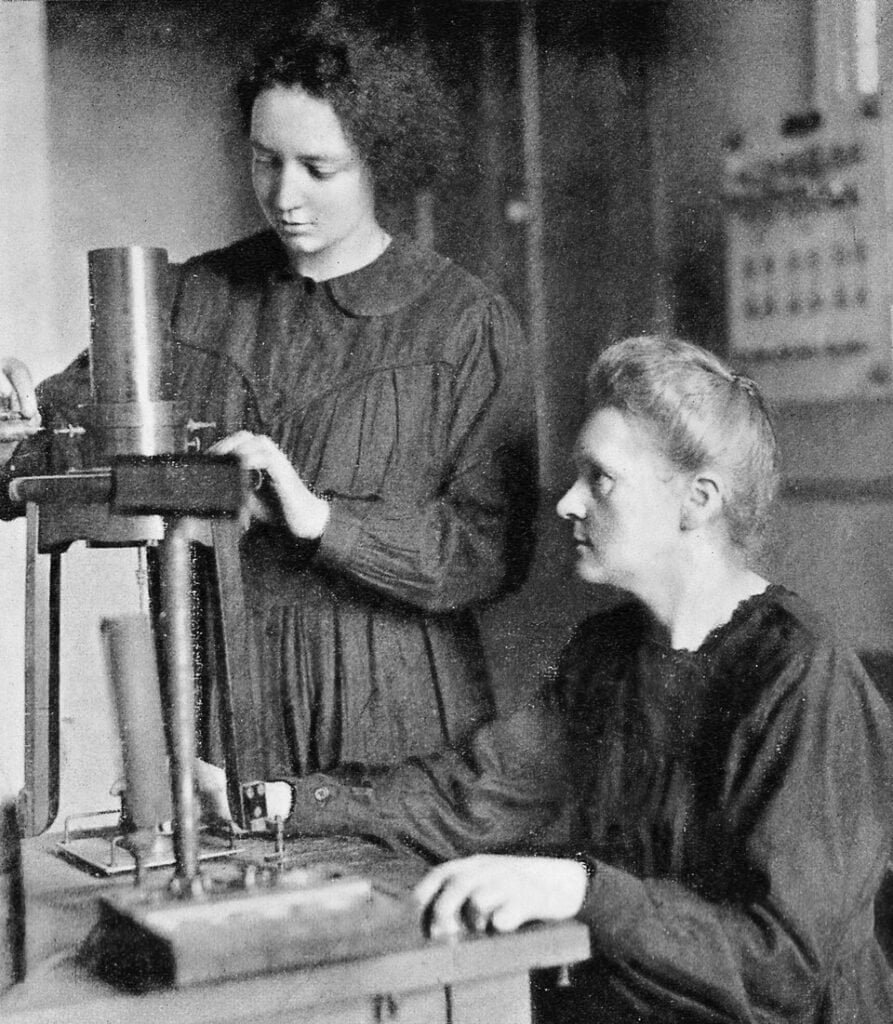
Image credit: Unknown author/ CC BY-SA 4.0 (via Wikimedia Commons)
The Enduring Legacy of Marie Curie
Albert Einstein, who had been a friend of Curie’s, said: “Marie Curie is, of all celebrated beings, the only one whom fame has not corrupted.” Perhaps what is most stunning, and rare, about the achievements of Madame Curie are her consistent modesty, selflessness, and generosity. In spite of the fact that she made one of the most important contributions to science and medicine, that she paved the way for women in fields of science and education, and that she did it all under conditions of terrible hardship, she was without pride and desired neither publicity and recognition nor profit. She was not just a great scientist – she was a great benefactor. And her spirit of giving was equally as remarkable as her intellect.
References:
- Curie, Marie (1921). The Discovery of Radium;
- Curie, Eve (2001). Madame Curie: A Biography;
- Quinn, Susan (1996). Marie Curie: A Life;
- Redniss, Lauren (2010). Radioactive: Marie & Pierre Curie: A Tale of Love and Fallout;
- Giroud, Françoise (1986). Marie Curie: A Life. Translated by Lydia Davis. New York: Holmes & Meier
FAQs About Marie Curie
Who was Marie Curie?
Marie Curie, born Mariya Sklodovski, was a pioneering scientist who discovered the elements polonium and radium. She made one of the most important contributions to science and medicine and became the first woman to receive a Nobel Prize.
Which Nobel Prizes did Marie Curie receive?
She shared the 1903 Nobel Prize in Physics with Pierre Curie and Henri Becquerel for the discovery of radioactivity. In 1911, she received a second Nobel Prize in Chemistry for isolating pure radium, the first person ever to win two Nobel Prizes.
What is radium and why is it important?
Radium is a radioactive element discovered by Marie Curie. It had the unprecedented power to both destroy harmful cells and heal diseases, including certain forms of cancer.
What were Marie Curie’s main challenges in her research?
She worked in a poor, damp, and cold laboratory, often with minimal food and resources. Being a woman in science at the time also made recognition difficult, but her dedication never wavered.
How did Marie Curie contribute to medicine?
She developed Curie therapy using radium to treat infected cells and tumors. During World War I, she converted a small car into a “radiological car” to x-ray soldiers on the front lines, personally improving battlefield diagnostics.
When and how did Marie Curie die?
Marie Curie died at age 66 from leukemia, likely caused by prolonged exposure to radioactive materials she handled during her research.
What is Marie Curie’s legacy for women in science?
She became the first female professor at the Sorbonne and inspired generations of women in science. Despite her groundbreaking work, she remained humble, selfless, and dedicated to the service of humanity.


Your mode of explaining the whole thing in this post is in fact nice, all be able to
easily understand it, Thanks a lot.