

Cover image: Biblioteca Nacional de Portugal, public domain
Table of Contents
Vasco da Gama was having trouble with his men. Four months had passed since they had left their home in Portugal in search of a water route to India. They had traveled thousands of miles, through terrible storms, before they had rounded the southern tip of Africa at the Cape of Good Hope, a cape Bartolomeu Dias had discovered nine years before. But there, Dias had stopped and turned back. What lay before da Gama and his sailors were unknown waters, strange lands and unfamiliar people, and maybe or maybe not and maybe or maybe not the first sea route to India.
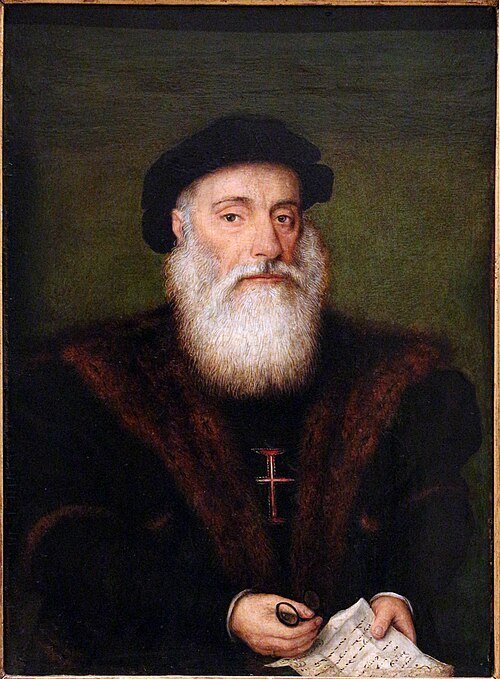
Image credit: Sailko, CC BY-SA 3.0 (via Wikimedia Commons)
It was the fervent hope of their king and their countrymen that India did lay ahead and that Vasco da Gama would find it. For India possessed riches in spices, jewels, and silk that could make Portugal the wealthiest nation in the world. Until now, the only route to India had been overland; a long treacherous journey through country controlled by the Muslims, or as Europeans called them, Moors. The Arabs now had a complete monopoly on trade with the East. Europe desperately needed a sea route to India if it was to develop its own trade. Six years before da Gama, Christopher Columbus had left Spain to find such a route by traveling west. He had failed. Da Gama would try an eastern approach.
It was now November in 1497, and yet another storm was battering at da Gama’s ships. The captain stood on deck, peering into the dark and the slashing rain, wondering what lay ahead, and wondering what to do about his men. The men were tired and frightened. They had been at sea for a long time and had suffered terrible hardship. But nothing they had suffered concerned them as much as what they might suffer in the future. What waited for them in the unknown seas? What if India couldn’t be reached this way, what if they sailed on forever and ever into eternity? What if they never saw land again? What if their food and water ran out, what if there were enemies out there, what if the seas were full of whirlpools or monsters or giant rocks?
Vasco Da Gama was growing angry. He was sure that somewhere beyond them to the east was India and he was disgusted by his men’s lack of courage. He had heard they were talking of turning back. Well, Vasco da Gama was not turning back. He had never turned back from danger before and he wasn’t going to do it now. He had promised his king he would find India and find it he would. At that moment one of the four ships of da Gama’s fleet sailed close to his own and he heard the captain shout to him: “If we don’t turn back the men will kill us and sail the ships home themselves. We must turn back!”
At first Vasco da Gama was shocked that even his bravest captain had turned into a coward. Then he realized the captain was trying to warn him. The men were planning a mutiny. It was then that da Gama came up with a plan. He called his grumbling, fearful crew together and pretended to sympathize with them. “We shall turn back,” he told them, “but first you must all sign a paper telling the King that you forced me to do it.” The men were only too happy to agree – better to face the wrath of the king and disgrace at home, then a horrible slow death in unknown seas. Da Gama then ordered the sailors who were leading the rebellion to go into his cabin to sign the papers, releasing him of guilt. But as the men gathered below, suddenly the door to da Gama’s cabin flew open, and there before they were a group of loyal sailors, armed with pistols. They grabbed the mutineers and put them in chains. Then da Gama went on deck and gathered up all the compasses and instruments that had been used to navigate the ships through the Atlantic Ocean. He stood before his crew and held the instruments high above his head – then, to their horror – he tossed them into the sea. “Now,” said da Gama, “We sail with God as our pilot.” The men had no choice but to accept their fate. There would be no turning back into the Atlantic now. The only course was eastward – onward with their bold Captain towards the mysterious waters between Africa and India.
The daring and determination of Vasco da Gama wouldn’t have surprised his king back home in Portugal. The king was once heard to remark that Vasco da Gama was “a person who knew how to get things done.” Da Gama was famous as a man who knew almost everything there was to know about the sea and ships. After all, he’d been born in a seaport in the country that led the world in seafaring and exploration, and his father too had been known for his strong leadership qualities.
Vasco Da Gama was born sometime between the years 1460 and 1469, right before the peak of Europe’s great age of exploration. For the next thirty years, navigators from western Europe would search all along the Atlantic shores of Africa for a sea route to India, and a few, like Columbus and Magellan, would even venture westward across the Atlantic, not expecting to find the continents of the Americas in their way. Da Gama was in his twenties when all of Portugal rejoiced the return of Bartolomeu Dias from the Cape of Good Hope at Africa’s southern tip – a golden age that would inspire generations of European explorers for centuries to come. Dias had braved terrifying currents and turbulent weather to make his discovery and now that discovery had given Portugal new hope. If Dias could get that close to the Indian Ocean, which lay on the other side of Africa, then perhaps some other brave man could lead his ships across the ocean. On the other side were the great trading centers on the eastern coast of India, like Calicut. But the Indian Ocean was vast – that much everyone knew. What they didn’t know was how long it would take to cross it, or what the currents were like, or the weather or what other unexpected dangers might be lurking there. To find out, Portugal would need a man of great skill and courage.
Vasco da Gama Early Life and Education
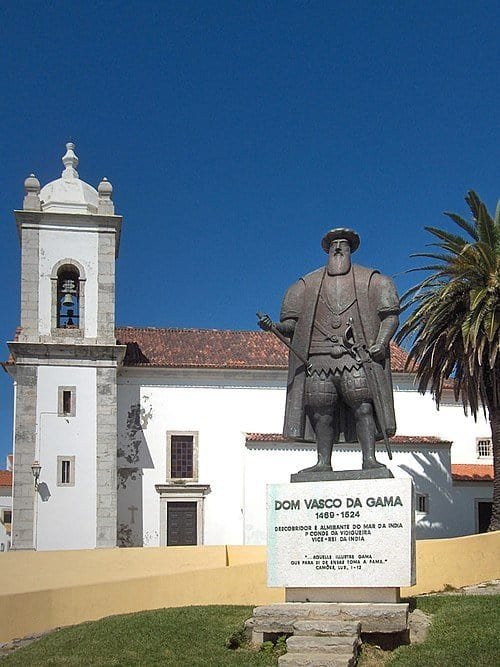
Image credit: Georges Jansoone, CC BY-SA 3.0 (via Wikimedia Commons)
Vasco Da Gama was born in a seaport in the south of Portugal called Sines, but little else is known about the first thirty years of his life. He was the youngest of three sons of a nobleman named Estavan da Gama who served for a time as mayor of Sines and commanded the city’s fortress. Da Gama probably attended a nearby school, as most boys of his class did. As a young man, he learned astronomy and navigation, two required subjects in this country that ruled the seas of Europe. Somewhere in the mid-1480’s Vasco da Gama became a member of the royal court and was one of the most trusted assistants of King John II, a king whose judgment must have been fairly sound since the nickname his subjects gave him was “John the Perfect.” Da Gama distinguished himself early on by helping to seize French ships that invaded the Portuguese ports in 1492. He was made an officer and commanded ships all along the coast of Portugal.
“John the Perfect” was in the process of organizing an expedition to cross the Indian ocean when he died suddenly in 1495, the year Christopher Columbus had crossed the Atlantic in his second voyage for Spain. Columbus too had once sailed for Portugal but he’d changed his loyalties when Portugal refused to finance his voyage westward. Although Columbus had not yet found a route to India by heading west, there was always the possibility he might. And Portugal was feeling more anxious than ever to try and beat him by finding a route eastward.
After “John the Perfect” died, King Manuel, I ascended to the throne of Portugal. It took him two years to follow-up on John’s plan for a voyage around Africa but when he finally made his decision, he did it with great pomp and circumstance. At a ceremony at his summer castle near Lisbon, he gathered together elegant priests, nobles, and state officials and grandly announced he was sending out a fleet to find a sea passage to India. That sea route would hopefully accomplish two things: it would enable Portugal to acquire the rich merchandise of the East through trade; and it would enable Portugal to spread the word of Christianity to new lands. King Manuel then further announced that the voyage would very arduous. The sailors would be crossing waters no European had ever before crossed. Many of the ports along the way would belong to the Moors, long-time enemies of the Christians. But King Manuel had chosen a man to lead the Portuguese expedition whom he felt the people could put their greatest faith in. If anyone could make a successful voyage across the Indian Ocean it was their naval hero, Captain-major Vasco da Gama.
The truth is that the king had originally chosen da Gama’s father to lead the expedition but the elder da Gama died even before plans could get underway. It’s also said that the king’s second choice was then Vasco’s older brother, Paulo, who declined because of ill health. But the King wasn’t unhappy to finally settle on the younger da Gama – he had equally as good a reputation as the other members of his family.
The First Voyage to India (1497–1499)
Preparation and Departure from Lisbon
Vasco Da Gama left the port of Lisbon shortly after King Manuel’s grand speech, on July 8, 1497, when he was about 37 years old. There were four ships in his fleet – three regular sailing ships and a storage ship loaded with supplies. He sailed on a ship named the Sao Gabriel. The other two ships were the Sao Rafael and the Berrio. Both the Sao Gabriel and the Sao Rafael were medium-sized ships that weighed about 120 tons and were powered by three masts. The Berrio was a smaller 50-ton ship. The only navigational equipment the ships carried were compasses, an instrument called an astrolabe for measuring the stars, and astronomical maps. All of these would later be jettisoned when the crew threatened to turn back. Onboard were also several stone pillars, to be erected wherever the crew landed. These pillars would announce to the world that Christians had arrived and that Portugal might someday add these lands to the territories it had already claimed in Africa. Among the crew members, there were three interpreters – two who spoke Arabic and one who spoke several African dialects. As the crowds cheered and wished them luck, da Gama and his 170 men set sail on what was to be the longest ocean voyage ever made.
Accompanying the ships as they set out that summer morning was another ship commanded by Bartolomeu Dias himself. The man who had discovered the Cape of Good Hope was now on his way back to Africa, where he intended to do some trading on the Gold Coast, in what is now Ghana.
Crossing the Atlantic and Rounding the Cape of Good Hope
Da Gama’s fleet made two short stops – one on the African mainland and another at the Cape Verde islands, off the far western tip of Africa. The waters off the coast of central Africa are known for their turbulence, soda Gama then made the strategic decision to sail westward, away from Africa and almost all the way to South America, to avoid the dangerous currents. Then he headed south and back across the Atlantic to southern Africa. Ninety-six days after they’d left Lisbon, the fleet landed two hundred miles north of the Cape of Good Hope at the Bay of St. Helens. The men ran onto the shore, happy to feel the earth under their feet once again. Before long, they discovered there were others in this land – people with brown skin who lived beyond the sandy hills that ridged the bay. They were called Hottentots.
The Hottentots were hesitant to come out at first – the Portuguese made a fearful sight in their armor and metal helmets, marching about in tall leather boots, with swords dangling at their sides. But after a few days of observing the sailors as they gathered wood and other supplies, the Hottentots ventured closer and happily accepted the trinkets da Gama offered. One sailor, a man named Fernao Velloso, decided he wanted to return over the hills with the natives and get a look at their village. Vasco Da Gama didn’t like the idea – they still knew very little about the natives and he had no desire to lose one of his best soldiers in the African wilderness. Da Gama finally relented when his brother Paul, who had come along as captain of one of the ships, encouraged him to let Velloso explore.
Only a few hours later Velloso was back- scurrying down the hills with several natives chasing him all armed with wooden spears. Velloso was wounded in the leg but da Gama’s men were able to row him out to a ship before further damage was done. When teased about how he’d come down the hill much faster than he went up to it, Velloso cheerfully replied: “Of course. I suddenly realized you fellows could never get along if anything happened to me.”
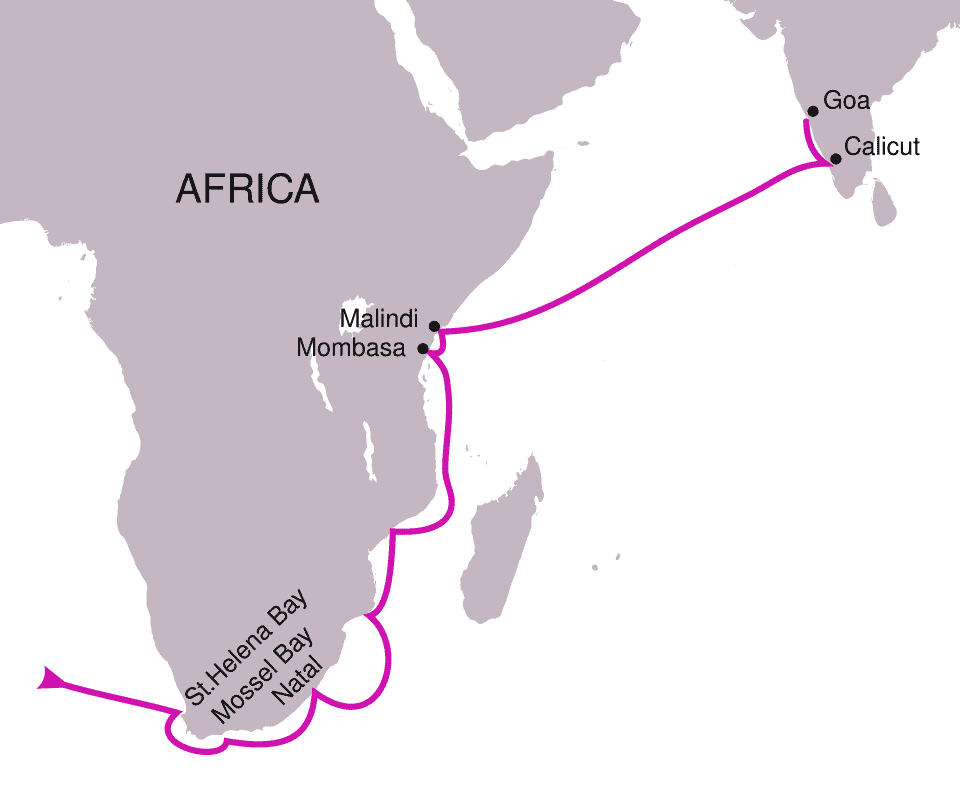
Image credit: PhiLiP, CC BY-SA 3.0 (via Wikimedia Commons)
That was the end of the short friendship between the Portuguese and the Hottentots of St. Helena Bay. The next morning they set sail again and six days later they rounded the Cape of Good Hope and landed in what is now South Africa. They spent two weeks gathering supplies and transferring the goods from their storage boat onto the other three ships so the storage boat could be left behind. Another group of Hottentots appeared from the hills, but this time the relationship was friendly from start to finish. When the sailors embarked again, the Hottentots stood onshore playing farewell songs with their flutes, which the Portuguese answered with their trumpets. Then all broke into a dance – the Hottentots on land and the sailors on shipboard.
In the middle of December, da Gama’s crew arrived at the farthest point reached by Bartolomeu Dias nine years earlier. From here on, they were in unchartered waters. It was at this point, out at sea again after so many months of travel, and headed into the unknown, that Vasco da Gama had to quell the rebellion of the sailors who wished to turn back.
With everything back under control, he worked his way eastward until he rounded the tip of Africa, and then the fleet headed north along its eastern shores, stopping now and then to explore unknown lands and to leave one of the stone pillars. Whenever they landed, more Hottentots met them or by tribes of Zulus, all of whom offered them food, water, animal skins, and ivory, in exchange for trinkets the sailors had brought from home.
Encounter with Indigenous Peoples along Africa
Finally, in March 1498, the Portuguese came across a different type of civilization – where the people lived in attractive white houses and were fully clothed like Europeans. They had finally stumbled upon the great trading centers of their enemies, the Moors.
The first Muslim colony the sailors encountered was in Mozambique, but in a strange twist of fate neither, people recognized the other as their enemies. The sultan of Mozambique presumed the sailors were followers of Muhammad and the sailors presumed these civilized looking tradesmen must be Christians. For a while, all was well. But then Vasco da Gama asked the sultan if he could supply some men to guide his fleet through the Arabian Sea – the northern section of the Indian Ocean. Once these men were on board they soon realized that the sailors were Christians and they deserted. When da Gama heard the sultan was now planning an attack, he quickly sailed onward. Perhaps, he thought, he could find guides at another port along the way.
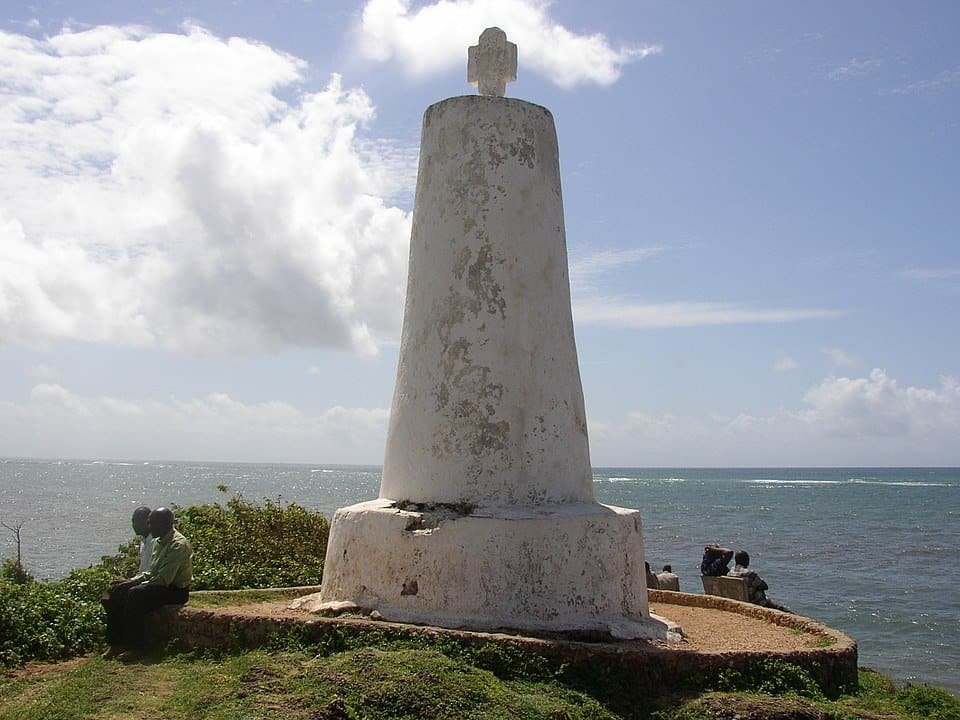
Image credit: Mgiganteus, CC BY-SA 3.0 (via Wikimedia Commons)
The next stop was Mombassa but there was no friendly welcome waiting for the sailors there either. Instead, the Moors launched plans to seize the Portuguese fleet, and Vasco da Gama was forced to level their waterfront with his ship’s cannons. Weary, the sailors traveled on to the next port – Melinda – the largest Arab port in east Africa, located in what is now Kenya. Here, the sultan had already heard about the large cannons the Portuguese carried so he readily supplied them with food and more valuable yet, an elderly man named Ibn Majid who was the finest navigator of the Arabian Sea.
Arrival in Calicut and Initial Challenges
It was the Arab Ibn Majid who successfully guided Vasco da Gama and his fleet across the waters of the Indian Ocean and up the coast of India to the great city of Calicut. When they first spotted the shadowy lands of India, the crew knelt down on the deck and thanked God for bringing them safely to their goal. Three hundred and fourteen days had passed since the ships had left Lisbon, but they had fulfilled their promise. They had opened a sea passage for Portugal and all of Europe, to the rich lands of the East. Now they had only to collect their bounty and return home the way they had come.
For one day and one night, the ships cruised the coast of India, scanning the wide sandy beaches of its shores. Then, on May 20, 1498, they arrived at Calicut. In its harbors were many ships with brightly colored sails. Sailors were loading and unloading cargoes filled with the spices, silks, and jewels that had made India famous throughout Europe. Vasco da Gama and his men were eager to have their share. They disembarked, erected one of their stone pillars to prove they had reached India and marched hopefully into town to make trade arrangements.
What da Gama had not been counting on was the Hindu King of Calicut – a conflicted, ambivalent ruler named Zamorin, who wasn’t quite sure what to do about Vasco da Gama. At first, the Portuguese made the same mistake they’d made with the Arabs on the African coast. They mistook the Hindus for Christians. But soon they recognized that Zamorin and his people followed yet another faith, so any hope of approaching them as “brothers” was abandoned.
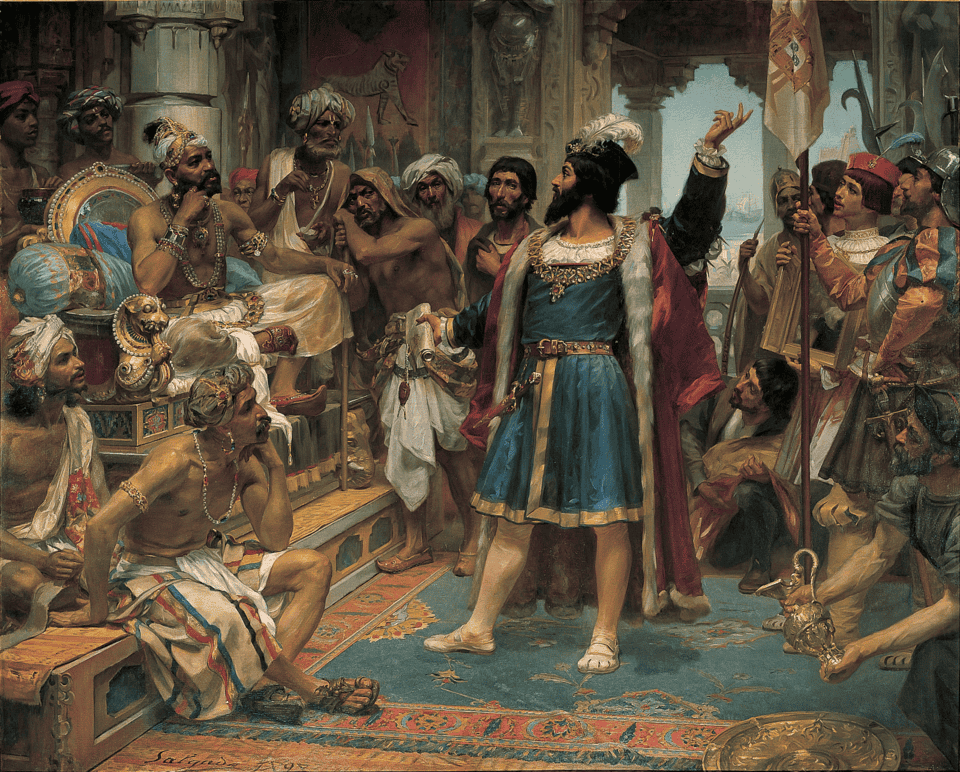
Image credit: Sociedade de Geografia de Lisboa, public domain
Vasco da Gama got off to a bad start when he presented Zamorin with gifts brought from Portugal, which the Hindu leader considered worthless. The gifts were suitable for Africa but the Portuguese, knowing little of India, had underestimated how culturally refined it was. Da Gama then presented Zamorin with his proposal that they conclude a trade agreement between their two countries. Zamorin liked the idea of establishing trade with Portugal, a country that da Gama assured him was the most powerful country on earth. Da Gama had promised that in exchange for India’s riches, Portugal would send ships loaded with far better goods than his ships had come with – things like gold, silver, and elegant cloth. This sounded much better to Zamorin, but unfortunately, he had political concerns to address. Arab merchants in Calicut had no desire to share their wealth with a Christian king. For many years they had been sending spices and jewels to Europe over the slow, dangerous land route. It was obvious to them that da Gama had discovered a far better route, a sea passage that might put them out of business. So they pressured Zamorin to arrest him. He was a pirate, they said, with a secret plan for sacking the city. His letter from this king was a sham – anyone could have written and signed it. Zamorin had no idea whom to believe. On two different occasions, he invited Vasco da Gama and his crew to the palace where he held a gala celebration for them. Then, on a third occasion, he threw da Gama and thirteen of his men into prison, at the insistence of the Arabs. He released them only after da Gama’s brother, Paul, and the other captains still on the ships, threatened to put their cannons to use.
In the end, Vasco da Gama managed to convince Zamorin of his sincerity. He sailed from Calicut on August 29, his ships’ holds bulging with cinnamon, cloves, ginger, nutmeg, pepper, and precious jewels. Onboard were a half dozen Hindus, one of whom Zamorin had sent as his official ambassador to Portugal. The others were invited so that King Manuel could learn about their customs and beliefs.
The trip back to Lisbon was long and difficult. This time the fleet was sailing against the wind – it had taken them 23 days to cross the Arabian Sea to India but it took them three months to cross it back to Africa. As the ships headed into the southern parts of the Indian Ocean, a dreadful case of scurvy hit the crew. So many men were lost that Vasco da Gama had to burn one of his own ships, the Sao Rafael, for lack of a crew to handle it. Now only two of the original four vessels remained. And of the 170 men who had left Portugal, there were now only 55.
After the two ships rounded the tip of Africa and headed into the Atlantic, they were battered by storms and became separated at sea. They never found each other and returned to Lisbon separately, almost two months apart. Vasco da Gama made a side trip to the Azores, where he spent some time recovering from the death of his brother Paul, who died of consumption on the islands.
The first ship – the Berrio – staggered into the port of Lisbon at the beginning of July in 1499. Da Gama’s ship, the Sao Gabriel arrived on September 9, after a journey of two years and nearly 24,000 miles. The entire city came out to meet Vasco da Gama and the celebrations continued for days. King Manuel was pleased with the riches Vasco da Gama presented to him; he was delighted with his Hindu ambassador from India, and all of Portugal was proud and excited that they had found the very first sea route to the lands of the East.
Vasco da Gama was well rewarded. He was given money, an annual pension, the title of “dom” which is equivalent to the English “Sir,” and a parcel of land. Only a year later he married a noblewoman named Catherine de Ataide and together they had six children, all of the boys.
Vasco da Gama, however, was not the type to settle into a comfortable domestic life in the suburbs of Lisbon. Three years after his return to Portugal he set out for India once again, but this time it was a mission of the war.
After Vasco da Gama returned to Portugal, the king sent another fleet to India, under the command of Pedro Alvares Cabral. Cabral left some of his men behind in India and word soon reached Portugal that the men had been massacred. Hindus, who had been incited by Muslim traders, had committed the murders. King Manuel wanted revenge.
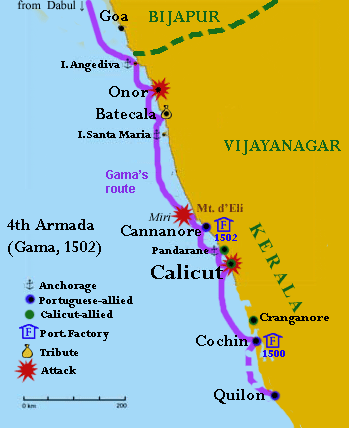
Image credit: Walrasiad, CC BY-SA 3.0 (via Wikimedia Commons)
In 1502 the King sent Vasco da Gama to take possession of Calicut and all other trading centers along the eastern coast of Africa and India, to break Muslim control of the area. With the title of Admiral of India, and twenty ships – ten of them warships – he set out to claim for Portugal the lands he’d discovered in 1499. After a series of brutal naval bombardments of ports on both sides of the Indian Ocean, and the massacre of many innocent Indians and Muslims, he accomplished his mission. His most savage assault was at a port in southwestern India called Cannanore. He lay in wait at the port for the arrival of Arab ships. After several days, one ship approached, bearing merchandise and as many as 400 passengers, many of them women and children. Da Gama seized the cargo, locked up all the passengers in the hold, and set the ship on fire, killing everyone on board. Then he moved on to Calicut and his old friend Zamorin. Zamorin approached in peace but Vasco da Gama demanded that he banish all Muslim traders from the port. To prove he meant business he massacred 38 Indian fishermen who had sailed out to his ships to sell their wares to the sailors. He had them thrown overboard so their bodies would wash ashore and be seen by all. After a few more battles and several forced alliances, da Gama returned to Lisbon for a second hero’s welcome. Now, much of India was under Portuguese rule and would remain so, until the Dutch arrived and seized control 160 years later.
Again, Vasco da Gama was showered with gifts, money, and honors, including a large grant of land that made him a count and one of the wealthiest men in Portugal. As part of his privileges, he was entitled to collect taxes and rents in two Portuguese towns. Apparently, Vasco da Gama was dissatisfied with his rewards and felt he deserved even more – in particular, he wanted the leadership of his hometown, Sines. After a few years of debate, he was awarded Sines as well and was once again on friendly terms with his government. Da Gama became an important advisor to the king of India and divided his days between duties at the royal court and time spent with his family on his private estate. But his days of travel were not yet over.
After da Gama’s second trip to India, King Manuel died and was succeeded by King John III. The new monarch sent Vasco da Gama back to India in 1524, as viceroy, or governor, of all the territories he’d won for Portugal on his second trip. His assignment was to establish some sort of administrative order in India, a task that was almost as difficult as his famous crossing of the Indian Ocean. Vasco da Gama was organizing this administration in the city of Cochin in India, when he died of an unknown illness, on Christmas morning, 1524, at about the age of 64. He was buried at a Christian monastery in Cochin but eleven years later his body was exhumed and sent back to Portugal where it was interred in a church on the estate he’d been given by his king.
Vasco da Gama legacy
Vasco da Gama, like almost all explorers and conquerors of the 15th and 16th centuries, was a man who made a dramatic impact on history, but whose behavior and actions are difficult to accept when viewed from a modern perspective. In the context of his own times, he behaved no better or worse than others of his class and culture. He was a man of enormous courage and skill, and a man of deep prejudice, capable of merciless brutality. He was a man devoted to God and his church, loyal to his king and country, with no regard or tolerance of other religions, races, or cultures. He was, in short, a typical 15th century European.
What was not typical was what he accomplished. He was the very first European to travel by sea to India. He was therefore the first to open an all-water trade route between Europe and Asia. This route was the only direct connection between East and West since Marco Polo had traveled overland two hundred years before. Because of Vasco da Gama, the rich lands of the East were open to direct trade with Europe. And also because of da Gama, the lands of the East became open to colonization. He laid the foundation for the vast Portuguese empire that included colonies in Africa, India, and the Spice Islands. He made Portugal a world power and ushered in a new era in world history.
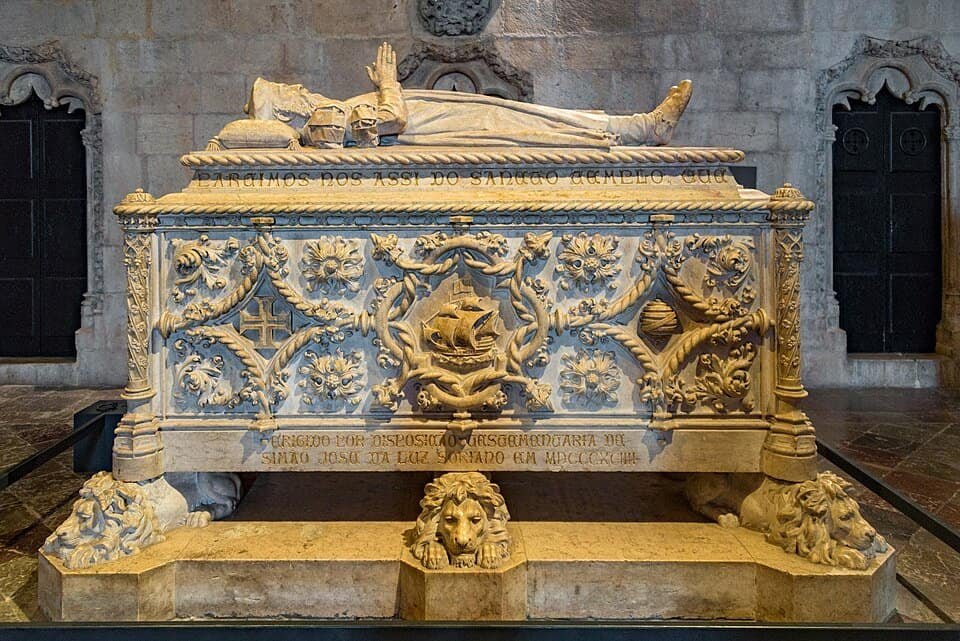
Image credit: xiquinhosilva CC BY-SA 2.0 (via Wikimedia Commons)
Most importantly, Vasco da Gama was instrumental in formulating a cultural link between East and West, which before his time existed as almost two completely different worlds. If there is a moment at which East met West, and West met East, it was the moment in 1499 when Vasco da Gama sailed out of the Indian Ocean and onto the shores of India.
References:
- Ames, Glenn J. (2004). Vasco da Gama: Renaissance Crusader. Longman;
- Ames, Glenn J. (2007). The Globe Encompassed: The Age of European Discovery, 1500–1700;
- Corrêa, Gaspar (2001). The Three Voyages of Vasco da Gama, and His Viceroyalty
- Diffie, Bailey W.; Winius, George D. (1977). Foundations of the Portuguese Empire 1415–1580. Minneapolis: University of Minnesota
- Vasco da Gama (Ernst Georg Ravenstein, Gaspar Corrêa, Alvaro Velho) [2011] Viartis

