

Cover image: Preus Museum Anders Beer Wilse, licensed under CC BY 2.0.
From North Pole Disappointment to a Bold New Goal
Roald Amundsen’s South Pole expedition of 1911 is one of the greatest feats of exploration in history — but it almost never happened. In the year 1909, in the country of Norway, Roald Amundsen read his morning paper and a deep frown settled on his face. For two years now he had worked day and night preparing for a journey that was to fulfill a lifelong dream. Now the dream was shattered. Papers throughout the world were announcing the news that Edwin Peary, an American explorer, had reached the North Pole. Amundsen had dreamed of being the first to discover the North Pole since he was a child. In recent years he’d worked tirelessly to acquire the backing and support such a trip would require. He had researched and studied maps, gathered equipment and supplies, obtained a ship, put together a skilled crew, and now, just when he was ready to embark, someone else had beat him to it. Peary had been discreet about his expedition – Amundsen had known nothing about it until he read in the paper that it had already been accomplished.
Most men in Amundsen’s place would have felt defeated by what they read. Most would have cancelled their plans, cut their losses, and spent the rest of their lives mourning their lost opportunity. But Roald Amundsen wasn’t most men. In an instant he made a very bold decision. His expedition would continue as planned. But since the North Pole had already been conquered, he would head instead towards the South Pole. Many explorers had tried to reach the South Pole and all had failed. It was a challenge equally as worthy as the one he’d just missed. Amundsen tossed out his maps of the Arctic, and began to pore over his maps of the Antarctic.
Amundsen was a careful, studious man, with a scientific and methodical approach to everything he did. He thought carefully about his next move. And he decided that he would tell no one, except a very few close associates, that he had changed his plans. Let the world think he was still headed for the North Pole. Let his crew think they were sailing north. Sooner or later they would find out the truth. But for now, he would be discreet, as Peary had been. He was unsure whether the man who had given him the boat for his trip to the North Pole would let him keep it for a trip to the South Pole. He was unsure that his backers would support his change of plans and he was unsure that his crew would like it. Better to keep quiet.
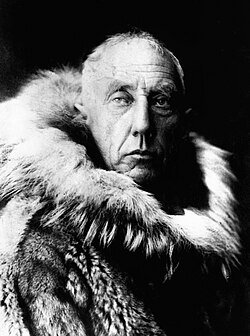
On August 9, 1910, when Roald Amundsen set sail from Norway with nineteen colleagues and one hundred Eskimo dogs, both his friends and the public thought he was on route to the Arctic, via the Pacific Ocean. A month later the ship dropped anchor near the Madeira Islands, off the coast of Africa. Amundsen paced up and down the deck in the hot tropical sun and prepared himself for an announcement that he knew would shock his crew. Finally, he called all the men on deck. Amundsen first talked about Peary’s discovery of the North Pole and how disappointing that news had been to all of them. Then he told them, as calmly as he could, that instead of simply following in the steps of Peary, they were setting out to make their own discovery. They were sailing to the opposite end of the earth to become the first men to reach the South Pole! Amundsen added that since the men had signed up for a trip to the Arctic, they were free to leave at this point, without any blame. The men listened, first in stunned silence. But then they began to cheer and pat each other on the back. One at a time they promised their captain they would stay with him. It was then that Amundsen made his second, startling announcement.
They were not alone in their quest to reach the South Pole. Amundsen had heard that an Englishman named Robert Scott had already left on an expedition to Antarctica – they were no longer just on a voyage of exploration; they were in a race! It was just the challenge the men needed. The cheers grew even louder and there were shouts of “Victory to Norway.” For the next hour, Amundsen was busy sending telegrams. He sent messages to his backers and to the owner of his ship, the Fram, that he was really on his way to the South Pole. Then he sent a telegram to Captain Scott announcing his plans and challenging him to a race to the Pole. Scott had been preparing for years for his expedition to the Antarctic and now his ship, the Terra Nova, with sixty-five men on board, was half way to the Antarctic when it received the news that Amundsen was going to try and get there first. The world press loved the story – newspapers carried huge headlines which asked – Who will get there first? England or Norway? Amundsen or Scott? It was a race the whole world watched. A few hours after he made his announcement, Amundsen ordered his crew to prepare to sail. They pulled up the anchor and watched as the sails filled with wind, anxious and excited to get started. It was a different crew than the one that had left Norway two months earlier, thinking it was headed for the already claimed North Pole – this was a crew with a mission. As the Fram sailed out into the ocean that day in September of 1910 some of its men were still cheering.
Amundsen’s Early Years
Roald Amundsen’s dreams of exploration had started almost as soon as he was able to read. He was born on July 16, 1872 on a family estate in southeast Norway but soon after the family moved to Christiania, the capital of Norway – now called Oslo. Roald’s father had made a fortune in the shipping business but although the family was wealthy, the children weren’t spoiled. Rather than buy them skis, Mr. Amundsen fashioned some home made skis out of wood planks and willow twigs so they could “learn the hard way.” Roald was the youngest of four boys and the smallest member of the gang his brothers formed with their friends. He learned early on to fight and to stick up for his rights. Childhood friends remember the day, when overpowered by his bigger brothers and their friends, Roald came running out of the woodshed waving an ax and screaming warnings at them.
When Roald turned fifteen he read a book that so inspired him that he dedicated himself then and there to the cause of exploration. It was written by Sir John Franklin, an English explorer who had tried for years to find the Northwest Passage. Before Franklin, Henry Hudson, John and Sebastian Cabot, and many other men had tried to find this passage between Newfoundland and Greenland, to Asia, but all had failed. Franklin failed too – but not before many explorations of the North American coast along the Arctic Ocean, and many dangerous and heroic adventures that stirred the hearts of young boys like Roald Amundsen. Roald read Franklin’s book over and over, enthralled by descriptions of his journeys across the frozen north, like this one: “We had no means of making a fire, the moss being covered by the ice and snow. On being exposed to the air, I became quite faint with hunger. We commenced our cheerless march. The ground was covered with snow a foot deep, and we had to cross swamps and marshy places, sometimes stepping up to the knee in water, and at others on a slippery stone, which often brought us down. The men who carried the canoes had a most laborious task. They frequently fell down. The best canoe was so damaged as to be rendered wholly useless.”
Roald’s admiration for Franklin was heightened even more by the Englishman’s tragic death on his third expedition into arctic waters. His ship became frozen in the ice and Franklin died on board. His men struggled to return to civilization on foot, but they perished on route from starvation. Amundsen later described his reaction to reading Franklin’s book, saying it filled him with a longing “to suffer for a cause, and not in a burning desert, but in the frosty north.” After reading Franklin’s book, Roald devoured every other book on the Arctic he could find. He launched a campaign to strengthen his body, spending long hours skiing and playing football. Even though he hated football, he played because he felt it hardened his muscles and increased his stamina.
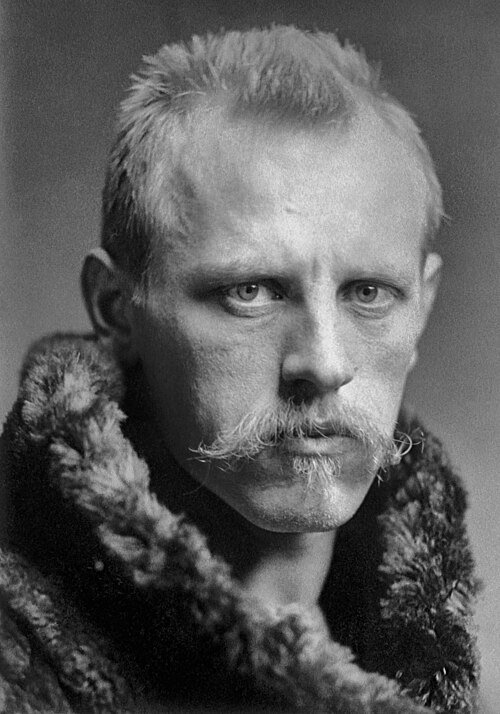
Image credit: Henry Van der Weyde (1838–1924). Public domain.
A few years after he read Franklin’s book, when he was then seventeen, Amundsen discovered another hero – and so did the rest of Norway. In 1889, a man named Fridtjof Nansen crossed the 500 mile ice cap that covers Greenland, aided only by skis and sledges pulled by dogs. When Nansen returned to Norway the young Roald Amundsen was among the hundreds of others who were cheering at the docks in Christiania. It was at that moment, he said later, that he knew what he was going to do with his life. He was going to live it as Franklin and Nansen had. The first major obstacle to Roald’s plan was his mother, Gustava. Roald’s father had died a few years before but Gustava, although a loving mother, could be just as tough as the sternest father. And she wanted Roald to become a physician. Obediently, Roald enrolled in medical school and pretended to be studying hard, while secretly reading books about exploration. He was beside himself with excitement when he read that his hero Nansen was planning yet another expedition to the Arctic, this one aboard his new ship called the Fram, a Norwegian word for “forward.” Nansen’s plan was to let the Fram freeze into the ice and then let it move with the currents across the Polar basin. Roald was down at the docks once again, this time to cheer Nansen as he headed out on his three-year experiment, which had been dubbed “the drift of the Fram.” Shortly after, Roald took his medical exams and failed.
Roald’s mother never knew of his failure and she died only two months later, conveniently freeing him to pursue his dream of exploration. He was now twenty-one. He was a tall man, very lean, with piercing blue eyes, a hawk-like nose, and a determined mouth. His mother had nicknamed him “The Last of the Vikings” and it was an apt description. He was a quiet man, not very talkative, but an attentive listener. He was something of a prude – he left the room if the conversation turned to sex, and he showed no interest in women and never married. He seemed, to everyone who knew him, to have only one single-minded interest in life – the Arctic.
Preparation for Polar regions
Amundsen now set out with fierce determination to prepare himself for his own explorations. He practiced skiing in the rugged mountains of Norway. He studied astronomy, map reading, and surveying, and signed up as a sailor on every voyage he could. Finally, when he was 25 he found a place on a ship headed for one of the Polar Regions. The ship was the Belgica and its mission was scientific research in the Antarctica. Originally, the captain planned to encamp with his scientists on the mainland and send the ship to winter in Australia. But nothing happened as planned. Instead the ship was caught in ice off the western coast of Antarctica and the crew was stuck on board for thirteen months while it drifted slowly southward. For most of the men, it was a nightmare. The sun disappeared and for the next seventy days they lived, jammed together in the endless dark and the freezing cold. All the men became ill with scurvy, some lost their minds; and some even died. Amundsen was not among them.
To Amundsen, this was an experience of a lifetime. He kept himself busy studying the Antarctic and working on inventions that would make exploration of the Polar Regions easier. He created a new aerodynamic tent that was resistant to the fierce winds of Antarctic storms. He went out on an expedition to find seals and penguins so the fresh meat would cure the sailor’s scurvy. By the time spring came and the Belgica was released from its frozen prison, the crew had become the first group to spend a winter in the Antarctic. And Amundsen was brimming with ideas about his own first expedition – he had decided he would find and cross the elusive Northwest Passage. Explorers had been searching for the Northwest Passage ever since Christopher Columbus had discovered the American continents. These continents, which Europeans called “The Barrier”, stood between them and the rich lands of Asia with which they hoped to trade. Magellan had discovered one passage through, in a strait at the bottom of South America. But the Magellan Strait was a lengthy and difficult journey, barely worth the effort. So for hundreds of years men continued to poke around at the inlets all along the Atlantic shores of the New World, hoping to find a sea passage through. Finally, they’d become convinced that the only channel must be at the top of North America, through the icy waters of the Arctic. By the mid 1800’s everyone knew the passage was there – one explorer discovered its western entrance, another discovered its eastern entrance; and then two others managed to travel half way up, each from a different end. What remained was for one expedition to sail completely through, from one end to the other. Amundsen had resolved that this expedition would be his.
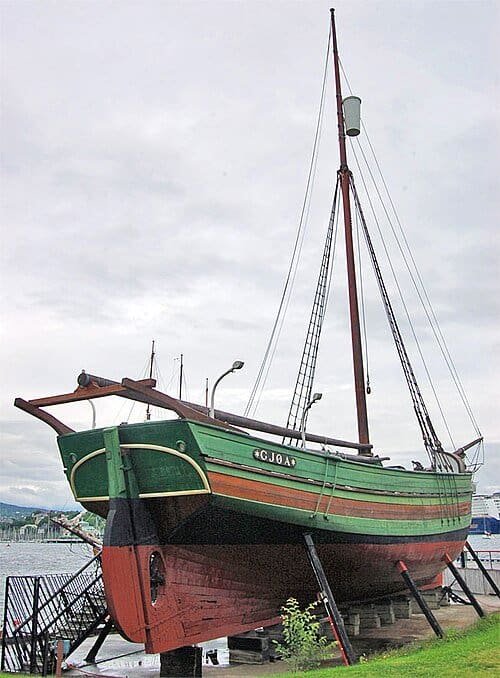
Image credit: Islandmen CC BY-SA 3.0 (via Wikimedia Commons)
For the next four years Amundsen devoted his full time and energy to preparing for his crossing of the Northwest Passage. He studied magnetism and meteorology and visited scientists who could help with his plans and studies. With his inheritance from his mother he bought a 29-year-old sloop called the Gjoa. It was a simple and modest little boat, weighing only 47 tons. Then he called on Fridtjof Nansen, the man who had first crossed Greenland and was the world’s expert on polar exploration. Nansen offered advice and helped Amundsen in any way he could. Finally, on June 6, 1903, when he was 37 years old, Amundsen boarded the Gjoa and set out into a blinding rainstorm to make history. Unlike John Franklin, who had a crew of 128 men on his last fatal voyage to the arctic, Amundsen took exactly six men. It was always his policy that a large task was best accomplished by the smallest number of people.
The Gjoa chugged through Lancaster Sound and in October became frozen into the ice. The crew set up camp on the coast of King William Island in Canada. The camp would be their home for almost two years. Although the spring thaw enabled them to move on, Amundsen stayed to try to find the answer to a question that had puzzled scientists for eighty years. At each end of the great magnet that is earth there is not just one pole, but two poles – the geographical pole and the magnetic pole. The location of the geographical pole in the north had already been determined. The magnetic pole had also been located. But what no one knew was whether the magnetic pole stayed in one place, as the geographical pole did, or whether it changed location. Amundsen led his men to the location of the magnetic pole that had been identified seventy years earlier by the explorer James Ross. When they arrived, their instruments told them the answer – the magnetic pole had moved. From then on scientists knew what they had always suspected – the magnetic poles of earth are not fixed spots, but are forever shifting their ground.
Amundsen also delayed his travels so he could acquaint himself with the Eskimos of the region, called the Netsiliks. He knew the Netsiliks would have much to teach him about travel and survival in the frozen north. With their help, he learned to erect igloos, how to find food, what to wear to survive the freezing temperatures, and how to train and manage Eskimo dogs. Finally, when he felt he’d learned all he could, Amundsen steered the Gjoa westward through the unchartered and dangerous waters of the Simpson Strait – then the Victoria Strait – then the Deane Strait, and finally through the Coronation Gulf and into the Beaufort Sea of Alaska. There, his men saw the stars and stripes flying above a whaler out of San Francisco. The whaler’s captain leapt aboard, vigorously shook Amundsen’s hand and congratulated him on his brilliant success. Amundsen’s first dream had been realized: he had conquered the Northwest Passage. Now he set to work on his second dream.
The first step in planning his expedition to the North Pole was to find a ship – and Amundsen knew exactly what ship he wanted. He wanted the same ship his hero Fridtjof Nansen had drifted in across the Arctic Ocean – he wanted the Fram. Amundsen visited Nansen, who was now Norway’s ambassador to Great Britain, in his castle-like home outside of Christiania. Nansen was an old man now and his duties for the state kept him very busy – his days of exploration were over. With a touch of sadness in his eyes, he passed his kingdom on to Amundsen and granted him the Fram. It was two years after he obtained the famous ship, that Amundsen discovered that Robert Peary had already conquered the North Pole. He quickly changed his plans, kept them secret until the Fram was already off the coast of Africa, and then steered his ship and his excited crew towards the waters of Antarctica, and the undiscovered South Pole.
Expedition to South Pole: Framheim and the Journey to the Pole
For nearly four months the men of the Fram sailed southward. They were a relaxed and happy crew and there was much laughter and conversation on board. It was mid January – summer in the southern hemisphere – when the Fram approached the Antarctica and saw before it the Great Ross Barrier…a natural phenomenon unlike anything else on earth. The Barrier is a solid wall of ice that rises 200 feet above the sea and extends four hundred miles from east to west, 200 miles north to south. Behind it is a great field of ice that covers much of the Ross Sea. To reach the South Pole from this end, the men would have to somehow haul their supplies over the massive Barrier. Amundsen carefully guided the ship eastward into the Bay of Whales. Here, other explorers had found that the ice hadn’t moved in many years and was probably located on land instead of water. Amundsen found a place where the edge of the ice was only twenty feet high and here they laid anchor and began to unload supplies. Right on the barrier itself Amundsen and nine of his men set up a base camp they called Framheim. Some of the men were worried – they feared the ice would split and float away. But Amundsen had carefully chosen a spot on the glacier that had reportedly not moved in 68 years. Once settled, he sent some of his crew with the Fram to South America for the winter. He and the rest of his men would stay alone on this cold, lonely ice field until it was time to begin the trek to the South Pole. At the same time, on the far east end of the Barrier, the English explorer Robert Scott and nineteen of his men set up a base called Cape Evans.
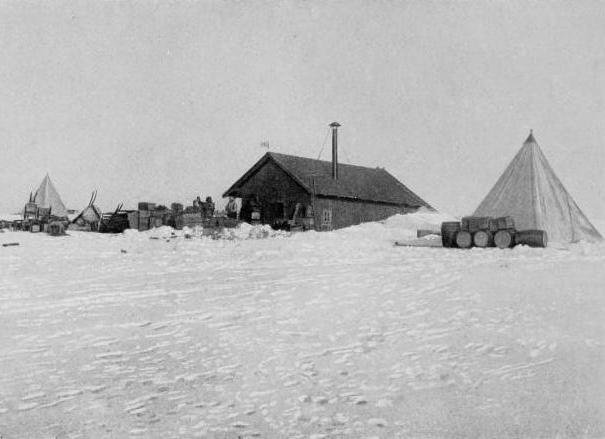
Nine months after landing, Amundsen and his men set out on a treacherous journey of 1400 miles to the point at the bottom of the world. On their way they would have to cross the enormous barrier, scale two mountain ranges, and cross the great central plateau of Antarctica. As was his style, Amundsen had planned the trek to the minutest detail. He used well-trained Eskimo dogs to pull the sledges, which were heavily laden with supplies. The skis his men wore had been specially designed for the polar snow and ice. And in a brilliant move that probably saved the lives of his men, he erected depots at seven spots along the route. At each depot supplies and food were stored so the men would have what they needed on their return trip, and could travel to the Pole more lightly. The depots were well marked with black flags and signposts so they could be easily located, even in dense fog. It took months to establish the depots – each one was a little farther from camp and a little closer to the Pole. By April the Antarctic winter was setting in and the temperature was dropping. The sun set and would not rise again until spring. For the duration of the long dark winter, the men would stay at the base camp, checking and repairing their equipment, and wondering if Scott had already reached the Pole before them.
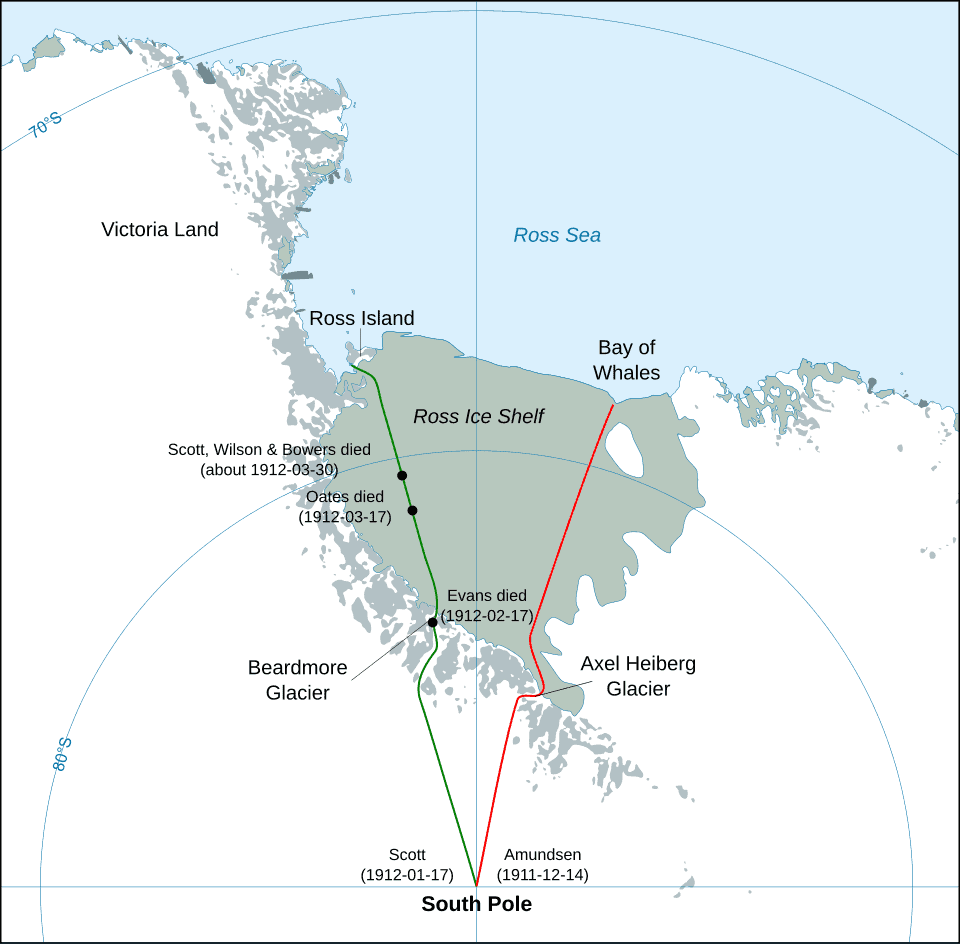
Image credit: Shakki. Public domain.
Triumph Over Adversity: Beating Scott and Returning Safely
Robert Scott had not reached the Pole before them. He too was waiting out the Antarctic winter at his base camp farther east. Scott had taken a different approach than Amundsen and had left many things to chance. The route he had chosen was a longer one than Amundsen’s, and less flat. He took only a few dogs and few of his men were trained in how to handle the animals. Instead, he hoped to rely on three motorized sledges and 21 ponies. The motorized sledges broke down and the ponies, unsuited for the rigors of polar life, became exhausted and suffered terrible deaths. Unlike dogs, they couldn’t curl up in the snow to protect themselves from the frigid temperatures. Shortly after the trip began all 21 ponies had died or been killed out of mercy. Without ponies, the men themselves had to pull the heavy sledges. They labored against fierce winds and severe cold, in clothes that were inadequate for the freezing conditions.
By the time spring arrived in late September, Amundsen had selected four men and 52 dogs to accompany him to the South Pole. They set out from the base camp with four sleds on October 19, 1911. As they traveled across the icy wilderness, they had to struggle through blizzards that made it hard to see, and violent winds that tore at their clothes and slowed their progress. Occasionally the men and dogs would fall into huge cracks in the ice and had to be pulled out with ropes. The depots proved to be invaluable. The sleds were so light the men could travel swiftly over the snow, and the provisions along the way kept them fit and healthy. In November, the party passed its last depot and headed onward, across the mountains and the steep glaciers of Antarctica. As they went, they built five more depots for the return trip. At last Amundsen and his men reached a wide, even plain where travel was easier. Anxiously, they looked for tracks in the snow or any other sign that Captain Scott and his party had preceded them. They saw nothing.
Amundsen and his men reached the South Pole at 3:00 in the afternoon on December 14, 1911. They erected a tent, raised the Norwegian flag, and took pictures of themselves standing reverently before it. They stayed in the area for three days, exploring the terrain and checking their instruments. Before they departed, Amundsen left a note for Scott, saying the Norwegians had arrived first, but offering him sympathy and congratulations on his own expedition. Amundsen and his men made their return trek to the camp, stopping at the depots along the way. Near the end of their journey, when the dogs were no longer needed to pull the sleds, the men killed the weaker ones and used them as food for themselves and the other dogs. They arrived back quickly and in good health.
A very different fate awaited Scott and his men. They reached the South Pole a month after Amundsen and found his note. Disappointed and weary, they started back across the ice towards their base camp. Scott had left depots along the way, as Amundsen had, but his were poorly marked and in the vast sameness of the frozen plains, they couldn’t all be found. The trek back was slowed by numerous blizzards and terrible storms and some of the men suffered injuries. In one storm in March, Scott and two of his men became separated from the rest of the party, and wandered for weeks without food. Finally, too weak and ill to go on, they curled up in a tent in the snow, and wrote the last entries in their diaries. Scott’s entire party perished of cold and hunger. When their bodies were located months later, the note that Amundsen had left at the South Pole was found in Scott’s pocket.
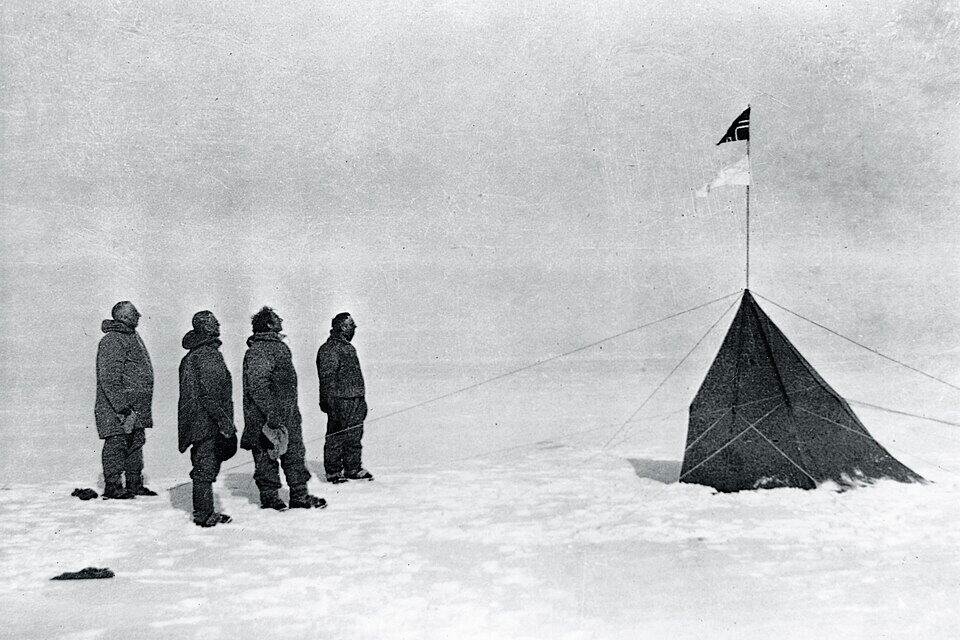
Image credit: Olav Bjaaland (1873–1961). Public domain.
When Roald Amundsen returned to Norway he was a world famous figure and a hero, just like Nansen before him. But the years that followed his discovery of the South Pole were difficult ones. First of all, he never felt he achieved the lasting fame and money he deserved from his journey. Ironically, it was Robert Scott who was remembered as a hero. The obstacles he’d endured and his tragic death on the ice captured the imagination of the public more than the relatively easy trek made by Amundsen and his men.
Furthermore, Amundsen was never able to find a challenge to match his great achievement in Antarctica, and he grew restless and dissatisfied. He used the funds he’d earned from his adventure – which included fees for books and speaking engagements – to establish a successful shipping business. But always, he craved more adventures. He came up with several ideas for expeditions but none of them came to pass. Then, from 1918 to 1920 he took his last great sea voyage. He traveled the Northeast Passage – from Norway through the Arctic Ocean to the Bering Sea. The Northeast Passage had been sailed before but Amundsen became the first to sail both the Northwest and the Northeast Passages. Still, he longed for more.
The first man to visit both poles
The year after his return from the South Pole, Amundsen saw his first airplane flight and realized the days of dog and sledge exploration were over. Future explorers of the Poles would do their exploring from the air. After the American Richard Byrd flew over the North Pole in 1926, Amundsen decided he would do the same thing, thus becoming the first man to visit both poles. He enlisted the aid of a brilliant Italian aeronautical engineer named Umberto Nobile. Nobile built and piloted an airship called the Norge that carried Amundsen over the North Pole. There, they hovered in the air while Amundsen surveyed the land and made notes about topography and wind directions. At the age of 54 he thus became the only man who could say he had seen both the North and South Pole. But after the history-making event the two men quarreled. Amundsen felt that Nobile was claiming more credit for the trip than he deserved. Nevertheless, it was Amundsen who set out to rescue Nobile two years later, when it was reported that Nobile’s dirigible had crashed on another flight in the arctic. When Nobile disappeared, Amundsen was 56 years old and under doctors orders not to engage in any more explorations or adventures. Nevertheless, he took off from Norway on June 18, 1928 with two other men aboard a plane called a flying boat, and headed towards the region of the Arctic where Nobile had sent his last radio message. A few minutes later a fisherman saw the plane as it was heading into a fog bank on the northwestern horizon. It was the last anyone ever saw of the plane or of its passengers.
Umberto Nobile was safely rescued a short time later by another rescue team. For months search teams from many different countries scoured the Arctic for any trace of Roald Amundsen or his airplane. None was ever found. How and where he died is not known. All that is known is that he’d fulfilled the longing he had as a teenager to “suffer for a cause” just as Sir John Franklin, whose death in the Arctic had first inspired Amundsen to conquer the polar regions himself.
Amundsen’s scientific achievements
The achievements of Roald Amundsen are many. He was a member of the first group to spend the winter in Antarctica. He conquered the Northwest Passage by being the first to sail from the Atlantic to the Pacific through the arctic waters of Canada. He determined the precise position of the magnetic North Pole and established the fact that it continually shifted. He led the first expedition to the South Pole. He was the first person to sail both the Northwest and Northeast passages. And he was the first to see both the North and South Poles, one by air, one by sled.
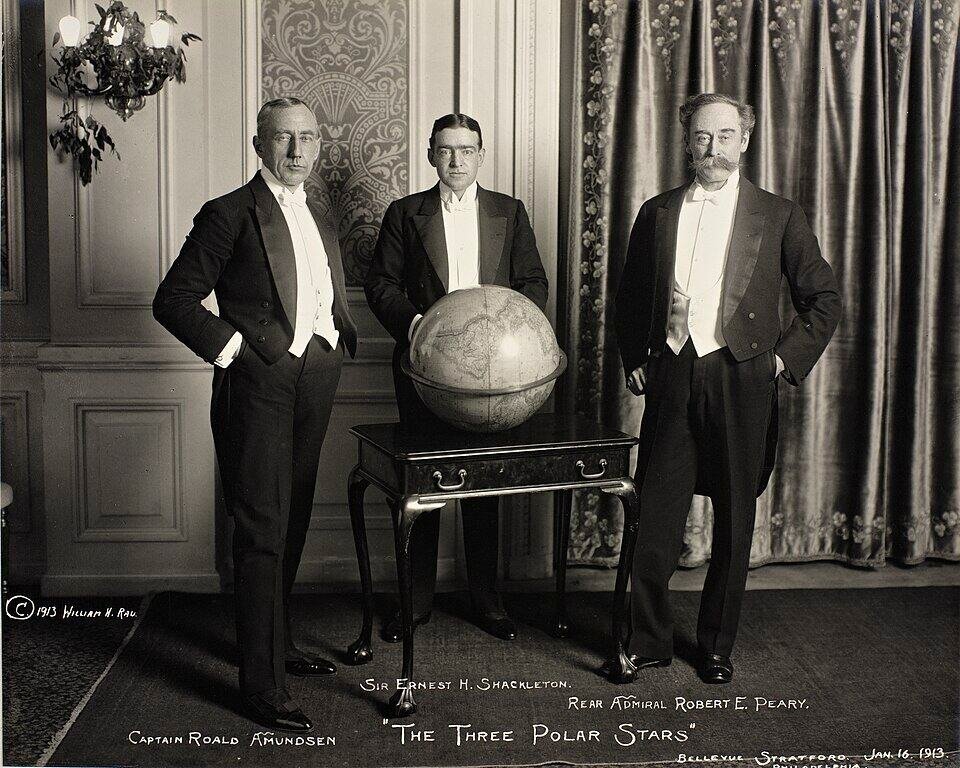
Image credit: Nasjonalbiblioteket from NorwayCC BY-SA 2.0 (via Wikimedia Commons)
Besides all these firsts, Amundsen left a volume of scientific information and research from his travels. His observations and discoveries helped many explorers and scientists who came after him. Roald Amundsen possessed two characteristics that probably contributed more than any others to his repeated successes. First of all, he was a meticulous planner. He carefully thought through every step and detail of his expeditions, acquired the top equipment, and obtained all the knowledge and skills he needed. Sometimes these arrangements took years. But he never allowed impatience or urgency to interfere with his caution. He was a man who left nothing to fate. Secondly, he was enormously single-minded. Through his entire life he had only one focus and one interest and that was exploration of the Polar Regions. Once he’d identified that focus, he poured all his time and energy into it. His mind was always on his goal.
Like many great achievers, Amundsen had a clear, well-defined vision of what he wanted to accomplish. When that vision was threatened, by Commander Peary’s discovery of the North Pole, he quickly formed a new vision, The South Pole. Then he put all his resources to work at making that vision a reality. Yet in spite of all he achieved, Roald Amundsen is remembered and admired for his death almost as much as for his life – he’s admired as a man as much as he’s admired as an explorer. He didn’t hesitate an instant to risk his life to save a fellow explorer, even though he felt that man had once wronged him. That is why, although he conquered the Northwest Passage and the hostile terrain of the South Pole, his greatest trip of all was perhaps his last. He made no discoveries on that trip, he conquered no new territories, but his contribution to the human spirit was as great as any he had made to science.
References:
- Amundsen, Roald; Nilsen, Thorvald;
- Prestrud, Kristian; Chater, A.G. (tr.) (1976) [1912]. The South Pole: An Account of the Norwegian expedition in the Fram, 1910–12;
- Huntford, Roland (1985). The Last Place on Earth.;
- Stephen Bown. The Last Viking: The Life of Roald Amundsen: conqueror of the South Pole
- Huntford, Roland (1979). Scott and Amundsen. London: Hodder and Stoughton.

