

Table of Contents
The Life-Saving Miracle: Joseph Meister and the Rabies Vaccine
In 1885, Louis Pasteur stood on the edge of one of the most important discoveries in modern microbiology. What pushed him over that edge was a little boy standing in the hallway, crying pitifully as people bustled about him. His mother stood nearby, wringing her hands and begging to see the famous doctor. The boy was only nine years old and his name was Joseph Meister. Joseph had been playing happily near his home in the Alsatian hills of France when a rabid dog suddenly attacked him. The dog would have killed him but for the intervention of a bricklayer who drove the beast off. As it was, little Joseph had been bitten fourteen times. There was no known treatment or cure for rabies or hydrophobia as it was called in humans. Hydrophobia means fear of water, but the disease didn’t actually make people afraid of water. Instead, rabies victims would suffer a terrible thirst so that the sight of water sometimes made them swallow. And swallowing was very painful because one of the symptoms of the disease was throat spasms. There were other symptoms too, all of them agonizing – extreme restlessness, rage, shuddering, convulsions, paralysis, choking – and eventually death. Sometimes the symptoms didn’t appear for a week or more, but when they did, it was just a matter of time.
Little Joseph wasn’t showing any symptoms yet but there was no doubt he would. The boy had been savagely attacked and the dog had been frothing at the mouth and acting wild and confused. Everyone knew it was rabid. And everyone knew what came next. The mother’s eyes were red with crying and the boy too was sobbing now – he was in pain, but more than that he knew that everybody believed he was going to die.
The desperate mother had come to the only man she thought might have a chance of saving her child. He had saved many people’s lives, this brilliant scientist in his magical laboratory in Villeneuve l’Etang. Of course, none of those people had suffered from rabies. But she had heard he was studying rabies. Perhaps he could work yet another of his miracles.
Louis Pasteur heard the commotion from his laboratory and came out to see what the fuss was about. When he saw the little boy and heard the mother’s story, his heart was torn in two. It was his natural impulse to do anything he could to relieve suffering. He had lost three children to disease, three beautiful little girls, and he couldn’t bear the idea of not doing something to save the little boy weeping before him. But no one had ever tried to treat rabies before – the very treatment itself might kill the child.
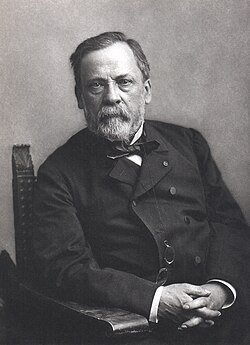
Image credit: Paul Nadar. Public domain.
Louis Pasteur had been researching rabies for several months. He knew a virus so small it couldn’t even be seen through his microscope caused it. He also knew it tended to concentrate in nerve tissue. With that in mind, he had prepared vaccines from the spinal cords of rabid animals, using the same principles he’d used in making other vaccines. He used oxygen to weaken the infection, and then he gave other animals a series of immunizations, each a little stronger than the previous one. Always, he anesthetized the animals first so they felt no pain. Louis Pasteur had been fearless in his work – handling the rabid animals himself and even once using a tube to suck the saliva out of the jaws of a rabid bulldog that was being restrained by his assistants. Someday he hoped to perfect his immunization method for use on humans but first, he had asked a commission to evaluate his experiments. That commission had not even had time to reach its conclusions, and here before him was Joseph Meister, his eyes wide with fear, his small body quivering with pain. Finally, Pasteur made up his mind – without treatment, the boy would surely die. There was nothing to lose and everything to gain.
Pasteur began treating Joseph with the exact method he had used on his animals in the laboratory. He would give him twelve injections, each one a little stronger than the last. It was a process that left Louis Pasteur badly shaken. He had to guess at the dosage and was frightened about possible after-effects. After each dose of the vaccine was injected into the boy’s side, Pasteur had nightmares in which the boy was suffocating, and it was he who was killing him. He became so overwrought, he got ill, and the injections had to be given by an assistant. There was a long incubation period after the immunizations, so Pasteur removed himself to the country, where he could recuperate and wait out the results. He lived in dread of the fearful message that Joseph had died. But the message, when it arrived, was not dreadful; it was jubilant! Joseph had survived. And he was well and healthy – the first human being to be successfully vaccinated against rabies.
Now Pasteur was inundated with patients. Because rabies often didn’t hit until weeks after the person had been infected, victims of dog bites flocked to his laboratory from all over the world, seeking his help. America raised funds to send orphans and charity cases to him. Nineteen Russians who had been bitten by rabid wolves showed up at his door. People came from England, Hungary, Spain, and Holland. Many people knew only one word of French: “Pasteur.” He helped them all, and he saved almost every one of them.
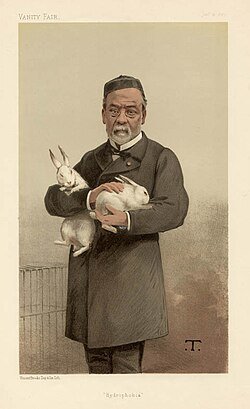
Image credit: Théobald Chartran (1849–1907). Public domain.
A half-century later, in the year 1940, Joseph Meister was made the official gatekeeper at the Louis Pasteur Institute. Joseph, who was then 64 years old, was proud of his chance to humbly serve the man who had once saved his life, and the lives of so many others. Then, when the Germans occupied France, a Nazi official commanded Joseph to open Pasteur’s burial crypt. No one knows what the Germans were looking for or what they hoped to achieve by opening the crypt. But rather than obey their command and violate the memory of the man he so respected, Joseph Meister committed suicide.
Louis Pasteur inspired the dedication, gratitude, and love of millions of people. Scientists will forever be grateful for his pioneering work in chemistry that laid the foundation of modern microbiology. The public will be forever grateful that he launched a new era in immunizations that protected the health and saved the lives of millions.
There was one great invention, one magnificent instrument that made the achievements of Louis Pasteur possible – the microscope. The microscope had been discovered almost 200 years before Pasteur but scientists had still only begun to explore the vast tiny world revealed by its lens. What they had seen only confused them. Some scientists believed the tiny organisms visible under a microscope generated themselves spontaneously – that is, they just developed life independently in a vacuum. In the 1500s, one scientist went as far as to suggest that if you filled a jar with dirty rags, a quantity of wheat, and cheese, and put a lid on it, mice would grow. Others conducted experiments that proved spontaneous generation didn’t exist, but somehow this didn’t stop the controversy. Besides the debate over the origin of microorganisms, was the controversy over what they did. Some believed they caused disease and others believed they had no connection with disease. Both these questions – as to how germs developed and whether they caused illness, would be answered once and for all by the work of Louis Pasteur.
Louis Pasteur early life and career
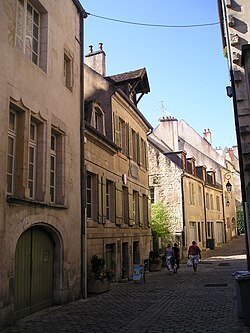
Image credit: KBWEi. Public domain.
Louis Pasteur was born in France on December 27, 1822, the year after Napoleon died. His father was a tanner and his mother came from a family of gardeners. He attended primary and secondary schools, but he was a lackluster student, preferring fishing and searching for hidden treasure to studying. Most of all he loved to draw. He made numerous pastels and portraits of his family and friends. When he was sent off to secondary school, Pasteur was so homesick he became ill and begged to come home. His kindly father agreed. It was a close-knit family, and his parents and sisters had missed him as much as he missed them. Louis Pasteur did better at college where he earned two bachelor’s degrees, one in the Arts, one in Science. The diploma in science described his performance in chemistry as “mediocre,” but he told his father to be patient – he would do better as he went on. Even as a young man he had developed a formula for success, which he wrote down in a letter to his sister: “To Will is a great thing, for Action and Work follow Will, and almost always Work is accompanied by success. Will opens the door; Work passes them, and Success is waiting to crown one’s efforts. These three things will work, and success, between them, fill human existence.” They were three things that Louis Pasteur would have in abundance.
Louis Pasteur landed a post as a professor of chemistry at the University of Strasbourg. He fell in love with a young woman named Marie Laurent, the daughter of the university’s rector, and in only two weeks he proposed. As was customary in those days, Pasteur first wrote to her father, saying:
“My father is a tanner at Arbois. My sisters help him in his business and in the house, taking the place of my mother whom we have had the misfortune to lose last May. My family is comfortably off but not rich. As for myself, I have long ago resolved to surrender to my sisters the whole share of the inheritance, which would eventually be mine. I have therefore no fortune. All that I possess is good health, good courage, and my position at the university. I plan to devote my life to chemical research with – I hope – some degree of success. With these humble assets, I beg to submit my suit for your daughter’s hand.”
The rector turned the matter over to his daughter, whose response was lukewarm at best. But Louis Pasteur put his Will-Work – Success theory into operation and took his case next to Marie’s mother and finally to Marie herself. He begged her not to judge him too hastily, saying, “Beneath this cold, shy and scarcely pleasing exterior, there is a heart full of affection.” Marie was finally won over and agreed to marry him. Even though Pasteur was late for his own wedding because he was in the middle of an experiment, the marriage lasted forty-seven happy years and produced five children.
Discoveries in Fermentation and Pasteurization
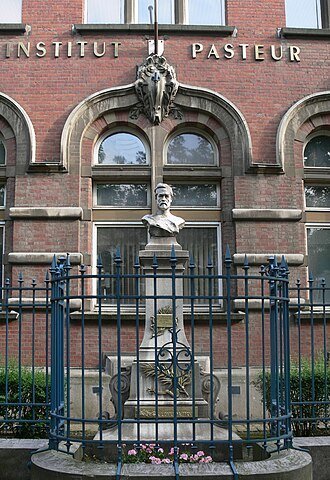
Image credit: Lamiot / CC BY-SA 3.0 (via Wikimedia Commons)
When he was 32, Louis Pasteur became dean of sciences at a new university in Lille, where he would make one of his earliest and most dramatic discoveries. The discovery resulted from a problem with beer. A manufacturer in Lille complained to Pasteur that his alcohol often became contaminated in the fermentation process. He was losing money and he didn’t know what to do about it. Louis Pasteur went to work, spending hours at his microscope examining the yeast that appeared during fermentation. At that time, scientists believed that yeasts were dead and consisted of nothing more than decomposing chemical substances. But suddenly Pasteur had a new idea – a radically new idea. It occurred to him that yeast was not dead, but alive. And far from being a product of fermentation, it caused fermentation. It was living organisms that did it!
Over time, Louis Pasteur continued to work on this theory and to disprove the idea that yeast was decay. He studied the fermentation process of beer, wine, vinegar, and milk until he could prove that fermentation was always an active, living process caused by microorganisms. These microorganisms could live with or without oxygen, and they extracted energy from the organic substance being fermented. That was how yeast, in a fermenting solution of grapes, would change the sugar in the grapes to alcohol, thus producing wine. When he shifted his attention to milk, he made the discovery that milk became sour when microorganisms changed the sugar in milk, called lactose, into lactic acid. These discoveries were the beginning of modern-day microbiology.
When Louis Pasteur discovered that harmful germs in wine and vinegar could be destroyed with heat, he invented the process now known as pasteurization. It made it possible for manufacturers in France, and everywhere else, to produce, preserve and transport their products without fear they would spoil. Even as he made his discoveries and proved them scientifically, there was always resistance. Many scientists clung stubbornly to the old views, even those of spontaneous generation. Louis Pasteur was a gentle and compassionate man, but he was also a fighter. He spent most of his life defending his discoveries and patiently explaining his work to critics, many of who had never even conducted one experiment in his field. It was a lifelong campaign of Louis Pasteur to eradicate ignorance and awaken people to the truth. He courageously took on the issue of spontaneous generation, even when a professor warned him it was too controversial and would cause him trouble and grief. Pasteur once said: “A man of science may hope for what may be said of him in the future, but he cannot stop and think of the insults – or the compliments – of his own day.”
Louis Pasteur finally disproved the theory of spontaneous generation in experiments he conducted in flasks with S-shaped necks. The curve part of the S caught the microbes in the air, allowing the solution at the bottom of the flask to remain uncontaminated. Still, some wouldn’t believe that microbes existed free in the air. So Pasteur set out on a long journey. He took with him 73 flasks that held fluids in which bacteria could easily multiply. At different stops along his way, he opened the flasks and then resealed them. The trip reached a climax, both literally and figuratively, when he climbed high into the Alps at Mer de Glace. There he opened and quickly closed twenty different flasks – yet only one became contaminated. The reason for the clean flasks was that humans and animals often breathe bacteria into the air, where it then attaches itself to dust particles. But high in the Alps there were few life forms to spread bacteria, and less dust to absorb it.
Battling Silkworm Disease and Saving France’s Industry
Louis Pasteur had solved the economic and health problem of contaminated wine, beer, and milk – now France approached him with another problem. The silk industry was in trouble. The disease was spreading through the silkworms, drastically reducing production, at a time when silk was one of France’s major products. For twenty years the problem had been increasing and now thousands of people who relied on silk for their living were threatened with starvation. There were similar epidemics among the silkworms in Italy, Spain, Greece, Turkey, and China. At first, Louis Pasteur was hesitant to accept the challenge. “But I have never even seen a silkworm,” he said. Finally, he was persuaded. He moved to the south of France, the center of silkworm breeding, and began a precise and laborious study of silkworms that lasted five years. He interviewed the growers and began to collect eggs, larvae, and moths. When he didn’t find an immediate solution, the silk producers began to criticize and insult him, but he kept on. Finally, he did find the solution. He destroyed the silkworm moths after they laid their eggs. These eggs were then examined under a microscope. If the disease was present, the eggs were burned. If the eggs were healthy, they were cultivated. When seed producers heard he was burning eggs they were so furious they threw rocks at him. When asked by a friend what he was going to do about this, Pasteur replied: “Remain patient and remain here.” After some time, that patience paid off. The silkworm industry showed the first profit it had shown in ten years.
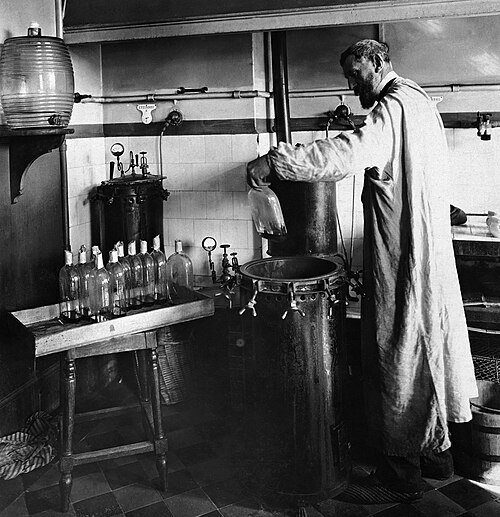
Image credit: Britannica Kids. Public domain.
His success in saving the silk industry came at the most difficult and tragic time of Pasteur’s life. He had already lost his oldest daughter, Jeanne, to typhoid fever. Then, while he peered at silkworm eggs under his microscope in Alais, came the news that his father had died. A few months later his two-year-old daughter, Camille also died. And next his 12-year-old daughter, Cecile, also succumbed to typhoid. Of his five children, only two remained. When a friend, unaware of the tragedies, wrote to Louis Pasteur to see how he was doing on his experiments, Pasteur wrote back:
“My studies have been associated with sorrow; perhaps your charming little daughter will remember Cecile Pasteur among the other little girls of her age that she used to meet at the Observatory. My dear child was coming with her mother to spend Easter holidays with me at Alais when during a few days stay at Chambery, she was seized with an attack of typhoid fever, to which she succumbed after two months of painful suffering. I was only able to be with her for a few days, being kept here by my work and full of deceiving hopes for a happy issue from that terrible disease. I am now wholly wrapped up in my studies, which alone take my thoughts from my deep sorrow.”
While he had been studying microbes under his microscope in Alais, microbes of a different kind had taken his children.
When Louis Pasteur was 45, Emperor Napoleon III was persuaded to build him a modern, well-equipped laboratory so he could pursue the studies that had proven so beneficial to France and its people. Work was begun in 1867 but the following year, the stress of his work and the grief over his losses finally began to exact their price. At only 46, Louis Pasteur had a stroke that left him paralyzed on his left side. After several months he recovered, but he never regained full use of his left arm. He once commented that the useless arm felt like lead to him and he wished someone would just cut it off. While he was convalescing, Louis Pasteur noticed that the workmen had stopped construction on his new lab, in anticipation of his death. For once his will failed him for a while, and he sank into a deep depression. Finally, the Emperor ordered the men to resume work, thus lifting Pasteur’s spirits and hastening his recovery.
Experiments with Chicken Cholera and the Principle of Attenuation
Back at work again, Louis Pasteur turned his attention to another disease that threatened both the health and economy of his nation -anthrax. “Do not think too much about things that have already been accomplished,” he said. Better to move on to new challenges. The primary victims of anthrax were sheep but it could infect other animals and occasionally people. The disease was threatening half the livestock of France. One moment a sheep would be healthy, the next minute it would be lagging behind the flock, its limbs shaking and blood spurting from its mouth. The farmers knew that in just a few hours there would be convulsions and then death. While he studied anthrax, Pasteur also began exploring chicken cholera, which was also an epidemic in France. Every morning poultry farmers would walk into their coops, only to find dead hens collapsed on their nests and roosters that had been strutting proudly the day before, now lying motionless in the dust. It was Pasteur’s experiments with chicken cholera that led to a mistake that would prove an important key to his immunization discoveries.
The mistake happened in his laboratory when he was injecting hens with the bacillus that caused cholera. By accident, he injected them with an old culture instead of a new one. The old culture had been exposed to oxygen and its microbes had been weakened, so the hens didn’t get the disease, as planned. But more importantly, they didn’t get the disease when he later ingested them with a fresh culture. The first, weak injection had made them immune. It was the most important discovery of Pasteur’s life and the one on which all modern vaccinations are based. The concept is called attenuation – it means simply that a virus is diluted or weakened; is then injected in a body; and the body fights it off without becoming ill but develops a resistance to further exposure of the same virus. Edward Jenner had pioneered the idea of immunization the century before Louis Pasteur. It was Louis Pasteur who expanded and perfected the idea for broader, more effective use. Jenner had used cowpox to prevent smallpox in humans – Pasteur showed that the microorganism itself could protect against the disease it caused.
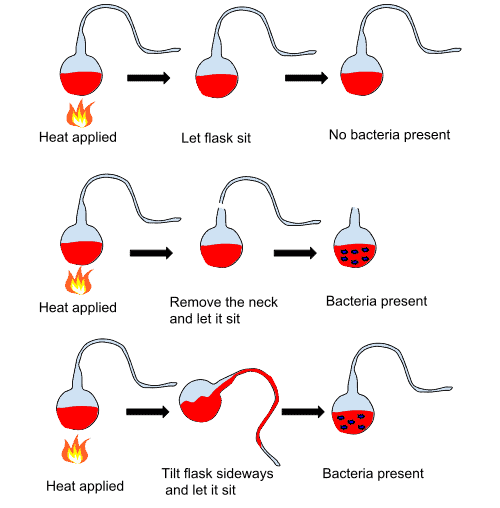
Image credit: Kgerow16 / CC BY-SA 4.0 (via Wikimedia Commons)
Anthrax Research and Public Demonstration
Confident over his results with chicken cholera, Pasteur now decided to try the same technique on anthrax. He gathered 25 sheep on a farm in the French countryside near Chartres and invited his critics and opponents to witness an experiment. Scientists, doctors, and journalists from around the world gathered to see whether Louis Pasteur would triumph or fail. He vaccinated half the sheep with a weakened form of the anthrax virus and the other half he left alone. His plan was to return after three weeks and give all the sheep an injection of anthrax that would normally be fatal. The spectators were invited to return and see the results.
They did return. There was a lot of excitement in the air that day in May of 1881 when Louis Pasteur gathered the sheep and gave them each a deadly injection of anthrax. He first announced: “The 25 unvaccinated sheep will all perish. The 25 vaccinated ones will survive.” Now everyone waited to see if he was right. Louis Pasteur was confident enough to make such a bold statement because he knew his theory was supported by years of study, experiment, and proof. It was the way he always worked – steadily and patiently, checking and re-checking every detail, conducting experiment after experiment, and never making a claim or a statement that he didn’t know he could fully support with hard scientific evidence. By the time Louis Pasteur said something was true, there was little chance of error.
Still, the first night on the farm was a hard one for Louis Pasteur. Someone had mistakenly told him that one of the vaccinated sheep was dying and he spent a restless night trying to understand what had gone wrong. But the next morning when he arrived at the farm, everyone burst into cheers and applause, even his critics. Twenty-three of the unvaccinated sheep were already dead and the other two were dying. But all of the vaccinated sheep were as healthy as before. The inoculations had worked. A disease that had long plagued farmers and ranchers had been vanquished. And there was hope many other diseases could be vanquished by the same method. Only the suffering of the sheep that had been forced to sacrifice their lives so that thousands of others might live dimmed Pasteur’s happiness.
It was after his triumph in the treatment of anthrax, that Louis Pasteur began his work on rabies and eventually saved the life of little Joseph Meister. By then he was 63 years old and his health was beginning to fail. Pasteur began to pull back on his intensive research and concentrated instead on teaching, inspiring many of his students on to their own great achievements in the fields of medicine and science. Never did he think of retiring, although the French government had voted him a stipend that guaranteed he would always have an income. “There is no amusement like work,” he said. In 1888, when he was 66, the Pasteur Institute was founded in Paris, with Pasteur himself as director. The Institute was built with thousands of contributions from around the world, from rich and poor alike. It became a leading center for teaching and research on virulent and contagious diseases.
Despite his curtailed activities, when he was 67 Pasteur made one more important contribution to medicine when he discovered the cause of what was known then as “childbed fever” by identifying the streptococcus germs.
In his last years, Louis Pasteur was the recipient of almost every scientific award possible. He was always proud to accept these honors but he was also humble. Once, he accepted an invitation to an International Medical Congress in London and was invited to come up to the platform. As he walked down the aisle thunderous applause burst forth from the audience. Turning to his son, he said: “The Prince of Wales is arriving, no doubt. I ought to have arrived sooner.” The President of the Congress had to explain that it was not the prince, but Louis Pasteur the audience was applauding. When he turned 70, there was a huge gala in his honor at the Sorbonne, hosted by the president of the Republic. The keynote speaker said: “You have raised the veil which for centuries had covered infectious diseases.”
A few years later, while working on a cure for diphtheria, Pasteur was stricken with a case of uremic poisoning. He lay for two months in gripping pain, hovering near death. When he recovered, he returned to the laboratory to supervise his students, but his days of intensive research were over. He retired to his country home in Villeneuve l’Etang where he converted the stables into a laboratory and continued to work on a diphtheria vaccine. Day by day he became weaker until finally he was put to bed. In his last days, he was too frail to lift his head for a sip of milk. He sank into a coma for 24 hours and then died quietly on September 28, 1895, at the age of 73. On one hand, he clutched a crucifix; with the other, he held the hand of his wife, Marie.
Louis Pasteur Legacy and Achievements: Modern Microbiology and Vaccination
Louis Pasteur had the satisfaction of living to see his discoveries put to the beneficial service of humanity throughout the world. His contributions were vast and varied, affecting fields of science, health, industry, agriculture, and animal husbandry. He founded modern microbiology, advanced the theory that germs cause disease, invented the process of pasteurization, developed vaccines for anthrax, rabies, and chicken cholera, and laid the groundwork for modern medicine. He saved the beer, wine, and silk industries of France and other countries. He also campaigned ardently for hygiene, sanitation, and sterilization, especially in surgical operations. He is responsible, either directly or indirectly, for the health and prosperity, and even the survival, of millions of people throughout the world. Scientists agree that Pasteur’s discoveries have done more to prevent and cure diseases than the discoveries of any other scientist. Pasteur’s work on germ theory directly inspired a generation of scientists, including Alexander Fleming, whose discovery of penicillin took the fight against disease even further.
The key to Pasteur’s greatness lies in part in his own philosophy of Will – Work – and Success. But he was also extraordinarily patient and thorough – willing to wait until he was sure of his conclusions, and willing to bear the impatience and criticism of others while he painstakingly pursued what he knew was the right and accurate course. He was also one of the first medical scientists who took his work out of the laboratory and into the field – the brewery, the silkworm factory, the ranch or farm. He studied disease in its natural environment so he could gain a thorough understanding and arrive at a complete solution. He was a skillful scientist with enormous curiosity and a remarkable ability to apply what he’d learned wherever it was needed. He never restricted himself and he tried never to say no to a plea of help – whether it came from a desperate farmer, a failing industrialist, a child in pain, or an animal that suffered in silence. His sense of compassion and humanity was enormous. His hope for science had been, in his words, to “extend the frontier of life.” To Pasteur, it was a frontier without boundary.
Long after Louis Pasteur died, the children of France were asked in a national survey to name the greatest French citizen in history. Most people predicted the winner would be Napoleon. But the children surprised everyone. They chose not the glamorous soldier and conqueror but the modest scientist and humanist, Louis Pasteur.
References:
- Debré, P.; E. Forster (1998). Louis Pasteur. Baltimore, MD: Johns Hopkins University;
- Duclaux, E.Translated by Erwin F. Smith and Florence Hedges (1920). Louis Pasteur: The History of a Mind;
- Reynolds, Moira Davison. How Pasteur Changed History: The Story of Louis Pasteur and the Pasteur Institute (1994);
- Geison, Gerald L. (1995). The Private Science of Louis Pasteur

