

Cover image: Denis Luyten, public domain
Table of Contents
Majestic Yet Vulnerable
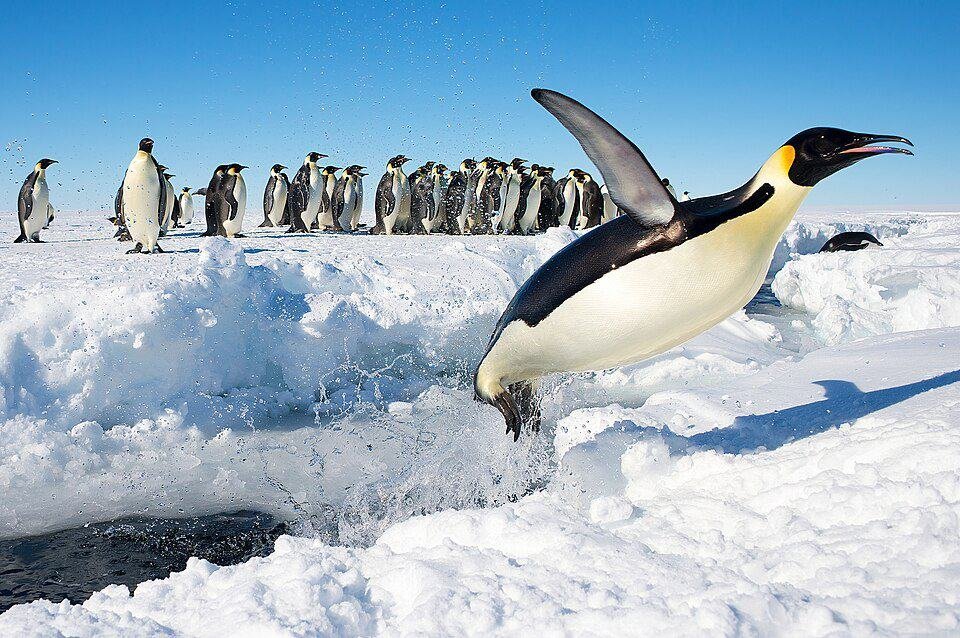
Emperor penguins might look majestic with their fancy appearance and regal names, but their lives are actually full of hardship and sacrifice. And things aren’t looking good for their future—by the end of this century, their population could drop by as much as 99 percent.The emperor penguin (Aptenodytes forsteri) is the biggest penguin species alive today and only lives in Antarctica. Understanding the emperor penguin life cycle reveals just how extraordinary — and fragile — their existence truly is. Males and females look pretty similar in their feathers and size, reaching about 100 cm (39 inches) tall and weighing anywhere from 22 to 45 kg (49 to 99 pounds). Their heads and backs are black, which contrasts sharply with their white bellies, pale-yellow chests, and bright-yellow ear patches. They wouldn’t normally leave Antarctica on their own, but sometimes individual penguins do wander outside their habitat. Some even end up in captivity where life might be easier, but definitely not as royal.
The Long March: Journey to the Breeding Grounds
It’s April. Winter’s coming to Antarctica soon. An endless column of these birds walks with real dignity. The yellow ornaments around their ears and the shine of their magnificent feathers make it look like some kind of imperial procession, but behind that superficial appearance is a life of serious hardship.
A column of adult penguins—all older than three years—sets out on this long journey toward the deep interior of the ice sheet where they’ll lay their eggs. Sometimes they have to cross a hundred kilometers, trudging across ice through winds and snow, to find the perfect spot for their chicks. They need a place sheltered by an icy ridge from the wind, but it’s going to be far from the sea and food. Penguins don’t walk very fast, and when they get tired, they slide on their bellies across the ice. Watching them, you might think they’re playing or having fun, but they’re actually just trying to make this difficult journey toward reproducing their species as easy as possible.
Breeding in Extreme Conditions
Emperor penguins are the only penguin species that breed during the Antarctic winter. They’re probably the only animals that raise their young in such brutal conditions—temperatures can drop to -90 degrees Celsius. But this sacrifice isn’t pointless. Their chick needs to be standing on its own two feet and independent by the start of summer when life gets significantly easier.
The penguins start their courtship in March or April when it can be as cold as -40°C (-40°F). A lone male does this whole ecstatic display where he stands still, puts his head on his chest, inhales, and gives a courtship call for 1-2 seconds. Then he moves around the colony and repeats the call. When a male and female pair up, they stand face to face, with one extending its head and neck up while the other mirrors it. They both hold this pose for several minutes. Once they’re paired up, couples waddle around the colony together—usually with the female following the male.
They bow their heads to each other like they’re at some royal ball, and after choosing a partner, they stick with that partner for the whole season. In the animal world, that’s considered pretty faithful and devoted, even though they’ll probably mate with someone else next year.
Creating Life: Egg and Chick Care
At the beginning of winter, the female lays an egg—always just one, and it’s tiny compared to the mother’s size. After that long march, months without eating, and giving birth, the mother has completely exhausted her energy reserves. If she doesn’t go find food immediately, she won’t survive.
This bird has no nest—ice is the only surface available—so she has to transfer the egg to the father. But very, very carefully. She slowly lowers the egg onto the ice and gently pushes it toward the male, watching her every move. All the mothers in the colony do this almost at the same time, so you’ll see these shocking scenes where lots of eggs get broken and freeze instantly, and the life inside them just disappears.
The male penguin—one of the best dads in the animal world—takes the eggs that are lucky enough to survive and places them under his skin in this special pouch covered with feathers where the egg will stay warm. A male emperor penguin has to endure the extreme Antarctic winter cold for over two months while protecting his egg. He doesn’t eat anything during this whole time. Most male emperors lose around 12 kg (26 pounds) while waiting for their eggs to hatch.
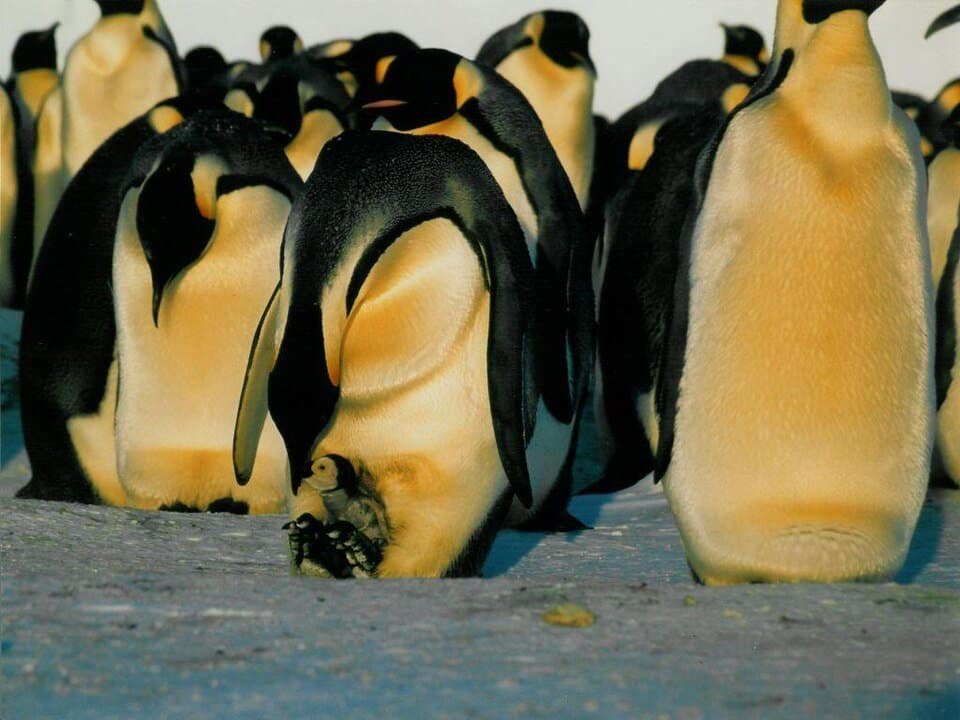
EvaK / CC BY-SA 2.5 (via Wikimedia Commons)
The Mother’s Journey: Searching for Food
The egg stays protected from winter for two months while the father balances on the tips of his feet to keep it safe. Meanwhile, the mother travels to the sea in groups with other females. She returns anywhere from when the egg hatches up to ten days later—mid-July to early August. She finds her mate among hundreds of fathers by recognizing his vocal call and takes over caring for the chick. She feeds it by regurgitating partially digested fish, squid, and krill that she’s been storing in her stomach.
Even though their wings are useless for traveling on land since they can’t fly, they’re incredibly valuable underwater where they work like oars. These natural divers can stay underwater for up to 20 minutes and reach incredible depths—even up to 500 meters. The mothers are finally where the food is, swimming frantically and trying to collect as much as possible in their stomachs to bring back to their young. But they need to be careful and watch out for the only predators that can kill an adult emperor penguin: orcas and leopard seals.
The Fathers’ Vigil: Protecting the Egg
During all that time, the fathers huddle together to stay warm but are still careful not to touch each other too much for better insulation. It’s winter and completely dark for weeks. Winds reach speeds of up to 144 kilometers per hour, and the temperature is brutal, so the group of fathers acts like one massive organism just to survive.
Penguins on the edges are more exposed to the wind, so they rotate positions occasionally so nobody stays in the wind the whole time—everyone gets a turn in the middle. It all happens really slowly. Energy is precious. It’s freezing, and the fathers haven’t eaten in months. To someone not paying close attention, it might look like they’re spending these two months with their heads almost completely still, like they’re praying to some ice god for the winter to be as mild as possible. But actually, they’re conserving energy by sleeping up to 20 hours a day.
Family Reunion
After two months, the chick hatches from the egg, but that brings additional challenges for this dedicated father. The egg phase is done, but the chick is still in serious danger—only 20 percent of chicks survive their first year. Birds can eat them, but hunger is also a major threat. The mother hasn’t returned with food yet, so the father needs to help. Male emperor penguins create this substance similar to whey in their esophagus—you could call it “bird’s milk”—and feed the chick with that. But if the mother doesn’t show up in a few days, the chick probably won’t make it.
It’s August, and a group of mothers arrives at their destination. The return is really noisy with tons of different voices and sounds—it seems like the entire colony is excited about reuniting. Emperor penguins actually identify each other using characteristic sounds. That’s how the mother finds her family without any mistakes. They’re finally together, and this is one of the rare happy moments in their royal life. Soon the father will have to go hunting for food. The parents will switch off several more times until the chicks can be left alone in a group called a nursery.
But the mother’s return doesn’t always mean joy. Many fathers couldn’t handle the hunger, so they left for the sea earlier, abandoning their chicks who didn’t survive being alone. On the other hand, some of the fathers who stayed couldn’t defend their chicks from predators. When a mother finds herself alone, in her desperation she’ll try to steal someone else’s chick. After a few shifts, both parents go to the sea together and leave a group of several thousand chicks to protect and warm themselves while waiting for food.
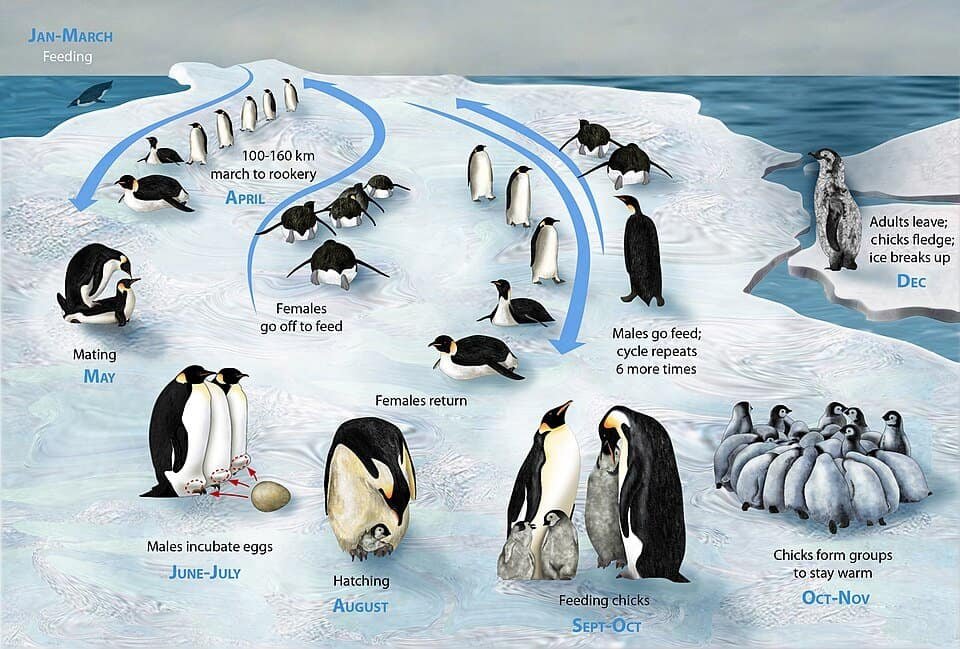
Image credit: Zina Deretsky, National Science Foundation. Public domain.
A Kingdom in Decline: Climate Change and Threats
It’s December now. Summer in Antarctica—the temperatures are much milder. The chicks already have their gray feathers unlike the white feathers of adults, and they’re walking more and more confidently. The ice is melting. The ice sheet they were born on is cracking, so water is getting close. Now the whole family can swim in search of food. It’s much easier to get to the open sea where they’ll stay until it’s time for a new march to the mating grounds.
Every year the cycle repeats. Based on the length of the day, penguins figure out when it’s the right time to go on the trip, find partners, lay eggs, separate, meet again, and spend most of the year traveling between their chicks and food. These kings who sacrifice themselves have lived like this for centuries. But how long will their kingdom last?
According to 2009 data, there were 595,000 adults across 46 colonies at that time. Despite that pretty large number, a study published in June 2019 in the journal Biological Conservation—conducted by the Woods Hole Oceanographic Institution—warns that emperor penguins need to be declared an endangered species to survive. Without sea ice, there’s no reproduction. It’s still not completely clear what migrations would look like or whether these birds could find new habitats without too much trouble. According to the mathematical model in this research, the population could drop by as much as 99 percent by the end of the century because of climate change, melting ice, and fishing. The same forces driving rising sea levels are directly threatening the Antarctic ice sheets emperor penguins depend on for breeding.So researchers are warning that these birds need help, which means giving them a formal spot on the endangered species list.
In June 2011, a juvenile emperor penguin was found on the beach at Peka Peka, north of Wellington in New Zealand. He’d eaten 3 kg (6.6 pounds) of sand—apparently he mistook it for snow—along with sticks and stones, and had to go through several surgeries to remove all of it and save his life. After recovering, on September 4th, the juvenile (named “Happy Feet” after the 2006 movie) was fitted with a tracking device and released into the Southern Ocean 80 km (50 miles) north of Campbell Island. But 8 days later, scientists lost contact with the bird. The transmitter probably fell off (most likely scenario), though there’s a chance he was eaten by a predator (less likely).
References:
- Williams, Tony D. (1995). The Penguins. Oxford, England: Oxford University Press; Wienecke, B. (2009).
- Kooyman, Gerald L.; Mastro, Jim (November 2023). Journeys with Emperors: Tracking the World’s Most Extreme Penguin. University of Chicago Press.
- Stonehouse, B. (1975) “Introduction: the Spheniscidae”. In: Stonehouse, B. (ed) The Biology of Penguins,
- “The history of the discovery of emperor penguin colonies”; Marchant, S; Higgins PJ (1990).
- Handbook of Australian, New Zealand and Antarctic Birds, Vol. 1A.
- Khan A (20 October 2015). “Emperor penguins’ feathers defy conventional wisdom, study finds”. Los Angeles Times.
- “Emperor Penguins: Uniquely Armed for Antarctica”. National Geographic. Archived from the original
- Robertson, G (1992). “Population size and breeding success of Emperor Penguins Aptenodytes forsteri at Auster and Taylor Glacier colonies, Mawson Coast, Antarctica”. Emu. 92

