

Cover image: Vyacheslav Argenberg / licensed under CC BY 4.0.
Table of Contents
The latest research is showing something concerning: when temperatures rise extremely high, forests lose some of their ability to absorb carbon dioxide from the air and store it. Currently, forest ecosystems and other vegetation provide a significant benefit by absorbing approximately 30% of the CO2 emissions humans release into the atmosphere each year. But according to a new study published in the journal Science Advances, almost half of the world’s forests could actually flip and become a source of forests CO2 emissions by around the middle of the century. The main culprit? Rising temperatures mess with photosynthesis and, at the same time, crank up the amount of carbon dioxide plants release when they “breathe” (transpiration). So what’s really going on here?
We all know trees and plants are kind of our best friends in the fight against climate change, since they soak up CO2 through photosynthesis during the day and give us oxygen in return. That’s why planting more trees and protecting the forests we already have matters so much if we want to keep the global temperature rise under the 1.5 or 2 degrees Celsius mark. But here’s the thing — trees breathe too, just like every other living thing. At night, they pull in oxygen through their stoma and release carbon dioxide. Normally, the CO2 they take in during the day is way more than what they put out at night, which is why forests end up absorbing roughly a third of the carbon dioxide emissions we humans produce.
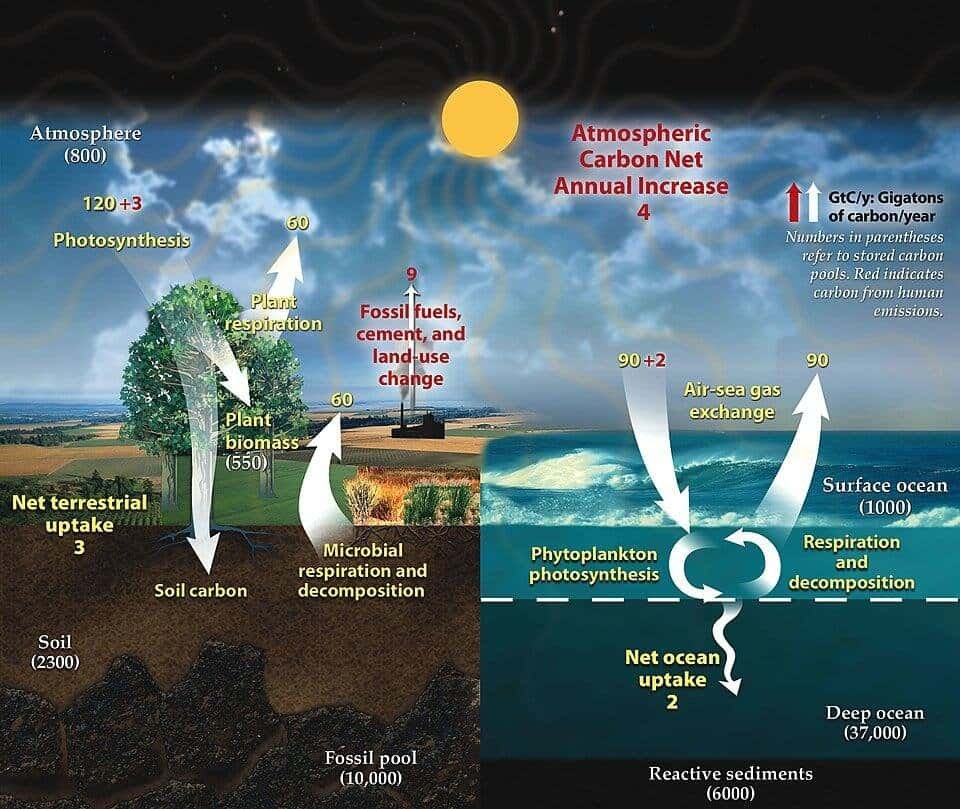
Image credit: Diagram adapted from U.S. DOE, Biological and Environmental Research Information System. / public domain
Now, because plants basically use CO2 as food, climate skeptics like to argue that more CO2 in the atmosphere is actually a good thing — plants grow faster, the planet gets greener, everybody wins. But this new study kind of throws cold water on that idea. It turns out the negative effects of a big jump in temperatures pretty much outweigh whatever benefits plants get from the extra CO2. And honestly, if you’ve been paying attention to the news over the past couple of years, you’ve probably noticed that more and more research is pointing in the same direction. It’s not just one isolated study anymore — there’s a whole pile of evidence stacking up.
How Rising Temperatures Disrupt Photosynthesis
Plants, just like the human body, work best within a certain comfort zone of temperatures. Go past that limit and things start going sideways. A team led by Katharyn Duffy at Northern Arizona University recently took a close look at how rising temperatures affect both photosynthesis and plant respiration, trying to figure out what global warming might actually do to forest ecosystems.
In Canada’s boreal forests, around 80% of the total carbon is locked away in the soil as dead organic matter. A 40-year study of tropical forests across Africa, Asia, and South America, done by the University of Leeds, found that tropical forests absorb about 18% of all carbon dioxide that comes from burning fossil fuels. And over the last three decades, the amount of carbon being soaked up by the world’s intact tropical forests has actually been dropping, according to a study published in 2020 in Nature.
The total amount of carbon stored in forests went down from 668 gigatonnes back in 1990 to 662 gigatonnes in 2020. On the flip side, another study points out that the leaf area index has gone up globally since 1981, and this was responsible for 12.4% of the accumulated terrestrial carbon sink from 1981 to 2016. The CO2 fertilization effect, meanwhile, accounted for 47% of the sink, while climate change knocked the sink down by 28.6%.
In 2019, tropical forests took up about a third less carbon than they did back in the 1990s, basically because of higher temperatures, droughts, and deforestation. The typical tropical forest could become a carbon source by the 2060s. Truly mature tropical forests, by definition, grow fast — every tree puts out at least 10 new trees a year. Based on studies by FAO and UNEP, Asian forests have been estimated to absorb roughly 5 tonnes of carbon dioxide per hectare each year. The global cooling effect of forests sequestering carbon is partially canceled out by the fact that reforestation can lower how much sunlight gets reflected back (albedo). Mid-to-high-latitude forests have a much lower albedo during snowy months compared to flat open ground, which actually contributes to warming. Modeling that compares the albedo differences between forests and grasslands suggests that expanding forests in temperate zones only gives you a temporary cooling benefit.
After digging through data from the FLUXNET database — which pulls together info from over 800 measuring points covering the years from 1991 to 2015 — the scientists found that photosynthesis intensity does increase as temperatures go up, but only up to a point. After that, it drops off exponentially. Meanwhile, the intensity of transpiration (respiration) just keeps climbing exponentially. Past a certain temperature, the amount of carbon dioxide being released this way ends up exceeding what photosynthesis can soak up, which turns forest ecosystems into sources of CO2 emissions.
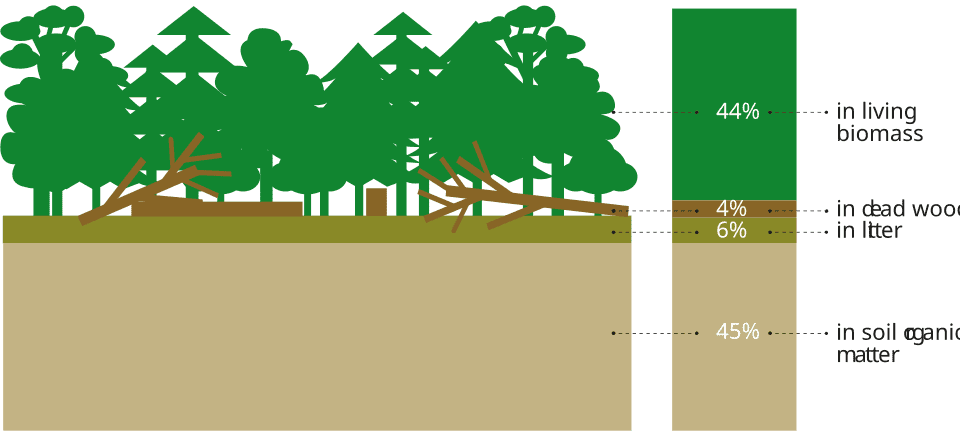
Image credit: Food and Agriculture Organization of the United Nations (FAO) / licensed under CC BY 3.0.
The temperature limit where this flip happens isn’t the same for every tree species. Tropical forests are made up of trees that are better adapted to high temperatures, so their threshold sits well above that of forests in temperate zones. But since global warming is hitting basically every part of the planet, both types of forests are at risk from rising temperatures.
Looking at the data, the scientists figured out that over the past decade, about 10% of the Earth’s surface has already experienced temperatures high enough for forests to release more CO2 than they take in — though for now this is mostly limited to the hottest stretches of the year. What’s worrying, though, is that if greenhouse gas emissions don’t start coming down, temperatures could climb high enough by the middle of the century to threaten how many plant species function. The research showed that if that happens, the total global capacity of land and forest ecosystems to pull CO2 out of the atmosphere could drop by around 45% by mid-century.
Recent Findings: Things Are Moving Faster Than Expected
Since the original Science Advances study came out, more recent research has unfortunately confirmed a lot of what scientists were warning us about — and in some cases, the situation looks even worse than the early projections suggested. A 2025 analysis from the World Resources Institute, based on data from Global Forest Watch, found that extreme fires in 2023 and 2024 caused forests to absorb far less carbon than usual. In those two years, forests took in only about a quarter of the CO2 they’d normally pull out of the air during a typical year. 2023 actually marked the lowest forest carbon sink in over two decades, once you account for the trees lost and the greenhouse gases released by burning.
Europe is dealing with its own version of this problem. A study published in Nature in 2025, led by researchers at the European Commission’s Joint Research Centre, found that the carbon sink of EU forests dropped by roughly 27% between 2020 and 2022 compared to the average for 2010-2014. To put some numbers on that: forest carbon uptake fell from an average of about 457 million tonnes of CO2 equivalents per year in the early 2010s to around 333 million tonnes by 2020-2022. And the early data for 2025 suggests the decline is getting even steeper. Forests cover roughly 40% of the EU’s land area, and they used to absorb something like 10% of the continent’s human-caused carbon emissions between 1990 and 2022, so this is a pretty big deal.
The reasons behind the European decline are kind of a mix. Timber harvesting has gone up, partly because of the push to use wood for energy. On top of that, climate change keeps throwing more frequent heatwaves and droughts at the forests, which slows down tree growth. There’s also been a noticeable increase in insect outbreaks, wildfires, and overall tree mortality. And here’s a problem a lot of people don’t talk about: around 30% of EU forests are monocultures — basically single-species plantations — which are way more vulnerable to climate stress and pests than mixed forests would be.
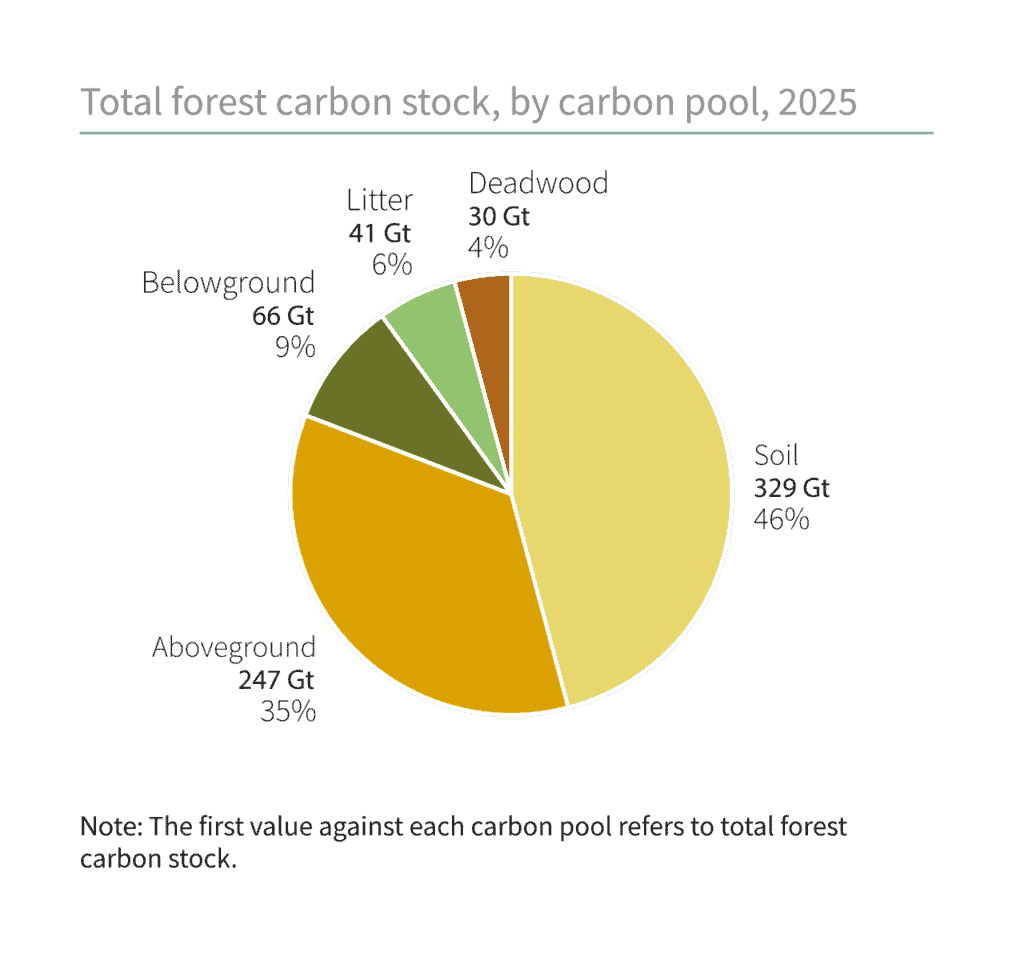
Image credit: http://www.fao.org Food and Agriculture Organization / CC BY-SA 4.0 (via Wikimedia Commons)
It’s not just Europe either. Researchers have also been documenting how forests in the Northern Hemisphere have shifted in recent years, with some areas tipping from being carbon sinks into actual carbon emitters. The 2022 drought and the record temperatures that came with it really accelerated this trend, slowing plant growth and cutting into the ability of forests, grasslands, and soils to soak up CO2. The Amazon has shown similar patterns during severe drought years — vegetation that’s normally absorbing carbon ends up releasing it instead during the worst stretches. These droughts are often intensified by climate phenomena like El Niño, which dramatically reshapes global rainfall patterns.
Forests CO2 Emissions and the Fight Against Climate Change
When we talk about hitting carbon neutrality, or net-zero emissions, the whole point is getting to a place where the total greenhouse gases going into the atmosphere from various sources match up with the amount being taken out by natural processes. Right now, every country’s plan for cutting greenhouse gas emissions factors in some estimate of how much carbon dioxide its land and forests can absorb and store. What scientists are finding now suggests that these estimates might be pretty far off, which means keeping warming to a manageable level would be even tougher than we thought — because Earth basically isn’t going to give us as much of an assist as we were counting on.
That said, it’s worth pointing out that the scientists in this study were looking at the most pessimistic scenario — the one where GHG emissions just keep growing unchecked. Thanks to a lot of positive shifts that have happened over the past few years, that scenario is looking less and less likely. And the point at which we’d hit that limit where photosynthesis starts dropping off exponentially really comes down to how well the world manages to cut emissions.
There’s also a feedback loop here that’s worth thinking about. When forests release more carbon than they absorb, that extra CO2 in the atmosphere makes warming worse, which then puts even more stress on forests, which release even more carbon, and so on. Scientists call this kind of thing a positive feedback — though there’s nothing positive about it from our perspective. The faster we can break that cycle by cutting emissions, the more wiggle room we leave for forest ecosystems to recover and stabilize.
The good news, if you can call it that, is that researchers have laid out some pretty concrete steps that could help reverse the decline. The Nature study from 2025 talked about specific measures around forest monitoring, modeling, and better management practices — things like diversifying tree species instead of relying on monocultures, being smarter about harvesting, protecting older forests that store huge amounts of carbon, and using satellite data (like what the European Space Agency’s new BIOMASS satellite is providing) to keep tabs on what’s actually happening on the ground. None of these are silver bullets, but combined together they could buy us some real time.
Still, all this really means is that we’ve got a little more time. What’s pretty clear, and what we should really take away from this research, is that natural ecosystems are probably more fragile than we used to think, and we don’t have time to waste. The situation is still in our hands, but unless every country in the world starts making a serious, systemic push to ditch fossil fuels and decarbonize the economy over the next decade or so, hitting the goals set out by the Paris Agreement and keeping global warming under the safe limit is going to be really hard. Failure would mean cascading consequences — including accelerating sea level rise that’s already threatening coastal regions worldwide. The forests have been quietly carrying a big chunk of the load for us this whole time — but we can’t keep counting on them to bail us out forever.
References:
- Carolyn Gramling (28 September 2017). “Tropical forests have flipped from sponges to sources of carbon dioxide;
- “Global Carbon Budget 2021”. Global Carbon Project. 4 November 2021
- A closer look at the world’s trees reveals a loss of density in the tropics”;
- Baccini A, Walker W, Carvalho L, Farina M, Sulla-Menashe D, Houghton RA (13 October 2017). “Tropical forests are a net carbon source based on aboveground measurements of gain and loss”;
- Harvey, Fiona (4 March 2020). “Tropical forests losing their ability to absorb carbon, study finds”;
- Malhi, Yadvinder; Meir, Patrick; Brown, Sandra (2002). “Forests, carbon and global climate”;
- Migliavacca, M., Grassi, G., Bastos, A. et al. (2025). “Securing the forest carbon sink for the European Union’s climate ambition,” Nature 643, 1203–1213;
- World Resources Institute / Global Forest Watch (2025). “World’s Forest Carbon Sink Shrank to its Lowest Point in at Least 2 Decades, Due to Fires and Persistent Deforestation.”

