

Cover image: Al. Aumuller / public domain
Table of Contents
Albert Einstein was one of the world’s great revolutionaries. But his arena was not the halls of government, or the city streets, or the remote battlefield. His arena was the human mind. What he revolutionized was the entire human perspective on space, time, and the nature of the universe. Einstein took the prevailing theories on physics, which dated back two hundred years to Isaac Newton, and radically re-worked them. His theories, especially his Theory on Relativity, had a dramatic and immediate impact on human history and the future of scientific thought.
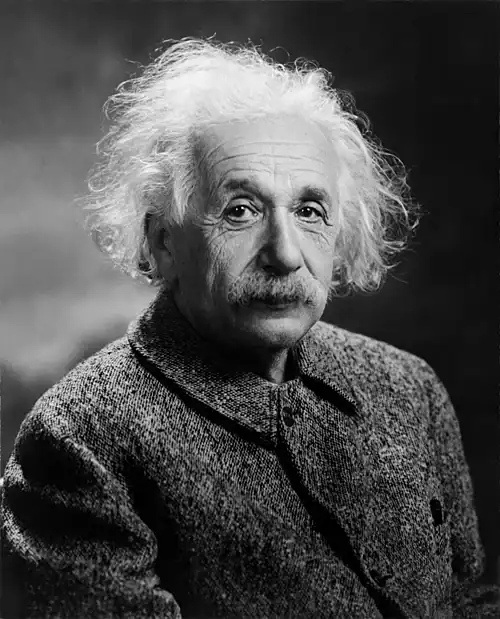
Image credit: Orren Jack Turner (1889–1968) / public domain
As the world becomes more sophisticated and as scientific learning continues to advance, the genius of Einstein’s work has only become clearer, and his theories themselves have become increasingly understandable. Yet he was also widely acclaimed and appreciated in his own time, a favorite of the international press, a revered colleague in the scientific community, and a hero to the public. He was awarded the Nobel Prize for physics in 1921, and many other prizes and awards, most of which roused only his indifference.
Einstein’s three most famous and important discoveries were: the THEORY OF RELATIVITY; the EQUIVALENCE OF MASS AND ENERGY; and the PHOTON THEORY OF LIGHT. All these theories proposed entirely new ways of thinking about the physical world and re-defined scientific and philosophic inquiry. Even though many people couldn’t understand the theories, they could understand the uniqueness of the creative intellect that conceived them. They could also understand, and honor, the gentle, modest, and idealistic nature of the man to whom that intellect belonged.
Albert Einstein’s Early Life in Germany
Albert Einstein was born in Ulm, a city of southern Germany, on March 14, 1879. When he was only one, his parents moved to Munich where his father, Hermann Einstein, set up a small shop for the manufacture of electric supplies.
The Einstein house soon became popular in town as a place where one could spend evenings engaged in sparkling conversation, or listening to music or poetry readings. The house became so well known that visitors from out of town would ask their hosts if they could possibly arrange an invitation to Einstein’s. But for the most part, invitations were unnecessary. The house was open to all. Sometimes Mrs. Einstein would play Mozart or Brahms; sometimes she would sing folk songs from Germany and Austria. Guests would gather around the piano and sing together. On other evenings people simply sat in the warm living room talking about the latest scientific inventions, particularly those that might affect sales at Mr. Einstein’s shop. Other times Mr. Einstein would read aloud from great German writers such as Goethe. Young Albert loved these evenings and always dreaded bedtime.
As a little boy, Einstein was slow to talk and his parents worried about him. There is a story about how, at dinner one night, he finally broke his silence and said: “The soup is too hot.” His parents, very relieved, asked him why he never spoke before. Albert replied: “Because up to now everything was in order.”
School Years and Early Struggles
Albert Einstein was shy and took little interest in playing with other children. He had a particular distaste for war, the military, and all the ceremony that went with it. When he saw parades of soldiers he would say that he never wanted to be one of those “poor people” who followed a leader. In school, Albert didn’t perform well. He attended a local Catholic elementary school and had a particularly difficult time with languages. He hated the strict discipline of the school and took a dislike to the lesson plans popular in all German schools at the time: memorization, recitation, and mechanical, repetitive exercises. At both, his elementary and secondary schools the teachers thought him backward and slow. Today he would probably be considered “learning impaired” or dyslexic.
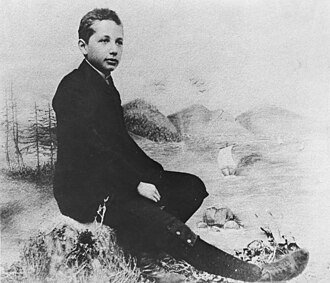
Image credit: Unknown author / public domain
When Albert Einstein was 12, he finally found something that sparked his curiosity and imagination. He read a geometry book. Years later he explained his excitement over the book by saying it opened for him the possibility of “getting certain knowledge of the objects of experience through pure thinking.” He called this first geometry text a “holy booklet,” so fully had it awakened him to his own interests and potential.
Still a boy, Albert Einstein continued to teach himself mathematics, including differential and integral calculus. He also devoured a six-volume publication on the history of scientific discoveries. By the time he was fifteen he felt assured of his career: he would specialize in mathematics and physics. His goal was nothing less than to solve the great riddle of the universe.
Near this time Einstein’s father lost his business and the family, now bankrupt, decided to leave Germany and make a new start in Italy. Albert was left behind to complete his studies, a decision that made him miserable. He had just conceived of a plan to convince a doctor he was having a nervous breakdown and needed a six-month vacation with his family when the problem was solved for him. The school dismissed him for his poor academic record. Elated, young Albert Einstein joined his family in Milan.
Albert Einstein in Switzerland and the Patent Office
The stay in Italy was among his happiest years. Albert Einstein loved the music, art, and the relaxed atmosphere that contrasted so sharply with the austerity of life in Germany. He decided he wanted to give up his German citizenship. He also decided, that to help his family, he would become a teacher. Teaching, he believed, would allow him the freedom to pursue his own studies in physics. The solitude and the time for his own work would be the most important priority for Einstein throughout his life.
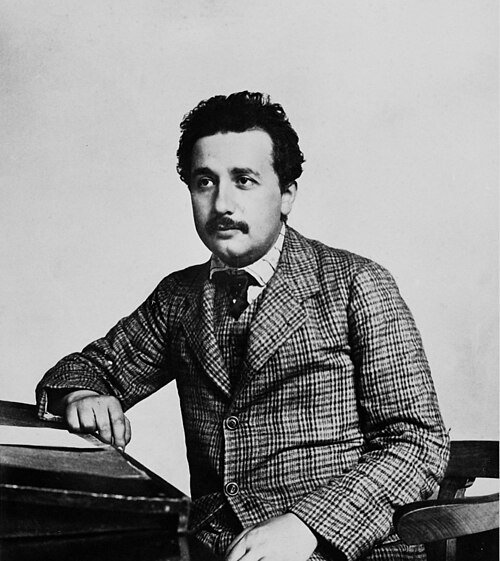
Image credit: Lucien Chavan (1868 – 1942) / public domain
Before he could teach, Albert needed a degree. He applied to an institute in Switzerland but failed the entrance exam. Although he did well in mathematics, he flunked botany, zoology, and languages. Now he would have to return to secondary school and do some catch-up. He chose a secondary school in Switzerland, studied hard, took the exam once more, and passed. Then he enrolled in the Federal Institute of Technology in Zurich.
In Zurich, Einstein’s academic record was also mediocre. He met the minimum requirements but spent most of his time pursuing his own studies. Around this time he met a young woman named Mileva Marec, a Hungarian also very interested in physics. They were married in 1901 when he was 22; the same year Albert Einstein became a Swiss citizen.
For a few years after graduation, Albert Einstein drifted, sometimes unemployed, sometimes teaching part-time. Then he landed a job as a patent examiner in the Swiss federal office, a job that still supplied the precious freedom to research his own theories. He worked on these theories in isolation, without the benefit of contact with other scientists or colleagues. In 1905, at the age of 26, he published his first of three major theories that would shatter conventional views on physics. The title of the piece was: On the Electrodynamics of Moving Bodies, but it’s come to be known as simply as THE SPECIAL THEORY OF RELATIVITY.
The Miracle Year of 1905
The paper was 30 pages long, had few footnotes, and no references. The thoughts were all his own. It was this first, groundbreaking paper that contained the now-famous formula E=mc2, which will be described later. The paper amazed people with its depth and the immense amount of complex thought it required. It also confused people. It was a difficult theory to grasp. Albert Einstein himself once told about a contest for the best-written explanation of his theory, under 3,000 words. The prize was several thousand dollars. He remarked: “I’m the only one of my entire circle of friends who are not entering. I don’t believe I could do it.”
1905 was a productive year for Albert Einstein. After he published The Special Theory of Relativity, he then published four more papers – all of them highly significant. One of them described his remarkable theory of light quanta, called today THE PHOTON THEORY. It would later earn him a Nobel Prize. In only one year, Einstein had founded and advanced the two theories that are today the basis of all physics.
Academic Career and Move to Berlin
Public recognition of the value of Einstein’s contribution was not immediate. It took three years before he had the opportunity to gain the audience he needed. In 1908 he was asked to lecture on his Theory of Relativity to a group of eminent scientists in Salzburg, Austria. Shortly after that, he was asked to serve as an associate professor at the University of Zurich.
It was now 1909 and Albert Einstein was thirty years old. He said later that before he arrived at the University in Zurich he had never known a real physicist. Now he joined the world of academia, where he would remain the rest of his life. It was not always a comfortable world for Einstein – he disliked academic politics, the constant meetings, and the campus gossip. But it also offered him free time and an atmosphere in which he could pursue his studies. By 1911 he was a full professor, lecturing at other colleges in Prague, in Germany, and back in Switzerland. He joined the faculty of the Institute of Technology, where he had studied.
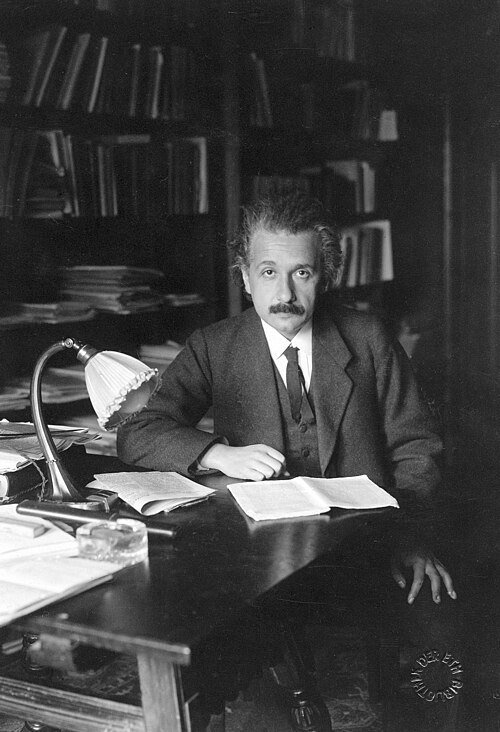
Image credit: Unknown photographer / public domain
In 1913, as the machines of war were gearing up all over Europe, Einstein was asked to join the prestigious Prussian Academy of Science. An acceptance meant he would have to return to Germany. But an acceptance also meant he could accept a position as the director of the new physics department at the Kaiser Wilhelm Institute in Berlin, the most prestigious physics university in the world. Einstein couldn’t refuse – the offer came with a promise he would have no official duties and complete freedom to pursue his own interests.
The decision to return to Germany marked the end of Einstein’s marriage. His wife Mileva had been unhappy for a long time. She was frustrated at the limitations of being a wife and mother to their two boys and was anxious to resume a career. Furthermore, she disliked Germany and refused to move, although she felt it was an opportunity that Einstein should take. The two agreed to separate and sometime later they divorced.
In Germany, Einstein had all the time he needed to complete his latest work: THE THEORY OF GENERAL RELATIVITY. For the rest of his life, he would work diligently at expanding this theory, a goal that proved unattainable.
The Nobel Prize and International Fame
The fame Albert Einstein achieved during the 17 years he worked in Germany was phenomenal. Both the public and the scientific community lionized him. When World War I broke out he was one of the few who was able to protest it and still maintain his popularity. He received so many honorary degrees and appointments that he lost track of them. He received his Nobel Prize in physics in 1922, not for his Theory of Relativity, which was still considered too controversial, but for his discovery the same year of the photoelectric effect. The prize included an award of $50,000. Einstein sent half to his first wife, Mileva, in appreciation of her help and love during hard times early in their marriage. The other half he donated to charity. Later he won the Copley Medal of the English Royal Society, became an honorary citizen of Prussia, and had a tower erected in his name in Potsdam. On his 50th birthday, he had to flee Berlin to avoid the extensive festivities in his honor.
In the 1930s things began to change in Germany, changes that would affect all of Europe and the world – changes that would affect Albert Einstein. By the time 1933 arrived and Adolph Hitler came to power, Albert Einstein had become a national symbol. Germans felt he was yet another example of the superiority of the German mind and the German people. This created a problem. Albert Einstein, although he was by no means orthodox, was also a Jew. So, despite his undeniable brilliance and success, the Nazis could not permit him to be revered. Instead, they burned his books in public, railed against his works at public meetings, and filled the newspapers with angry editorials. His Theory of Relativity had always been controversial and subject to criticism. But now this criticism centered on the fact the writer was a Jew. Albert Einstein boarded a ship and left for the land of liberty.
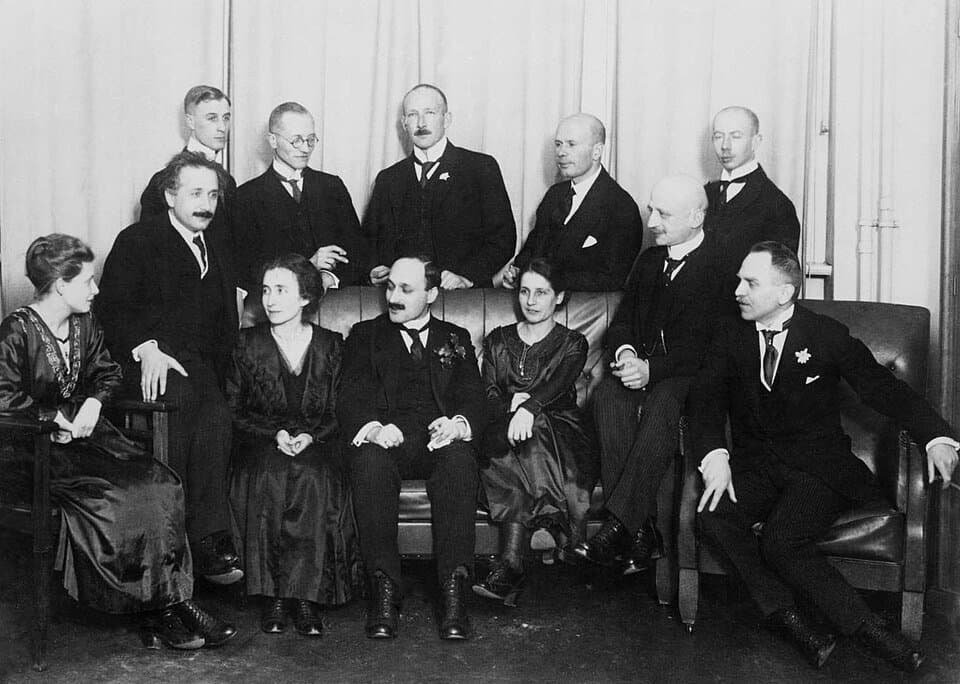
Image credit: Unknown photographer / public domain
In the United States too, Einstein was famous. When he arrived, a throng of reporters met his boat. The little German physicist was always considered good human interest because he was a genius and furthermore he was an eccentric genius. He had long, untamed white hair; he always wore turtleneck sweaters but he never wore socks; his pants were too baggy and everywhere he went he carried a violin. There was a reason for his famously careless dress – Albert Einstein deliberately spent as little time as possible on the trivial, so he could have more time for his work. Still, despite his sometimes sloppy and distracting ways, the brilliance always shined through. A friend once said: “If you could meet and talk to Einstein, without knowing that he was Albert Einstein, you would still be impressed by his brilliant eyes, sense of humor, and by the fact that whatever he might say would be the product of his own mind uninfluenced by the shrieks of the outside world.”
While Albert Einstein was in the United States, Hitler became fuehrer, or ruler, of Germany. Einstein promptly resigned from the Prussian Academy and vowed never to return to Germany. The Nazis immediately confiscated his property. When 100 Nazi professors published a book condemning his Theory of Relativity, Albert Einstein was unperturbed. He said: “If I were wrong, one professor would have been enough.”
Shortly after this Albert Einstein moved to England, but he returned to the United States when he was offered a position at the Institute for Advanced Study at Princeton, New Jersey. It was an incredible offer. The terms were a lifetime professorship that required no teaching whatsoever and Einstein could name his salary. Einstein took the offer but the salary he requested was so low that the institute had to raise it simply to maintain its own standards. Albert Einstein settled in the United States with the comment that; “As long as I have any choice, I will stay only in a country where political liberty, toleration, and equality of all citizens before the law is the rule.” In 1940, at the age of 61, he became a United States citizen.
Einstein’s second wife, Elsa, joined him in America and they settled into a small house in Princeton and into a regular and reliable routine. Albert Einstein rose at 8 o’clock in the morning and left the house before 9 o’clock. He walked for a mile and a half to work, through the campus of Princeton University and along a country road to the Institute. As he walked, people stared. He was famous, and besides he was such a comical sight in his mismatched clothes, his long wavy hair, which frizzed out at the ends. Those who dared to say hello always received a broad smile. Albert Einstein walked in rain or shine, snow or hail, and he was never known to wear hats or boots or to carry an umbrella. He also never noticed the attention he attracted. His mind, already, was in his work.
His office at the Institute was on the second floor in a spacious two-room suite. He used the small, less luxurious one that had been designed for an assistant. He would sit with a pad in his lap and fill sheet after sheet with figures. Albert Einstein was on a quest – a quest that consumed him the entire second half of his life, and which he never completed. The quest was for unity.
Albert Einstein believed there must be a single theory, a unified system of mathematical laws that governed all the forces in the universe. His colleagues thought his search futile and mourned over the time he was wasting. But Albert Einstein remained adamant. He once said: “The most incomprehensible thing about the world is that it is comprehensible.”
Life in Princeton and Daily Routine
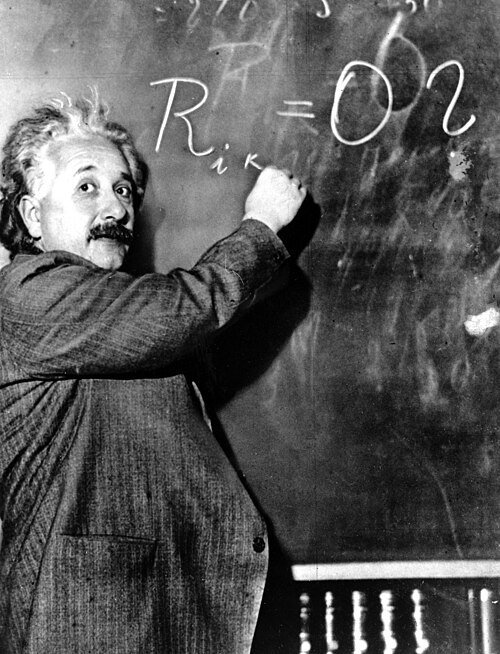
Image credit: Associated Press / public domain
Shortly after noon, Einstein would return home for lunch, usually in a state of distraction. He said: “I think and think for months, for years. Ninety-nine times the conclusion is false. The hundredth time I am right.” After lunch, Albert Einstein would work at home in his study, with the same pad and pencil. As he was working out his ideas, he would often pace the room, dropping and scattering his papers on the already cluttered floor. It was one of the tasks of his secretary to find these papers and save them for future reference. At the end of the day, Einstein sometimes played the violin – he had a preference for Mozart and Bach. He was an accomplished player and sometimes gave concerts to raise money for causes he supported. Once, when invited to speak at a hotel in Prague he instead rose up and said: “I don’t think anyone here really wants to hear me make a speech or deliver a lecture on my Theory of Relativity, so instead of making a speech, I’m going to play the violin for you.” He then proceeded to delight the audience with his renditions of Mozart and Bach. Albert Einstein also played the piano, but this he always did in private.
Although Albert Einstein always remained as shy as he was in childhood, he did like to entertain at home. He would sit with friends and discuss not just physics, but politics and philosophy. He seldom had the time to read but did have a partiality for Dostoevski to whom he gave the ultimate compliment when he said: “He gives me more pleasure than Gauss, the great mathematician.” Einstein’s favorite pastime, when not working, was sailing on a nearby lake. His eighteen-foot sailboat was his most cherished possession. In general, life in Princeton was pleasant and peaceful. He once wrote to Queen Elizabeth describing the academic town as: “a wonderful little spot, a quaint and ceremonious little village of puny demigods on stilts.”
Albert Einstein, the Atom Bomb, and Pacifism
But life was not all pleasant. As the world plunged into war at the turn of the decade, Albert Einstein would confront a personal crisis of enormous proportions. Although always a pacifist he now found his ideals being put to the test by a dictator whose megalomania and inhumanity threatened the entire world. He reversed himself publicly, admitting that in this particular and very grave case, the war was justifiable. He even helped raise money for it in bond drives. And he donated his services to charitable organizations that were helping the large number of refugees fleeing Germany for the United States.
In writing of the war at that time he said: “The ancient Jehovah is still abroad. Alas, he slays the innocent along with the guilty, whom he strikes so fearsomely blind that they can feel no sense of guilt…We are dealing with an epidemic delusion which, having caused infinite suffering, will one day vanish and become a monstrous and incomprehensible source of wonderment to later generations.” Then he confronted another crisis – one caused by his seminal work over 30 years before on the subject of relativity. His formula E=mc2 had eventually led scientists to split the atom, unleashing a power that they well knew could be channeled into the most deadly weapon the world had ever seen. Now his colleagues begged him to write a letter to President Roosevelt proposing that this weapon actually be constructed. Physicists in Germany, they warned, were already working on it and had discovered the fission of uranium. If the United States didn’t act fast, this weapon would soon be in the hands of the madman Adolph Hitler. Albert Einstein asked only a few questions. Then he changed the subject. But later that day he sat down and wrote the following words, and more, to the President:
“In the last four months it has been made probable through the work of Joliot in France as well as Fermi and Szilard in America – that it may become possible to set up a nuclear chain reaction in a large mass of uranium, by which vast amounts of power and large quantities of new radium-like elements would be generated. Now it appears almost certain that this could be achieved in the immediate future.
This new phenomenon would also lead to the construction of bombs, and it is conceivable – though much less certain – that extremely powerful bombs of a new type may thus be constructed. A single bomb of this type, carried by boat and exploded in a port, might very well destroy the whole port together with some of the surrounding territory. However, such bombs might very well prove to be too heavy for transportation by air. I understand that Germany has actually stopped the sale of uranium from the Czechoslovakian mines, which she has taken over. That she should have taken such early action might be understood on the ground that the son of the German Under-Secretary of State is attached to the Kaiser-Wilhelm Institute in Berlin where some of the American work on uranium is now being repeated.”
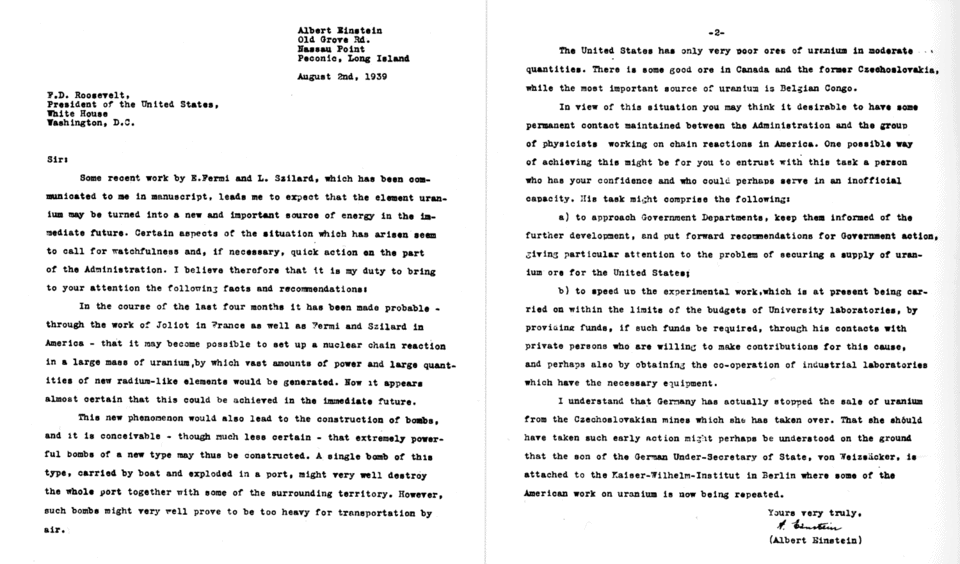
Image credit: Franklin D. Roosevelt Presidential Library & Museum / public domain
Roosevelt took immediate action after receiving Einstein’s letter and established the Manhattan Project whereby scientists could work full-time to create the bomb before Germany did. On July 16, 1945, the first test of the atom bomb took place in a remote section of New Mexico. The test was successful.
Albert Einstein, and many other scientists, would be haunted ever after for the role they played in the dropping of the atom bomb on Hiroshima and Nagasaki, even though the role was inadvertent. Albert Einstein went out of his way to direct people towards productive use of the atom. He was one of the first to point out to the medical profession that harnessing the atom might have potential in future treatments of disease. He seemed to work hard at his attempts to balance the negative results of his discovery with the possibility of positive results. Meanwhile, he continued to work on new theories, although that work was becoming harder to accomplish.
It was inevitable that the admiration Albert Einstein inspired would bring an endless stream of visitors, fans, young aspiring scientists, and curiosity seekers to his door and this is exactly what happened. Elsa served as his protector, gently turning away the uninvited and screening his calls and invitations. Her loyalty to him and to his work never wavered. When someone once asked her if she understood her husband’s theory of relativity, Elsa responded: “No. But I know he can be trusted.” After Elsa died in 1936, her daughter from a previous marriage came to live with Albert Einstein and stepped into Elsa’s shoes as the guardian of his privacy. One of the biggest challenges of Einstein’s later years was to find the time and concentration for his own work during great public attention.
Although he led a somewhat ascetic and reclusive life, Albert Einstein was by no means out of touch with the world. He was very fully involved in several controversial issues of great importance to the world. One of these was Zionism, a cause to which he dedicated himself passionately. He felt the real tragedy of the Jews was their lack of a community and so he supported and worked for the goal of making Palestine the Jewish nation. He was not intensely nationalistic about it and he held no religious orthodoxy – but he was committed.
He was also one of a handful of prominent people who spoke out against the communist witch-hunts of the McCarthy era when a group of congressmen required citizens to testify about their past and present political activities and beliefs. These witnesses were also required to report on the political leanings of their friends. Einstein’s comment at the time was: “It is shameful for a blameless citizen to submit to such an inquisition, which violates the spirit of the Constitution.”
Albert Einstein also continued to oppose war and militarism. One of his favorite points was that although there were over a hundred colleges in the United States that offered courses on warfare, there were only one or two that offered courses in peacemaking. Even though Albert Einstein had once said: “Politics is for the moment; an equation is forever,” he nevertheless felt compelled to serve humanity in other areas besides science.
Shortly before his death, Albert Einstein joined many other prominent people, including the philosopher Bertrand Russell, in a declaration against the war. They focused particularly on the next and future weapon: the H-bomb. This bomb, they argued, could end the entire human race and no treaties between nations could guarantee it would not be used. Their conclusion: the only choice was to prohibit war entirely. Einstein worked throughout his later years for the cause of nuclear disarmament and even established the Einstein War Resisters International Fund. He grew less and less patient with statesmen and politicians saying: “They have cheated…fooled us. Hundreds of millions of people in Europe and in America, billions of men and women yet to be born, have been and are being cheated, traded, and tricked out of their lives and health and well-being.” He discussed with Sigmund Freud his view that people must have an innate compulsion for hatred and destruction, to which Freud agreed. Meanwhile, he discussed with the famous Hindu poet, Rabindranath Tagore, the nature of truth. Tagore held that truth was realized through man. Albert Einstein instead maintained that scientific truth must be conceived as a valid truth independent of man. “I cannot prove I am right in this,” he said, “but that is my religion.” Accused of atheism at various times in his life, Einstein firmly denied it, saying he believed in Spinoza’s God, “who reveals himself in the harmony of what exists.”
Albert Einstein’s Death and Final Years
In 1947, following an illness, Einstein’s doctors discovered he had an aneurysm – a small ballooning in a weak wall of an artery in his heart. Within a few years, his condition grew worse, but he still managed to put in several hours of work a day at the Institute. He continued a few years and then, in 1955, began to grow frail. His legs were so weak that his customary walk to the university became harder and harder. His fingers were so weak he could no longer play his beloved violin. Then he began to suffer stomach pains, but he rejected the idea of surgery, saying he had too much work to do. He was still working steadily on his attempt to find a unified theory of physics. Soon Albert Einstein collapsed and a bed was brought to his study. Specialists wanted to operate, saying there was a 50-50 chance they could succeed in repairing the artery, but Einstein would have none of it. His view of death was simply that it happened to everyone and was not particularly important. A few days later doctors insisted on taking him to the hospital and shortly after midnight that day, April 18, 1955, the weak artery broke and Albert Einstein died. He was 76 years old.
He had already left instructions on what was to be done. There was to be no funeral, no grave, and no monument. His brain could be used for research but he wanted his body cremated. His wishes were carried out and his ashes were scattered in a nearby river. Albert Einstein’s brain was carefully examined under a microscope and although details of this examination were never released, it was made known that the doctors found nothing unique in the brain’s size, weight, or formation. The expansive imagination and brilliant reasoning that had created such monumental work were stored in some recess inaccessible to science.
Albert Einstein’s Theory of Relativity Explained
Since his death, the work of Albert Einstein has only inspired more admiration and awe. New learning has only helped to confirm the importance and accuracy of what he determined so many years ago. Einstein’s first great work was the paper he wrote in 1905 now referred to as The Special Theory of Relativity. It is not an easy theory to understand or to describe. Once Albert Einstein himself was asked to give a lecture on it to an audience in Berne, Switzerland. He started his remarks by saying: “I’m sure you will all find the theory very simple.” The roar of laughter that greeted this remark continued for a full five minutes.
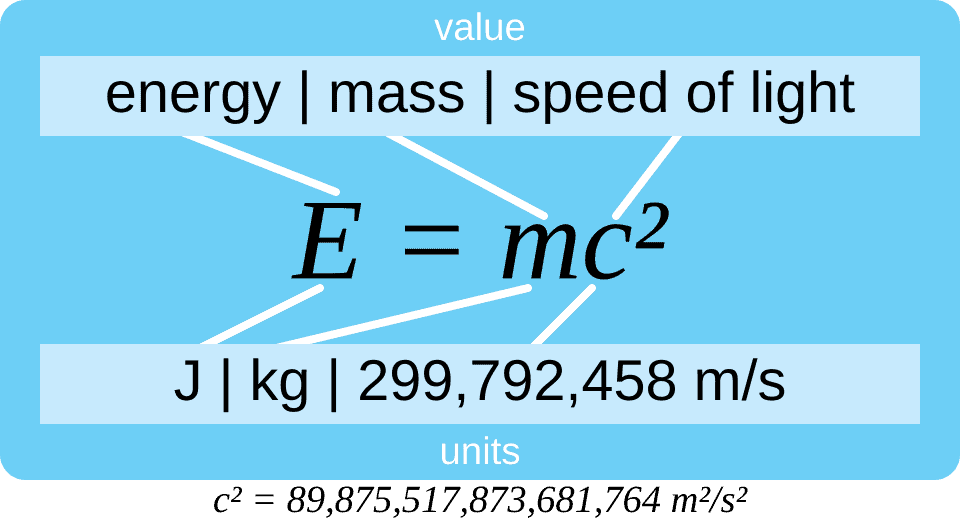
Image credit: JTBarnabas / licensed under CC BY 3.0.
The theory showed that there is no fixed or absolute standard for comparison, for judging the motion of the earth or other moving systems. The only movement that can be detected and measured is relative movement: the change of position of one body to another. That was the first premise. It then led to a conclusion. The conclusion was the famous E=mc2. With this formula, he said that mass and energy are interchangeable, that mass represents stores of energy, and that energy contains a small mass. Thus, mass can be converted to energy and vice versa. The rate of exchange between mass and energy is that Energy equals Mass times the Speed of Light, squared. For instance, one could take an atom of uranium and break it into two pieces in a laboratory. The two pieces together would weigh less than the original single atom. So there would be extra energy that wasn’t there before. The missing mass – M – has turned into an amount of energy – E – given by the velocity or speed of light, which is C. Because C is so large, and C squared is even larger, even a minute amount of mass equals an enormous amount of energy. His work, therefore, revealed the reservoirs of energy held within the atom and also supplied the means for calculating the amount of it, thus paving the way for scientists who split the atom 34 years later. His formula is the basic principle behind the operation of nuclear reactors.
Einstein’s Lasting Legacy in Modern Science
Shortly after publishing The Special Theory of Relativity, Albert Einstein published his next major work, The Photon Theory. In a single stroke, this work revolutionized the theory of light. The theory held that if the speed of light is constant and if all natural laws are the same, then both time and motion are found to be relative to the observer. This paper demonstrated the photoelectric effect, that is, it showed that light, under certain circumstances, exists as pockets of radiant energy. He said the energy carried in a beam of light is divided into tiny little bits called photons. The energy of each photon depends on the frequency of the light, in other words, it’s color. Blue light has a high frequency so its photons carry more energy than the photons in a red light, which has a lower frequency. This theory created a bombshell in scientific circles because experts had previously perceived light as a wave phenomenon traveling through space. The idea that it had its energy in separate little packets, was at first difficult to grasp. Einstein’s paper was an enormous development in the area of quantum theory and it is the paper that won him the Nobel Prize.
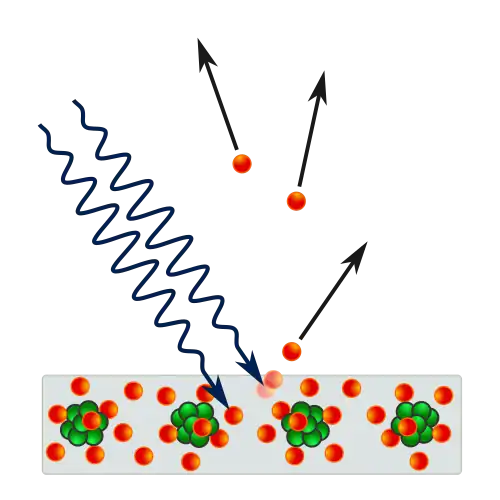
Image credit: Ponor / CC BY-SA 4.0 (via Wikimedia Commons)
Albert Einstein also published a third paper this year, 1905, in which he put forth his theory of Brownian motion. In this paper, he accounted for the apparently random movement of pollen in fluids and provided strong evidence for the existence of atom-sized molecules. There had already been much theoretical discussion of molecules but it was Albert Einstein who offered the first concrete evidence of their existence, later elaborated by other scientists.
Eight years after these pioneering works, Albert Einstein released a third: The General Theory of Relativity. The core of this theory was that gravitation is not a force, as Newton had believed, but a curved field in the space-time continuum, created by the presence of mass. Gravitation determines the curvature of space and time. This paper put forth a unified theory of gravitation. It suggested that light was bent by the sun’s gravitational pull but that the only way this theory could be proved was through photography. He explained that proof further. He said that as light passes near the sun, for example, it should be deflected by an amount, which can be calculated. So when we see a star near the sun, it should appear slightly displaced from its normal position. But these stars, near the sun, are completely hidden from human sight because of the brightness of the sun. Only when the sun is hidden, as in a total eclipse, would one be able to measure the displacement of these stars.
Three years later, in 1919, there was a total eclipse of the sun and scientists set out to test Einstein’s theory. Observers were sent to the two places on earth where the eclipse could best be seen and photographed – northern Brazil and an island in the Gulf of Guinea, off Africa. Their photographs were studied for months and astronomers discussed all possible errors and interpretations. Then the astronomers, along with mathematicians and other scientists, announced to an excited audience at the Royal Astronomical Society in London that the photographs completely verified Einstein’s theory. The rays of light were bent as they passed close to the sun. The president of the Society called it: “one of the greatest achievements in the history of human thought. It is the greatest discovery in connection with gravitation since first Newton enunciated his principles.” And headlines around the world screamed: REVOLUTION IN SCIENCE, NEWTONIAN PRINCIPLES OVERTHROWN! Later, when a pupil asked him: “What would you have said if there had been no confirmation of this kind?” Albert Einstein replied: I would have been obliged to pity our dear God. The theory is correct.”
For the rest of his life, he devoted himself to extending this unified theory of gravity to include electromagnetic forces – the first step towards finding the common laws governing the behavior of everything in the universe, from molecules to planets. He was unable to do so. Even without proof, however, scientists today still refer with awe to Einstein’s great dream – a grand unification of physical theory.
There was further work that he accomplished and there was further work that developed from what he had already accomplished. Although he took no part in the building of the atom bomb and knew of it only after Hiroshima had been destroyed, his name is ever associated with the advent of the atomic age. He eagerly joined other scientists in seeking ways to prevent further use of the bomb and to transform the atomic age into one of the human benefits. Advances in medicine, nutrition, lighting, and heating have all occurred because of our ability to harness the atom.
The life of Albert Einstein might be the ultimate example of the “misunderstood genius.” He first gained fame as a German although he had an aversion to nationalism. Then he was persecuted as a Jew, although he didn’t practice the Jewish religion. Next, he was accused of atheism even though he many times stated his belief in God, a God “who reveals himself in the harmony of all being.” Finally, his name has always been linked with the development of the world’s most deadly weapon although he was a pacifist and fought for years for the cause of disarmament. It is a disturbing irony that this idealistic man’s most famous equation had its most spectacular proof in the creation of instruments for destruction. Albert Einstein could understand the most complex and obscure elements of physics, he had almost intuitive perception into the physical world, and he could create and comprehend theories that baffled even the most sophisticated. But he could not understand or fathom the extremes of human behavior.
The real understanding of Albert Einstein lies in what he came to symbolize to the entire world: the pure quality and potential of human intellect and thought, the creative ability of individuals who live in free societies the passionate sense of justice and social responsibility, and the conviction of order and purpose within the universe. Albert Einstein believed the physical world was precisely engineered: “God does not play dice with the universe,” he once said. In this belief, which fueled all he did and strove to do, Albert Einstein forever changed man’s view of his world.
References:
- Whittaker, E. (1 November 1955). “Albert Einstein. 1879–1955”. Biographical Memoirs of Fellows of the Royal Society.
- Yang, Fujia; Hamilton, Joseph H. (2010). Modern Atomic and Nuclear Physics. World Scientific.
- Bodanis, David (2000). E = mc2: A Biography of the World’s Most Famous Equation.
- Overbye, Dennis (24 November 2015). “A Century Ago, Einstein’s Theory of Relativity Changed Everything”
- Kleppner, Daniel (1 February 2005). “Rereading Einstein on Radiation”. Physics Today.
- “Albert Einstein – Biography”. Nobel Foundation. Archived from the original on 6 March 2007. Retrieved 7 March 2007.
- Einstein, Albert (1901) [Completed 13 December 1900 and manuscript received 16 December 1900]. Written at Zurich, Switzerland. Paul Karl Ludwig Drude
- Troemel-Ploetz, D. (1990). “Mileva Einstein-Marić: The Woman Who Did Einstein’s Mathematics”. Women’s Studies International Forum.

