

Cover image: Raul654, licensed under CC BY 3.0.
Table of Contents
For many centuries in Europe, in quiet monasteries secluded throughout the hills and countryside, monks worked laboriously to record the writings and ideas of great thinkers of the present and past. They worked in a special room called a “scriptorium” and reproduced older manuscripts on paper or parchment, which was made from the skin of sheep or goats. They wrote with blunt pointers made of metal, painstakingly recreating each word and sentence in the ornate, elegant script typical of their times. They worked by day and they worked by night. In the flickering candlelight, bodies weary, and the muscles of their hands cramping from fatigue, they struggled to concentrate on the beauty of their letters and the accuracy of their copy: “In the beginning, God created the Heaven and the Earth; and the Earth was without form and void, and darkness was upon the face of the deep. And the spirit of God moved upon the face of the water. And God said Let there be Light and there was Light.” This was the world of the written word before the Gutenberg printing press changed everything.
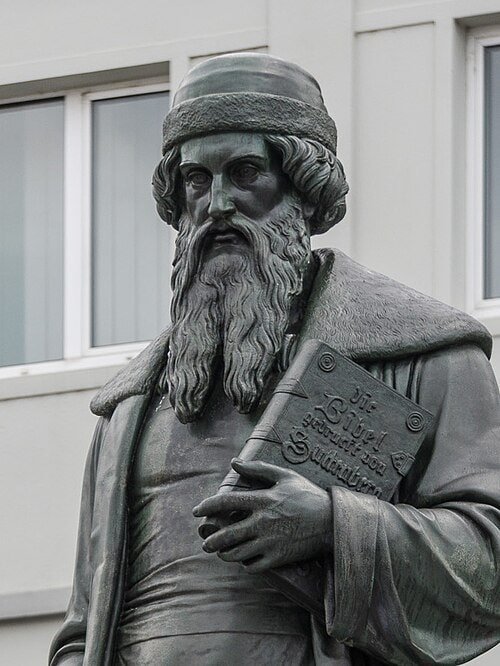
Image credit:
Kenneth C. Zirkel / CC BY-SA 4.0 (via Wikimedia Commons)
The calligraphy of the monks was often exquisite, but always it was slow. To produce one copy of the Bible took them a few years, even with several monks working together. Other manuscripts might take even longer.
“Manuscript” is a word derived from the Latin for hand, “manus.” And for more than a thousand years of human history that is exactly how all manuscripts were copied, by the labors of the human hand. In different parts of the world professional scribes, slaves, students, and people in religious cloisters, such as the monks, did this. It’s no surprise, with the amount of time each manuscript required, that there were very few in circulation. Officials of the church had some and the governments had some. But the only private individuals who owned manuscripts were wealthy nobles who could afford the high cost of them – sometimes 100 gold pieces for a single volume. People in the lower classes would be lucky to even glimpse one manuscript in their entire lives.
Even if one did have access to the few manuscripts tucked away in vaults and gold boxes and secret chambers all over Europe, it would often have been difficult to read them. The parchment might be wrinkled at the edges, so the words at the end of the lines were lost. The spelling and grammar might be incorrect, depending on the skill of the person who copied it. Some manuscripts were in scrolls as much as twenty feet long, and the process of rolling and unrolling them was difficult and damaging. Other manuscripts were written in wax, on wooden tablets, and the wax had eventually smeared over some of the writing. Manuscripts from the Orient were sometimes written on palm leaves, which dried and cracked. As for the content itself – since scribes copied the work of other scribes, and those scribes copied still earlier ones, the information became less and less reliable with each succeeding generation. In other cases, blotches and fading had marred certain words, so scribes had simply guessed at what they might have been. Nevertheless, all these manuscripts, no matter what state of perfection or deterioration, were stored like treasures in the libraries of the privileged few.
By the 15th century, humanity had accumulated a wealth of knowledge and had produced vast amounts of beautiful poetry and fiction. Yet none of it could reach the common people. The public had never read Homer’s Iliad or Odyssey; it knew almost nothing of the genius of Socrates, Aristotle, Plato, or Pythagoras. Out of its reach were Beowulf, Chaucer’s Canterbury Tales, Dante’s Divine Comedy, the poems of Omar Khayyam and Rumi, and the teachings of Saint Francis. As the 1400s dawned, humanity lived in ignorance of all that it had learned.
This was the state of the written word in the year 1400 when Johannes Gutenberg was born. Within fifty years he would change it all with a discovery that is among the most important events in all of history. Johannes Gutenberg would give us the printing press and with it the modern book. And with that book, human knowledge and ideas were free to reach and affect the lives of every person on earth.
Today, we know almost nothing about Johannes Gutenberg other than his one phenomenal contribution. What we know conclusively about his life would barely fill one of his printed pages. He must have been modest in his achievement – we know that. For he never even put his name on his works and would have remained in obscurity if not for the diligent work of historians. For five hundred years they have worked to unravel the story of the printing press and the mystery that was Johannes Gutenberg – with very little success.
Johannes Gutenberg’s Early Life in Mainz
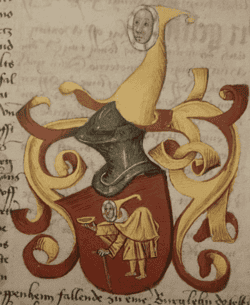
Image credit Gutenberg Museum / public domain
Here is what we do know. We know he was born sometime between 1394 and 1400, just as the new century was also being born. It was the very early days of the Renaissance and soon it would be the great age of exploration. A hundred years before, Marco Polo had returned from his travels to Asia and in the next hundred years, Columbus would set out to find the Indies and would instead stumble across America.
Johannes Gutenberg was born in the city of Mainz, on the southern banks of the Rhine River in Germany. His full family name was Gensfleisch zur Laden zum Gutenberg, but he took the shorter name Gutenberg instead. It was either his mother’s name or the name of the house in which he grew up. At the time, Mainz was a center for goldsmiths and jewelers. Gutenberg’s father was a goldsmith who worked at a mine operated by the archbishop of Mainz. Part of a goldsmith’s work is to impress figures on metal, so young Johannes may have first learned this skill from his father. Because he was an aristocrat he wasn’t expected to serve a regular apprenticeship.
Years of Exile in Strasbourg
Gutenberg’s family had always been aristocrats, but it wasn’t a good time to be an aristocrat in Mainz. There were many rebellions in the city, most of them organized by workers who belonged to guilds. These guild rebellions eventually drove Johannes’s father out of town, in about 1411, when Johannes was perhaps 11 years old. Seventeen years later the guilds took over the government of Mainz, and Johannes, now about 28, fled 100 miles up the river to the city of Strasbourg, where he remained in exile for several years. Strasbourg was then still a part of Germany, though it now belongs to France. In Strasbourg, Johannes Gutenberg worked in such trades as gem cutting and also taught this trade to several students. In the ten to fifteen years Johannes Gutenberg spent in Strasbourg he seems to have spent much of his time in court. Almost all the records we have of him are from legal documents of the time. In 1436 or 1437, a woman filed a suit, claiming he’d promised to marry her and backed out. We don’t know how the court ruled on this sensitive matter, but we do know he never married, neither this woman nor any other.
During this court proceeding Johannes Gutenberg managed to get himself into even deeper trouble by denouncing one of the witnesses as a “poor creature, leading a life of lies and deceit.” The witness was a shoemaker, and he sued for slander. This time we have the verdict in the case – the humble shoemaker won and Gutenberg the aristocrat lost.
Three years later there is another legal record on Johannes Gutenberg – a contract with a group of young men had agreed to pay him a healthy sum in exchange for which he was to teach them “the secret of the art.” Unfortunately, the document doesn’t say what that art was, but it does mention that Johannes Gutenberg spent 100 guilders on lead, and other metals, the building of a wooden press, and some printer forms, which leads one to believe that already he was working out some sort of instrument for the casting of movable type. When one of these men died, Johannes Gutenberg was in court defending himself against a suit filed by the heirs of the deceased. They demanded to be made partners even though his contract with the three men had specifically stated that if one of them died, the heirs were not to be let into the company but were to be compensated financially. Johannes Gutenberg won the suit but what’s more interesting is the testimony about supplies he’d purchased, which clearly point towards the invention of a press. Whether this led to any actual printing, and to any books, we don’t know. What’s most likely is that Johannes Gutenberg, now about 39 years old, was experimenting with a printing press but hadn’t yet figured out how to make it work. If he did print anything during these experiments they were probably rough and he no doubt destroyed them. In fact, the same document states that the young men were required to destroy certain forms – a form being both the frame in which type was set and the type itself.
The Invention of the Gutenberg Printing Press
When he was approaching 50, Johannes Gutenberg returned to Mainz, where things had quieted down politically, and set up his own shop with the help of a loan from a relative. He hired a man named Peter Schoeffer to serve as his foreman and began work on what would become his masterpiece – a printed copy of the Bible. There is little information on how his experiments with the press developed because Johannes Gutenberg was very secretive about it – he had to be. In the 1400s, there was no such thing as a patent, so most people inventing something new tried to protect themselves by working behind closed doors. All we really know about Gutenberg’s invention of the printing press is that it was an expensive proposition and he had to borrow money. We know this because, once again, he ended up in court.
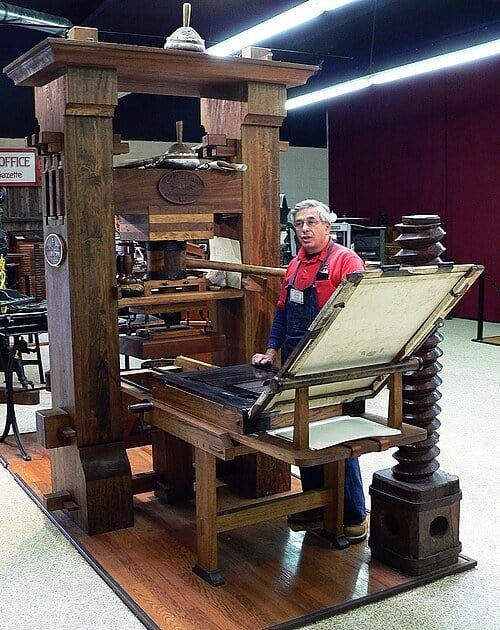
Image credit: vlasta2 / CC BY-SA 2.0 (via Wikimedia Commons)
Somewhere around 1449, Johannes Gutenberg went to Johann Fust, a lawyer in Mainz, and persuaded Fust to loan him 800 guilders – a considerable sum at the time, enough to fund a substantial business venture. Sometime later he returned to Fust for 800 guilders more, even though he hadn’t repaid the first loan. This time Fust agreed to the loan only if he became a part-owner of the business, which he did. The two also agreed that if Gutenberg couldn’t repay the loans in a reasonable amount of time, Fust would take over the entire business. And this is where all the later confusion about the invention of the printing press had its start.
The Gutenberg Bible and the Lawsuit with Fust
By 1455 Johannes Gutenberg hadn’t paid up and Fust came collecting. Fust was concerned with a quick return on his investment whereas Gutenberg seemed more concerned with perfecting the press, no matter how long it took. The court, which seldom seemed to be on Gutenberg’s side, ordered him to repay both loans immediately, with interest – a sum that totaled about 2,020 guilders. Gutenberg couldn’t do it. He lost his shop to Fust and with the shop went everything in it – including the famous Gutenberg Bible. The Bible was also known as the forty-two-line Bible because its huge pages were printed in two columns of forty-two lines each. Later it would also become known as the Mazarin Bible because it was first discovered in a library in Paris belonging to the Cardinal Mazarin. The famous Bible with its many names may or may not have been completed when it fell into Fust’s hands. If it wasn’t, Fust finished the job. And he began selling copies to the public, undoubtedly making far more money than the 2000 guilders Gutenberg couldn’t pay to keep it.
Fust also took with him Gutenberg’s foreman, Peter Schoeffer, who had testified against Johannes Gutenberg at the trial. Schoeffer soon married Fust’s daughter. The new company was named Fust and Schoeffer and from then on historians have wrangled over just who should get the credit for the first book ever to be printed by machine.
Some historians say Fust and Schoeffer did all the work on the Bible and Gutenberg’s only contributions were his initial experiments with the printing press. It doesn’t help that none of the copies of this original book are dated or signed. Most historians, however, have no doubt that it was Johannes Gutenberg who printed it. And they have some strong evidence on their side. One is a handwritten note attached to one of the copies of the Bible that is now in the national library of France. The man who wrote the note is Heinrich Cremer, the same man who designed the exquisite borders of the book. According to Cremer, the Bible was completed and bound on August 24, 1456, probably a matter of months after Fust confiscated Gutenberg’s business. The Bible was so large – two volumes, one of 324 leaves and one of 318 leaves – and would have taken so long to complete, that it must have been already finished or nearly finished when it came into Fust’s hands. Besides, Fust’s own grandchild, and Peter Schoeffer’s son, wrote in 1505, in the preface to a book, that: “the admirable art of typography was invented by the ingenious Johannes Gutenberg at Mainz in 1450.” Therefore, the Gutenberg Bible remains the Gutenberg Bible.
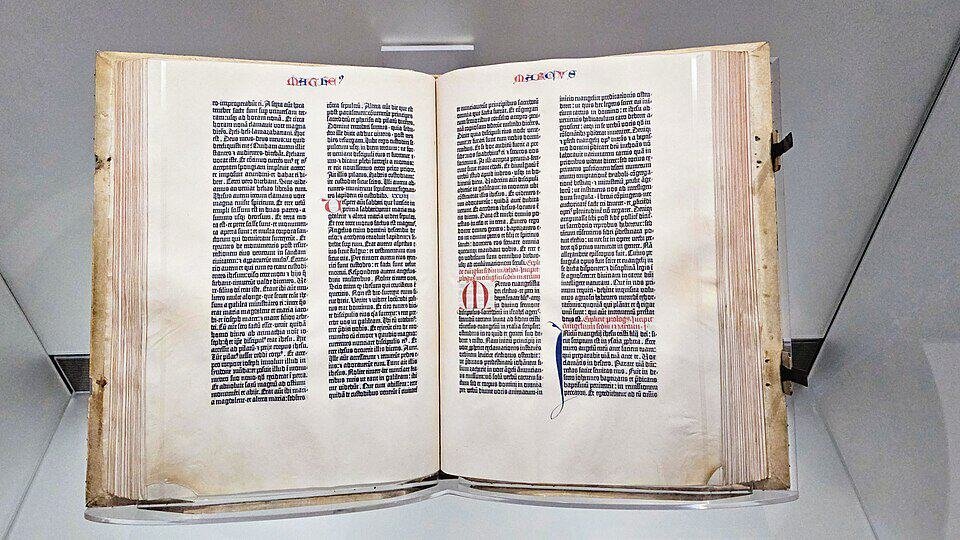
Image credit: MC BSU / CC0 1.0 (via Wikimedia Commons)
Part of Fust’s winnings in the lawsuit also included Gutenberg’s second masterpiece, a Psalter, or book of psalms. It was the first printed book in Europe to bear the name of the printer and the name listed is Fust and Schoeffer. But scholars all agree that the mastermind behind the book was Johannes Gutenberg. It’s decorated with hundreds of two-color initial letters and elegant scroll borders that required the clever technique of multiple inks on a single metal block. It would have been impossible for Fust and Schoeffer to have invented and perfected this technique in less than two years between winning the lawsuit and publishing the book. It’s even possible that the elaborate work on the Psalter is what made Fust so impatient with Gutenberg in the first place.
Gutenberg’s Final Years and Death
After Johannes Gutenberg lost his shop, he opened another one and worked there for several years. Some people believe he printed another Bible, a 36 line Bible, and others believe he printed a Latin dictionary called the Catholicon. Neither of these works gives credit to the printer so it’s impossible to be sure. The only other works that can be clearly associated with Johannes Gutenberg include some school texts and a publication called the Turkenkalender, which warns of the danger of a Turkish invasion after the fall of Constantinople in 1453.
Later in life, Johannes Gutenberg left the printing field and took a post with the archbishop of Mainz, where his father had once been employed. The archbishop gave him a yearly supply of grain, wine, and clothing and exempted him from taxes. He was believed to be poor at the end of his life, although not destitute. He had also gone blind. He died on February 3, 1468, at the age of something between 67 and 70. What he bequeathed to us was the entire history of human thought and deed in the form of the printed word, from the mythological exploits of Beowulf to the news in our morning papers.
The History of Printing Before Gutenberg
Johannes Gutenberg did not invent printing – what he did invent was the movable type, which enabled people to make numerous copies of a work in a fairly rapid amount of time. The printing itself dates back centuries before Johannes Gutenberg to the Orient and was most advanced in China and Korea. Printing began, first of all with the invention of paper. The Chinese were experimenting with paper as far back as 1500 years before Johannes Gutenberg and the Arabs were using it as early as the year 712. Almost six hundred years before Gutenberg’s press, China began producing its first printed books. The oldest of these, which dates to the year 868, is called The Diamond Sutra and its subject is the teachings of the spiritual master Buddha, who lived 1300 years earlier.
“Upon a memorable occasion, Buddha sojourned in the Kingdom of Shravasti and lodged in the grove of Jeta. With the Master were twelve hundred and fifty disciples, all of which had attained great learning. The noble Subhuti, His chief disciple, was in the midst of the assembly. He arose from his seat, and kneeling upon his right knee, he pressed together with the palms of his hands and raised them towards Buddha. He exclaimed: “Thou, who possesses such great understanding, O most Honored One, what must your disciples do to obtain perfect wisdom?”
The Diamond Sutra is now in the British Museum.
These early printed books were made from wooden blocks. Oriental characters were carved into a slab of wood about the size of a page. The ink was then poured over the slab and paper was pressed against it. The inky images transferred to the page. Some Chinese books were also made from a form of movable type. In this case, one character at a time was carved in wood inside a mold. These many separate pieces were then put into a frame. The ink was poured over the whole frame and again paper was pressed against it. The pieces, or characters, could then be removed and reorganized to form a new page. Later, the Chinese invented movable types made of porcelain and metal.
Printed books were not a success in China. The Chinese language consists of so many characters – hundreds and hundreds – that it was too difficult and time-consuming to carve, mold, and print them. Luckily for Johannes Gutenberg, his language was based on the same simple 26-letter alphabet now common throughout the West.
How Gutenberg’s Printing Press Worked
In the 1200s, when Marco Polo returned from China, the invention of Chinese paper found its way to Europe. But the idea of printed books somehow got left behind. It would be up to the innovative minds of Europe to invent printing all over again. Johannes Gutenberg dreamed up his printing press entirely on his own. To start out, Johannes Gutenberg created what is known as replica casting. He engraved individual letters in relief, and then punched them into slabs of soft metal, such as bronze or brass, to produce models. Then he duplicated these models by casting them in molten, liquid metal. Johannes Gutenberg found just the right blend of metals for his molds, the same blend that’s used today. It consisted of lead, tin, and antimony. The tin was needed because lead alone would have oxidized and deteriorated the molds; the antimony was needed because lead and tin alone lack durability. These molds were one of the earliest precision instruments. They enabled Johannes Gutenberg to arrange even lines of letters which he then locked into place with wedges, to make up a form – a flat printing surface that was the key to a process that became known as letterpress printing. Many pages containing thousands of types, or letters, could easily be loaded and removed from the press.
Image credit: Tentotwo / CC BY-SA 3.0 (via Wikimedia Commons)
Gutenberg’s next important step was to develop an ink that would adhere to his metal type. Up until that time, the ink was used only on wood and paper. He needed ink of completely different chemical compositions and he found it by using some oil-based pigments used by early Flemish painters. Finally, Johannes Gutenberg needed a machine. He took the simple winepress of the time and adapted it into a screw-and-lever press that could print large pages of type.
The press Johannes Gutenberg used had a fixed, flat lower bed or surface, and a movable, flat upper surface called a platen. The upper bed was moved up and down through a small bar or worm screw. The form, with the type in it, was inked, covered with paper, and put between the two surfaces. Then the surfaces were pressed together like a vise. After printing, the types were separated and then used again for other pages.
The basic four-step process that Johannes Gutenberg created was still the basis of typography until the mid 19th century: Typographers: 1) took the type pieces letter by letter 2) arranged them side by side in a composing stick – a strip of wood with corners 3) evenly-spaced the letters in each line by using blank pieces of lead between words and 4) printed and then returned the letters to their typecase.
Gutenberg’s type was a rich, decorative style of Gothic handwriting popular during the period. The Gutenberg Bible was printed in Latin, on both sides of the paper. It had no title page, no page numbers, and nothing to distinguish it from the manuscript style of handwritten works. It’s impossible to know how many copies were first printed but today 40 are still in existence. There are perfect copies in the United States Library of Congress, and in the French and British national libraries. There are nearly complete copies in five other American libraries: the Huntington, the Morgan, The New York public, and Harvard and Yale.
There had been others working on the idea of type and printing when Johannes Gutenberg started out – at least one printer in Holland was well on his way to solving the problem. But the Bible produced by Gutenberg in 1455 showed that he was not only the first to print a book but that he had mastered every technical detail.
Gutenberg’s printing methods weren’t significantly modified until the 20th century. For 500 years they produced most of the printed material of the world. After that, there were many changes and improvements to the printing press, until it became the modern and massive industry it is today.
Johannes Gutenberg’s Legacy
We may never know what kind of a man Johannes Gutenberg was. We know, of course, that he was inventive, that he was an excellent craftsman and a perfectionist, that he had a vision and he was committed to that vision. We know that he lost the recognition and the profit of his life’s labor and love. Was he bitter? That we do not know. He had been betrayed by his partners and by his foreman, whom he helped train. He had been forced to surrender all his equipment and his greatest masterpieces. Later he lost his eyesight and died in relative obscurity and possibly in poverty. But his feelings about his life to this day remain a secret.
Being a man of vision we can hope he took some comfort, if not joy, in the vast doors that had been opened by his invention. He opened the door for knowledge and learning and communication for everyone – not just the nobles and the priests and the wealthy, but for all the world. Through printing and books, poets, philosophers, and scientists from the past and present have been able to enlighten and inspire all of humanity. Geniuses, heroes, and sages have been able to teach and awaken us. Without the printing press, the revolutionary ideas of thinkers like Nicolaus Copernicus might never have reached beyond a handful of scholars.” As printing grew into its own craft, Emperor Maximilian gave it the coat of arms of an eagle with its wings spread over a globe. Written words soar over the world, freeing knowledge from its binds, and then knowledge itself brings freedom of the spirit. This, then, is the sacred legacy of Johannes Gutenberg and his Bible.
References:
- Gutenberg Museum (2000). Gutenberg: Man of the Millennium.
- Dudley, Leonard (2008). Information Revolutions in the History of the West
- Eisenstein, Elizabeth (1980). The Printing Press as an Agent of Change. Cambridge University Press.
- Lehmann-Haupt, Hellmut (1966). Gutenberg and the Master of the Playing Cards
- Davies, Martin (1996). The Gutenberg Bible. British Library.
- Gowan, Al; Meggs, Philip B.; Ashwin, Clive (1984). “A History of Graphic Design”. Design Issues.
- Boruchoff, David A. (2012), “The Three Greatest Inventions of Modern Times: An Idea and Its Public”, in Klaus Hock
- Bechtel, G. (1992), Gutenberg et l’invention de l’imprimerie, Paris: Fayard

