

Cover image: Joe Ravi, licensed under CC BY 3.0.
Table of Contents
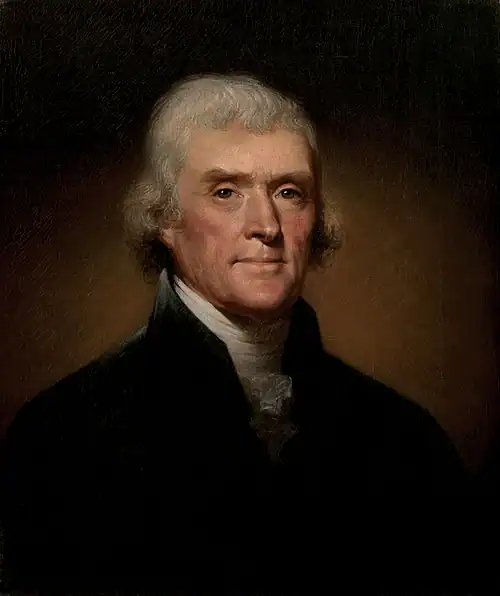
Image credit: White House / public domain
On a chilly morning in March 1801, Thomas Jefferson awoke early, as was his habit. He always believed, and taught his children, that a key to success and happiness in life was to start each day as the sun was rising. Thomas Jefferson dressed in his usual work clothes, clean and well-tailored, but plain and simple. Later that morning, he left the modest boarding house in Washington D.C. in which he’d rented a room and walked several blocks to the appointment he had. When he returned later for dinner, he saw that all the places at the table were full. Rather than wait for the other boarders to finish, he simply went to his room without dinner and began his paperwork. It never occurred to him that he should be given special consideration at dinner that night, or on any other night – even though his appointment that day had been his inauguration as the third President of the United States of America.
There is no man in history who so fully embodies the principles of democracy and equality upon which our country was founded as does Thomas Jefferson. In both his work and writings and in his personal life and conduct, he is the model for what has been called “the American mind” – it was his thoughts and ideas, more than any others, that was written into our Declaration of Independence and came to define the very essence America.
Thomas Jefferson himself wrote the inscription on his tombstone, which says only that he was “an author of the Declaration of Independence, and author of the Statute of Virginia for Religious Freedom, and Father of the University of Virginia.” He said he wanted “not a word more.” But there are hundreds of words that could be added, among them: Governor of Virginia, Secretary of State of the United States; Vice-President of the United States; President of the United States; a founder of the Democratic Party; lawyer, architect, philosopher, scientist, inventor, linguist, botanist and a list of government achievements that range from the Louisiana Purchase to the creation of our system of currency. His vast talents and genius were perhaps best summed up by a famous comment made by President John F. Kennedy in 1962. Kennedy was entertaining a group of Nobel Prize winners and referred to the event as the “greatest gathering of intellects to have dined at the White House with the possible exception of when Mr. Jefferson dined there alone.”
Thomas Jefferson Early Life and Education
Family Background and Childhood in Virginia
Thomas Jefferson’s origins were somewhere between the humble country background of a Lincoln and the wealth and privilege of a Roosevelt. He was born in Shadwell, Virginia, on April 13, 1743, on a middle-sized plantation owned by his father, Peter Jefferson. Mr. Jefferson had held various eminent posts in Virginia – sheriff, colonel of the militia, and a member of the House of Burgesses. Jefferson’s mother, Jane Randolph, was descended from one of the first families of Virginia, a pedigree that little impressed Thomas Jefferson.
The Jefferson family was huge – he was the third of eight children, six of them girls. He was a typical country boy and loved to hunt, fish, canoe, and ride horses. But he also had a passion for books and music and learned to play the violin when he was still very young. The violin was a joy to him his entire life.
When Jefferson was only 14, his father died, and as the oldest son, he became head of the family. He inherited 2500 acres of land and at least twenty slaves. Later, he would try to change the Virginia law that required landowners to leave their full estate to the oldest son. He would also try to enact laws against slavery.
Years at the College of William and Mary
Until he was 9, Thomas Jefferson studied with a tutor. Then he stayed with a clergyman who taught him Latin, Greek, and French. When he was 16 he enrolled at the College of William and Mary in Williamsburg, the provincial capital. Even though he was very young, he became friends with some of the most prominent men in town and spent many evenings at the Governor’s mansion, playing music, and participating in conversations about a wide range of intellectual and political subjects. Thomas Jefferson always felt these conversations were pivotal to his education and said it was during these years that he formed his ideas about humanity and God. Although he’d been raised in the Anglican Church, the official church of Virginia, he began to develop a distaste for organized religion and once said: “To love God with all thy heart and thy neighbor as thyself is the sum of religion.” During one of these evenings in Williamsburg, he struck up a friendship with another young student named Patrick Henry.
From Law Practice to the Virginia House of Burgesses
When he finished college, Thomas Jefferson studied law. As he studied, he followed with concern the increasing tension between the colonies and Great Britain. When he was 22, he attended a speech by his friend Patrick Henry against the Stamp Act, which required colonists to buy and put stamps on all printed material, including newspapers and even playing cards. The profits went to Great Britain. Henry’s speech against the Stamp Act was impassioned and eloquent and is considered one of the most important events leading up to the American Revolution.
Monticello and Marriage to Martha Skelton
After he became a lawyer, Thomas Jefferson served as a representative in the Virginia House of Burgesses. Around this time, when he was 27, he began to build a house on a hilltop he had chosen on land near Charlottesville, inherited from his father. The plot of land he selected was considered an unusual choice for the time when most people preferred to build near rivers or waterways. But Jefferson liked being up high, and he loved the broad view of the surrounding woodlands and mountains. He also liked identifying himself with the immigrants who had hacked their farms out of the wilderness, rather than with the aristocrats who owned the land down below in the basin. The house he would build, named Monticello, would become one of the most famous houses in the world. Jefferson designed every detail of it and spent many years building and refining it.
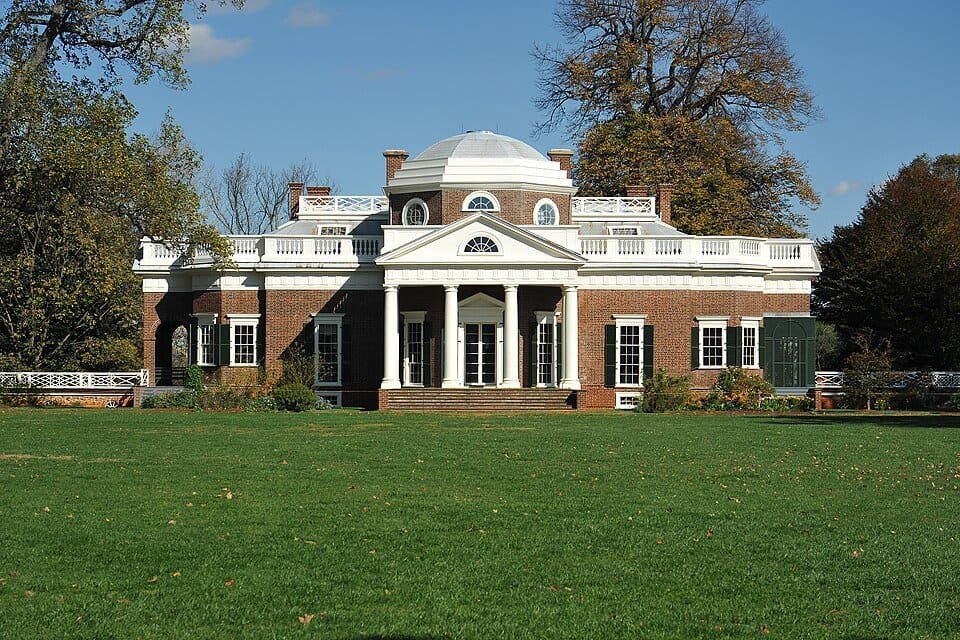
Image credit: YF12s / CC BY-SA 3.0 (via Wikimedia Commons)
While he was beginning his work on Monticello, a slave rode up the hell with the news that the family home in Shadwell had burned to the ground and all the contents had been lost. Jefferson’s anguished response was “Not one of my books saved? Not one?” The slave tried to console him by reporting that although the books had been lost, they had managed to save his fiddle.
When he was 29, Thomas Jefferson married a 24-year-old widow named Martha Skelton, who was the daughter of a prominent lawyer near Williamsburg. Martha was a popular young woman, with many suitors. There is a story that one afternoon two men courting Martha decided to visit her together. When they arrived at her house and were led into the hall, they heard the sound of music – a violin accompanied by a harpsichord and a lady and a gentleman singing. They knew immediately who the gentleman was; Thomas Jefferson was the only man in the area who played the violin. Each agreed with the other that they were wasting their time and they quietly stole out of the house, never to return.
Thomas Jefferson would indeed have been a difficult rival. He was not exceptionally handsome, although he was always described as pleasant and interesting looking. He was 6 feet 2 inches tall, large-boned but slim. He had thick red hair, a ruddy complexion, and freckled skin. His features were angular features and his eyes were flecked with hazel. He was supposedly relaxed in manner and somewhat awkward. But he had a keen mind, could converse intelligently about almost any subject, was talented and entertaining, and had a love of his fellow human being that manifested in open friendliness and interest in everyone he met. In his later years, it was said he was sometimes reserved and aloof when first meeting someone, but would quickly overcome it.
Thomas Jefferson was very much in love with his wife, Martha. Although he meticulously saved all his writings and correspondence, he diligently destroyed every single letter between him and his wife so their relationship would always remain private. The couple had six children but only two survived, both girls. His marriage and family were a source of profound happiness for Jefferson. One of the greatest crises of his life was when Martha died, in only the tenth year of their marriage, after giving birth to their last child. He never remarried.
Thomas Jefferson and the Declaration of Independence
Thomas Jefferson served in the House of Burgesses in Virginia between the ages of 26 and 32. He quickly developed a reputation for his brilliant and eloquent writing of laws and resolutions. Jefferson was a master with a pen. He was NOT a master with voice. He was such a poor speaker that throughout his life he tried to deliver all his speeches on paper and not in person. He was the first president to deliver his State of the Union Address in printed form – thereby starting a trend that lasted until Woodrow Wilson, who reinstated the idea of delivering it in person. On paper, however, Jefferson was unsurpassed. His ability to translate ideas into English that was simple and clear, yet strong and inspiring, was admired by all his fellow legislators.
The Continental Congress and the Road to Revolution
While serving in Virginia, Thomas Jefferson joined up with a group that included Patrick Henry and other patriots and began to draft protests to certain Virginia laws and laws originating in Great Britain. In Virginia, the men challenged the control of the aristocrats in government. The British laws they protested were import duties. The men held their meetings in the now-famous Raleigh Tavern in Williamsburg.
In 1774, Thomas Jefferson called for a meeting of representatives from all the colonies so everyone could discuss their grievances together. The meeting came to be known as the First Continental Congress. Jefferson was chosen as a member of the First Virginia Convention, which in turn was going to select members for the First Congress. But he became ill and was forced to send his views along in a paper, which probably suited him just fine. The main thesis of that paper was that the British Parliament had no control over the American Colonies because when the original settlers came to America they had exercised their natural right to emigrate. His theory was backed up by sound legal arguments and examples that impressed the Virginians, but they found the views too extreme. Nevertheless, the following year they elected him as one of the delegates to the Second Continental Congress.
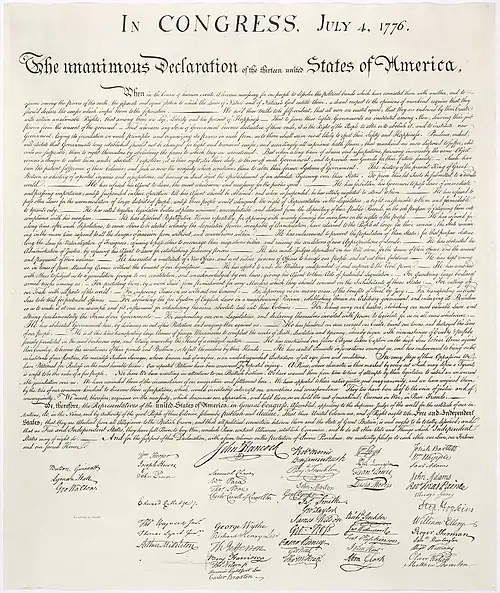
Image credit: reproduction: William Stone / public domain
Writing the Declaration of Independence
While Thomas Jefferson was serving in the Continental Congress, The Revolutionary War began. On June 7, 1776, Virginian Richard Henry Lee, a member of Jefferson’s tavern group, introduced his famous resolution stating that: “these United Colonies are, and of right ought to be, free and independent states.” His resolution inspired Congress to appoint a committee to draw up a Declaration of Independence. The committee included John Adams, Benjamin Franklin, Roger Sherman, Robert Livingston, and Thomas Jefferson. Immediately, the other four bowed to Jefferson’s superior writing talents and asked him to complete the first draft. When it was completed, in less than a month, the committee approved it with very few changes. Congress began debating the Declaration on July 2 and adopted it only two days later on July 4. The members of Congress also made a few edits. As one of them said at the time: “The thing in its nature is so good that no cookery can spoil the dish for the palates of freemen.”
The Legacy of the Declaration
The Declaration of Independence will always be the work for which Thomas Jefferson is best known. It put forth the position of the American revolutionaries not only with stunning eloquence but with strong legal argument. Few of the ideas in it were new but Thomas Jefferson never intended them to be. He said his aim was “to place before mankind the common sense of the subject, in terms so plain and firm as to command their assent…neither aiming at originality of principle or sentiment, nor yet copied from any particular and previous writing; it was intended to be an expression of the American mind.” It has remained an expression of the American mind for over two hundred years and is considered one of the most significant and inspiring documents in the history of the world.
Building the Foundations of American Democracy in Virginia
Two months after he finished the Declaration, Jefferson resigned from Congress and returned to his post in the Virginia House of Delegates. He was never attracted to the military and did not fight in the Revolutionary War. Instead, he stayed at home and focused on social and legal reform to prepare Virginia to take its place in the emerging nation of the free. He sponsored a bill that allowed landowners to leave their property to whomever they wished rather than to descendants, as required. He succeeded in outlawing primogeniture – a practice in which all property automatically passes to the eldest son. His aim with these bills was to make land, most of which was then in the hands of a few aristocrats, available to larger numbers of people. In his words, it was to help create “instead of an aristocracy of wealth…an aristocracy of virtue and talent.” Since only landowners could vote, Thomas Jefferson felt his laws would also broaden the electorate to include larger numbers of citizens.
During these years Thomas Jefferson also worked on a bill that he considered so important, it is one of only three achievements he wanted on his tombstone – the Statute of Religious Freedom for the state of Virginia. When he wrote the Statute, religious intolerance was common throughout the states. In some states, only Protestants could hold office. In others, special privileges were given to the followers of certain religions and denied others. Jefferson’s bill assured religious tolerance in Virginia and abolished the special privileges of the Anglican Church, which was then the official church of Virginia. Its clergymen were on public payroll and Virginians paid taxes to support the church. Jefferson’s bill established that all churches were separate from the state, and all were equal. He wrote: “all men shall be free to profess, and by argument to maintain, their opinions on matters of religion, and that the same shall in no way diminish, enlarge, or affect their civil capacities.” The statute was a landmark in human history; at the time, no other state and no other nation in the world provided for complete religious liberty.
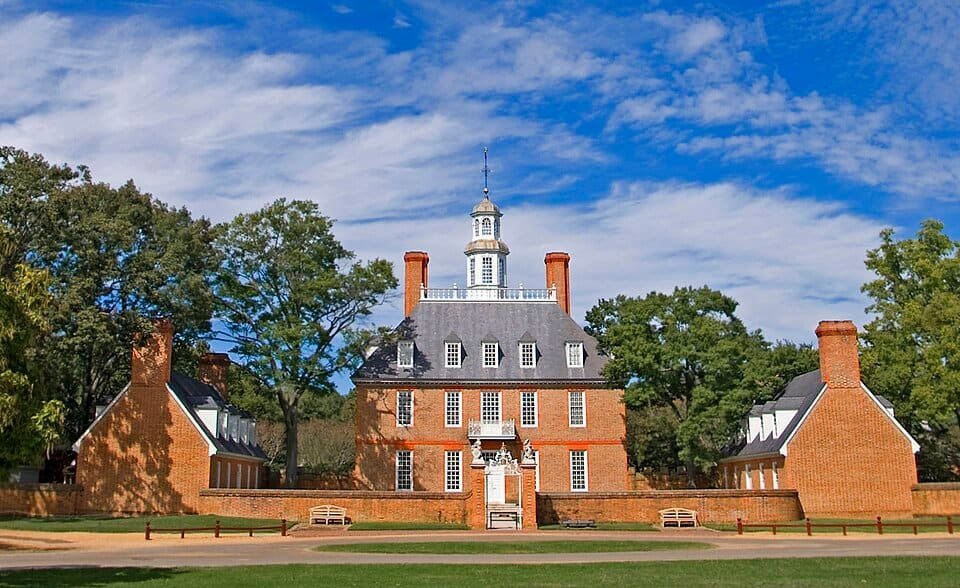
Image credit: Ron Cogswell / CC BY-SA 2.0 (via Wikimedia Commons)
One bill Thomas Jefferson couldn’t push through, despite his tireless effort, was one that called for a system of free public education at the elementary and secondary level and a state-supported university. Although part of his plan later became law, the rest of it was simply too far ahead of its time.
Thomas Jefferson also introduced legislation to put an end to slavery in Virginia. His efforts were unsuccessful and he didn’t push hard; inside, he felt the people of Virginia weren’t ready. Although he freed some of the slaves he’d inherited from his father, Jefferson owned slaves until the day he died. He believed slavery was morally wrong, but he felt the shift from a slave-based society to a non-slave society would be a difficult one for whites and blacks alike and might require many years. He hoped that succeeding generations would be able to change the system, and in fact, he believed such a change was inevitable. He wrote: “Nothing is more certainly written in the book of fate than that these people are to be free.”
Governor of Virginia and Personal Tragedy
When he reached the age of 36, Thomas Jefferson was elected Governor of Virginia for two one-year terms. It was a difficult time for him and eventually led to his disenchantment with public service. The problems started when George Washington asked Jefferson to send all the state militia to fight in the Revolutionary War. Jefferson obliged him. But then the British, led by Benedict Arnold, invaded Virginia, which was now virtually defenseless. When Jefferson heard British troops were approaching Monticello, he fled the state to avoid capture.
The Virginians were merciless with Jefferson. They accused him of failing to protect them, leaving them vulnerable to attack, deserting them, and being a coward. Thomas Jefferson was deeply hurt. Even when an official investigation cleared him of all blame, he was still bitter. When his term was up he retreated to Monticello, determined to give up public life forever. It took a personal tragedy to convince him to change his mind.
The same year Thomas Jefferson left the governorship, while he was still reeling from the sharp criticism of his fellow Virginians, his wife Martha gave birth to their sixth and last child. Martha never regained her strength and as the days passed, Jefferson realized she was dying. He spent every hour either in her room or in his adjoining library. When she finally died, he went into seclusion, speaking, and writing to no one. His older daughter wrote many years later: “The violence of his emotion to this day I dare not describe to myself.” Jefferson himself later told a friend: “A single event wiped out all my plans and left me a blank which I had not the spirits to fill up.”
The plans he had made – for a quiet domestic life at Monticello – were not the plans destiny had in store for Thomas Jefferson. In many ways, his loss was to be the country’s gain. For now, desperate to take his mind off his grief, Jefferson agreed to return to public life and run for Congress. He entered Congress in 1783, at the age of 40, and joined several committees, which helped define the future course of the emerging republic. He devised a decimal system of currency that freed the states from the pound and paved the way for the dollar. He steered the Treaty of Paris, which ended the Revolutionary War, through Congress. Most importantly, he wrote ordinances that established how the states would handle territories west of the Appalachians. Under Jefferson’s leadership, existing states gave up their private claims to the territories and a plan was devised under which the territories would eventually be divided into states completely equal to the original thirteen. Jefferson also added a provision forbidding slavery west of the Appalachians, but it lost by a single vote. If one representative, who was sick and confined to bed, had been present, the vote would have been different. Jefferson later reflected: “Thus, we see the fate of millions unborn hanging on the tongue of one man, and heaven was silent in that awful moment.”
Minister to France and Secretary of State
After Martha died, Thomas Jefferson personally took on the responsibility of raising his two daughters, something many men of the time would never have considered. He often took his daughters along on his business trips and when they were parted he wrote to them constantly. He checked on what they were reading, advised them on their studies and behavior, and poured out wisdom and love with is the ever-eloquent pen. When he served as minister to France, both daughters went along and attended school in a French convent nearby. Then, when he feared they might end up marrying Frenchmen, whom he considered less moral than Americans, he escorted them back home.
Thomas Jefferson replaced Benjamin Franklin as minister to France in 1784, when he was 41. When a French official greeted him with “It is you, sir, who replaces Franklin?” Jefferson responded: “No, sir, I succeed him; no one can replace him.”
Thomas Jefferson in Paris During the French Revolution
Thomas Jefferson was in France when the French Revolution started and although the revolutionaries sought his advice, he preferred not to be involved. He supported the revolution, but in his heart believed the French weren’t ready for a representative government. Jefferson traveled widely on the Continent, pursuing a special interest in European architecture and farming, and attending the theater and opera. While in France he received a copy of the newly written Constitution of the United States, sent to him by his good friend James Madison. Jefferson approved of the Constitution but he objected strongly to the lack of a Bill of Rights and began lobbying for one from abroad. Soon after Madison, introduced the ten Amendments to the Constitution that became the Bill of Rights.
Feud with Alexander Hamilton and the Birth of Political Parties
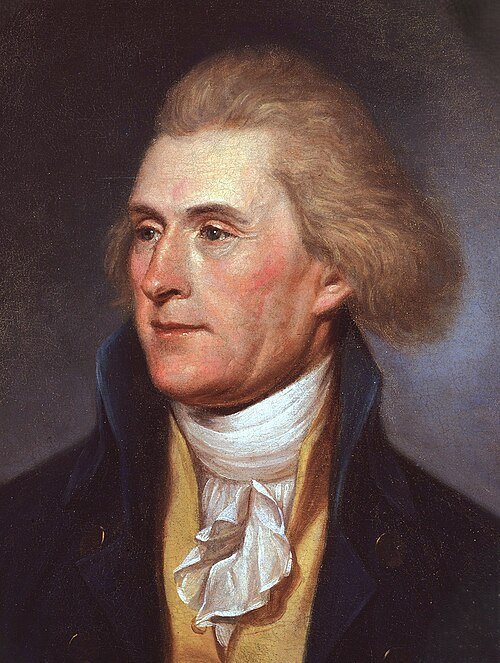
Image credit: Establishing a Federal Republic – Thomas Jefferson (Library of Congress Exhibition) / public domain
When he was 46, Thomas Jefferson received a letter from George Washington asking him to serve as the first Secretary of State – an invitation Jefferson accepted with what he called “real regret” but a sense of duty. He would have preferred to remain out of the political mainstream. Almost as soon as he entered the new cabinet, Jefferson was at loggerheads with Secretary of the Treasury, Alexander Hamilton. The two men had very different philosophies about democracy. Hamilton put little trust in the common people and thought the United States should be governed by an aristocracy of the rich and well-born. He also wanted to promote shipping and manufacturing, while Jefferson hoped the United States could remain an agricultural nation. Hamilton supported a national bank, which Jefferson felt would give the government too much power. Jefferson believed in a strict, literal translation of the Constitution; Hamilton favored a loose interpretation. Jefferson believed the Federal government should concern itself chiefly with foreign affairs and leave local affairs to the state and local governments. In general, Hamilton wanted to strengthen the role of the central government and Jefferson wanted to limit its power. Their differences of opinions led to a bitter feud and eventually to the development of the first two political parties. The Federalists were behind Hamilton – the Democratic-Republicans were behind Jefferson. Although called Democratic-Republicans, this party is considered by historians to be the origin of our modern Democratic party. The tensions with the Federalists were so difficult that when Washington was elected for a second term, Jefferson resigned his post. He gleefully departed from what he called “the hated occupation of politics” and returned to his beloved Monticello where he said he could be “in the society of my neighbors and my books, in the wholesome occupations of my farm and my affairs…owing account to myself alone of my hours and actions.”
Thomas Jefferson as the Third President of the United States
Jefferson’s respite lasted only two years. In 1796, his party nominated him as a candidate for President of the United States, against the Federalist John Adams. It was the first party contest for the office and Adams won it by a mere three electoral votes. According to the law of the time, Thomas Jefferson automatically became vice-president. Since the administration was largely Federalist, Jefferson played almost no active part as vice-president. Instead, he focused on strengthening his party, seeking support among the small farmers, settlers, and laborers of the young country. His relationship with Adams became so strained that by the end of the term they were barely speaking. In 1800, the Democratic-Republicans once again nominated Jefferson as their candidate and he once again squared off against Adams. But this time the Federalists quarreled among themselves, with Adams taking the lead on one side and Alexander Hamilton taking the lead on the other. The united Republicans scored a victory, even though the Federalists had denounced Jefferson as an anarchist and an “unbeliever.” Jefferson’s vice-president was the hot-tempered Aaron Burr, who killed Hamilton in a duel four years later.
Life in the White House
Thomas Jefferson was the first President to be inaugurated in the new capital of Washington D.C. He then moved into the partially built White House, which was then called simply “the President’s House.” Jefferson thought it was lonely in the expansive house, which he described as “big enough for two Emperors, one Pope, and the Grand Lama.” For the company, he kept a pet mockingbird. By then Jefferson’s wife Martha had been dead for over 18 years. His daughter served as a hostess from time to time, but his most popular hostess was the famous Dolly Madison, wife of his good friend and Secretary of State, James Madison. Jefferson’s grandson, James Randolph, was the first child born in the White House.
Life in the Jefferson White House was as simple and democratic as the man himself. He eliminated all the formality and protocol that so distressed him in the Washington and Adams administrations. Before Thomas Jefferson, people bowed to the President of the United States. After Thomas Jefferson, they shook hands. He also moved in a round dining table so there would be no head-of-the-table and all his guests would feel equally important. Two days each year he held an open house so citizens could see the president’s home and speak with him. It was Jefferson, always passionate about architecture, who designed the east and west terraces and the north portico of the White House. The informal, democratic tone Jefferson established in the White House became a lasting part of American presidential tradition, influencing leaders for generations to come — from Lincoln to Dwight D. Eisenhower.
The Louisiana Purchase
Thomas Jefferson served two terms as President. In that time he sharply reduced government spending and kept the United States out of the war between France and Great Britain. But most importantly, he expanded United States territories to the west. In 1803, Jefferson obtained two million dollars from Congress and sent James Monroe to France to negotiate a purchase of New Orleans and “the Floridas.” He was chiefly interested in the control of the Mississippi. But everyone was astounded when the French responded by asking: “What would you give for the whole of the province of Louisiana?” The province of Louisiana covered a vast area from the Mississippi River to the Rocky Mountains. Thomas Jefferson, who feared the area might be a threat to democracy if it remained in the hands of Napoleon, permitted Monroe to strike a bargain. Monroe offered $11,250,000 for the land and agreed to cancel a debt of $3,750,00 the French owed the United States. For a total of about $15 million, the United States doubled its size.
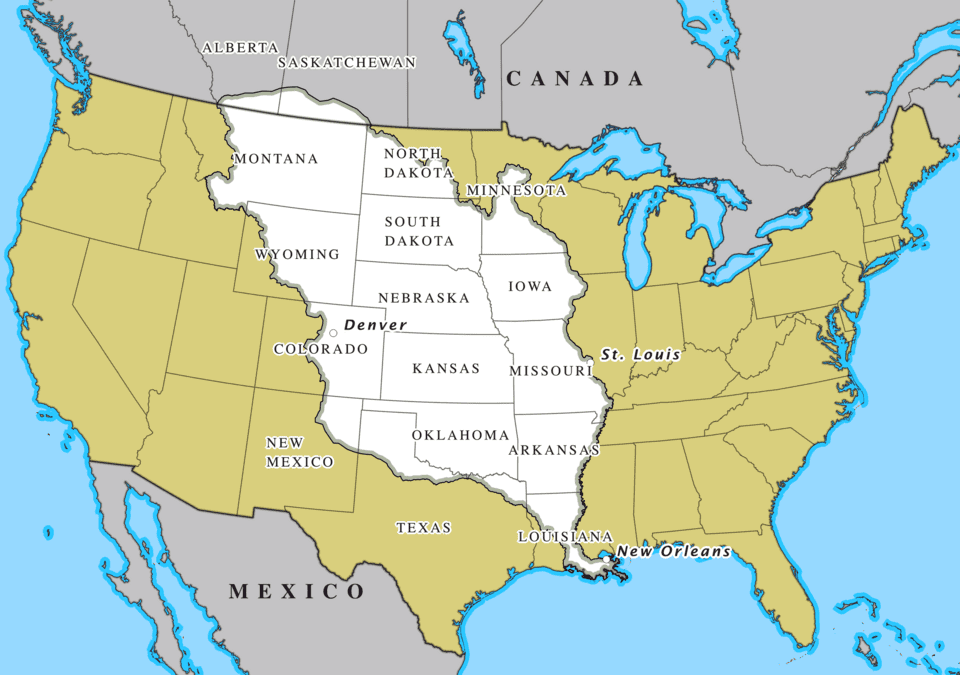
Image credit: William Morris / CC BY-SA 4.0 (via Wikimedia Commons)
Lewis and Clark Expedition
Thomas Jefferson was never sure the Constitution gave him the right to buy and add this vast new territory to the Union. He later said that to make the Louisiana Purchase he had “stretched the Constitution till it cracked.” The following year he sent Meriwether Lewis and William Clark to explore the region west to the Pacific Ocean. After that, the population of the Northwest Territory grew quickly. Thomas Jefferson encouraged settlement by reducing the minimum acreage a settler could buy from 320 to 160. For only $80 any settler could make the first payment on a farm in the new frontier. The same year the Purchase was made, Ohio joined the union as the 17th state.
Retirement at Monticello and the University of Virginia
When his two terms as President expired, Jefferson’s followers urged him to run for a third. He decided instead to follow Washington’s example and retire. It had always concerned him that the Constitution established no limit for the terms of the presidency. When he retired, Thomas Jefferson was 65 years old and anxious to finally resume his quiet life of farming and study at Monticello. He said: “Never did a prisoner released from chains, feel such relief as I shall on shaking off the shackles of power.”
Back in Monticello, Thomas Jefferson pursued his music, the study of philosophy, law, and religion, and experiments with new crops and farming methods. He also found time to entertain an unending stream of guests and to keep up an extensive correspondence. One of his favorite correspondents was John Adams. Now that they were retired from public life, they were able to renew their friendship and forget past differences.
Thomas Jefferson was far from wealthy. He supported various family members and poured enormous sums of money into Monticello and into entertaining his visitors, who sometimes numbered as many as fifty at a time. He sold his extensive personal library to the Library of Congress to improve his finances, but in later years he had to rely on public contributions for the maintenance of Monticello. After his death, the estate passed out of his family’s hands completely.
In his later years at Monticello, Thomas Jefferson worked energetically to create the University of Virginia, which he described as “the last of my mortal cares, and the last service I can render my country.” He envisioned a school that would be based “on the illimitable freedom of the human mind to explore and to expose every subject susceptible of its contemplation.” He designed the buildings, organized the curriculum, hired the faculty, and selected the library books. The university opened in 1825, with 40 students. The code of discipline at the university was liberal – Jefferson believed the students would take it upon themselves to study hard and behave responsibly. Yet in its first year, there was a student riot in which professors were attacked with bricks. The next day the board held a meeting with the defiant students. Thomas Jefferson, devastated by how the students had betrayed his trust, began by saying: “This is one of the most painful events of my life,” and then he started weeping. The tears of Thomas Jefferson had an overwhelming effect on the students. Readily they came forward to give their names and confess their crimes. Then they returned to their studies and caused no more trouble.
Death of Thomas Jefferson and John Adams
The year after the University of Virginia opened, Jefferson’s health began to fail. As summer approached, there were plans to celebrate the fiftieth anniversary of the Declaration of Independence, but knowing he would not be well enough to attend he sent his regrets, with the comment: “May it be to the world, what I believe it will be…the signal of arousing men to burst the chains under which monkish ignorance and superstition had persuaded them to bind themselves, and to assume the blessings and security of self-government.”
While Thomas Jefferson steadily declined at Monticello, his friend John Adams was nearing death in Massachusetts. Their friends and relatives later said it was clear that each man was trying desperately to survive until July 4, the anniversary of the event they held most dear. Both succeeded. After asking if the 4th had arrived, and being told yes, Thomas Jefferson fell into a deep sleep and died shortly before 1:00 in the afternoon. Adams, who had not yet heard of Jefferson’s passing, died a few hours later. His last words were: “Jefferson still survives.” Jefferson was buried beside his wife at Monticello.
Thomas Jefferson’s Legacy and Contributions to American Democracy
Besides the three remarkable contributions Thomas Jefferson listed on his tombstone, are many others of which he seldom spoke. He doubled the area of the United States with the purchase of the Louisiana territory. Under his presidency, Congress passed a law banning the slave trade. He revised Virginia’s laws, developed the decimal system of coinage, and compiled the Manual of Parliamentary Practice still used in Congress. Outside of politics, his achievements were equally illustrious. As an architect, he designed the Virginia Capitol, the University of Virginia, his splendid house Monticello, and helped design the nation’s capital in Washington D.C. He was a lover of art and music and encouraged their development and support in the United States. He played the violin in chamber music concerts. He was president of the American Philosophical Society, which promoted a wide range of scientific and scholarly research. He recorded the vocabulary of many different Native American languages. He learned Latin, Greek, French, Spanish, Italian, and Anglo-Saxon. He analyzed the New Testament in an attempt to discern which quotes of Jesus were accurate. He collected and classified fossils from all over the United States. He cultivated one of the finest gardens in America and was always on the lookout for new plants and seeds that would help farmers become prosperous. He invented a decoding device, a lap desk, a swivel chair, and the improved plow. He contributed over 6,400 books to our Library of Congress.
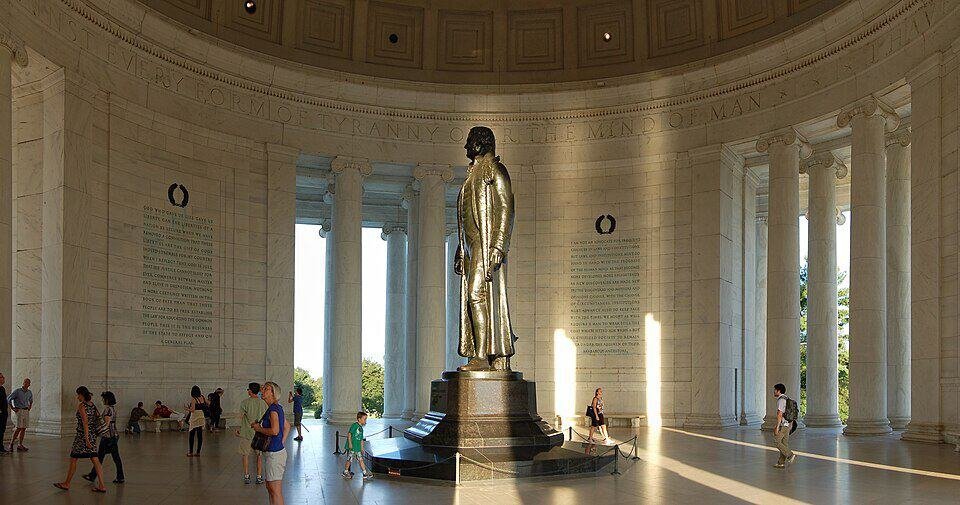
Image credit: Michael Kranewitter / CC BY-SA 3.0 (via Wikimedia Commons)
Thomas Jefferson never considered himself a politician. Unlike politicians today, he viewed politics not as a profession, but as a service. Even though he spent most of his life in public office, he preferred his family, books, and gardens to public life. In his mind, the ideal public servant was an individual of varied interests and talents – well educated and cultured, with experience in many fields of life. When called to serve, he served. But his main focus was on developing his character and knowledge so he would be qualified to serve.
To Thomas Jefferson, the common person was far nobler and trustworthy than the aristocrat. He once said: “Those who labor in the earth are the chosen people of God.” This deep respect for working people and the self-made citizen would echo through American history, inspiring industrialists and innovators like Henry Ford, whose assembly line revolutionized what ordinary workers could achieve and own. His faith in self-government, and in a people’s ability to make wise, beneficial decisions, was perhaps deeper than that of any other founding father. He was devoted to liberty on every level – in speech, religion, and the press. It was he who so strongly pushed for a Bill of Rights. It was he who chose the three achievements to be engraved on his tombstone: one, the liberty of the American people through the Declaration of Independence; two, the liberty of religious choice through the Statute of Virginia for Religious Freedom; and three, the liberty of the mind, in the founding of the University of Virginia. His trust in the majority was not a blind trust. He firmly believed that this majority must be informed and educated to rule itself efficiently and justly. That is why he pushed so strongly for freedom of speech and the press, and the establishment of schools. Early on he vowed himself to what he labeled “eternal hostility against every form of tyranny over the mind of man.”
All the founding fathers contributed to America’s character. But there is no other single individual who molded the American mind and spirit as much as Thomas Jefferson did. In every sense, he was a creator of America, the man who defined its ideals, verbalized its beliefs, and continues to be a symbol of its highest aspirations.
References:
- Adams, Herbert Baxter (1888). Thomas Jefferson and the University of Virginia. U.S. Government Printing Office.
- Alexander, Leslie (2010). Encyclopedia of African American History (American Ethnic Experience)
- Ambrose, Stephen E. (1996). Undaunted Courage: Meriwether Lewis, Thomas Jefferson, and the Opening of the American West.
- Andrews, Stuart. “Thomas Jefferson and the French Revolution” History Today (May 1968)
- Bailey, Jeremy D. (2007). Thomas Jefferson and Executive Power. Twenty-First Century Books.
- Bear, James Adam (1967). Jefferson at Monticello. University of Virginia Press.
- Berry, Trey; Beasley, Pam; Clements, Jeanne (2006). The Forgotten Expedition, 1804–1805: The Louisiana Purchase Journals of Dunbar and Hunter
- Boles, John B. (2017). Jefferson: Architect of American Liberty

