

Cover image: Imperial War Museum United Kingdom, public domain
Table of Contents
It was a lonely decision Dwight D. Eisenhower had to make that gray, cloudy day in 1944 — the day that would go down in history as D-Day. The fate of millions of people, the fate of all of Europe and the world depended on it. Yet it was a decision he had to make alone. And the results, whatever they were, would be his responsibility. For days now he had been consulting meteorologists, hoping for the weather conditions he had described as perfect: “Clear and with a wind of five or six miles an hour blowing inshore, so the smoke and dust of the battle will blind the enemy and not us.”
Supreme Allied Commander and Operation Overlord
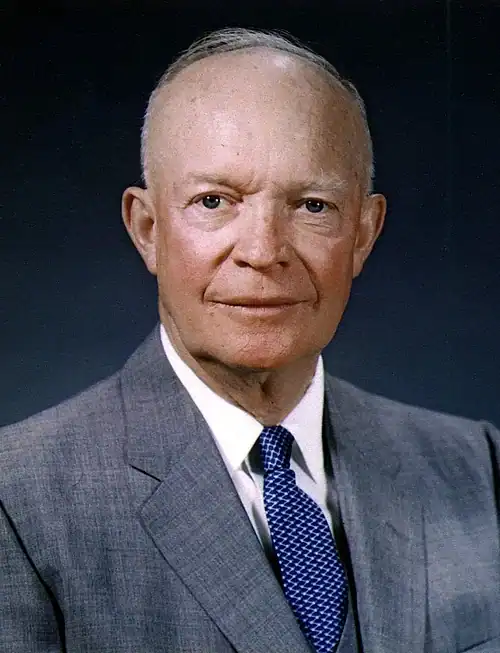
Image credit: White House, public domain
Also waiting were the leaders of the Allied forces, including President Franklin Roosevelt and British Prime Minister Winston Churchill who, with tears in his eyes had told Eisenhower: “I am in this thing with you to the end, and if it fails we will go down together.” Waiting too were the commanders and generals and the divisions of soldiers – millions of Americans and Englishmen who struggled not to think about the horrors and glories that might lay ahead. To boost their morale Dwight D. Eisenhower traveled by train through England, Ireland, and Scotland to visit 26 divisions, 24 airfields, five naval vessels, and several hospitals and ships. At one site, where sailors stood at attention in a heavy downpour dressed only in their uniforms, he removed his own raincoat, a gesture they never forgot. When Dwight D. Eisenhower talked to his men, it was about their plans for when the war was over. He also ordered his subordinates to move about their troops and talk to them, and in this way, a warm sense of unity and teamwork had developed among the men. They were men who knew that one way or another, they were about to make history. They were the players in what was to be the largest military invasion the world has ever known – Operation Overlord.
Planning D-Day: The Largest Military Invasion in History
Planning for Operation Overlord had taken a full year. Thousands of details had been involved, including forming a staff, gathering data, and procuring millions upon millions of tons of supplies and equipment. The industrial capacity that made this possible was itself a product of the American manufacturing revolution — a transformation largely set in motion by Henry Ford’s assembly line. All of this had to be transported and housed, as did the men themselves. Artificial harbors were built so the constant stream of supplies could be efficiently delivered. Then there were the military strategies themselves. Beginning in the spring of 1944, squadrons of bombers were sent out to destroy vital bridges, rail centers, and factories to disrupt German supply routes and sources. Then intelligence reports showed that the Germans were erecting obstacles at many of the possible landing sites in France. So the allies built replicas of these obstacles – underwater minefields, barbed wire tangles, concrete pillboxes, high stone walls, booby traps in the sand, and anti-tank ditches – and then they devised new equipment and trained their men to overcome the obstacles.
Besides all this, the armies and navies of the United States, Great Britain, and other allies had to be coordinated to ensure they worked smoothly as one force. Operation Overlord was a gigantic task, from beginning to end. And all of it was under the command of General Dwight D. Eisenhower, or, as he was known to almost everybody, “Ike.” Even Prime Minister Churchill called him Ike – in response, Eisenhower called Churchill “Prime.”
Dwight D. Eisenhower had arrived in England in January, six months before the invasion was scheduled to begin. His offices were called SHAEF – an acronym for Supreme Headquarters, Allied Expeditionary Force. SHAEF was located in some dingy brick buildings in the English woods near London, camouflaged with the usual leaf and dirt-brown nets designed to confuse enemy pilots. Its location was supposed to be secret but it didn’t take long for the press and public to figure out something important was taking place under those leaf-strewn roofs. VIPs went back and forth, a ten-foot-high wall surrounded the area, and it was guarded by white-gloved, white helmeted MP’s whom the press nicknamed “Ike’s snowballs.”
The landing sites of Operation Overland could be kept secret but the expedition itself was far too large to escape the attention of the Nazis. Dwight D. Eisenhower decided to use its size to his advantage, launching a propaganda campaign aimed at intimidating and confusing the enemy. Allied radio stations continuously blared reports of an imminent invasion. Rumors were spread that the allies would invade Norway, or that the entire force would be concentrated on Calais, a French seaport across the channel from Dover. On several occasions, Dwight D. Eisenhower sent armadas steaming across the channel and as the Nazi alarms rang out and their men sprang into battle positions, the ships would simply turn around and calmly head back for England. Soon, the German look-outs on the coast of France grew careless and stopped sounding the alarms.
Operation Overload, the gigantic final effort to stop the Nazis, was based on a seven-step plan, of which the invasion of Normandy from across the English Channel, was step one. The following steps were:
- Amass resources in northwestern France for a major battle against the Germans, who would attempt to encircle the Allies.
- Send one of the two Allied armies to the left to capture ports and reach the German border.
- Send the other army to the right to join forces with an expedition invading Germany from southern France.
- Create a new base on Germany’s western border and keep the Germans off-balance with a relentless offensive.
- Destroy the German military force west of the Rhine and make bridgeheads across the river.
- And make the final attack, with the left army taking the Ruhr, Germany’s industrial center, followed by an immediate thrust through Germany.
June 6, 1944: The Decision That Changed the War
It was an ambitious and bold plan and all of it relied on the success of the first step, the landing of the allied troops on the beaches of Normandy. That landing, which had been dubbed D-Day, was scheduled for either June 5, 6, or 7, depending on the weather. They would need low tides and calm seas for the landing boats, and clear skies for the bombers protecting them. As the deadline approached, Dwight D. Eisenhower developed a painfully sore eye and a ringing in one ear. The stress he endured was enormous. The Allies, as he said, “we’re definitely placing all their hopes, expectations, and assets in one great effort.” “Failure,” he added, “would carry with it consequences that would be fatal.”
If the weather on the proposed dates weren’t favorable, D-Day would have to be delayed two weeks before there was once again the proper combination of moonlight, low tide, and the hour of sunrise. By then, they would have probably lost both their secrecy and the morale of their troops, and the enemy would have had time to prepare. Eisenhower said the prospects of a delay were “terrifying to contemplate.”
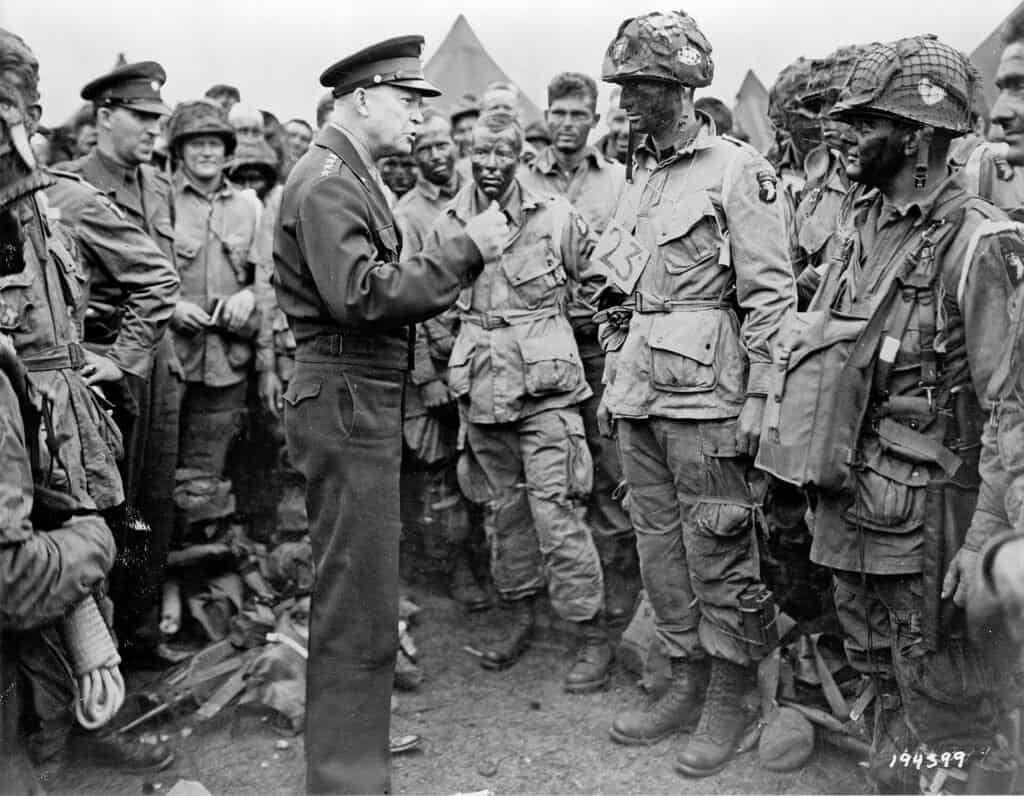
Image credit: United States Library of Congress‘s Prints and Photographs division, public domain
But on June 4, the meteorologists gave their prediction – strong winds, high waves, and dark clouds. A June 5 invasion was canceled. Word went out immediately to the top commanders of the fleets in the crowded harbors, and to the army posts throughout southern England, which was now one vast military camp. All through the day on June 5, Dwight D. Eisenhower conferred with the meteorologist about the possibility of June 6. He waited until the last possible report, which predicted a slim chance the weather would clear up on June 6, and a good chance it would turn bad again on June 7.
Dwight D. Eisenhower now faced a soul-wrenching decision – he could risk millions of lives on the small chance of good weather or he could delay the landing and lose the vital military advantage of surprise. Finally, he made his decision. “Let’s go!” he said.
On June 6, 1944, one million men in 4,000 ships landed on the beaches of Normandy. By nightfall, they had a firm hold. Then they began to fight their way into the heart of France to drive back the forces of Adolph Hitler’s fascism. Within ten weeks the Germans had been driven from most of France. Then began a slow, broad advance, culminating in the Battle of the Bulge at the end of the year. By May the next year, 1945, Germany had unconditionally surrendered. Operation Overlord had succeeded. The decision Dwight D. Eisenhower had made on the fateful day of June 5 had been the right decision. He was now the biggest hero in America.
Early Life, Education and Military Career
In some ways, Dwight D. Eisenhower was the least likely person to rise to the highest ranks of the military and gain fame as a war hero. He was born to a deeply religious couple who belonged to a protestant sect called the River Brethren, which believed in pacifism. The only soldier in the family tree had been a brother of his grandfather who fought in the Civil War. And Dwight, from childhood until he died, was known not for his toughness, but for his geniality and his wide warm grin.
He was born October 14, 1890, in Texas and was christened by David Dwight Eisenhower, but for some reason, he was always called Dwight David – that is until his schoolmates began calling him Ike. From then on, his mother was the only one who persisted in calling him, Dwight. There were six boys in the Eisenhower family (a seventh died in infancy) and Ike was right in the middle as number three. When Dwight was still a baby, his family moved to Abilene, Kansas, where his father took work in a creamery. The Eisenhower’s were always very poor and the sons raised and sold vegetables and found other jobs to help with the expenses.
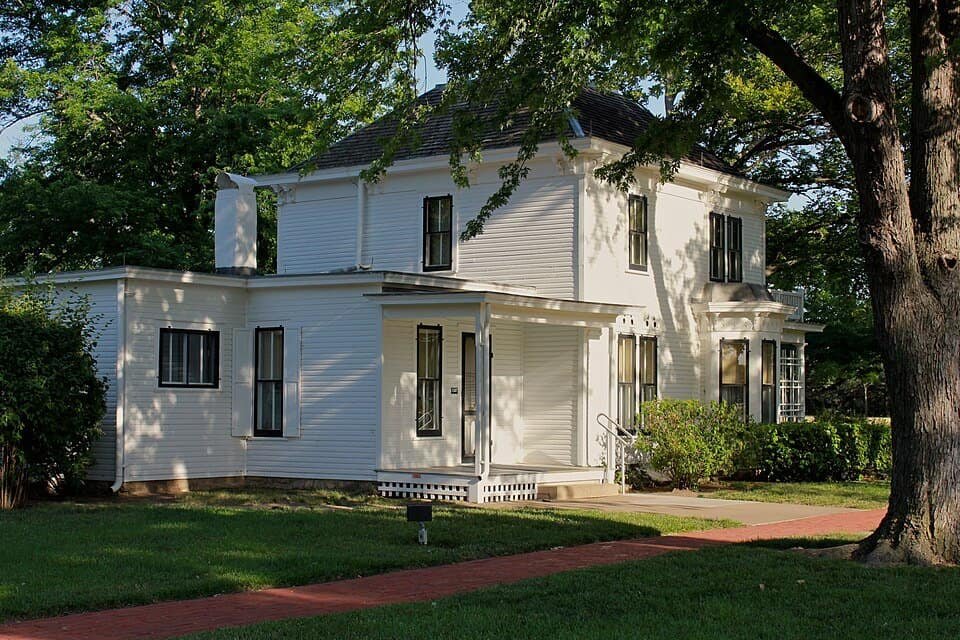
Image credit: Andre Porter, licensed under CC BY 3.0.
All through school, Dwight D. Eisenhower was popular with his classmates. Just the same, in his high school yearbook the prediction was that he would become a history professor and that his older brother, Edgar, would someday be President of the United States.
When he graduated from high school, Dwight D. Eisenhower worked full-time at his father’s creamery to help pay his brother’s first-year college expenses. He had no plans for higher education until a friend persuaded him to apply to the national military academies, where tuition was free. He received an appointment to West Point and accepted it, simply because it was the only opportunity he had to pursue his learning. He always respected his parents’ opposition to war, even after he’d begun his career as a soldier.
At West Point, Dwight D. Eisenhower was an outstanding football player but his hopes of becoming a star half-back were dashed when he suffered a knee injury on the field. He graduated when he was 25 years old, 61st in a class of 164, and was assigned to Fort Sam Houston in the state of his birth, Texas.
The most important thing that happened to Dwight D. Eisenhower at Fort Houston was that he met a visitor from Denver named Mamie Geneva Doud, and began squiring her around to the social gatherings at the base. Mamie was the daughter of a wealthy Denver meatpacker, a girl so pretty and lively that early on everyone had agreed that her real name, Marie, was far too subdued. The day after he met her, Ike called her fifteen times until he finally found her home and could arrange a date for her first free evening, four weekends later. Within a year, on the same day he was promoted to the first lieutenant, they were married. Eisenhower brought her home to meet his family, and they took to her immediately. The only complaint his mother ever had about Mamie was that she called him by the nickname “Ike.”
Sometime later when the newlyweds were on vacation, Mamie sent Eisenhower’s mother a postcard that was answered with the short note: “I’m very glad you’re having a good time. But who is this Ike you’re traveling with?” The couple’s first son died of scarlet fever when he was only three years old but they had another, John Eisenhower, who later became an army officer and a diplomat. It was his son, David, who married Julie Nixon, the daughter of Eisenhower’s vice president, Richard Nixon. Like most military families, the Eisenhower’s were continually on the move from post to post and house to house. It would be over 40 years before they had a permanent house to call their own.
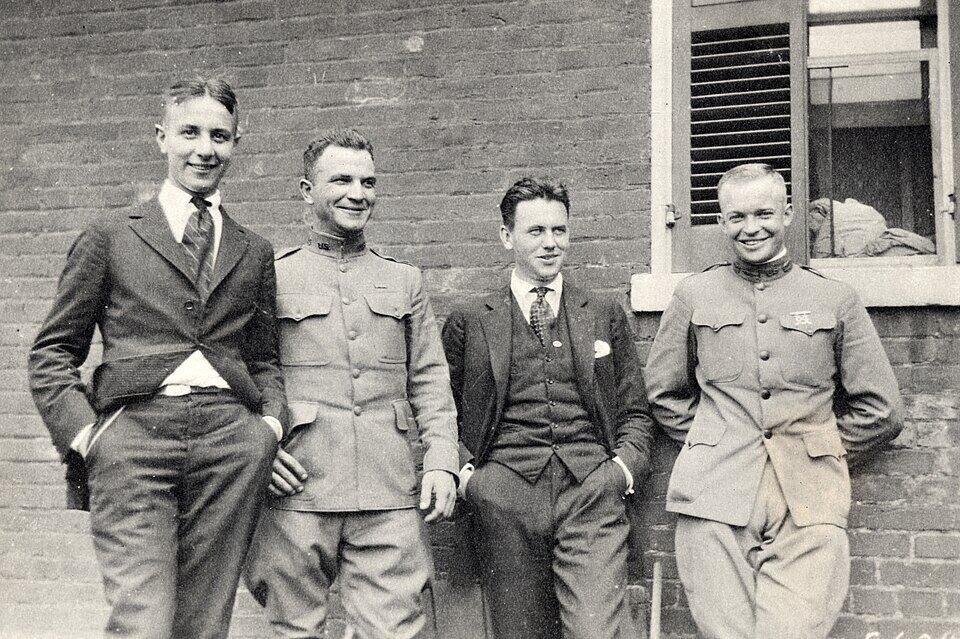
Image credit: Unknown author, public domain
Dwight D. Eisenhower’s military career climbed slowly but steadily, started in obscurity, and ended in glory. Although he applied for overseas combat service during World War I, he was instead put in charge of tank training programs near Gettysburg, Pennsylvania. When the war was over he was sent to the Panama Canal Zone to serve under Brigadier General Fox Conner, a man who greatly influenced him. Dwight D. Eisenhower, then 28, was deeply impressed with Conner’s self-discipline and attention to detail. Conner, in turn, was so impressed with Eisenhower that he recommended him for what was known as the army’s “leadership factory” – the Command and General Staff School in Kansas. There, the army’s best men were taught a highly demanding course in tactics and other military skills. Eisenhower completed his training when he was 36, graduating first in a class of 275.
During the next few years, Ike held several posts, including one as an aide to General Douglas MacArthur, the Army Chief of Staff in Washington. MacArthur took Dwight D. Eisenhower with him when he was appointed military advisor of the Philippines, a country which was then a U.S. possession but was being prepared for independence. Eisenhower’s task was to plan the military defense of the Philippines and establish a military academy for the new government. While he was there, he also took flying lessons and proudly made his first solo flight when he was 47 years old. Then came the cataclysmic year of 1939.
World War II: Dwight D. Eisenhower’s Rise to Command
In the first years of World War II, only Great Britain and France were fighting Germany, which was later joined by Italy and Japan to form the Axis powers. But by 1940, the United States began to build up its own military forces as it seemed more and more inevitable that it too would be drawn into the battle. That war would be the source of Eisenhower’s meteoric rise as a military commander.
In 1941, the Army set up a war game in Louisiana to test the strength of its forces. The games involved over 500,000 troops and the army’s most brilliant commanders. Dwight D. Eisenhower was in charge of planning the strategy of the Third Army in a mock battle that pitted it against the tank division commanded by George S. Patton – a friend of Eisenhower’s and a future war hero himself. Eisenhower’s men brilliantly defeated Patton’s and Eisenhower was awarded a promotion to brigadier general. His performance also caught the eye of General George Marshall, who had replaced MacArthur as Army Chief of Staff.
The United States entered the war in December 1941 after Japan bombed the U.S. Naval base at Pearl Harbor, Hawaii. Immediately, Marshall called Eisenhower to Washington to participate in the war plans division. He was promoted to major general shortly after, and in June 1942, when he was 52 years old, he was named Commanding General of U.S. Forces in the European Theater of Operations. He had been chosen from a field of over 366 skilled and experienced senior officers. The rapid advancement of Eisenhower was due not just to his military knowledge, but to his ability to persuade and mediate. Throughout his career, men from all kinds of backgrounds and different nationalities were impressed by his friendliness and optimism and liked and trusted him.
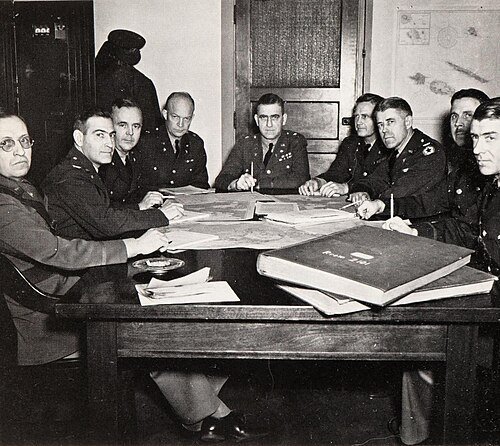
Image credit: U.S. War Department Library, public domain
Only a month after being named major general, Dwight D. Eisenhower was promoted to lieutenant general and assigned to command the Allied forces invading North Africa. The invasion of North Africa was a stunning victory in which the region was recaptured from German and Italian forces. When it was over Dwight D. Eisenhower was promoted to four-star general, which was at that time the highest rank in the army. His next tasks were to organize the Allied invasions of Sicily and Italy. In all his campaigns, Eisenhower was especially gifted at creating unity among commanders from the different nations that made up the Allies. It was not always an easy task. Many of these commanders were stubborn and outspoken, and Eisenhower had to be as much a diplomat as a planner.
Finally, in 1943, the United States and Great Britain set up a combined staff to plan Operation Overlord, the Allied invasion of German-occupied Europe. Both Eisenhower and his former supervisor George Marshall were highly recommended to command the operation. But because he thought Marshall’s work in Washington was too critical, President Franklin Roosevelt gave Eisenhower the job. In December 1943, at the age of 53, he was named Supreme Commander of the Allied Expeditionary Force in Europe.
After the success of Operation Overlord, and the final defeat of Germany and the Axis powers, Eisenhower was promoted to the newly created rank of five-star general. He returned to the United States in triumph, receiving a hero’s welcome everywhere he went. But the hero had seen enough of war. His only goal after the war was to retire from the military and find a quiet civilian position somewhere. It was not to be.
Dwight D. Eisenhower After the War: From Army Chief of Staff to NATO Commander
Only six months after he returned home, Eisenhower was called on to replace Marshall as Army chief of staff and help the military make the delicate transition from wartime to peace. He took the position from a sense of duty and began a program of slowly disbanding the armed forces, to keep the nation strong while gradually shifting it towards a peacetime military. It took almost three years for that transition to complete itself, and then he did what he intended to do from the beginning – he retired from the army and took a civilian post, as president of Columbia University in New York City. He also wrote a book about his wartime experiences called Crusade in Europe, which astonished him by becoming a best-seller and making him a wealthy man, overnight.
It seemed that nothing could keep Dwight D. Eisenhower out of uniform for long. By the end of the 1940s, the Soviet Union had established Communist governments in most countries of Eastern Europe. In response, the United States and Canada joined several western European nations to form a military alliance known as NATO – the North Atlantic Treaty Organization. President Harry Truman asked Eisenhower to serve as the supreme commander of NATO forces in Europe, which included troops from all the varied nations which were members. It was a unique opportunity – the molding of an international army – and Eisenhower eagerly accepted it. He knew, as most others did, that his experience in organizing and unifying the Allied forces of World War II, had well prepared him for the task. But NATO was to be his last military work – soon, and unexpectedly, a new career called – politics.
After World War II (1945–1953)
Dwight D. Eisenhower intended to enter politics and certainly never planned on running for the presidency. But in 1950, deep divisions began to form in the United States over the Korean War. Many Republicans supported America’s involvement in aiding South Korea against the Communist North, but a group of conservative Republicans led by Senator Robert Taft wanted to withdraw from the war. Eisenhower disagreed with Taft – it was his belief that the United States couldn’t ensure its own peace and freedom while remaining aloof from the problems facing the rest of the world. Republicans began to pressure him to run for office, arguing that he had enough popularity to unite the party again and to settle the issues dividing the nation. Meanwhile, the Democrats urged him to join their party. The decision Eisenhower finally made was based on his strong belief in the two-party system and his concern that there hadn’t been a Republican President in twenty years. He agreed to join the Republican Party, but at first, he refused to run.
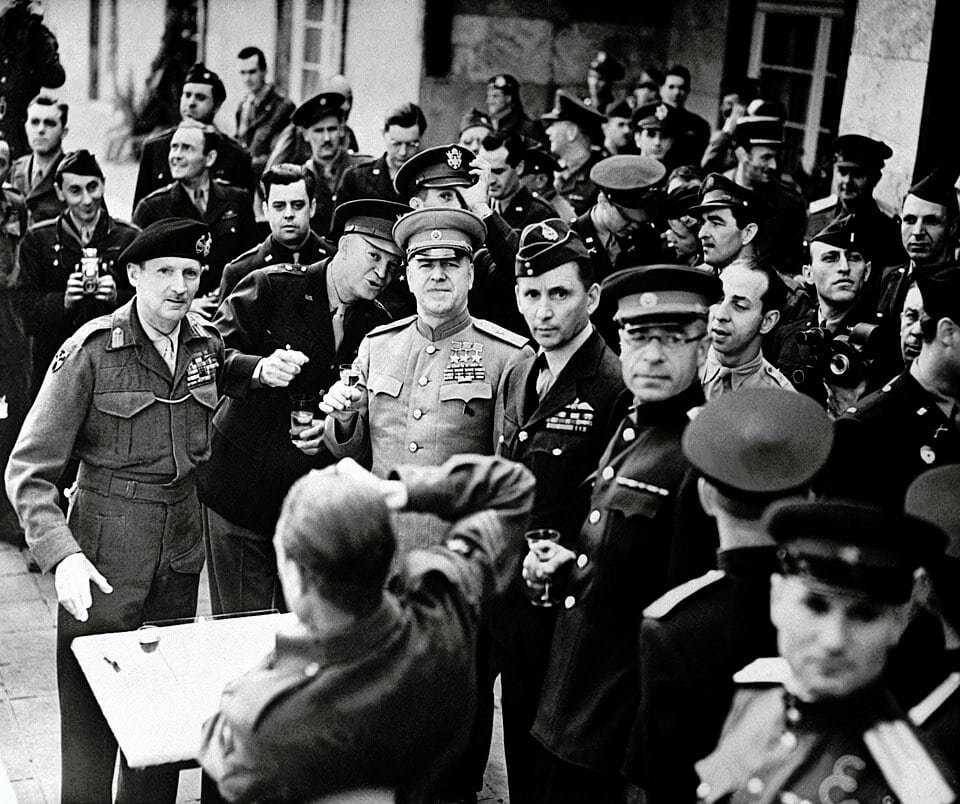
Image credit: US Office of War Information, public domain
To begin with, Dwight D. Eisenhower didn’t want to run against Truman, a man with whom he’d worked and whose defense policies he helped design. Secondly, he was worried about a letter he had sent to a newspaper in 1948, in which he said it was “necessary and wise that professional soldiers abstain from seeking high political office.” Nevertheless, forces began to conspire to change his mind.
The first event that influenced him was that Truman decided not to run for re-election. Then, groups called IKE clubs began to spring up all over America in support of his candidacy. Everywhere he turned he was being encouraged, even expected, to run for the presidency. Unable to resist the tide, he decided that a soldier’s duty might also include service in the White House, and declared himself a candidate for the Republican presidential nomination.
At the Republican National Convention in 1952, Dwight D. Eisenhower won the nomination on the first ballot. The vice-presidential candidate was Richard Nixon, then a senator from California. Their Democratic opponents were Adlai Stevenson and his running mate Senator John Sparkman.
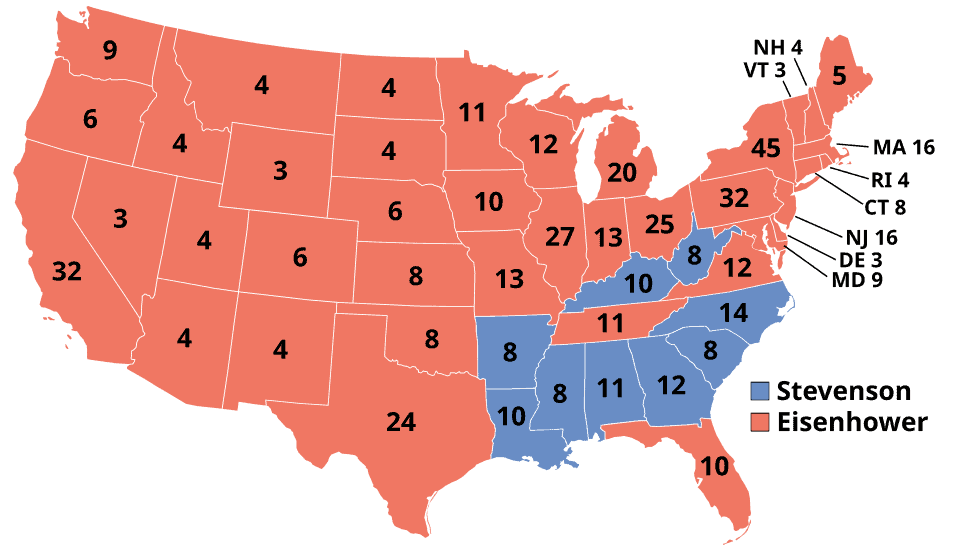
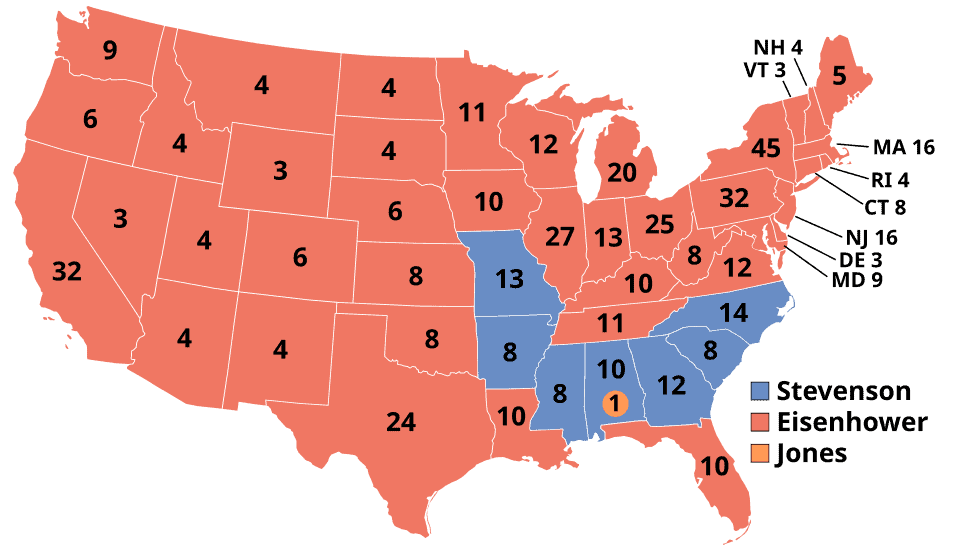
The campaign began slowly with Eisenhower complaining about how reporters always talked about his friendly grin instead of his experience…”As if I didn’t have a brain in my head,” he grumbled. His campaign speeches pledged that he would fight Communism and that he would go to Korea to help end the war. One of the greatest supporters Eisenhower had was the new medium of television – it showcased his geniality and dignity far better than the intellectual wit for which Stevenson was known. But most important was Eisenhower’s legacy from the War, the experience and integrity that Americans still remembered and respected. He won the election with 34 million popular votes, 55 percent of the ballots cast.
Presidency (1953–1961)
Dwight D. Eisenhower served two terms as President, between the years of 1953 and 1961. For a military man, he was decidedly un-military in his style of administrating. He delegated broad powers to his aides, commenting: “This idea that all wisdom is in the President, in me, that’s baloney.” He made each Cabinet officer and assistant responsible for an area of government, chose officials for their managerial skills and strong convictions, and warned them not to bother him with anything they couldn’t handle themselves. Dwight D. Eisenhower called his administration Modern Republicanism and liked to describe himself as a “middle of the roader.” He asked for a reduction in government spending and only involved himself with Congress when they debated programs he felt were essential. He reorganized the armed forces so there was an emphasis on fewer forces with stronger weapons, especially nuclear weapons. Not surprisingly, Dwight D. Eisenhower also emphasized close cooperation with the nation’s allies.
McCarthyism and Civil Rights
One of the most troublesome issues during Eisenhower’s first administration was the rise of a Republican senator from Wisconsin named Joseph McCarthy, who headed a subcommittee that spearheaded a virtual witch hunt of Communists in the government and the arts. Dwight D. Eisenhower strongly disliked McCarthy but refused to criticize him publicly, saying: “I don’t want to get in the gutter with that guy.” However, when McCarthy tried to ban books by authors he considered Communists, Eisenhower urged students at a commencement ceremony at Dartmouth College, “not to join the book burners” of society. As the President had expected, the Senate itself soon pulled the reins in on McCarthy, condemning him for conduct unbecoming a senator.
Dwight D. Eisenhower kept his campaign promise to visit Korea and although the trip failed to bring an immediate result, a truce was signed only months later, in July of 1953.
Despite the demands of his office, Dwight D. Eisenhower was one of the more relaxed presidents, and always scheduled time for recreation and rest. Ever since Dwight D. Eisenhower, the American presidency has been associated in the public mind with the pastime of golf. It was his favorite recreation, as it would be for several future presidents. Passers-by would sometimes see him practicing his golf shots on a special green he’d installed on the White House lawn. His other favorite hobby was cooking. One of his favorite social events was to invite friends to a barbecue on the White House roof, where he’d broil steaks on a charcoal grill.
At the time he served, Dwight D. Eisenhower was the oldest president America had ever had. The public was often concerned about his health; he suffered a heart attack during his first term, near his 65 birthday, and shortly after required surgery for an intestinal disorder called ileitis. During his second term, he suffered a mild stroke. But each time he continued to work from his hospital bed and made a quick recovery. Despite his age, he had all the energy necessary to apply himself to the critical issues of America in the decade of 1950s.
The controversy over civil rights for minorities was just reaching a crisis during the Eisenhower years and although he was not very passionate about the cause, he did favor a deliberate and orderly end to racial discrimination. He sent the National Guard into Little Rock, Arkansas when its Governor defied a federal court order to integrate its high schools. Dwight D. Eisenhower said his action was based on the simple desire to prevent further civil disorder – to the principles of the cause, he seemed indifferent. Following his move in Arkansas, Congress enacted federal civil rights legislation that paved the way for the energetic civil rights movement of the 1960s.
The Cold War and the Space Race
The real tension in the Eisenhower years was not at home but with the Soviet Union and its explosive, unpredictable leader Nikita Khrushchev. Hostilities and competition between Russia and the United States reached a pinnacle in the fifties, helped along, not just by military issues, but by the race to explore space. When the Russians sent Sputnik, the first artificial satellite, into space, Americans were shocked that the Soviets had beaten them in technology, the area of its greatest pride. In response, Eisenhower made two moves that went against his usual cost-cutting policies. He financed an all-out effort to catch up with Soviet space technology, which resulted in the founding of NASA – the National Aeronautics and Space Administration. And he provided federal assistance to schools in support of science education. As a result, the U.S. space program got off to a fast and dramatic start. The first American satellite, Explorer 1, went into orbit only four months after Sputnik had been launched.
Relations with the Soviet Union
In 1959, Khrushchev and Eisenhower reached an agreement on an exchange of visits, starting with Khrushchev’s visit to America in the fall of that year. He was the first top Soviet leader to ever visit the United States. But six months later, just when Eisenhower was preparing for his return visit to Russia, the Soviets shot down an American U-2 spy plane flying over their territory. Khrushchev demanded an apology – Eisenhower refused – and in a rage, Khrushchev withdrew his invitation for a visit.
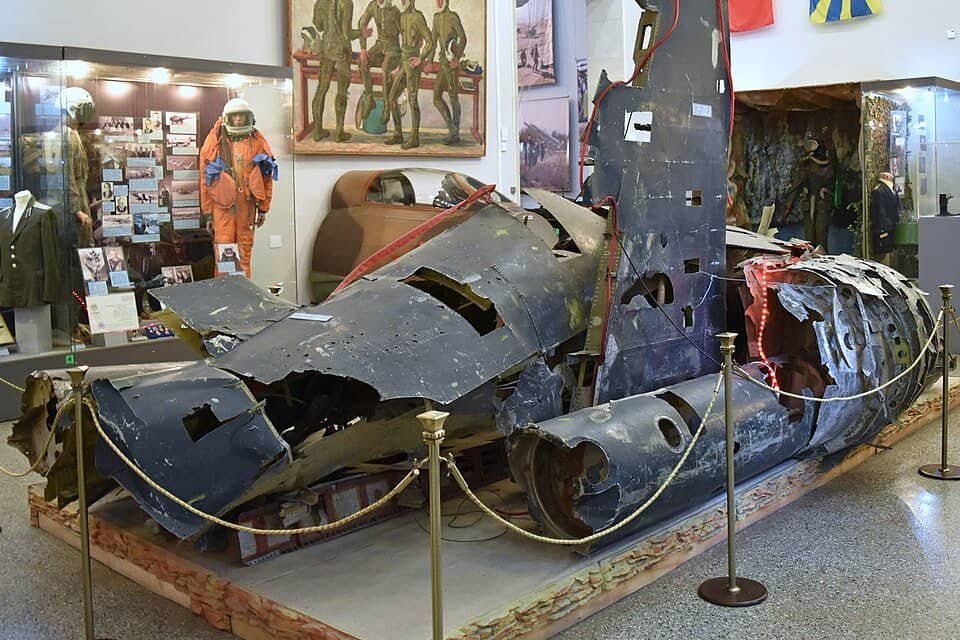
Image credit: Alan Wilson from Stilton, Peterborough, Cambs, UK, licensed under CC BY 2.0.
Behind the scenes, Dwight D. Eisenhower used the CIA to take action against other Communist-supported governments abroad, including the overthrow of leftist governments in Guatemala and Iran. The end of Eisenhower’s two terms in office was marked by yet another break-in Communist relations – this time with the country of Cuba. When Fidel Castro seized all property owned by U.S. companies in Cuba, Eisenhower responded by breaking off diplomatic relations with the country. By the time Eisenhower left office, the Cold War between America and its allies and Communist nations was at its peak.
Dwight D. Eisenhower was the first president whose term of office was limited by the Constitution. In 1951, Congress had approved the 22nd Amendment, limiting a president to two elected terms. There was never any question of Eisenhower running for a third, and the nomination of 1960 passed to Richard Nixon, who was defeated by John F. Kennedy.
The eight years the Eisenhowers spent in the White House marked the longest period they had ever lived in one place. Right before he was elected, they had purchased their first permanent home, a farm in Gettysburg, Pennsylvania. Now, with the presidency behind him, this is where they finally headed. During the eight years he spent on the farm, Eisenhower raised cattle and wrote three books of memoirs. When asked if leaving the White House had affected his golf game, he replied: “Yes. A lot more people beat me now.” After a series of heart attacks, he died of heart failure on March 28, 1969, at the age of 79.
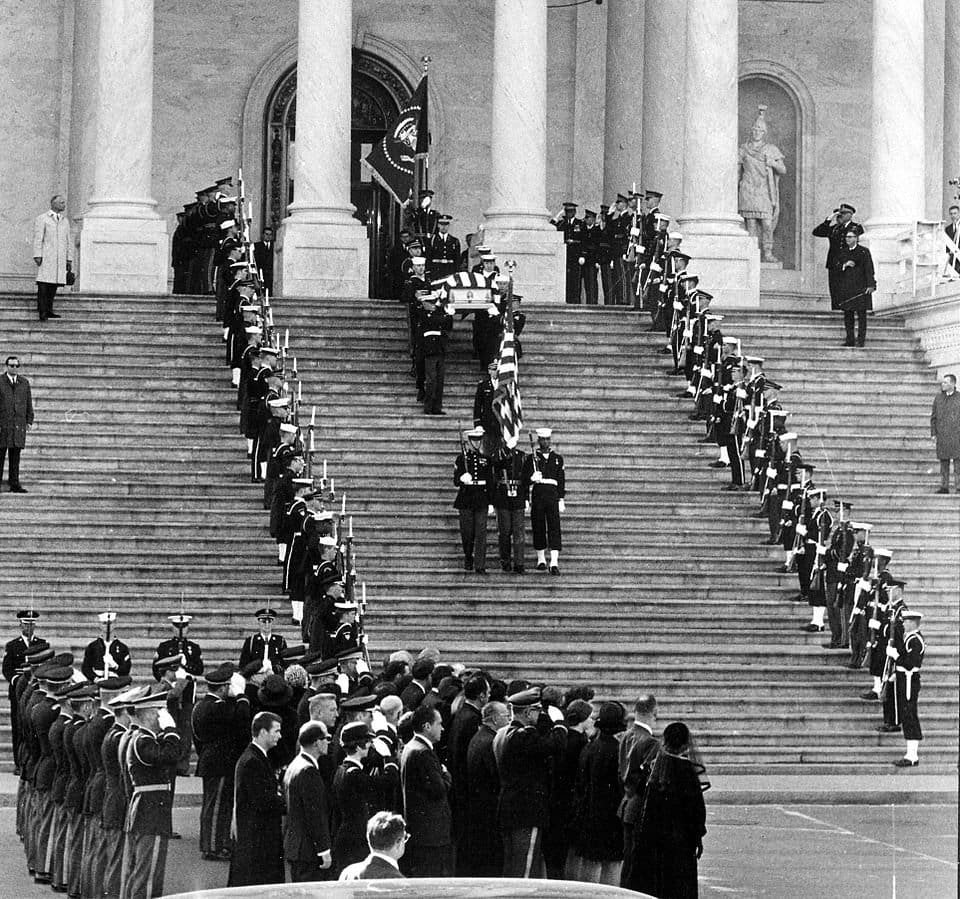
Image credit: Atkins, Oliver F., 1916-1977, Photographer, public domain
Dwight D. Eisenhower: Legacy and Memory
Today, Dwight D. Eisenhower is remembered both as a president and for his superb leadership during one of the most critical moments of American and world history – World War II. Eisenhower’s military gifts were not on the field – they weren’t the kind that sparkled during the heat of battle, with brilliant and daring maneuvers or bold, risky strategies. Instead, he was an organizer – one of the greatest military organizers the world has ever known. He was the perfect executive, with a unique ability to inspire others to cooperate, to encourage people to use their talents to the fullest, and to rally spirits and morale when progress seemed low or victory elusive. He served as planner, conciliator, compromiser, and public relations figure. His manner – friendly, open, “one of the guys,” did as much to motivate his men as his expertise.
It is not an exaggeration to say that Dwight D. Eisenhower is the one who held the allied forces together, with his own personality, energy, and abilities as the glue. In the original Dutch, the name Eisenhower means “hewer or maker of iron,” and that seems exactly what Dwight D. Eisenhower became. It was he who guided the mighty invasion and led the powerful alliance, that was unparalleled in the history of warfare. Because of that, and of the ensuing victory against the dark forces of Hitler’s Fascism, “Ike” remains one of the most beloved popular heroes of modern times.
References:
- Ambrose, Stephen (1983). Dwight D. Eisenhower: Soldier, General of the Army, President-Elect (1893–1952);
- Ambrose, Stephen (1984). Dwight D. Eisenhower: The President (1952–1969). Vol. II
- D’Este, Carlo (2002). Dwight D. Eisenhower: A Soldier’s Life;
- Newton, Jim (2011). Dwight D. Eisenhower: The White House Years. Doubleday.
- Parmet, Herbert S. (1972). Dwight D. Eisenhower and the American Crusades; Cook, Blanche Wiesen (1981). The Declassified Eisenhower: A Divided Legacy
- Smith, Jean Edward (2012). Dwight D. Eisenhower in War and Peace. Random House.
- Wicker, Tom (2002). Dwight D. Eisenhower. Times Books.

