

Image courtesy of NASA. Public domain image provided via Wikimedia Commons.
Table of Contents
El Niño is probably one of the most well-known climate phenomena on our planet. The reason is simple: almost the entire planet, especially the tropical regions, “feels” when it shows up, often through crazy weather in many parts of the world. What most people don’t know is that El Niño is just one part of a bigger phenomenon called El Niño – Southern Oscillation, or ENSO. We often use El Niño and ENSO interchangeably. Interestingly, the name comes from South American fishermen who noticed the occasional unusual warming of the tropical Pacific that would peak around the transition from one year to the next, near Christmas time. In Spanish, El Niño literally means “the boy,” but it’s also used to refer to baby Jesus.
What is ENSO, and what is El Niño?
El Niño is the warm phase of the El Niño–Southern Oscillation (ENSO) and is linked to a band of warm ocean water that develops in the central and east-central equatorial Pacific (roughly between the International Date Line and 120°W), including the area off the Pacific coast of South America. ENSO is basically the cycle of warm and cold sea surface temperatures in the tropical central and eastern Pacific Ocean. It’s a back-and-forth oscillation in ocean and atmospheric conditions across the tropical Pacific. This variation happens because of complex interactions between the water and air over a huge area, and we usually spot it through changes in ocean surface temperature. These temperature changes come with shifts in atmospheric winds, ocean currents, surface air pressure, and more. The phenomenon has three phases: the neutral phase, the warm phase (which is the most famous one and is called El Niño), and the cold phase (called La Niña, meaning “the girl” in Spanish). These phases cycle through over time. But there’s no strict pattern to when they switch or how long they last, which is why we call it quasi-periodic.
ENSO climate cycle
The El Niño phase, for instance, happens every two to seven years. There’s even evidence that in the past, before we had instruments to measure it, there were long, quiet periods. The warm El Niño and cold La Niña phases typically last about a year on average.
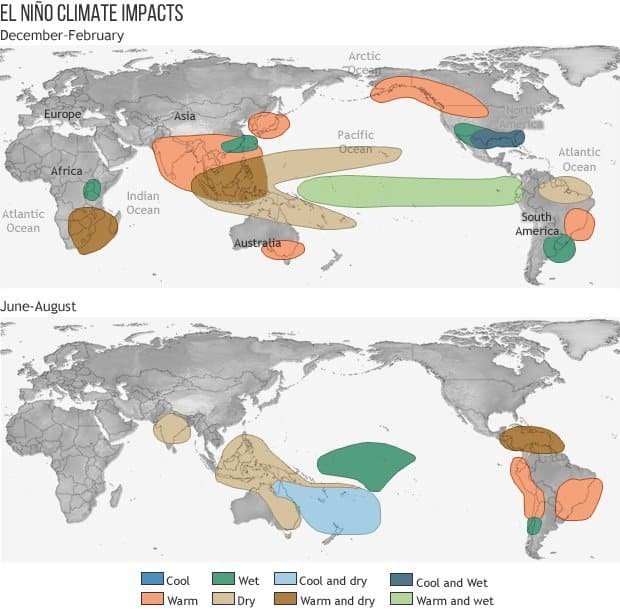
Image credit: Content published by Rebecca Lindsey and reviewed by Tom Di Liberto. Image credit to NOAA Climate.gov, public domain
To describe the individual phases of ENSO, let’s start from neutral phase.
Trade winds blowing along the equator from east to west in the Pacific create ocean currents that flow from the American coast to the Asian coast. This kind of ocean current allows cold water from the deep ocean to rise up on the American side. Meanwhile, the water traveling across the Pacific heats up, so by the time it reaches the Asian coast, there’s an “accumulation” of warm surface water. The temperature difference between the eastern and western Pacific (the U.S. and Asian coasts) during the neutral phase is about 8°C (around 14°F).
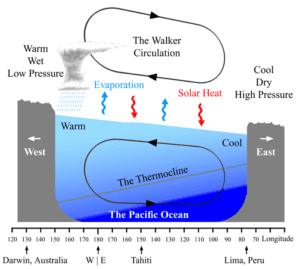
Because of intense evaporation, the warmer ocean near the Asian coast leads to the formation of convective clouds in the atmosphere. This is also known as one of the most effective rain-making processes, so during the neutral phase, this side of the Pacific gets significant rainfall. When the atmospheric surface winds along the equator start to weaken, the El Niño (warm) phase kicks in. In extreme cases, this weakening can result in a complete reversal of the trade wind direction, so the dominant flow goes from Asia to America. This allows the “pooled” warm water from the western Pacific to “slosh” eastward. In this situation, ocean surface temperatures in the central and eastern parts are significantly higher than they were during the neutral phase.
During the strongest El Niño episodes, the waters of the central Pacific are warmer by just over two degrees. But locally, these temperature differences can be even bigger. The convective clouds move east along with the warm water. During the El Niño phase, the central and eastern Pacific get way more precipitation, and these unusually heavy amounts often cause flooding in Central and South America. In the southwestern U.S., El Niño periods sometimes bring an end to multi-year droughts. On the other side of the Pacific, in Asia, there are usually rainfall deficits during this phase that can lead to droughts. El Niño brings warm and very wet conditions from April to October along the coasts of northern Peru and Ecuador, causing major flooding when the event is strong or extreme. La Niña causes sea surface temperatures over Southeast Asia to drop and brings heavy rains to Malaysia, the Philippines, and Indonesia.
La Niña cold phase
The La Niña (cold) phase happens when what characterizes the neutral phase gets amplified. The trade winds blow harder, pushing even more warm water toward Asia and leaving room for more cold water to rise from the depths, further cooling the surface in the central and eastern basins. During the strongest La Niña episodes, the water in the central parts of the basin can be up to two degrees Celsius colder, and Asia and Northern Australia may get more precipitation than usual.
We usually define the ENSO phase precisely by specific temperature thresholds that the ocean surface must exceed in the relevant Pacific region over several months.
El Niño and the global climate
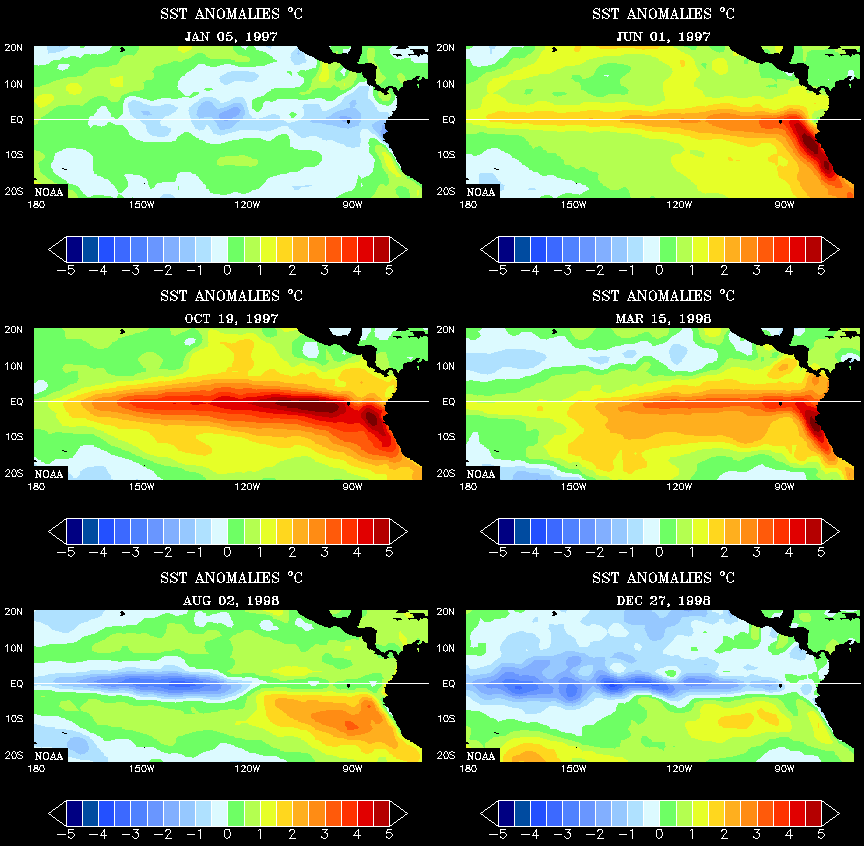
Image courtesy of NASA. Public domain image provided via Wikimedia Commons.
Since these changes—moving from one phase to another—happen over a huge area and for extended periods, it’s not surprising that the effects of this phenomenon are felt in many parts of the planet thousands of miles away from the Pacific. Studies of climate records have shown that El Niño events in the equatorial Pacific are generally linked to a warm tropical North Atlantic in the following spring and summer. During years when the system is in the warm El Niño phase, the large area of above-average warm water in the tropical Pacific has a significant impact on the planet’s average temperature and sea level. Globally, these periods are warmer than average across the entire Earth.
Quite the opposite: years during the cold La Niña phase are usually colder than average globally. This impact on global average temperature just reinforces the fact that this is a truly massive phenomenon whose impact can’t be ignored when we talk about global climate, especially its variability.
Climatologists often use El Niño when they want to explain the concept of internal climate system variability (clear impact on the global climate system). The climate of a location or region is usually described using decades-long averages of meteorological variables. A key climate characteristic is the range within which we should expect values of these variables to fall from year to year in that climate.
However, the average values of individual climate elements in a region—for example, mean annual temperature—don’t just randomly fluctuate within this range from year to year; they show a certain quasi-regularity over several years. These quasi-regular changes, along with the expected range of values for relevant quantities, define the internal variability of the climate system. Understanding the natural oscillations in the climate system is important so we can separate signals caused by natural internal processes from those we can consider as external artificial influences. We need to know whether the climate is behaving within expected variability or, as with climate change, whether an external factor like the artificial increase in CO2 concentration in the atmosphere is pushing us beyond expected values.
El Niño and the warmest year ever recorded
The year 2016 currently holds the record as the warmest year since organized instrumental measurements began. A very powerful El Niño that developed during 2014-2016 contributed to that. Interestingly, though, this El Niño, while very strong, wasn’t the strongest. By most measures, it came in behind the 1998 event, which is the unofficial El Niño champion. In terms of the amount of energy released from the ocean to the atmosphere, it ranks ahead of the 2016 El Niño.

Even though the global temperature jumped sharply in 2016, after the Pacific shifted to the La Niña (cold) phase in the following years, temperatures didn’t drop back to previous levels but stayed significantly above average. So the period from 2015–2019 is officially the warmest five-year stretch we’ve recorded. The fact that we had a record-breaking warm year in 2016 without a record-breaking El Niño event just shows how much the global warming signal has overtaken the signals from natural variability. In the past, breaking records required extreme variations, but today, moderate anomalies in natural variability that “ride” on top of the global warming signal easily break records.
References:
- Philander, S. George (1990). El Niño, La Niña, and the Southern Oscillation. San Diego: Academic;
- Caviedes, César N. (2001). El Niño in History: Storming Through the Ages
- Climate Prediction Center (2005-12-19). “Frequently Asked Questions about El Niño and La Niña”. National Centers for Environmental Prediction.
- “El Niño and La Niña”. New Zealand’s National Institute of Water and Atmospheric Research.

