

Cover image: D Mitriy, licensed under CC BY 3.0.
What Is Terraforming?
The idea of terraforming Venus and Mars — reshaping entire planets to make them habitable for humans — stands as one of the most ambitious concepts in the history of science. Terraforming—the deliberate transformation of a planet’s climate and atmosphere to make it habitable—may be the ultimate expression of planetary engineering. From the furnace of Venus to the frozen deserts of Mars, scientists have explored whether humanity could reshape entire worlds.
The first attempts by 19th-century astronomers to uncover basic facts about neighboring planets were hindered by the limited power of their telescopes and an unconscious tendency to project Earth’s reality onto other worlds. Thus, the seasonal color changes on Mars—now known to result from frozen CO2 frost and light refraction in the Martian and Earth atmospheres—were interpreted as spring vegetation and optical illusions, such as a network of straight lines supposedly built by Martian inhabitants. They envisioned cloud-shrouded Venus as a world of tropical forests and swamps, interpreting its night-side grayish glow as due to phosphorescent ocean microorganisms or forest fires.
As science evolved, it became clearer that neighboring worlds were far more unfavorable to life than previously thought. Milutin Milankovic calculated the climatic conditions on the neighboring planets and concluded that Mars is far colder than previously thought, that the climate at its equator is like the Earth’s polar regions. The first spectroscopic studies of Venus’ atmosphere showed that it was saturated with CO2 and that the surface temperature was probably above the boiling point of water. This shook the dreams of the visionaries of the middle of the 20th century about the peaceful settlement of the neighboring planets, when it was expected that the then rapid development of rocket technology would enable the settlement of Venus and Mars.
Eventually, the concept emerged to physically alter neighboring planets and modify their atmospheric composition to make them more habitable for humanity. This process of planetary engineering is termed terraforming. In our language, a suitable term would be “landforming.”
Cooling Venus: A Solar Shield at L1
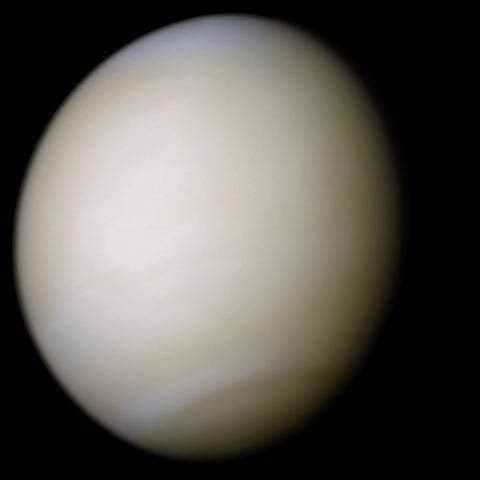
Image credit: NASA or Ricardo Nunes. Public domain image provided via Wikimedia Commons.
The first ideas of terraforming were related to the change of conditions on Venus. The American scientist and visionary Carl Sagan stated it more than half a century ago. It was thought that the clouds over Venus were composed of water droplets and that the surface pressure of the CO2 atmosphere was approximately 6 bar, which was sufficient to support the growth of terrestrial algae that would bind water and CO2 into carbohydrates, release O and create an atmosphere suitable for breathing. The greenhouse effect would be reversed, the temperature would drop to the appearance of liquid water on the surface, the polar regions would become almost ideal for life with a temperature of 20 ° to 30 ° C. The entire process could be done in a century. Data sent by Soviet Venus-type space probes from the surface of the neighboring planet showed that conditions on it were far more unfavorable than previously thought: the surface temperature was about 470 C, the pressure was about 93 bar. The atmosphere was 95% CO2, and clouds over Venus are made of sulfuric acid.
The idea of quick and easy terraforming with single-celled blue-green algae disappeared like a dream, but the question remained: can Venus become a new Earth? The visionaries did not waver easily and new ideas emerged, far more difficult to achieve, but with the goal of making Venus suitable for human life and the Earth’s biosphere, which would be transferred to it.
Of all the planets in the solar system, Venus is the most similar in size to Earth – its diameter is 0.95 and its mass is 0.82 in relation to the Earth’s size. Gravity on the surface is 0.9 G, which means that future settlers would feel like they are on Earth and would adapt easily. But, since it is closer to the Sun, Venus receives almost twice as much electromagnetic radiation in the form of light and heat. This has led to a completely different planetary evolution. An atmosphere of CO2 was formed, which is a kind of heat accumulator because it absorbs heat radiation in passing, which led to overheating of the planet.
A Solar Parasol at the Lagrange Point L1
The first step to change Venus is to prevent heat radiation from the Sun from reaching it. The visionaries devised a kind of heat shield, a kind of “umbrella” that would be placed at Lagrange’s point L1 between Venus and the Sun, about a million km from the planet, with a diameter twice the size of Venus. Such a shaded Venus would cool; first, a cloud layer of sulfuric acid would form rain, reach the surface, and chemically bind to the basalt rocks. The atmosphere would become more airy, which would speed up further cooling of the planet. The estimate that the temperature would drop to a level suitable for life in two to three decades seems too optimistic.
How to make an “parasol” of such dimensions? It would be exposed to light pressure, the changing action of the solar wind and the blows of micrometeorites. There is no technical experience in the construction of such disparate space constructions or performances in order for such a megamachine to move in a controlled manner. If a shield of that size is unattainable, a larger number of smaller mirror-shields could take over that role. If the individual diameter were about 20 km, several million would be needed and they would form a whole cloud around the Lagrange point L1. To build a shield 1 to 10 cm thick or a whole swarm of smaller ones, a carbon chondrite-type asteroid about 50 km in size would be used, and the material for construction would be glass or graphite fibers produced from the asteroid’s own regolith, woven and pressed into foil with a reflex layer of aluminum.
Scientists base another idea of cooling Venus on building reflective balloons and placing them above the cloud layer in such numbers it halves the sun’s thermal radiation that penetrates into the deeper layers of the atmosphere. Since these balloons would move carried by the winds and be somewhere more and somewhere less concentrated, the attenuation of the radiation would not be even and it could not achieve complete shading. And if Venus cooled down enough, the amount of light and heat close to that received by the Earth would be missed.
Cooling Venus is just the beginning of solving far more troublesome problems, one of which is: what to do with an enormous mass of CO2? If the temperature on Venus dropped to -75 C, all CO2 would turn into a liquid state and, like a huge ocean, cover the surface of the planet with an average depth of 1000 m! On Earth, 4 billion years ago, CO2 was dissolved in water to form carbonic acid that reacted with silicates to form carbonates of calcium, magnesium and potassium. That process lasted for millions of years.
Since the amount of water on Venus is almost negligible, it needs to be brought. One possibility is to turn and, passing by the large outer planets, direct some icy planetoids from the Kuiper belt (eg very strong nuclear explosion and “gravity slingshot” method). The time required for one or more ice asteroids to reach their target would be measured in centuries, and the total mass would correspond to the mass of one ice planetoid with a diameter of 1500 km, which is approximately the mass of the Earth’s hydrosphere. The ultimate goal would be for Venus’ oceans to be equivalent to Earth’s.
Rebuilding Venus: Atmosphere, Rotation, and Energy
Removing CO₂ from Venus
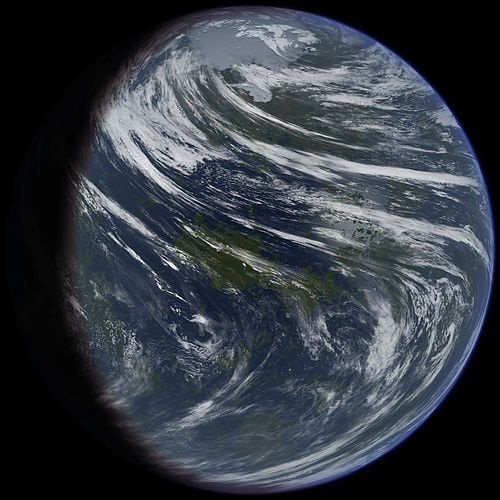
Image credit: Ittiz at English Wikipedia, CC BY-SA 3.0 (via Wikimedia Commons)
Probably ten times less water would be enough to start the process of binding CO2 to carbonates. Since this process would be very long, faster options such as e.g. backfilling Venus with hydrogen that would chemically react with CO2 to create water and carbon in the form of graphite, or artificial meteorites of Ca and Mg, produced on asteroids or Mercury that would bind CO2 without the presence of water. Sagan and Pollock considered the idea of directing a larger asteroid to Venus and rejecting most of the CO2 atmosphere into space, but that would lead to the release of other gases, e.g. CO2 from the magma that would break through the planet’s crust during that impact.
Venus’ atmosphere also contains four times more N than Earth’s. If we removed CO2, it would have an atmosphere of nitrogen with a pressure of 3.2 bar. It would release oxygen in the process of photosynthesis by terrestrial plants by binding a smaller proportion of CO2. Excess N from the atmosphere would bind to nitrates, which would make the soil very fertile, and the imaginative vision of 19th century astronomers about Venus as a world of vast forests would become a reality. The atmosphere would have a composition: 79% N2 and 21% O2 and a pressure of 1 bar and would be the optimal environment for people to stay.
To achieve that, perhaps the biggest problem needs to be solved beforehand – and that is the very slow rotation of Venus. The duration of day and night on Venus is about 117 Earth days, so the energy required for Venus to rotate and have a day of 24 hours is unimaginable 1.57x10exp29 J! One solution would be for the ice asteroids that are supposed to bring water to Venus to be directed so they enter its atmosphere tangentially from a direction opposite to its motion around the Sun, transferring part of their kinetic energy to the planet’s rotational motion at a relative speed of 70 km / sec and eccentric collision. Since this process would take a long time, a temporary solution would be to place a large mirror in orbit around Venus that would orbit it in 24 hours and simulate the earth’s change of day and night with reflected light while the shield “parasol” in L1 completely obscures the Sun.
Optimists believe that we could do the entire process of terraforming Venus in about a millennium, while more cautious visionaries estimate that it would take a hundred times longer. The energy needed to transfer enormous masses of water to Venus and to spin it is beyond our comprehension and the question is which energy sources could trigger these processes. Based on current knowledge, it could only be solar energy produced in large power plants with silicon cell panels built on asteroids and brought closer to the Sun. And if all the phases of terraforming Venus were solved simultaneously, i.e. if the heat shield in L1 were also a solar power plant, the required amounts of energy would be available.
New scientific discoveries and a better design of the entire process could bring one such endeavor closer in time, which would raise civilization to the cosmic level, where the use of energy sources larger than those on its own planet would begin. The struggle to change Venus can bring humanity a new Earth and the knowledge to save this Earth by migrating half of humanity to the terraformed Venus – Terra Nova! We could also apply the experience in building a heat shield for Venus to building a space shield that could save the Earth from gamma radiation generated by the explosion of a closer supernova or from increased solar radiation in the future.
Will Humans Become Martians?
Exploration of Mars with American space probes of the mariner type have shown that the conditions on it are significantly more unfavorable than expected. Atmospheric pressure on its surface is about 7 millibars, which is ten times less than earlier estimates. Such an atmosphere does not provide protection from cosmic radiation and micrometeorites, so life under transparent domes on the surface would be perilous. The first inhabitants would have to live in spaces below the surface, at a depth of at least ten meters. That is not a way of life that would suit most people, so ideas arose about planetary engineering that would make Mars more favorable for life.
The process of greenhouse gas emissions that lead to global warming on Mars on Earth would be the beginning of melting frozen CO2 on the polar caps and creating an atmosphere of that gas with a pressure of 0.5 -1 bar and a temperature at the equator above 0 °C.
In order for Mars to warm up to a level close to Earth’s, the purest way is to direct solar radiation reflected from cosmic mirrors at it. The size of the mirror would be smaller if it were closer to the Sun. A system of such mirrors in orbit around the Sun could directly reflect the light and Infrared radiation of the Sun towards Mars without disturbing the change of day and night on it. To an observer from Mars, it would look as if the sun had spread across the sky.
Heating the surface and the beginning of melting ice, and then the evaporation of water and the formation of clouds and precipitation would create river flows that would destroy the existing relief of Mars. We don’t know yet what amounts of water are below the surface of Mars in the form of ice or bound in hydrated minerals. And we do not know it how much CO2 it would release into the atmosphere before the planet started warming. If CO2 in the ancient history of Mars did not bind to carbonates because of rapid cooling and freezing of water but remained in the form of dry ice, then the outcome would be the creation of an atmosphere with a pressure greater than 1 bar. In the presence of liquid water, and since most of the surface of Mars is covered with layers of dust several kilometers thick, CO2 would quickly bind to iron carbonate whose oxides make up 14% of Mars’ regolith. It could happen that the atmospheric pressure drops sharply, and the planet cools down again.
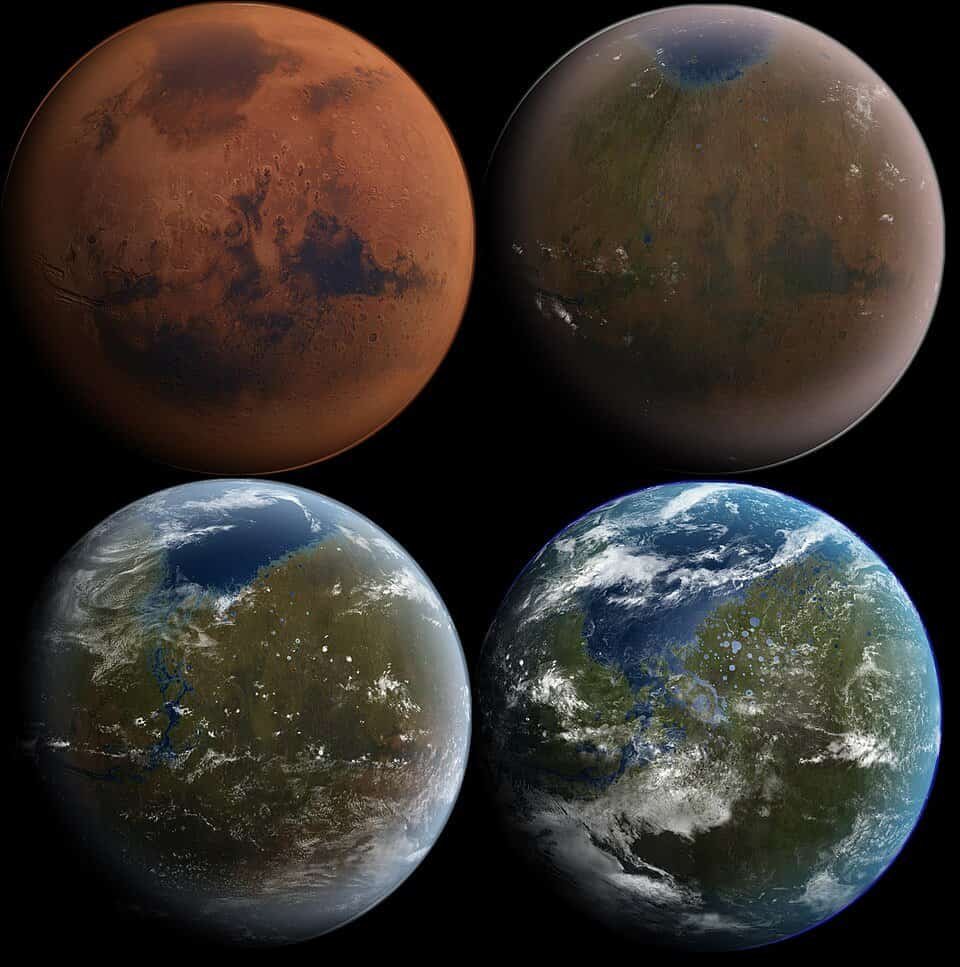
Image credit: Daein Ballard, CC BY-SA 3.0 (via Wikimedia Commons)
What we need is a nitrogen-oxygen atmosphere similar to the Earth’s. Oxygen on Mars is found in iron oxides and it could be released by heating dust that fills large craters. This would be achieved by directed thermal radiation from large solar mirrors with the by-product being iron. It could also be released by the process of photosynthesis by genetically modified plants, but the real problem is the lack of nitrogen on Mars. In the early phase of planetary evolution, 4 to 3 billion years ago, Mars lost almost all primordial N from the atmosphere because of its small gravitational force. The speed of nitrogen ions is higher than Mars’ second cosmic speed, 6.3 km / s versus 5 km / s, and today N makes up 2.7% of its rare atmosphere. It is necessary for N to be delivered from other bodies of the solar system, e.g. from Titan’s or Venus’ atmosphere and perhaps in the form of frozen ammonia isolated on some icy planetoid of the Kuiper belt. The mass of nitrogen required to form a new atmosphere on Mars is about 3x10exp15 tons, which would correspond to the mass of a ball of frozen nitrogen diameter of about 200 km. The energy to transfer it to Mars is of the order of 2x10exp26 J! As with the terraforming of Venus, the only visible source of energy here is the giant solar power plant, which would transmit energy to the place of use by directed microwave radiation, e.g. large accelerators, the so-called. “mass drivers” on balloons in the atmosphere of Titan or Venus, and perhaps to the ammonia separation plant on icy planetoids.
A new atmosphere on Mars?
To create an atmosphere on Mars with a pressure of 1 bar, we need a larger total mass of gas per unit area than on Earth, because the gravity of Mars is 2.6 times weaker. The newly created atmosphere would be thicker than the Earth’s, clouds would be significantly higher, its heat accumulation would be higher, and temperature differences on the planet would be smaller. If Mars finally terraforms, the Earth’s biosphere moves to it and is inhabited by humans, one unpredictable influencing factor remains – Mars’ small gravity of 0.38 G. It is a factor that cannot be changed.
How will it affect a longer period of time? We can assume that the plants will have a higher height, the animals will jump up and down more easily and the birds and insects will fly with smaller wings, it will be harder to run due to less weight and the force of friction will be less. It is not clear which species would survive in the struggle for survival in completely new conditions. Complete extinctions of some species and population explosions of others, more adapted to the new conditions, are possible. A smaller gravitational force on Mars will represent a new “sieve” of natural selection and direct evolution in an unimaginable direction. People who will settle there will also be exposed to that.
Will those born on Mars be able to get used to 2.6 times the force of gravity if they return to Earth, and what will be their physiology? In time, they will genetically distance themselves from people on Earth, and we can’t exclude the existence of some unexpected mutation factors. If people change Mars and settle on it, Mars will change them and they will become a new human species, they will become “Martians”!
Limits of terraforming
There are science fiction writers who share visions of the terraforming of Mercury, the Moon, Jupiter’s satellites, Titan, minor planets, ice dwarfs like Pluto … Where are the limits of terraforming?
Mars lost nitrogen from its original atmosphere, so this process would take place with a new atmosphere. To maintain the atmosphere, it is necessary to either create an artificial magnetic field around Mars that would protect it from the alpha radiation of the solar wind, or constantly deliver extra amounts of N. The mass of the Moon is 82 times smaller than the Earth, gravity is 6 times smaller and it could not hold the atmosphere, the rotation is slow, the lack of water is complete. Mercury is exposed to about 6 times stronger solar radiation than the Earth, it has a slow rotation. If we built solar power plants on Mercury to cover its surface, the energy needed to terraform Venus and Mars would be available, which is the complete opposite of terraforming Mercury itself.
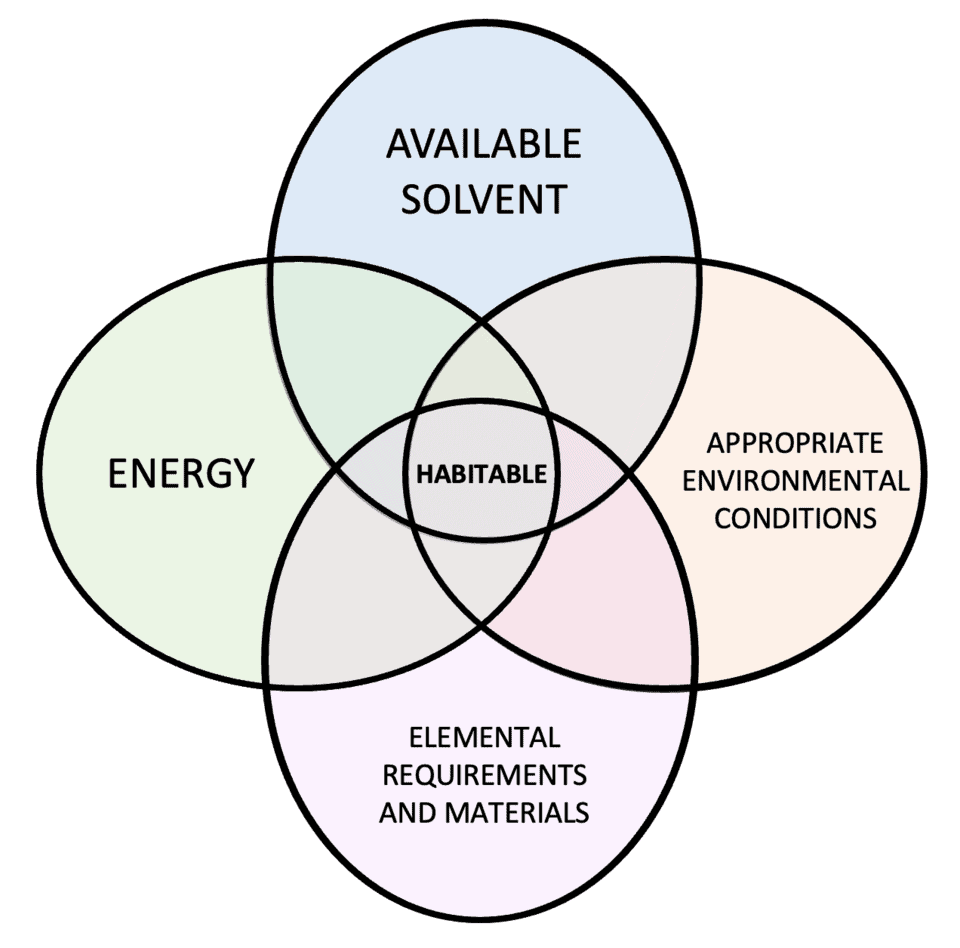
Image credit: Ebhughes20, CC 1.0 (via Wikimedia Commons)
Jupiter’s larger satellites, Callisto and Ganymede, have a crust of water ice and various frozen gases 400 km thick, and perhaps a liquid shell at great depths beneath which is a rocky core. If they warmed up and the ice crust melted, the question is how much of the various hydrocarbon gases would be released. The gravitations of Ganymede and Callisto are 7-8 times smaller than the Earth’s, so it is not possible to keep the atmosphere longer, and the question is how all this would affect the living organisms that would be inhabited there. It could be an exceptional experiment, but the outcome would not be a New Earth, but a very special world, an ocean without shores hundreds of kilometers deep and a small gravity with constant changes in the atmosphere.
Ethical Limits of Terraforming
The second limiting factor is ethical: is it moral to destroy the original and unrepeatable physical nature of a world to get an Earth-like world? People will find themselves in that dilemma, and they will probably not regret the hot Venus as it is now. Terraforming Mars would destroy all geological records of its climatic history in the ice layers of its polar caps as well as stratigraphy in sedimentary rocks – and perhaps traces of a short period of existence of living organisms? One should believe in the wisdom of people in the future and that, before any attempt to change, they will thoroughly explore Mars, take and preserve ice samples of polar caps and rocks formed by the sedimentary process to leave evidence of the former nature of the changed world.
References:
- Sagan, Carl & Druyan, Ann (1997). Pale Blue Dot: A Vision of the Human Future in Space. Ballantine Books. ISBN 0-345-37659-5.
- Thompson, J. M. T. (2001). Visions of the future: astronomy and Earth science. Cambridge University Press. ISBN 0-521-80537-6
- Beech, Martin (21 April 2009). Terraforming: The Creating of Habitable Worlds. Springer Science & Business Media.
- Fogg, Martyn J. (1995). Terraforming: Engineering Planetary Environments. SAE International, Warrendale

