

Cover image: NASA, public domain
Table of Contents
Global sea level rise began at the start of the 20th century. From 1900 to 2016, the global average sea level rose by roughly 16 to 21 cm (6.3 to 8.3 inches). With satellite radar measurements, the picture became much clearer: they reveal an accelerating rise of about 7.5 cm (3.0 inches) from 1993 to 2017, a pace that extrapolates to 30 cm (12 inches) per century. This acceleration is primarily caused by human-induced global warming, driving both thermal expansion of seawater and melting of land-based ice sheets and glaciers. From 1993 to 2018, ocean thermal expansion drove about 42% of sea level rise, melting temperate glaciers caused 21%, Greenland contributed 15%, and Antarctica accounted for 8%. Climate scientists broadly agree that the rate will keep accelerating throughout the 21st century.
Projecting future sea levels is genuinely challenging due to the complexity of the climate system and the long time lags between temperature changes and sea level responses. As climate research into past and present sea levels has led to better computer models, projections have consistently been revised upward. In 2007, the Intergovernmental Panel on Climate Change (IPCC) projected a high-end estimate of approximately 60 cm (2 ft) through 2099. By their 2014 report, that high-end number had climbed to around 90 cm (3 ft). A number of later studies have gone further, concluding that a global sea level rise of 200 to 270 cm (roughly 6.6 to 8.9 ft) this century is “physically plausible.” A more conservative long-term estimate suggests that each Celsius degree of warming triggers a sea level rise of approximately 2.3 meters (7.4 ft per degree Fahrenheit) over a period of two millennia, illustrating the significant climate inertia inherent in the system. In February 2021, a paper published in Ocean Science suggested that even the IPCC’s projections for sea level rise by 2100 were likely conservative, and that we should expect more rise than previously reported.
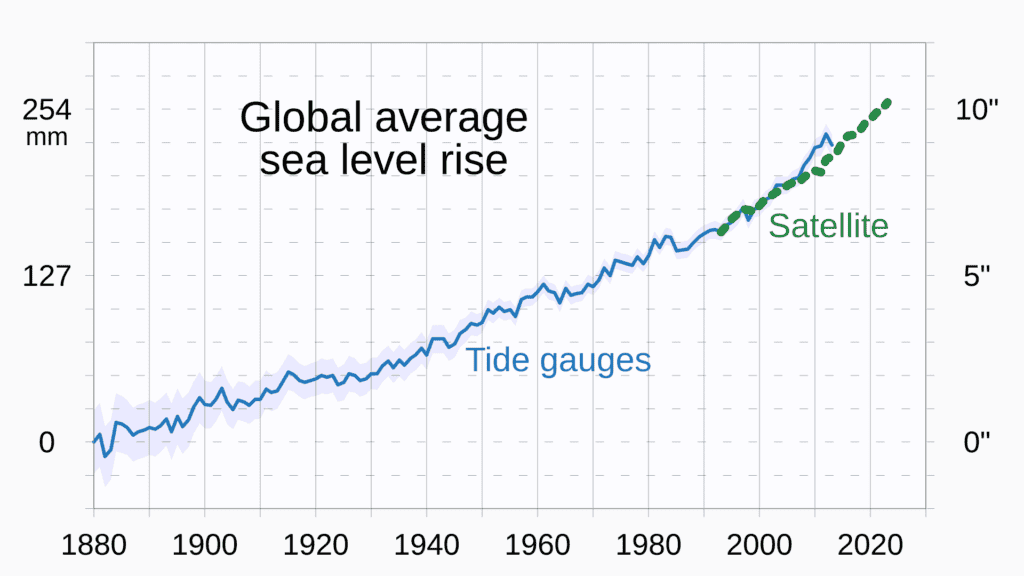
Image credit: RCraig09 / CC BY-SA 4.0 (via Wikimedia Commons)
One key point: sea level will not rise uniformly. It will actually fall slightly in some regions, such as parts of the Arctic. Local factors—including tectonic activity, land subsidence, tides, currents, and storm patterns—influence regional results. Human consequences will be especially severe for coastal and island areas. Widespread coastal flooding is expected if warming of several degrees persists over millennia. In addition, higher storm surges, more extreme tsunamis, mass population displacement, loss of agricultural land, and significant damage to coastal cities are anticipated. Natural environments will suffer too: marine ecosystems could lose vital habitats for fish, birds, and plants.
Past Changes in Sea Level
Understanding past sea level is really important for putting current and future changes into context. In the recent geological past, changes in land ice and thermal expansion from higher temperatures are basically the dominant reasons the sea level went up. The last time the Earth was about 2°C (3.6°F) warmer than pre-industrial temperatures, sea levels were at least 5 meters (16 ft) higher than today — and that warming happened because of slow changes in the Earth’s orbit that altered how much sunlight the planet received during the last interglacial. That warming lasted thousands of years, and the magnitude of the sea level rise that resulted implies a massive contribution from both the Antarctic and Greenland ice sheets. A report from the Royal Netherlands Institute for Sea Research also found that around three million years ago, CO2 levels in the atmosphere were similar to what they are today, which raised temperatures by two to three degrees Celsius and melted about a third of Antarctica’s ice sheets — causing sea levels to rise by roughly 20 meters.
Since the last glacial maximum about 20,000 years ago, the sea level has gone up by more than 125 meters (410 ft), with rates ranging anywhere from less than a millimeter per year all the way up to 40+ mm/year, as ice sheets over Canada and Eurasia melted away. Rapid disintegration of those ice sheets led to what scientists call “meltwater pulses” — periods when sea level shot up fast. The rate of rise started slowing down around 8,200 years ago, and sea level was pretty much stable for the last 2,500 years — right up until the recent rising trend that started at the end of the 19th or the beginning of the 20th century.
How Scientists Measure Sea Level Rise
Sea level changes can be driven either by variations in the amount of water in the oceans, changes in ocean volume, or by shifts in the land relative to the sea surface. The different techniques used to measure sea level changes don’t all measure exactly the same thing. Tide gauges can only measure relative sea level, while satellites can also capture absolute sea level changes. To get precise measurements, researchers have to factor in ongoing deformations of the solid Earth — particularly the way landmasses are still slowly rising from past ice masses retreating — as well as the Earth’s gravity and rotation.
Satellite Altimetry – Tracking Sea Level From Space
Since TOPEX/Poseidon launched back in 1992, altimetric satellites have been recording sea level changes. These satellites can detect the hills and valleys in the sea created by currents and track how their height changes over time. To measure the distance to the sea surface, the satellites fire a microwave pulse at the ocean and time how long it takes to bounce back. Microwave radiometers then correct for the extra delay caused by water vapor in the atmosphere. Combining all of that data with the precisely known location of the spacecraft makes it possible to pin down sea-surface height to within a few centimeters, which is actually pretty impressive. Current estimates from satellite altimetry put the rate of sea level rise at around 3.0 ± 0.4 millimeters (0.118 ± 0.016 in) per year for the period 1993–2017. Early on, satellite measurements didn’t quite line up with tide gauge measurements. It turned out there was a small calibration error in the Topex/Poseidon satellite that was slightly overestimating sea levels from 1992 to 2005, which masked the acceleration that was actually happening.
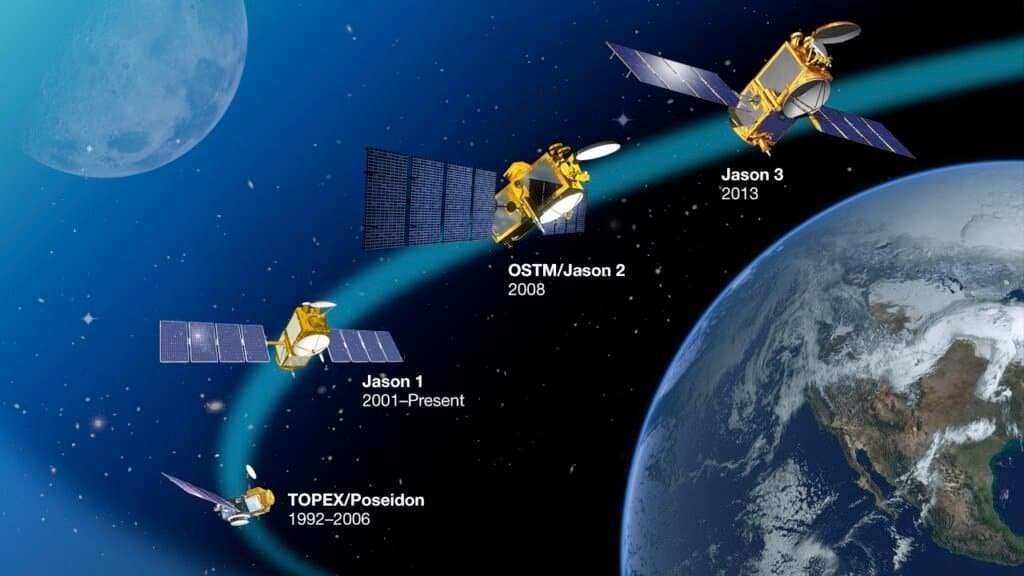
Image credit: NASA, public domain
Tide Gauges – A Century of Ground-Level Measurements
Another major source of sea-level data is the global network of tide gauges. Compared to satellites, the record has big gaps in coverage — but it goes back much further in time. Coverage started primarily in the Northern Hemisphere, and data for the Southern Hemisphere were pretty sparse right up until the 1970s. The longest-running sea-level measurements anywhere are the NAP, or Amsterdam Ordnance Datum, which were established in 1675 and recorded in Amsterdam, the Netherlands. In Australia, the record goes back quite a way too — including measurements taken by an amateur meteorologist starting in 1837, and measurements from a sea-level benchmark struck on a small cliff on the Isle of the Dead near the Port Arthur convict settlement in 1841.
This global tide gauge network, combined with satellite altimeter data, helped establish that global mean sea level rose 19.5 cm (7.7 in) between 1870 and 2004 — at an average rate of about 1.44 mm/yr (closer to 1.7 mm/yr during the 20th century). Data collected by the Commonwealth Scientific and Industrial Research Organisation (CSIRO) in Australia puts the current global mean sea level trend at about 3.2 mm (0.13 in) per year — basically double the 20th-century rate. That’s a meaningful confirmation of what climate change models have been predicting — that sea level rise would speed up in response to global warming.
Some regional differences also show up in the tide gauge data. Some of those regional variations reflect actual differences in sea level, while others are due to vertical land movements. In Europe, for instance, there’s a lot of variation because some land areas are rising while others are sinking. Since 1970, most tidal stations have recorded higher seas — but sea levels along the northern Baltic have actually dropped, because of post-glacial rebound.
What Is Causing Sea Levels to Rise
There are basically three main reasons why a warming climate causes global sea level to rise: oceans expand as they warm, ice sheets lose ice faster than snowfall can replace it, and glaciers at higher altitudes melt too. Sea level rise since the early 20th century has been dominated by glacier retreat and ocean expansion, but the contributions from the two big ice sheets — Greenland and Antarctica — are expected to grow significantly in the 21st century. The ice sheets hold the vast majority of the world’s land ice (roughly 99.5%), with a sea-level equivalent of about 7.4 m (24 ft) for Greenland and 58.3 m (191 ft) for Antarctica.
Each year, around 8 mm (0.31 in) of precipitation — mostly snow — falls on the ice sheets in Antarctica and Greenland, accumulating and eventually turning into glacial ice. A lot of that water vapor originally evaporated from the ocean surface. Some of the snow gets blown away by wind or disappears through melting or sublimation. The rest slowly turns into ice. That ice can then flow to the edges of the ice sheet and return to the ocean, either by melting at the edge or by calving off as icebergs. If precipitation, surface processes, and ice loss at the edge balance each other out, sea level stays the same. But scientists have found that ice is being lost — and at an accelerating rate.
Ocean Heating and Thermal Expansion
Most of the extra heat that gets trapped in Earth’s climate system by global warming ends up stored in the oceans. They hold more than 90% of that additional heat, basically acting as a giant buffer. The amount of heat required to raise the average temperature of the entire world ocean by just 0.01°C would be enough to raise the atmospheric temperature by around 10°C — so even a small change in ocean temperature represents an enormous shift in the total heat content of the climate system.
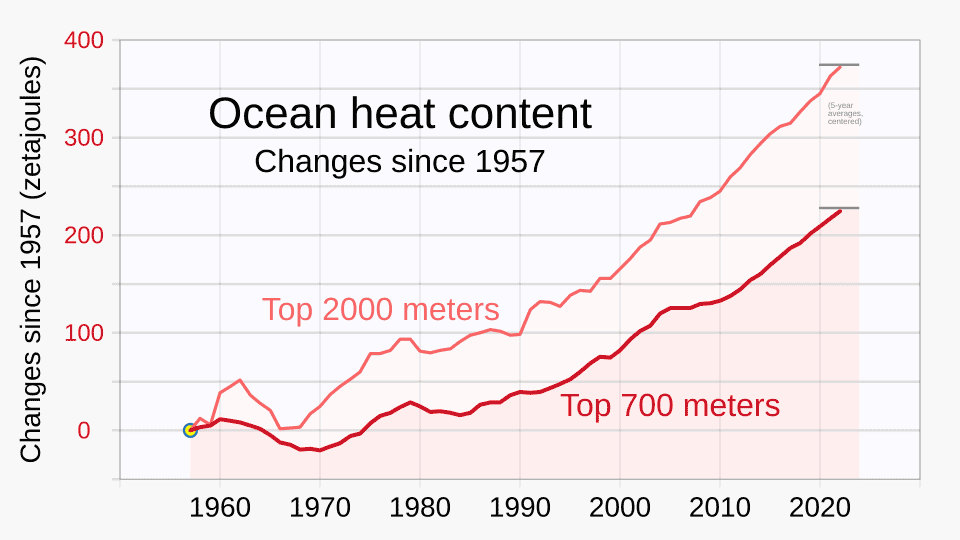
Image credit: RCraig09 / CC BY-SA 4.0 (via Wikimedia Commons)
When the ocean gains heat, the water expands, and the sea level rises. How much expansion happens depends on both water temperature and pressure — warmer water and water under greater pressure expand more than cooler water and water under less pressure. Cold Arctic Ocean water, for example, will expand less compared to warm tropical water. Because different climate models have slightly different patterns of ocean heating, they don’t fully agree on exactly how much ocean heating will contribute to sea level rise. Ocean temperatures also fluctuate significantly due to large-scale climate phenomena such as El Niño, which can temporarily accelerate or mask the broader warming trend across large portions of the ocean surface. Heat gets transported down into deeper parts of the ocean by winds and currents, and some of it reaches depths of more than 2,000 m (6,600 ft).
Antarctica’s Ice Sheet and Its Role in Sea Level Rise
The large volume of ice sitting on the Antarctic continent stores around 70% of the world’s fresh water. The Antarctic ice sheet’s mass balance is affected by snowfall accumulation and ice discharge around its edges. Under the influence of global warming, melting at the base of the ice sheet increases. At the same time, a warmer atmosphere can carry more moisture, so snowfall tends to increase in global and regional models. That additional snowfall drives increased ice flow into the ocean, which partially offsets the mass gain. Snowfall increased over the last two centuries, but no increase has been detected in the interior of Antarctica over the last four decades. Researchers looking at Antarctica’s ice mass balance over millions of years have concluded that sea ice essentially acts as a barrier against warmer water surrounding the continent — so the loss of sea ice is a major driver of broader ice sheet instability.
Different satellite methods for measuring ice mass are in pretty good agreement, and combining them gives even more confidence. A 2018 systematic review estimated that ice loss across the entire continent averaged about 43 gigatons (Gt) per year between 1992 and 2002, but accelerated to an average of around 220 Gt per year during the five years from 2012 to 2017. Most of that melt is coming from the West Antarctic Ice Sheet, but the Antarctic Peninsula and the East Antarctic Ice Sheet are contributing too. The sea-level rise from Antarctica has been estimated at 0.25 mm per year from 1993 to 2005, and 0.42 mm per year from 2005 to 2015. All the datasets generally point to an acceleration in mass loss from the Antarctic ice sheet, though with year-to-year variations.
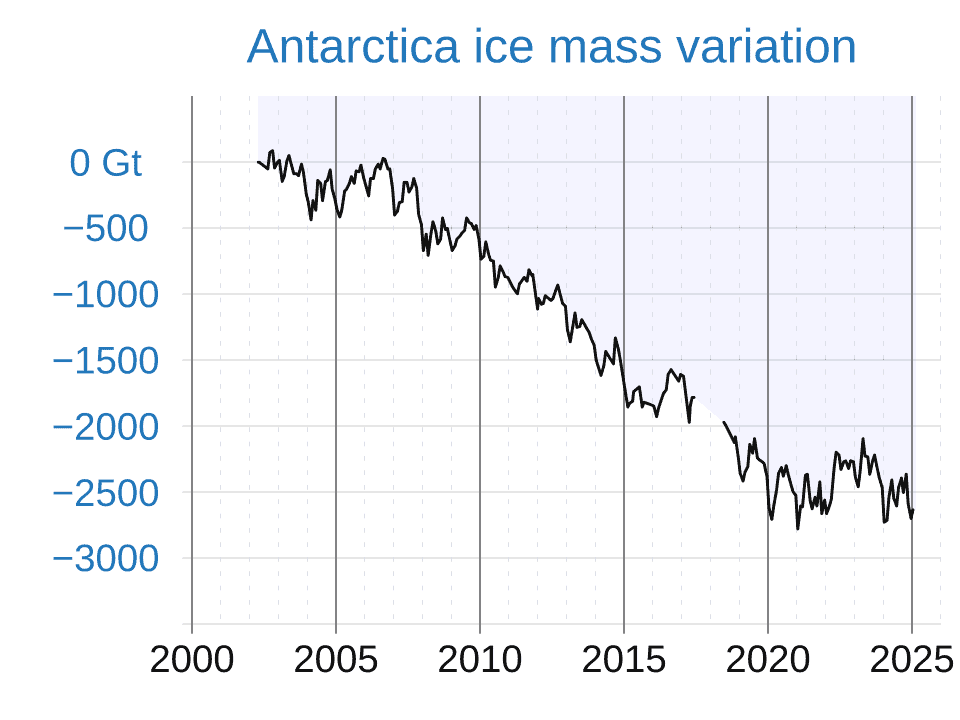
Image credit: Employee(s) of NASA, U.S. government / CC BY-SA 4.0 (via Wikimedia Commons)
East Antarctica – The World’s Largest Potential Source of Sea Level Rise
The world’s single largest potential source of sea level rise is the East Antarctic Ice Sheet, which holds enough ice to raise global sea levels by about 53.3 m (175 ft). Historically, scientists considered it relatively stable, so it attracted less research attention than West Antarctica. Combining satellite observations of its changing volume, flow, and gravitational attraction with modeling of its surface mass balance suggests the overall mass balance of the East Antarctic Ice Sheet was relatively steady — or maybe slightly positive — for much of the period from 1992 to 2017. A 2019 study using a different methodology, however, concluded that East Antarctica is actually losing significant amounts of ice mass. The lead scientist, Eric Rignot, told CNN: “melting is taking place in the most vulnerable parts of Antarctica … parts that hold the potential for multiple meters of sea level rise in the coming century or two.”
There’s agreement across methods that the Totten Glacier has been losing ice in recent decades, in response to ocean warming and possibly a reduction in local sea ice cover. Totten Glacier is the primary outlet for the Aurora Subglacial Basin, a major ice reservoir in East Antarctica that could retreat rapidly because of hydrological processes. The global sea level potential flowing through Totten Glacier alone — about 3.5 m (11 ft) — is in the same ballpark as the entire probable contribution of the West Antarctic Ice Sheet. The other major ice reservoir in East Antarctica that could potentially retreat quickly is the Wilkes Basin, which is subject to what’s called marine ice sheet instability. Ice loss from these outlet glaciers might be partially offset by accumulation gains elsewhere in Antarctica.
West Antarctica – The Most Rapidly Changing Ice Sheet
Even though East Antarctica holds the biggest potential source of sea level rise, it’s actually West Antarctica that’s currently experiencing a net outflow of ice and contributing to rising seas. Satellite data from 1992 to 2017 show melt increasing significantly over that period. Antarctica as a whole has caused a total of about 7.6 ± 3.9 mm (0.30 ± 0.15 in) of sea level rise. Given that the East Antarctic Ice Sheet was roughly stable, the major contributor was West Antarctica. Significant acceleration of outflow glaciers in the Amundsen Sea Embayment may have been a big part of that. Unlike East Antarctica and the Antarctic Peninsula, temperatures on West Antarctica have increased quite a bit — somewhere between 0.08°C (0.14°F) per decade and 0.96°C (1.7°F) per decade between 1976 and 2012.
There are multiple types of instability at play in West Antarctica. One is Marine Ice Sheet Instability, where the bedrock that parts of the ice sheet rest on gets deeper inland. That means when part of the ice sheet melts, a thicker section of ice gets exposed to the ocean, which can lead to even more ice loss. Then there’s the melting of ice shelves — the floating extensions of the ice sheet — which triggers a process called Marine Ice Cliff Instability. Since ice shelves act as a buttress holding back the ice sheet, losing them speeds up the flow of ice into the ocean. Melt of ice shelves is also accelerated when surface melt creates crevasses that fracture the shelf.
The Thwaites and Pine Island glaciers have been flagged as particularly prone to these processes. Both have bedrock that gets deeper further inland, which exposes them to warmer water intrusion at the grounding line. As they continue to melt and retreat, they’re contributing to rising global sea levels — and their melting has been accelerating since the early part of this century. This could eventually destabilize the entire West Antarctic Ice Sheet, though the process probably won’t run its course within this century. Most of the bedrock under the West Antarctic Ice Sheet sits well below sea level, and a rapid collapse of the whole thing could raise sea level by roughly 3.3 meters (11 ft).
Greenland Ice Sheet Melt and Its Growing Contribution
Most of the ice on Greenland is part of the Greenland ice sheet, which reaches about 3 km (2 mi) at its thickest. The rest consists of isolated glaciers and ice caps. About 70% of Greenland’s contribution to sea level rise comes from ice sheet melting, with the other 30% from glacier calving. Dust, soot, and microbes and algae living on parts of the ice sheet make things worse by darkening the surface, which causes it to absorb more thermal radiation — those dark regions grew by 12% between 2000 and 2012 and are likely to expand further. Average annual ice loss in Greenland more than doubled in the early 21st century compared to the 20th century. Some of Greenland’s largest outlet glaciers, like Jakobshavn Isbræ and Kangerlussuaq Glacier, are moving faster into the ocean than they used to.
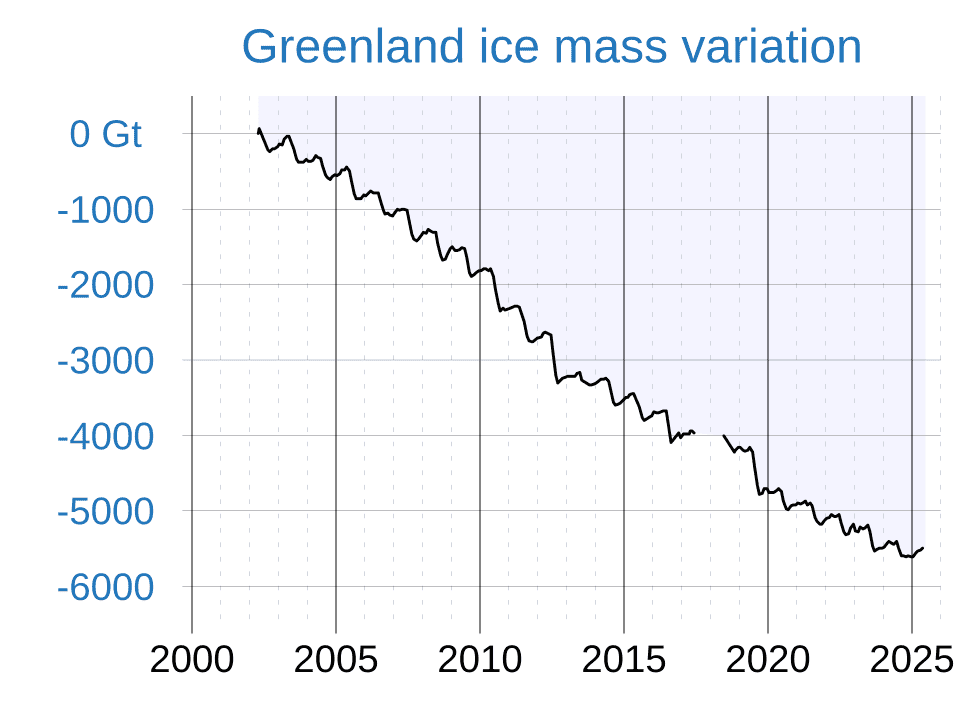
Image credit: RCraig09 / CC BY-SA 4.0 (via Wikimedia Commons)
A 2017 study concluded that Greenland’s peripheral glaciers and ice caps crossed an irreversible tipping point around 1997 and will continue to melt regardless of what happens to temperatures. Combined, the Greenland ice sheet and its glaciers and ice caps are the largest contributor to sea level rise from land ice sources (excluding thermal expansion), accounting for about 71 percent, or 1.32 mm per year, during the 2012–2016 period.
A 2020 study estimated that the Greenland Ice Sheet lost a total of 3,902 gigatons (Gt) of ice between 1992 and 2018, which translates to a contribution of 10.8 mm to sea level rise. That contribution has generally increased over time — from about 0.07 mm per year between 1992 and 1997, up to 0.68 mm per year between 2012 and 2017.
Another study found that in the years 2002 to 2019, Greenland lost 4,550 gigatons of ice — an average of 268 gigatons per year. In 2019 alone, Greenland lost 600 gigatons of ice in just two months, contributing 2.2 mm to global sea level rise.
Estimates for Greenland’s future contribution to sea level rise by 2100 range from about 0.3 to 3 meters (1 to 10 ft). By the end of the century, it could be adding 2 to 10 centimeters annually. The contribution from Greenland over the next couple of centuries could be really significant, thanks to a self-reinforcing feedback loop. Once melting starts, lowering the height of the ice sheet, the surface sits closer to the warmer air near sea level, which drives even more melting. And as ice melts, the surface gets darker, which absorbs even more heat. There’s a threshold in surface warming beyond which partial or near-complete melting of the Greenland ice sheet becomes locked in. Different studies put that threshold as low as 1°C (2°F) above pre-industrial temperatures, and almost certainly at 4°C (7°F). A 2021 analysis of sediment at the bottom of a 1.4 km Greenland ice core found that the Greenland ice sheet melted away at least once over the last million years — strongly suggesting its tipping point is below the 2.5°C maximum temperature excursion over that period.
Mountain Glaciers and Their Historical Impact
Less than 1% of glacier ice is found in mountain glaciers — the other 99% or so is in Greenland and Antarctica. Still, mountain glaciers have contributed a meaningful amount to historical sea level rise, and they’re set to keep contributing a smaller — but still significant — fraction going forward in the 21st century. There are roughly 200,000 glaciers spread across all continents. Different glaciers respond differently to warming temperatures. Valley glaciers with a shallow slope, for example, retreat even under mild warming. Every glacier has an elevation above which it gains mass and below which it loses mass — and even a small shift in that elevation has big consequences for shallow-slope glaciers. Many glaciers also drain into the ocean, so rising ocean temperatures can accelerate their ice loss too.
Studies of mass loss from glaciers and ice caps put their contribution to sea level rise at around 0.2 to 0.4 mm per year on average during the 20th century. Over the 21st century, that’s expected to increase, with glaciers contributing somewhere between 7 and 24 cm (3 to 9 in) to global sea levels. Glaciers accounted for around 40% of sea-level rise during the 20th century, with estimates for the 21st century coming in around 30%.
Why Sea Ice Melt Has a Minimal Effect on Sea Levels
Sea ice melt contributes very little to global sea level rise. If the meltwater from floating sea ice were exactly the same as seawater, then by Archimedes’ principle, no rise would occur at all. But melted sea ice actually contains less dissolved salt than sea water, making it slightly less dense — so even though it weighs the same as the sea water it was displacing, its volume ends up a tiny bit greater. If every floating ice shelf and iceberg on Earth were to melt, the sea level would only rise by about 4 cm (1.6 in).
How Human Land Water Storage Affects Sea Level
Humans also affect how much water gets stored on land. Building dams, for instance, prevents water from flowing into the sea and increases land-based storage. On the flip side, humans extract water from lakes, wetlands, and underground reservoirs for agriculture, which contributes to rising seas. The hydrological cycle is also affected by climate change and deforestation, which can push things in either direction. During the 20th century, these processes roughly balanced out. But dam building has slowed down a lot and is expected to stay low through the 21st century.
Projections – How Much Will Sea Levels Rise
There are basically two main approaches to modeling sea level rise and making future projections. The first is process-based modeling, where scientists include all the relevant and well-understood physical processes in a global model. An ice-sheet model is used to calculate contributions from ice sheets, and a general circulation model computes rising ocean temperatures and their expansion. The downside is that not all relevant processes are understood well enough to model accurately, though this approach is good at capturing non-linearities and long time delays. The second approach uses semi-empirical techniques, drawing on geological data from the past to figure out how sea level likely responds to a warming world, combined with some basic physical modeling. These semi-empirical models rely on statistical relationships between observed past changes in global mean sea level and global mean temperature. They were partly developed because most physical models in previous IPCC assessments tended to underestimate sea level rise compared to what was actually observed during the 20th century.
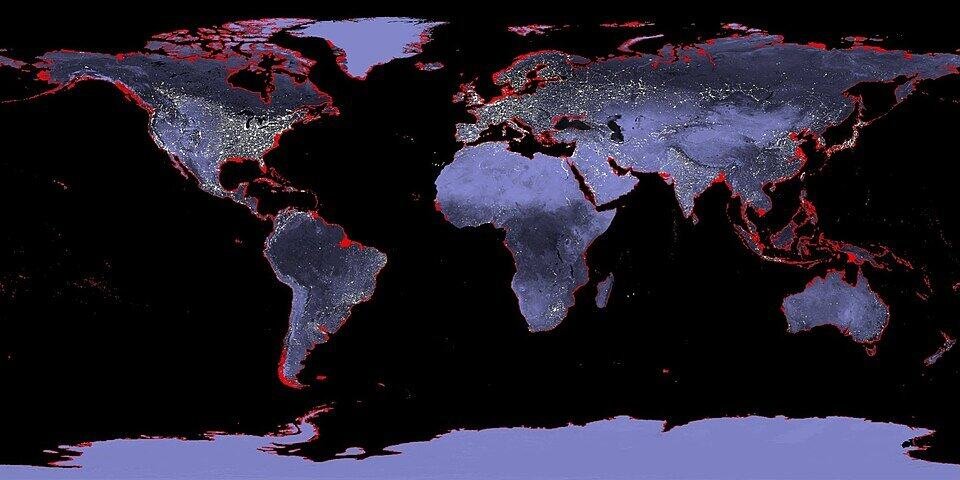
Image credit: NASA , public domain
Sea Level Rise Projections for the 21st Century
In its fifth assessment report from 2013, the IPCC estimated how much the sea level is likely to rise in the 21st century under different emissions scenarios. These projections are based on well-understood contributors to sea level rise, but they leave out some processes that aren’t yet modeled well enough. Under a rapid emissions cuts scenario (RCP2.6), the IPCC considers it likely that sea level will rise somewhere between 26 and 55 cm (10 to 22 in), with a 67% confidence interval. If emissions stay very high, the projection climbs to 52 to 98 cm (20 to 39 in). In August 2020, scientists reported that observed ice-sheet losses in Greenland and Antarctica were tracking the worst-case scenarios laid out in the IPCC Fifth Assessment Report.
Since 2013, a lot of work has gone into incorporating more physical processes and developing models that can use paleoclimate data. That’s typically pushed estimates higher. A 2016 study led by Jim Hansen, for instance, concluded that based on past climate data, sea level rise could accelerate exponentially in the coming decades — with a potential doubling time of 10, 20, or 40 years, raising the ocean by several meters over 50 to 200 years. Greg Holland from the National Center for Atmospheric Research, who reviewed the study, noted: “There is no doubt that the sea level rise, within the IPCC, is a very conservative number, so the truth lies somewhere between IPCC and Jim.”
A 2017 study projected sea level rise of up to 132 cm (4.3 ft) on average by 2100 under a high fossil fuel and strong economic growth scenario, with an extreme scenario projecting as much as 189 cm (6.2 ft). That could mean rapid sea level rise of up to 19 mm (0.75 in) per year by the end of the century. The same study found that if the Paris climate agreement’s emissions goals were actually met, the median rise would be about 52 cm (20 in) by 2100.
The Fourth (2017) National Climate Assessment (NCA) of the United States concluded it’s very likely sea level will rise between 30 and 130 cm (roughly 1.0 to 4.3 feet) by 2100 compared to 2000 levels. A rise of 2.4 m (8 feet) was described as physically possible under a high-emission scenario, though the authors couldn’t put a reliable probability on it. The worst case really depends on a large contribution from Antarctica, which remains the hardest part of the system to model.
The possibility of a West Antarctic ice sheet collapse and subsequent rapid sea level rise was actually raised back in the 1970s. Mercer published a study in 1978 warning that anthropogenic carbon dioxide warming could cause a sea level rise of around 5 meters (16 ft) from the West Antarctic ice sheet alone.
In 2019, a study projected that under a low-emission scenario, sea level would rise 30 centimeters by 2050 and 69 centimeters by 2100, relative to 2000 levels. Under a high-emission scenario, the level goes to 34 cm by 2050 and 111 cm by 2100. There’s also a real probability that the rise could exceed 2 meters by 2100 in the high-emission scenario, which would displace around 187 million people.
In September 2019, the IPCC published a report on the impact of climate change on the oceans, including sea level rise. One of the report’s authors, Michael Oppenheimer, summed up the main takeaway: if humanity drastically cuts greenhouse gas emissions in the coming decades, the problem will be tough but manageable. If emissions keep climbing, it becomes unmanageable.
In February 2021, researchers from Denmark and Norway suggested that the IPCC’s projections for sea level rise by 2100 were likely conservative — and that we should expect the rise to be greater than previously reported.
Long-Term Sea Level Rise Over the Coming Millennia
There’s a broad consensus among climate scientists that substantial long-term sea level rise will continue for centuries to come, even if temperatures stabilize. Climate models have been able to reproduce paleoclimate records of sea level rise, which gives researchers confidence in applying them to long-term projections.
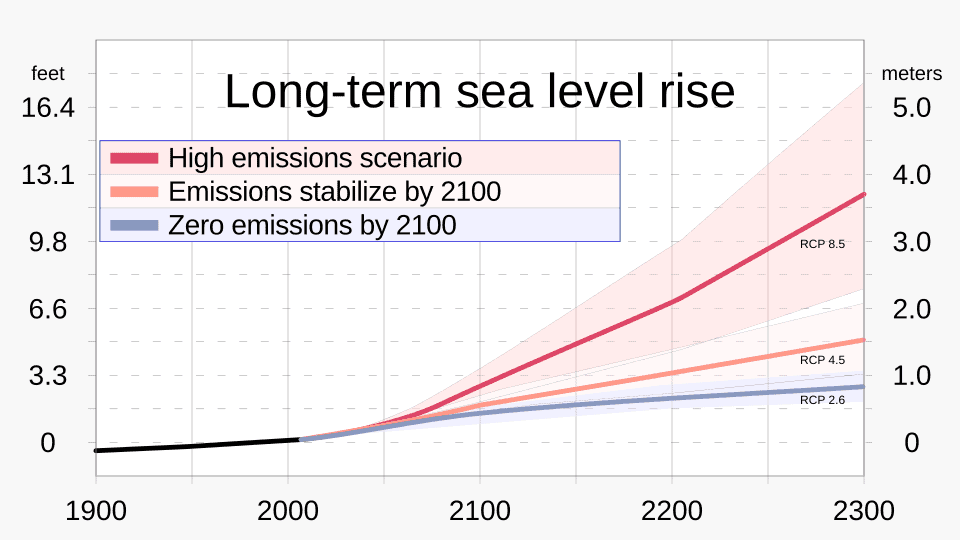
Image credit: RCraig09 / CC BY-SA 4.0 (via Wikimedia Commons)
Both the Greenland ice sheet and Antarctica have tipping points for warming levels that could be reached before the end of this century. Cross those tipping points, and you’re looking at potentially irreversible changes — even if temperatures were somehow brought back down to pre-industrial levels, it might not be enough to stabilize the ice sheets. Pinning down exactly what temperature triggers those tipping points is still a matter of debate. For Greenland, estimates range roughly from 1 to 4°C (2 to 7°F) above pre-industrial levels. As of 2020, the lower end of that range has already been passed. A 2021 analysis of sediment from the bottom of a 1.4 km Greenland ice core found that the ice sheet has melted away at least once in the last million years, strongly suggesting its tipping point is below 2.5°C above pre-industrial temperatures.
Melting of the Greenland ice sheet alone could eventually contribute an additional 4 to 7.5 m (13 to 25 ft) over many thousands of years. A 2013 study estimated that each degree of temperature rise locks in about 2.3 m (7 ft 7 in) of sea level rise over the following 2,000 years. More recent research — especially on Antarctica — suggests that’s probably a conservative estimate, and that true long-term sea level rise could be considerably higher. Warming beyond the 2°C (3.6°F) target could push sea level rise rates into territory dominated by ice loss from Antarctica. If we keep burning fossil fuels, continued CO2 emissions could drive tens of additional meters of sea level rise over the next millennia — and there’s actually enough fossil fuel on Earth to ultimately melt the entire Antarctic ice sheet, which would cause about 58 m (190 ft) of sea level rise. After 500 years, sea level rise from thermal expansion alone may have only reached about half of its eventual level, which models suggest could fall somewhere in the range of 0.5 to 2 m (2 to 7 ft).
Regional Differences – Why Sea Level Rise Is Not the Same Everywhere
Sea level rise isn’t uniform around the globe. Some land masses are moving up or down because of subsidence or post-glacial rebound, so local relative sea level rise can be higher or lower than the global average. There are even spots near current and former glaciers and ice sheets where the sea level is actually falling. On top of that, the gravitational effects of changing ice masses and varying patterns of warming lead to differences in how seawater is distributed around the planet. When a large ice sheet melts, for instance, it loses gravitational pull — so local water levels near the ice can actually drop, while water levels farther away increase more than the global average. Greenland melt has a different regional fingerprint than Antarctic melt.
A lot of the world’s major ports, urban centers, and agricultural areas are built on river deltas, where land subsidence adds to the already elevated relative sea level rise. This is driven by unsustainable groundwater extraction (and in some places, oil and gas extraction) and by flood management structures — like levees — that prevent sediment from naturally replenishing and compensating for the settling of delta soils. Estimated total human-caused subsidence in the Rhine-Meuse-Scheldt delta in the Netherlands runs to about 3 to 4 m (10 to 13 ft); more than 3 m (10 ft) in urban areas of the Mississippi River Delta around New Orleans; and over 9 m (30 ft) in the Sacramento-San Joaquin River Delta. On the other end of things, isostatic rebound is actually causing the relative sea level to fall around Hudson Bay in Canada and the northern Baltic.
The Atlantic is expected to warm faster than the Pacific. That has real consequences for Europe and the U.S. East Coast, which have already been experiencing sea level rise 3 to 4 times the global average. The slowdown of the Atlantic meridional overturning circulation (AMOC) has also been linked to extreme regional sea level rise on the U.S. Northeast Coast.
Effects of Sea Level Rise on Communities and Ecosystems
Current and future sea level rise is going to affect coastal systems in a lot of ways. These include increased coastal erosion, higher storm-surge flooding, interference with primary production processes, more extensive coastal inundation, changes in surface water quality and groundwater characteristics, increased loss of property and coastal habitats, higher flood risk and loss of life, loss of cultural resources and values that can’t be measured in dollars, impacts on agriculture and aquaculture from declining soil and water quality, and loss of tourism, recreation, and transportation functions. Most of these impacts are pretty clearly negative. Because coastal environments vary so much — and because regional and local differences in sea level rise, climate change, and ecosystem resilience all play a role — the actual impacts are going to vary quite a bit across time and space. River deltas in Africa and Asia, along with small island states, are especially vulnerable.
Globally, tens of millions of people will be displaced in the latter half of this century if greenhouse gas emissions aren’t drastically cut. Many coastal areas are also seeing large population growth, which puts more people in the path of rising seas. The direct risk is obvious — unprotected homes getting flooded — but there are indirect threats too, like higher storm surges, tsunamis, and king tides. Asia has the biggest population at risk, with countries like Bangladesh, China, India, Indonesia, and Vietnam having densely packed coastal populations. How bad the displacement gets will depend a lot on how successfully governments can implement coastal defenses, with the poorest countries — particularly in sub-Saharan Africa and among island nations — facing the biggest challenges.
A study published in Nature Communications in October 2019 concluded that the number of people who will be affected by sea level rise this century is about three times higher than previously thought. By 2050, around 150 million people will be living below the high-tide line, and 300 million will be in zones that flood every year. By 2100, the numbers diverge sharply depending on the emissions scenario. Under a low-emission scenario, about 140 million will be below the high-tide line, and 280 million will face annual flooding. Under a high-emission scenario, those numbers climb to 540 million and 640 million, respectively. About 70% of these people will be in just 8 countries in Asia: China, Bangladesh, India, Indonesia, Thailand, Vietnam, Japan, and the Philippines. Shortly after the study was published, UN Secretary General António Guterres cited it when calling on Asian countries to implement carbon taxes, stop building new coal plants, and end subsidies to fossil fuels.
How Rising Seas Are Threatening Coastal Areas
Rising seas are accelerating for a number of reasons, and the long-term cumulative effects — especially for coastal areas — are going to be serious. In recent years, some coastal areas have already started dealing with effects that have built up over decades. These areas are sensitive to rising sea levels, changes in storm frequency and intensity, increased precipitation, and rising ocean temperatures. About ten percent of the world’s population lives in coastal areas that sit less than 10 meters (33 ft) above sea level. And two-thirds of the world’s cities with populations over five million are in those same low-lying zones. All told, around 600 million people live directly on the coast somewhere in the world.
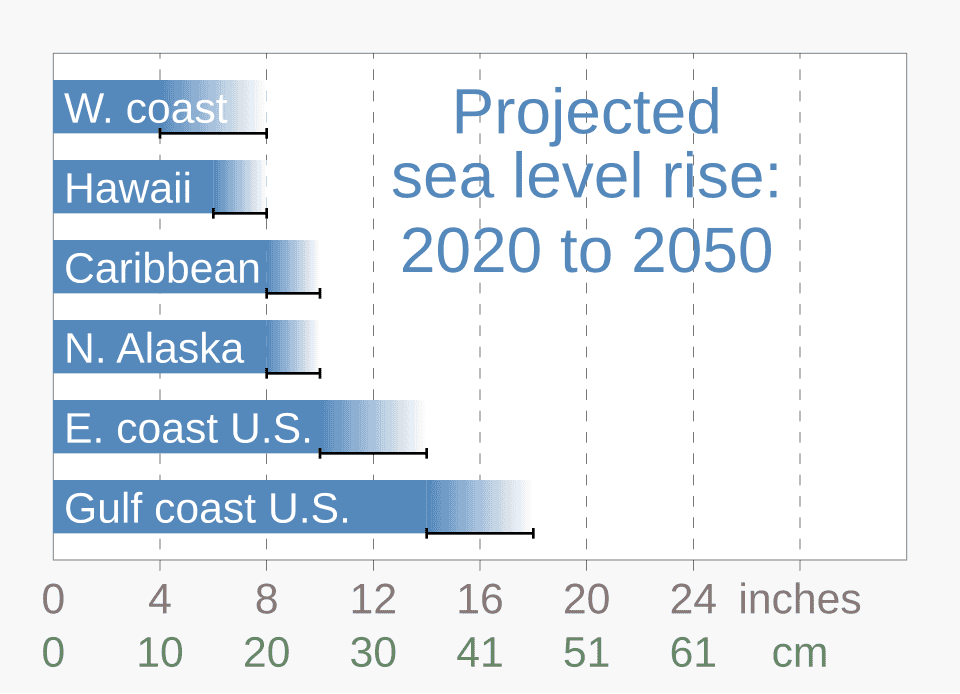
Image credit: RCraig09 / CC BY-SA 4.0 (via Wikimedia Commons)
Present-Day Effects Already Being Felt
Rising seas have also been linked to increased tsunami risk, potentially affecting coastal cities in both the Pacific and Atlantic Oceans. Venice is one of the more high-profile examples — the city sits on islands in the delta of the Po and Piave rivers and has experienced significant flooding. Sea level rise is increasing both the frequency and magnitude of those floods, even though the city has already spent more than $6 billion on a flood barrier system. Florida is another good example — extremely vulnerable to climate change and already dealing with substantial nuisance flooding and king tide flooding.
Food production in coastal areas is getting hit, too. Flooding and saltwater intrusion are raising the salinity of agricultural land near the sea, causing problems for crops that aren’t salt-tolerant. Salt intrusion into fresh irrigation water is a second problem for irrigated crops. Newly developed salt-resistant crop varieties are generally more expensive than the crops they’re supposed to replace. The farmland in the Nile Delta is being affected by saltwater flooding, and there’s now more salt in the soil and irrigation water in the Red River Delta and the Mekong Delta in Vietnam. Bangladesh and China are dealing with similar issues, especially when it comes to rice production.
Future Effects on Coastal Cities and Populations
Future sea level rise could create really serious problems for shore-based communities over the next few centuries. Cities like Miami, Rio de Janeiro, Osaka, and Shanghai could see millions of people affected if warming continues along its current trajectory of around 3°C (5.4°F). The Egyptian city of Alexandria is in a similar situation — hundreds of thousands of people in its low-lying areas may need to be relocated within the coming decade. That said, modest increases in sea level can potentially be offset when cities adapt by building sea walls or through planned relocation.
Miami has been called “the number-one most vulnerable city worldwide” in terms of potential property damage from storm-related flooding and sea-level rise. Storm surge will be one of the most damaging consequences of sea level rise — it can cause the largest losses of life and property in coastal areas. Storm surges have already been getting worse as sea levels creep up, increasing in both frequency and intensity. In New York City, for example, simulations show that what used to be a 100-year flood event will become something that happens every 19 to 68 years by 2050, and every 40 to 60 years by 2080.
Island Nations Facing Existential Threats From Rising Seas
Atolls and low-lying coastal areas on islands are especially vulnerable to sea level rise. Potential impacts include coastal erosion, flooding, and salt intrusion into soils and freshwater supplies. Sea level rise also threatens to devastate tourism and local economies — a rise of just 1.0 m (3.3 ft) would cause partial or complete inundation of about 29% of coastal resorts in the Caribbean, and another 49 to 60% of coastal resorts would be at risk from the resulting coastal erosion. It’s hard to separate out how much of the erosion and flooding that’s already happened was caused by sea level change versus other environmental events like hurricanes. And adapting to sea level rise is expensive for small island nations, since a large proportion of their populations live in at-risk areas.
The Maldives, Tuvalu, and other low-lying countries are among the most at-risk places on Earth. At current rates, the sea level could be high enough to make the Maldives uninhabitable by 2100. Geomorphological events like storms tend to have a bigger immediate impact on reef islands than sea level rise itself — the erosion and subsequent regrowth process can take anywhere from decades to centuries, and can actually result in larger land areas than existed before the storm. But with storm frequency and intensity expected to increase, storms could become a bigger factor in shaping these islands than sea level rise. The island nation of Fiji is already feeling the effects of sea level rise. And five of the Solomon Islands have simply disappeared — lost to the combined effects of sea level rise and stronger trade winds pushing water into the western Pacific.
If all of an island nation’s islands become uninhabitable or completely submerged, the state itself ceases to exist. When that happens, all rights over the surrounding ocean area are extinguished — and that area can be significant, extending out to a radius of 224 nautical miles (415 km; 258 mi) around the entire island state. Any resources in that area — fossil fuels, minerals, metals — could then be extracted by anyone without any obligation to the now-dissolved state.
How the World Is Adapting to Sea Level Rise
A lot of countries are putting together concrete plans for adaptation. One of the more prominent examples is the ongoing extension of the Delta Works in the Netherlands — a country that already sits partially below sea level and is slowly subsiding. In 2008, the Dutch Delta Commission recommended a massive new building program to strengthen the country’s water defenses over the following 190 years. That included drawing up worst-case plans for evacuations, as well as more than €100 billion (around US$114 billion) in new spending through to 2100 for precautionary measures — things like broadening coastal dunes and strengthening sea and river dikes. The commission said the Netherlands needs to plan for a rise in the North Sea of up to 1.3 meters (4 ft 3 in) by 2100, and a 2 to 4 meter (7 to 13 ft) rise by 2200.
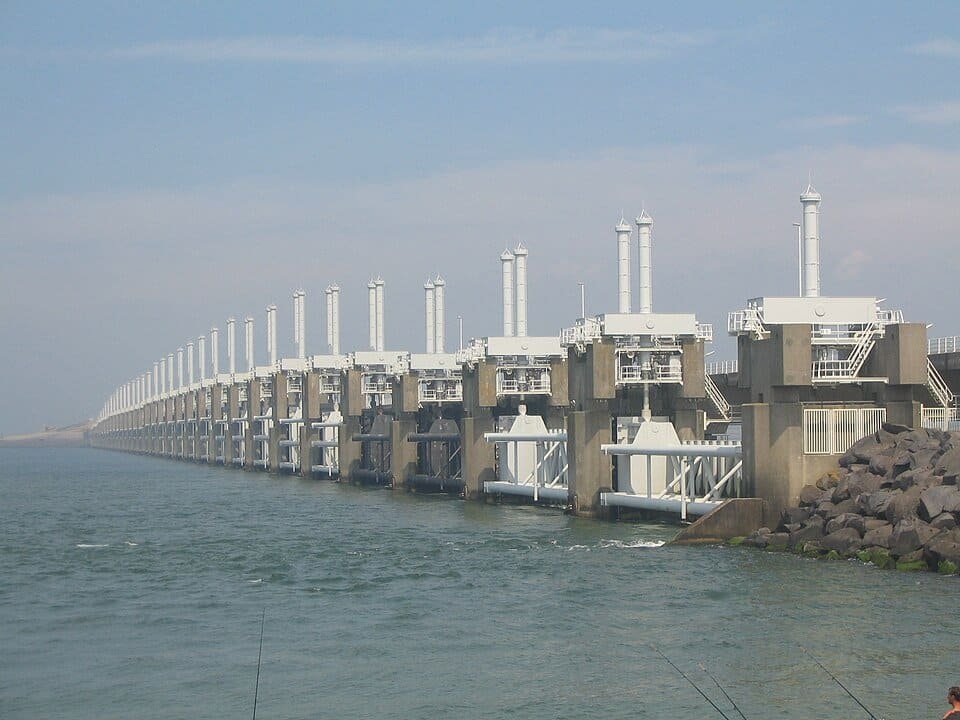
Image credit: Vladimír Šiman / CC BY-SA 3.0 (via Wikimedia Commons)
In the United States, Miami Beach committed $500 million from 2015 to 2020 to address sea-level rise — including a pump drainage system and raising roadways and sidewalks. Coastal U.S. cities also do what’s called beach nourishment (or beach replenishment), where sand is trucked in from elsewhere to build beaches back up. Other adaptation measures include zoning rules, restrictions on state funding in high-risk areas, and updated building code standards. Some island nations — like the Maldives, Kiribati, and Tuvalu — are even exploring the possibility of relocating their entire populations to other countries as seas rise. That’s not an easy solution by any means, since people need a steady income and social network wherever they land. Moving further inland and boosting the natural sediment supply needed for erosion protection is sometimes a more practical local option. In Fiji, residents have been restoring coral reefs and mangroves to protect against flooding and erosion — and that approach is estimated to be more cost-efficient than building sea walls.
Adapting to sea level rise often has to account for other environmental issues at the same time, like land subsidence or habitat destruction. In 2019, Indonesian President Joko Widodo declared that Jakarta is sinking so badly that the capital needs to be moved to another city entirely. A study conducted between 1982 and 2010 found that some parts of Jakarta had been sinking by as much as 28 cm (11 inches) per year — driven by groundwater extraction and the weight of the city’s buildings — and sea level rise is making that worse. There are concerns, though, that building a new capital could accelerate tropical deforestation. Other so-called “sinking cities,” like Bangkok and Tokyo, face similar compounding problems of subsidence on top of sea level rise. Current policies from the 2010s and 2020s that allow unlimited construction and rebuilding in coastal storm zones are also a small but growing source of deficit spending in the U.S. and many other countries.
References:
- Lynch, Patrick (2020-11-04). “27-year Sea Level Rise – TOPEX/JASON”. Visualizations by: Devika Elakara, Trent L. Schindler, Kel Elkins; Scientific consulting by: Josh Willis.
- Scambos, Ted; Abdalati, Waleed (2022-12-31). “How fast is sea level rising?”. Arctic, Antarctic, and Alpine Research.
- Byravan, Sujatha; Rajan, Sudhir Chella (14 April 2011). “The Ethical Implications of Sea-Level Rise Due to Climate Change”;
- “Climate Change Indicators: Sea Level / Figure 1. Absolute Sea Level Change”. EPA.gov. U.S. Environmental Protection Agency (EPA). July 2022.
- Pilkey, O.H.; Young, R (2009). The Rising Sea; National Snow and Ice Data Center (February 19, 2018), “Contribution of the Cryosphere to Changes in Sea Level”
- Grandey, Benjamin S.; Dauwels, Justin; Koh, Zhi Yang; Horton, Benjamin P.; Chew, Lock Yue (2024). “Fusion of Probabilistic Projections of Sea-Level Rise”
- Vital signs / Sea level (NASA)
- Sea level change / Observations from space (NASA; links to multiple measurements)

