

Cover image: André Hatala [e.a.] (1997) De eeuw van Rembrandt, Bruxelles: Crédit communal de Belgique, public domain
The Intellectual Climate of 17th-Century Europe
René Descartes looked something like one of the three musketeers. He had long wavy hair to his shoulders, a mustache, a neatly trimmed beard, and there was always a sword dangling by his side. But the image was not the man. Although he did join the army once, he never saw battle and spent his time thinking instead. Descartes’ real field was the field of the mind, and there he saw plenty of action. Within that mind, he battled against ignorance and tradition, and rose to the ranks of heroism, as the greatest philosopher of the 17th century and one of the most influential thinkers of all time.
Descartes, who is called “the founder of modern French rationalism,” is perhaps most famous for his declaration, “I think; therefore I am.” But there is another comment, one that better defines who he was and what motivated him; it was his statement that: “There is nothing so far removed from us as to be beyond our reach or so hidden that we cannot discover it.”
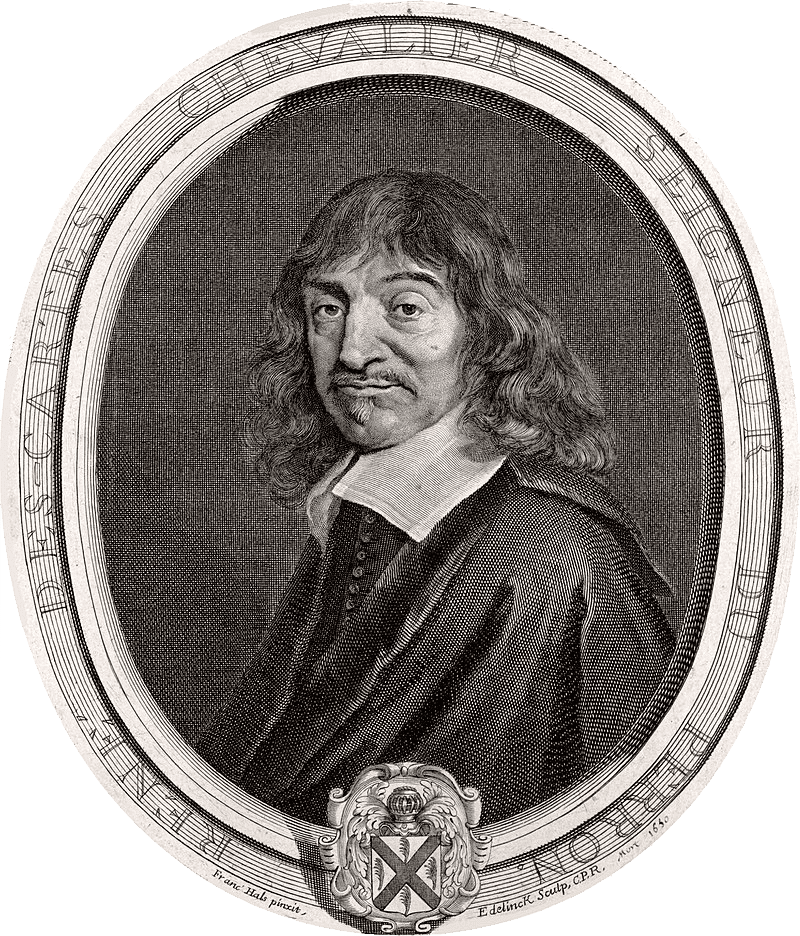
Image credit: Gérard Edelinck (1640–1707). Public domain.
Descartes was more than a philosopher; he was also a gifted mathematician who invented, among other things, analytic geometry and expanded algebra. But despite his mathematical genius, it was his writings and ideas in philosophy that gained him immortality. His greatest achievement is that he’s considered the first philosopher to clearly show the difference between mind and matter. He developed a system of philosophical thought that divided the world into two realms: the non-material, or God; and the material or physical. He maintained that reason and science could only be applied to the material world and that problems of theology and politics, or Church and State, were not to be investigated. With this view, he helped introduce the age of reason and science, without threatening the political and social structure of 17th century France. This delicate balance was upset later when English philosophy, led by Isaac Newton and John Locke, was imported to France and became a basis for examining French society, particularly the monarchy and the Church. But until that happened, Descartes was the prominent voice in French philosophy.
To understand the context of his thoughts, it’s important to know something of the time in which Descartes lived, between 1596 and 1650. He was born in France but spent much of his life in the Netherlands. Seventeenth-century Europe was an age of conflict and contradictions. It was a time when science was becoming more popular and religions were becoming less tolerant. Society was beginning to place its confidence both in reason and in religious authorities, two sources that didn’t always blend well.
In many ways, the 17th century was the first modern century. Although there was still a wealthy aristocracy ruling over a mass of miserably poor, there were also the beginnings of a middle class, comprised mostly of merchants. Capitalism and material progress were becoming evident and so people’s thoughts turned from classical traditions to the practical needs of daily life. This was also a violent chapter of history, with many wars and revolts, and much cruelty. But it also produced an abundance of creative geniuses in every field: Shakespeare, Donne, Milton, and Cervantes in literature; Spinoza, Bacon, Locke, and Berkeley in philosophy; Velasquez, Rubens, and Rembrandt in art; and Galileo, Kepler, and Harvey in science. It was a time when genius and creativity emerged from the darkest corruption and debauchery.
Morals were lax in the 17th century and a gross sensuality seemed to pervade the entire continent. One of the strong values people did hold, at least in the upper class, was that of personal honor. Duels were so frequent in France at this time that the king tried to prohibit the practice. But this was an age of action and combat and people were not to be deterred. Descartes was not the only one who carried a sword at all times – most people felt they lived in an atmosphere of constant danger and unpredictability. Armed bands of mercenaries roamed Europe looking for employment and when they couldn’t find any they resorted to robbery. There was continual war between Catholics and Protestants and both religions allowed their princes to terrorize the civilian population. As a result, neither was very popular with the peasants.
Despite a rising middle class and capitalism, the Europe of Descartes was still mostly rural and agricultural. There were only fourteen cities in Europe that could be called large, containing populations over 100,000. Most city dwellers lived in poverty, filth, and squalor, just as they had since medieval times. People residing in the country fared a little better. One-third of the residents who lived in Germany when Descartes was born were dead 48 years later – from famine, disease, massacre, and war.
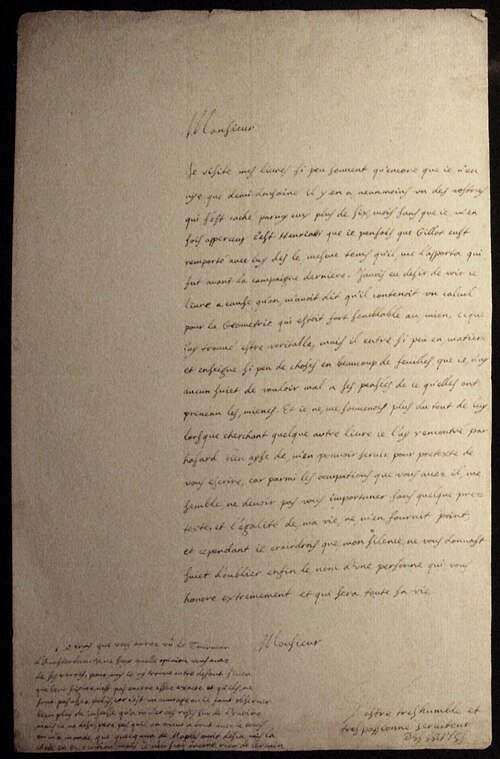
Image credit: PHGCOM / CC BY-SA 3.0 (via Wikimedia Commons)
In his earlier days, Descartes was often involved in the politics of his times, politics that were based mostly on the war. Louis XII was king of France and his Minister of State was Cardinal Richelieu – the man who was the real power behind the throne. A thirty-year war was waging between the Catholic rulers of Spain and Austria and the Protestant rulers of Germany, Sweden, and Denmark. Richelieu played off both sides, hoping to continue the war until everybody was so weak that France could step in and take over the leadership of Europe. Descartes served in the army in the early stages of this war.
France was a Catholic nation and to Richelieu, the cause of Catholicism and France was one. He attacked the Protestant minority in France, climaxing in the famous siege of La Rochelle, and succeeded in defeating them. Descartes took part in this offensive as an advisor. Richelieu was successful in his strategy of promoting the Thirty Year War. By the middle of the 17th century Spain, Austria, and their Catholic rulers were secondary powers in Europe. France was a leader but shared its lead with England and the Netherlands.
All the organized religions in Europe – Catholic, Protestant, Lutheran, Calvinist, and Anglican – were guilty of horrible tortures and atrocities in the name of their God. Hundreds of victims were burned alive for their alleged heresy. There was only one country that allowed religious freedom and that was the Netherlands, where the State controlled the Church. It was here that Descartes chose to spend his last twenty years. In the Netherlands, although his ideas were severely criticized, he was able to write in freedom. These are the times that gave birth to one of the greatest philosophers and thinkers of history. And his life both reflected and departed from the trends and social currents of his days.
Early Life and Education: From La Flèche to Intellectual Independence
René Descartes was born March 31, 1596, in the small village of Le Haye in the Province of Touraine, France. His father was a physician and his mother was the daughter of a prominent lawyer. She died only two days after his birth and the infant René, fragile and suffering from tuberculosis, was not expected to live much longer. He recovered but remained a weak and frail child.
Descartes’ father moved to Brittany where he remarried. He met with great success and fortune in his career and rose to the ranks of the nobility. Descartes was always proud of his family position but, more importantly, the wealth his father bequeathed him allowed him to pursue his philosophy and studies unfettered by financial concerns. Even as a child, it was apparent he was destined to live the life of a scholar and thinker. He had such an inquisitive mind that his father called him “the little philosopher.”
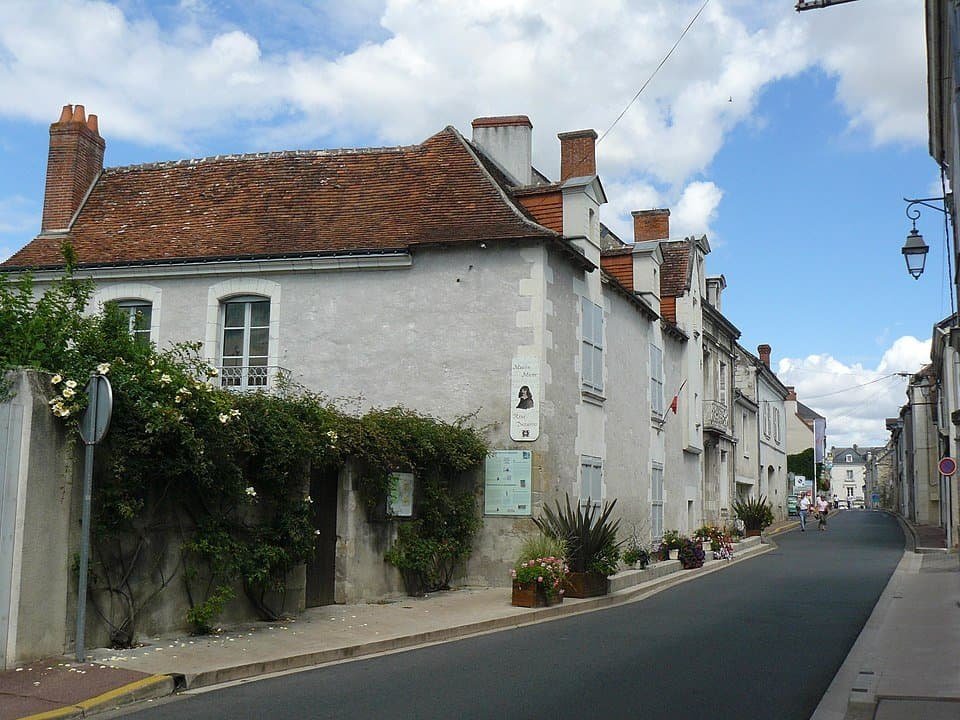
Image credit: Jean-Charles GUILLO. Public domain.
When René was eight years old he attended a Jesuit college that was among the best schools for mathematics. It also offered classes in literature, classical languages, history, logic, ethics, and physics, all of which Descartes mastered with ease. He later wrote of his extreme desire to acquire knowledge while at school, and his sense, as he so modestly put it, that he “was not inferior” to his fellow students. In fact, he was brilliant. At school, he began his lifelong interest in mathematics and his lifelong admiration of the Jesuit Order. He was a star pupil and was exempt from the more rigorous regulations of the school, because of his health. Due to a chronic cough, he was allowed to remain in bed as long as he wished. It was a habit that stayed with him his whole life; he did much of his studying and writing in bed, something he could easily do since he always lived alone.
Although he liked the Jesuits, Descartes would later rebel against the curriculum and philosophy taught in such schools. He felt he’d been given the best education possible at the time, but to him, this wasn’t saying much. Descartes felt teachers were simply passing on the opinions of the ancients, without any regard for current knowledge, such as mathematics, which to him was the only certain knowledge. The lessons in philosophy particularly bothered him. He said shortly after: “Philosophy teaches us to speak with an appearance of truth about all things and causes us to be admired by the least learned…no single thing is to be found in it which is not a matter of dispute and which in consequence is not dubious.” Mathematics, on the other hand, gave him clarity and certainty. Not only that, but he believed it held the truths of life within it, much as Plato had felt. Descartes said: “I do not accept or desire any other principle in physics than in geometry or abstract mathematics, because all of the phenomena of nature may be explained by their means.”
Despite his objections to the education given him by the Jesuits, Descartes always retained devout religious convictions, and carefully formed a philosophy, which he felt confident, violated none of the beliefs of the church. The church felt differently, as we will soon see. Although the Jesuits were among the last religious groups to attack Descartes’ writings, they nevertheless placed him on their Index of Forbidden Books after his death.
When he was seventeen, Descartes went to Paris intending to spend two years enjoying the social and cultural offerings of the city, and avoiding philosophy altogether. But his mind would not rest. Instead, he withdrew to a secluded house to devote himself to reflection and mathematical investigations. Following that he went to the University of Poitiers and obtained a doctorate in law. But instead of starting a legal practice, he joined an army in the Thirty Year War and went to Holland, refusing to accept any pay, which was just as well. Instead of fighting, he spent the idle winter months pursuing his mathematical studies. From these and later studies in math would develop his unique and valuable contributions to that field: the invention of coordinate geometry, which made it possible to determine the position of a point in a plane by its distance from two fixed lines; and his analytical method, by which he first supposed a problem completely solved and then proceeded to analyze the consequences of this hypotheses, thus working backward, so to speak, from traditional approaches.
Mathematics and the Cartesian Coordinate System
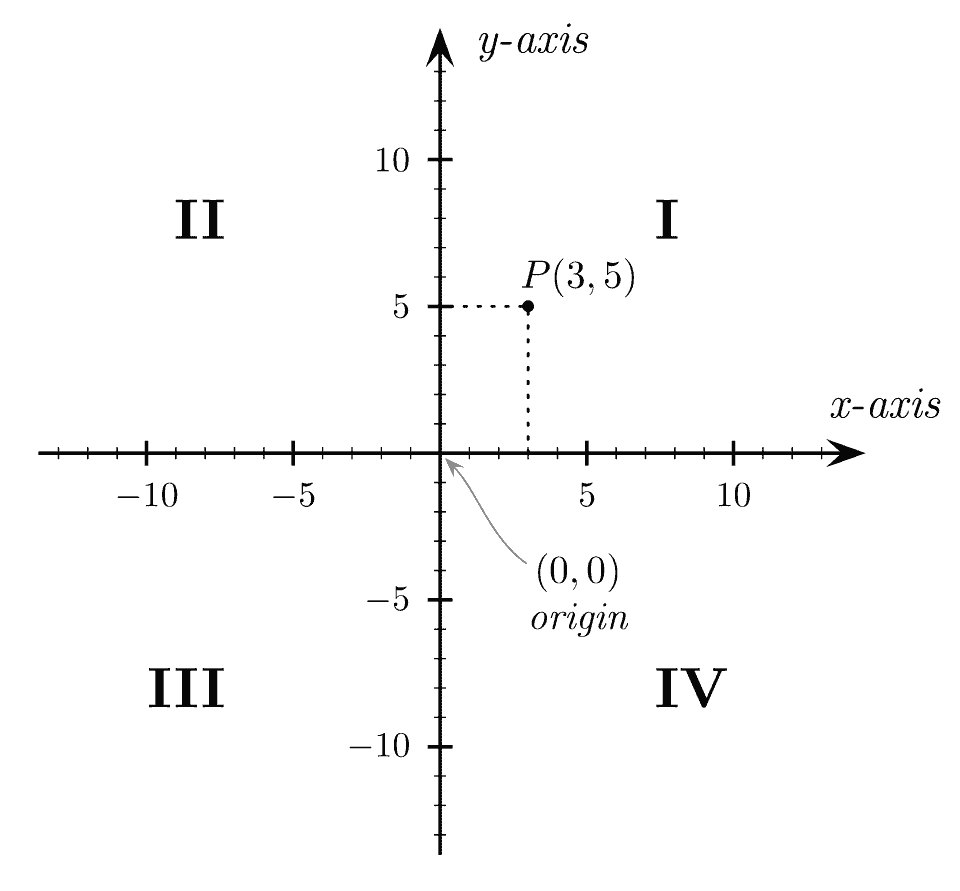
Image credit: Gustavb / CC BY-SA 3.0 (via Wikimedia Commons)
For his idea of coordinate geometry, a common housefly reportedly inspired Descartes. He was lying in bed, as he so often did, and watching the fly buzz around the room when it occurred to him that the fly’s position could be described at every moment by locating the three perpendicular planes that intersected the point it occupied. On a two-dimensional surface, such as paper, every point could be located by the intersection of two lines, such as longitude and latitude on a map. Today this system is known as the Cartesian coordinates because Descartes used to sign his work with the Latin version of his name: Renatus Cartesius.
After his military stint in Holland, Descartes joined the army of Maximillian, Duke of Bavaria, and was probably present during the crucial battle in which Maximillian’s Catholic forces defeated the Protestant armies of Germany. According to Descartes, he spent the tenth of November 1619, in the room of a farmhouse in Germany, involuntary seclusion, formulating a new approach to philosophy. He told of three dreams and visions he’d experienced that revealed to him the fundamentals of his new philosophy, and which told him his mission was “to seek truth by reason.” As a result of these visions, he made a vow to make a pilgrimage to the shrine of Our Lady at Loreto in Italy. The premise that came out of his visions was to apply the methods of mathematics to philosophical questions. His goal was to free himself from all traditions and develop an independent thought system all his own.
When he left the army a few years later, Descartes kept his vow and toured Italy, making a pilgrimage on foot, from Venice to the shrine of the Virgin. While traveling in Europe he devoted himself to observations of nature and human life. At some point in his travels, he constructed an early type of robot, which he had transported home by the sea. But the ship’s captain looked into the chest out of curiosity and was horrified when he saw the life-like form, which moved somehow like an automated being. Thinking it could only be the devil in disguise, he threw the entire chest into the ocean.
After his travels, Descartes returned to Paris, just long enough to make arrangements for a permanent move to Holland. Paris was too distracting and he felt a greater need for solitude and quiet. For the remaining twenty years of his life, he lived in Holland, except for the last five months, which were spent in Sweden. He never bothered to learn the Dutch language, fearing this would be a threat to the complete social isolation he desired.
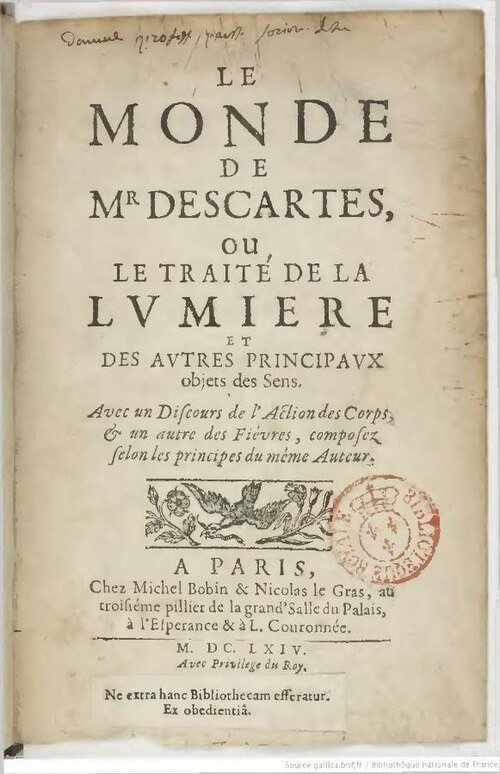
Image credit: Livre numérisé par Gallica – René Descartes (1596–1650) Public domain.
Descartes never married but he did have a mistress who gave birth to his daughter, Francine, in 1634. He adored the child and when she died only five years later, it took him many months to recover. The year before his daughter died, Descartes had completed some of his first writings on philosophy, called Le Monde, or The World, but he abandoned his book immediately when he heard that Galileo had been condemned of heresy. Galileo’s book included support of Copernicus’ theory that the sun was the center of the Universe and not the earth, as the church maintained. Since Descartes’ work also supported Galileo, he felt it best to keep it to himself. Whether he was motivated by loyalty to the church, or fear of its wrath, is a matter of interpretation. Instead, he worked out a compromise theory whereby the earth stood still in the middle of a vortex that traveled around the sun, a theory that was accepted by many until Isaac Newton set everyone straight several years later.
In Holland, Descartes moved 24 times but somehow managed just the same to complete some of his major works. This moving about from house to house was part of general secrecy he liked to maintain – often disguising his whereabouts and his interests, seldom sharing his genuine thoughts with people, and pretending to be working on nothing, when he was in fact consumed by his work. There has been a whole range of theories about his secrecy. Some believe he was just protecting himself from the opposition. Some even claim he was secretly a member of the Rosicrucians – an international fraternity that practiced an occult philosophy. Most, however, believe he was always a devout Catholic, who felt his philosophy reconciled with his faith, and that the goal of his secrecy was to avoid judgment before the work was completed. He was a self-confident man, who saw himself as something of a visionary, and so it made sense to him to “go it alone.” He did, however, have many distinguished, loyal friends, with whom he kept up a lively correspondence. Descartes lived modestly and was said to have a kindly disposition. He was very generous to his servants and concerned about their welfare and they in turn were devoted to him.
In 1637, when he was 41, Descartes released Discourses, one of which, Discourse on Method, was especially celebrated. It was also condemned. Prominent Protestants, who tried to obtain an indictment against him, accused Descartes of atheism and skepticism. But influential friends intervened and the final judgment merely limited all discussion of his philosophy. Four years after Discourses, he released Meditations, and then Principles of Philosophy. He continued to be accused of heresy by various religious groups but in later years was recognized as one of the leading philosophers of Europe.
Descartes’ fame became so great that Queen Christina of Sweden persuaded him to move to her country and become her tutor. It was common in these times for European royalty to fill their courts with intellectuals although they were usually motivated by a wish to appear fashionable rather than any burning desire for knowledge. Descartes accepted reluctantly – reluctance that was later justified – and Christina dispatched a royal ship to transport him. It seems Queen Christina was not always a receptive student. When Descartes was trying to explain his mechanistic theory – that is, his view that all animals are mechanisms, she responded that she had never seen a watch give birth to baby watches. The larger problem, however, was not his pupil’s aptitude, but the Swedish climate and the severe working conditions imposed on him by the eccentric queen. He was obliged to instruct her at 5:00 in the morning in her drafty castle, even in the bitter cold of winter. It proved too much for his delicate lungs and he came down with pneumonia. Descartes died eleven days after becoming ill, on February 11, 1650, at the age of 54. He had been in Sweden for barely five months. His body was returned to Paris, except the head, which for some reason was left in Sweden and was reclaimed later by his friends. His funeral went on, head or no head, and was interrupted by a court order forbidding the delivery of a eulogy. This was the beginning of Catholic opposition to his philosophy, which climaxed in 1663 when his books were banned.
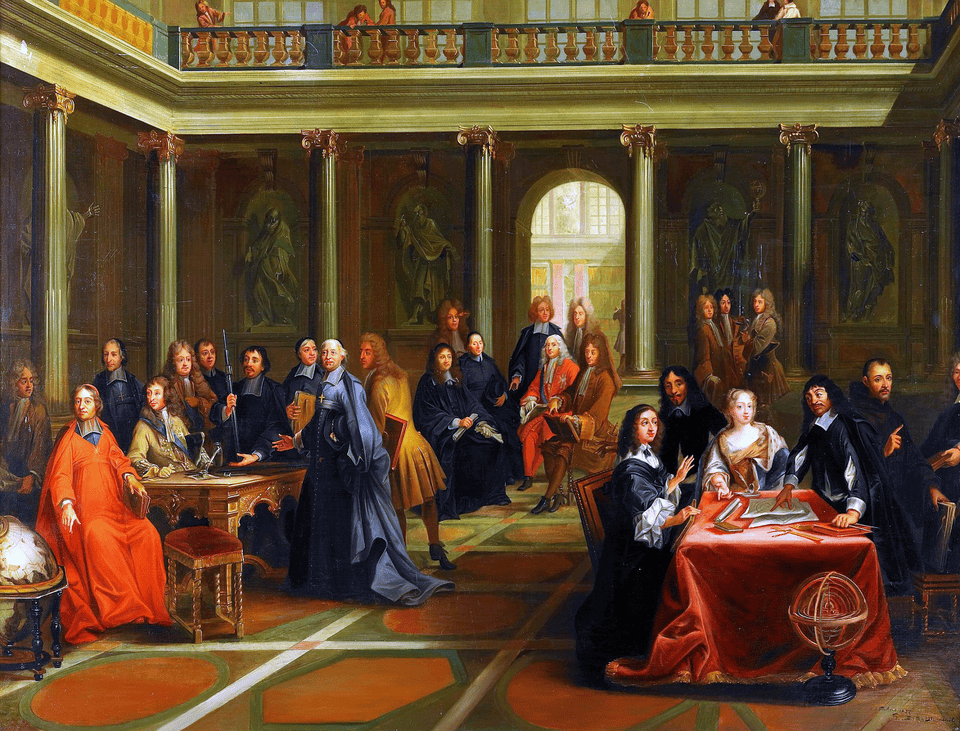
Image credit: Nils Forsberg (1842-1934) After Pierre-Louis Dumesnil the Younger (1698-1781). Public domain.
Descartes and the Scientific Revolution
Descartes was a threat to Catholicism because he insisted that doubt was essential in discovering the Truth and doubt, to the church, was in direct conflict with faith. Yet even while theologians were railing against him, he was gaining popularity in the court and the fashionable salons of Paris, where his ideas were a source of lively conversation and debate. In time, his insistence on rational evidence, and his demand for remaining doubtful in the absence of this evidence, would become the foundation for modern research and science. Although Descartes made errors in his own scientific conclusions (as examples: he rejected the existence of atoms; didn’t believe in the existence of a vacuum; thought the planets moved in a circular rather than elliptical pattern; and denied the theory of gravity) his methods for attaining truth contributed enormously to the future growth of science.
His chief contribution was his method of doubting all prior conclusions, accepting no conclusions based on assumption, and subjecting all knowledge to the analysis of individual thought processes. These were the principles he applied to his brilliant works of philosophy. The most important of those works were Discourse on Method, Meditations, and Principles of Philosophy. Meditation was Descartes’ favorite and is considered his masterpiece. There are many ideas and methods associated with Descartes’ work that has had a profound effect on the development of philosophy since the mid 17th century. Here are some of the most important…
First of all, Descartes believed that to arrive at the truth, individuals must first rid themselves of all their past education and beliefs. In this way, they can eliminate all the mistakes and prejudices accumulated since childhood. Every idea and belief we’ve previously held should be measured with doubt.
Secondly, Descartes believed that arrival at the truth required an orderly, methodical thinking process. No hasty generalizations and conclusions could be allowed. People must proceed carefully from simple, concrete, known objects up to the more abstract. The mind, therefore, is the instrument for discovering truth and the starting point for all philosophical thought.
Three: The purpose of philosophy is to analyze the content of human thought – the subject and conclusions. Every idea should be reduced to its basic elements, one by one.
Four: Descartes believed in the existence of God and felt that his own questioning and imaginings of God were proof God existed. He saw it this way: He is seeking perfection, yet perfection doesn’t exist in his mind. Therefore a perfect creator must have put the idea of perfection there. And if God is perfect, he cannot deceive. So it follows that perfection or knowledge of the truth can be attained, and it can be attained through the rational mind.
Five: Descartes believed man possesses a soul, which is spiritual and is united to the material body. The soul interacts with the body in the conduct of its business; Therefore soul and body are separate but related.
Six: Will and reason are properties of the soul. The body, on the other hand, has desires and needs of its own. Morality is the ability of a man to subject his passions to the will and reason of the soul.
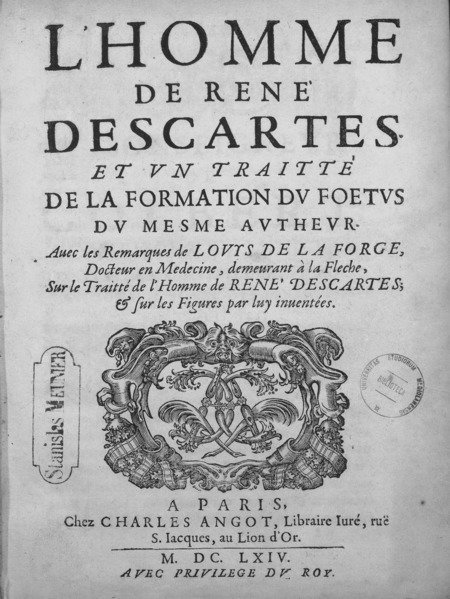
Image credit: Biblioteca Europea di Informazione e Cultura. Public domain.
It was these ideas, and others, that made a deep impact on the history of philosophy. Every philosopher who followed Descartes was in some way indebted to him. He’s considered the most influential European philosopher before Immanuel Kant, who appeared on the scene a hundred years later. One reason his work was so significant is that it broke away from traditional scholasticism – scholasticism was the very systematic philosophy developed by medieval scholars, between the 10th and 15th centuries, that was based on Aristotle’s work and the work of early Christian writers. It relied heavily on upon, in fact, insisted on traditional doctrines. Descartes, instead, preferred the use of science and reason in attaining his truths. When Descartes broke from scholasticism he paved the way for future philosophers to explore new and freer ways of thinking. That is why the work of René Descartes is often considered the first modern system of philosophical thought.
Discourse on Method was written in 1637 when Descartes was 41 years old. It’s considered the first great philosophical work written in French and its style became a model for all the future work in that country.
Four years later, when he was 45, Descartes published Meditations on the First Philosophy, popularly known as Meditations. He took the novel approach of including in the book the objections of other philosophers and theologians to whom he’d first submitted the work. Then he included his responses to their objections. Meditations are the most important of Descartes’ works because it contains his complete theories on metaphysics and what is called epistemology. Epistemology is the investigation of human knowledge, including its nature, limits, and criteria. In Meditations, Descartes considers the sources of knowledge, the validity of truth, the destiny of man, the existence of God, and the creation of the universe. In short, he takes on the most monumental questions of the human experience.
The Method of Doubt: Destroying Knowledge to Rebuild It
Descartes began his work by doubting everything, but to him, this very doubt was the evidence for what he searched. The existence of doubt implied the existence of something that doubted; hence he the doubter existed. He expressed that in the Latin phrase: Cogito, ergo sum, or as we know it: “I think, therefore I am.”
There are six meditations in the book, on six different but related subjects. In the first one, Descartes explains the reasons for his doubts about methods used to arrive at the truth. The second meditation, which is really the beginning of the important part of the book, describes the human mind. The third meditation is Descartes’ famous argument for the existence of God. The fourth describes errors in methods of thought and requirements for truths. The fifth talks about the essence of man’s physical nature and body. And the sixth and final meditation addresses differences between the soul and the body.
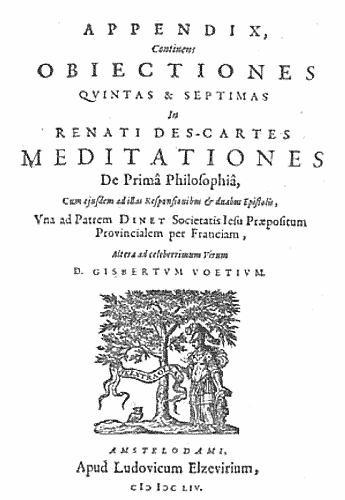
In the preface of Meditations, Descartes responds to the criticism of his previous book, Discourse, and says he’s continuing with the quest he began in that book – to meditate seriously on the important questions of God and the human soul. He advises his readers to try and detach themselves from prejudices and information they’ve gained through their five senses, so they can realize the maximum benefit of the meditations that follow. It is Meditation Three that contains his renowned argument for the existence of God. In his mind is an idea of a perfect God. It’s a clear and distinct idea. Clear ideas are true. Because this idea is true, he can proceed with an analysis of perfection. A thing can’t be perfect if it’s merely imagined in his mind. A perfect object must exist to be perfect. Therefore the idea of a perfect God necessarily includes existence.
Meditations was a work that helped establish an entirely new approach to knowledgeable thought and investigation, which influenced not just philosophy, but science and mathematics. Perhaps Descartes’ greatest contribution to these new methods was the idea he put forth at the very beginning of his meditations – the idea of doubt, or as he puts it, “universal doubt.” It was this encouragement to doubt all we’ve previously learned and believed, particularly if it was based on the perception of our senses alone, that freed people to give up their prejudices and conventional ideas, to pursue a more real and workable truth. Descartes put his confidence instead in intuitive knowledge – those ideas that come to us with clarity and distinctness and which do not proceed from our sensation of an external reality. Such clear ideas stimulate the will to accept them as true. Existence is something that’s intuited – it’s apprehended immediately by an active intellect and is therefore real. This includes his own existence as well as the existence of God.
It was the method of thought Descartes used to arrive at his conclusions that so affected his time and future philosophers. First, he doubts the truth of all he’s learned before. Second, he finds one certain principle upon which to rationally build all his following conclusions. For him, that principle is: “I think; therefore I am.” This he knew by direct intuition – it was a clear and distinct idea and his will acted upon it, to make it true. From that one fixed, an absolute point he was able to establish for himself a series of related, cumulative truths that spiraled upward and upward until he had his personal evidence for the existence of God. For some people, this evidence was convincing; for others, it was faulty, even sacrilegious. But the meticulous method and logic he created were to have a profound impact on many disciplines and was the foundation of modern philosophy.
Why Descartes Still Matters Today
When Descartes was born, philosophy had been standing in the same place for almost 2000 years. It was he who helped ignite the flame of knowledge that had been all but extinguished since the time of the ancient Greeks. He challenged his contemporaries to think for themselves, to ask questions, to not rely on past opinions and theories, but to use their own minds and reason to attain their own truths. His theories and methods, as creative and intelligent as they were, are only part of his contribution. His real contribution was in inspiring society to think again, to resume its’ learning, and to continue on a search that had been abandoned before the goal had been attained.
References:
- Clarke, Desmond (2006). Descartes: A Biography. Cambridge, England: Cambridge University Press
- Gaukroger, Stephen (1995). Descartes: An Intellectual Biography. Oxford, England: Oxford University Press
- Gottlieb, Anthony (2016). The Dream of Enlightenment: The Rise of Modern Philosophy. Allen Lane
- Grayling, A. C. (2005). Descartes: The Life of René Descartes and Its Place in His Times, The Free Press, London

