

Cover image: IBM Quantum System One in Ehningen, Germany – © IBM Research, licensed under CC BY 2.0.
Introduction: From Classical to Quantum Computing
When the first computer was built back in the 1940s, people estimated the world would need maybe five of these powerful, massive machines at most. Eighty years later, the average family has at least five personal computers if you count mobile phones, and that’s not even including all the devices with computer processors that wash our clothes, adjust our TV picture, or calculate gas mileage in our cars. Computers have gotten way more powerful and way smaller. And to make them even more powerful, we need to keep shrinking them down. Theoretically, they’d get so small that individual components would be just a few atoms in size. That means there are limits to their development that we’re going to hit pretty soon.
When we think about the world of the very small—the world of molecules and atoms—the laws of quantum mechanics take over. In our everyday macro-world, we don’t notice these laws, where particles behave completely differently from what we’re used to in normal math and physics. In that tiny world, particles aren’t just particles anymore. They can be both material particles and energy at the same time. In that world, the terms “yes” and “no” don’t really apply. Instead, we talk about the probability that something is or isn’t. And actually, it can be both simultaneously. According to Heisenberg’s uncertainty principle, we can’t measure both the energy and position of a particle at the same time (which is really frustrating for quantum physicists). Two particles can be connected in such a way that changing one particle instantly causes a change in the other, no matter how far apart they are. That “spooky action at a distance” even freaked out Einstein.
Qubits: Two States at Once
The weird properties of particles that follow quantum mechanics laws are what give quantum computers their power. In all the regular computers we use every day—the ones based on semiconductor transistor technology—the basic unit of information is one bit. It can be either zero or one. Using strings of zeros and ones, you can describe all the operations and data that the computer processor will process and show us as text, video, or interactive games.
In quantum computers, the information carrier is something from the quantum world with all its unusual properties. If we can harness these properties with the right algorithms, computational power increases dramatically. The unit of information a quantum computer processes is called a qubit. Its most important feature is that it can be in two states at the same time—being both zero and one simultaneously.
It’s like having a coin that we’ve carefully balanced on its edge on a table so it could fall to either side at any moment. This state of a qubit is called superposition. We won’t know what its condition actually is until we measure it at some point.
When we slap our hand on the table, the coin falls to one side and we know the result. Something similar happens when we measure a qubit. The probability of “which side it will fall on” is encoded in it when it’s created. The qubit itself disappears the moment we measure it, and we’re left with information that we read as either zero or one. The measurement gets repeated many times to figure out the probability that the qubit carries inside itself.
What Exactly Is a Qubit?
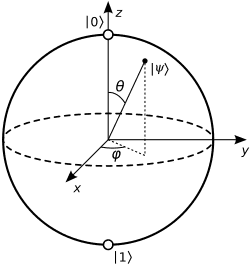
Smite-Meister / CC BY-SA 3.0 (via Wikimedia Commons)
The bits that form the foundation of our digital world are basically electrical impulses in a physical sense. They’re easy to make and easy to use. When it comes to qubits, the situation is way more complex. To get one qubit, we need an object where we can achieve superposition of two physical states.
Google and IBM have based their quantum computers on qubits created in superconducting electric circuits that are cooled to temperatures lower than those in the vast emptiness of deep space. The direction of current flow through the circuit determines the qubit’s state. Some other companies use isolated individual atoms in an electromagnetic field in an ultra-high vacuum, where the qubit’s state is determined by their spin.
No matter how the qubit is made, we need to make sure it has an isolated quantum state and that we can control its properties. The tiniest change in the external environment—whether it’s temperature, electromagnetic fields, or impurity atoms in the material—all of this seriously affects the qubit and can cause errors. These errors are called quantum noise and represent a major problem in quantum computer operation today. That’s why we need such extreme working conditions: temperatures close to absolute zero where the chaotic thermal movement of particles almost completely stops, or ultra-high vacuums where there’s practically nothing that could mess with the qubit.
Quantum Gates and Algorithms
In a classical computer, bits get processed through semiconductor transistor logic circuits. The equivalent in quantum computers are various quantum gates that qubits pass through. In some of them, qubits interact with other qubits, and the right algorithms use their quantum properties to get results much faster than regular computers.
One example of this speed boost is how they perform searches. When we want to find something in memory with a classic computer, the algorithm running in its processor has to check the contents of all memory locations “item by item” until it finds the one with the content we want. Each entry in memory—each item—is represented by a series of zeros and ones and represents one state. Reading one state at a time from memory takes a certain amount of time, no matter how fast the computer is. A quantum computer, though, can read multiple states at once and search much faster.
Quantum Supremacy: Google vs IBM
Theoretically, the speeds we expect from quantum computers should be as much as a billion times faster than the fastest supercomputers we can build with today’s widely used technologies. A year ago, Google proudly announced that with its Sycamore quantum computer—which uses 54 qubits—it solved a specific math problem in just 200 seconds. According to their calculations, the fastest supercomputer would take 10,000 years to complete the same task. That means they’d achieved quantum supremacy (basically demonstrating that a programmable quantum device can solve a problem that no classical computer could solve in any reasonable amount of time).
On the same day, their main competitor in quantum computer development, IBM, denied this claim. IBM gave a complicated scientific explanation saying that a regular supercomputer would actually only need 2.5 days for the same task. From their perspective, quantum supremacy hasn’t been reached yet. Beyond that, IBM publicly announced a development plan for their quantum computers, including the ambitious goal of building one with 1,000 qubits by 2023. The largest quantum computer IBM has produced so far contains 65 qubits.
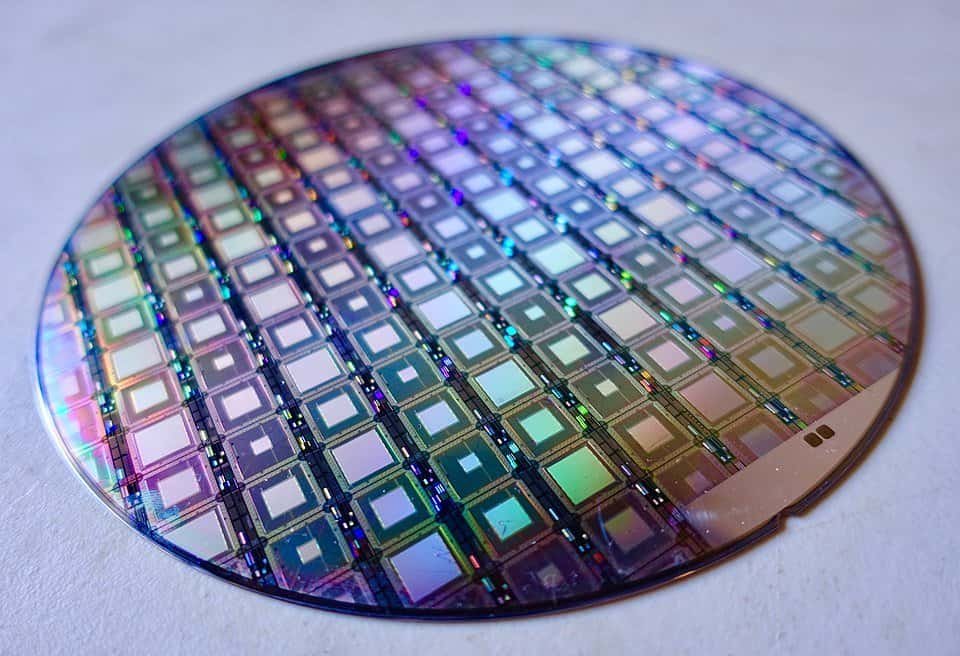
Steve Jurvetson / CC BY-SA 2.0 (via Wikimedia Commons)
Either way, quantum computer development seems to be heading in the right direction. We need a lot more work on hardware development since current solutions are still dealing with significant operational errors. For now, nobody expects quantum computers to replace ordinary computers in everyday life. We’ll use their superiority for special tasks that we can’t—and won’t be able to—perform with computers based on the technology we have now.
Quantum Computers: A Tool for Countless Solutions
When legendary physicist Richard Feynman first introduced the idea of the quantum computer in 1982, he saw it mainly as a device we could use to successfully model atoms and how they connect in molecules. That would let us better understand their properties and the behavior of the materials they make up. The quantum computer, by its very nature, was a logical solution to this problem because quantum phenomena at the molecular and atomic level would be modeled using a quantum system.
Less than forty years later, this idea is becoming reality. Today, auto giant Daimler uses quantum computers to simulate and compare chemical compounds while searching for those that will most improve the performance of batteries for electric cars. The pharmaceutical industry also has high hopes that quantum computers will help them develop new drugs faster and cheaper. Simulating how drug molecules behave could significantly cut down the time spent in the lab doing “try until you get it right” experiments.
Another important application area is analyzing huge amounts of data. The mathematical models we use to describe a phenomenon or system are only as accurate as the different variables we account for when calculating. When describing incredibly complex systems—like in meteorology, for example—we have to limit the number of variables and the amount of data we look at. Computers can’t process it all fast enough to give us a reasonably accurate weather forecast. If we could use quantum computers to account for much larger amounts of data and monitor more parameters, we could get extremely accurate forecasts of not just the weather but the behavior of entire climate systems.
In industry, quantum computers are being used for optimization. Airbus uses them to calculate optimal routes for aircraft takeoff and landing to reduce fuel consumption. Volkswagen has used them to find optimal routes for city buses or taxis to avoid traffic jams, and JP Morgan to predict stock values on the exchange.
Qiskit: Accessing Quantum Computers Today
Quantum computers have become a nightmare for everyone who needs to keep information secret because there’s no code used today that they couldn’t break. That’s why cryptographers have been preparing for years for the day when someone uses a quantum algorithm to crack ciphers.
Some quantum computers today look like huge steampunk jellyfish, with a bunch of cables hanging under the rounded body of a metal beast. It’s hard to imagine this technology could one day fit in a device in our home or on our wrist. But it’s pretty undeniable that their application will be able to improve our world in many ways.
And for those who want to play around with qubits today, IBM has provided access to its quantum computer via the internet. For the curious, the magic word is Qiskit. Qiskit [quiss-kit] is an open-source SDK for working with quantum computers at the level of pulses, circuits, and algorithms.
References:
- Mermin, N. David (2007). Quantum Computer Science: An Introduction. Cambridge University Press;
- Akama, Seiki (2014). Elements of Quantum Computing: History, Theories, and Engineering Applications
- Nielsen, Michael A.; Chuang, Isaac (2000). Quantum Computation and Quantum Information. Cambridge, England: Cambridge University Press.

