

Cover image: Own work from Copernicus 1543, public domain.
Introduction to Copernicus
Nicolaus Copernicus and his heliocentric theory represent one of the greatest turning points in the history of science — the moment humanity realized Earth was not the center of the universe. He was not a bold man – he was timid and quiet and preferred to spend his time administering to the poor and sick. He was not a strong or robust man – he was a bookish student who spent many years studying ancient documents and mastering difficult subjects. Yet although he was not bold, and he was not strong, Nicholas Copernicus managed to move heaven and earth, setting in motion what historians now call the Copernican Revolution, a turning point that helped ignite the Scientific Revolution.
At the time Copernicus was born, people had some very strong beliefs about the universe, beliefs they had stubbornly held for almost 2000 years. Their beliefs were based mostly on the work of two great ancient thinkers who had some brilliant ideas in their lifetimes, but who also made some big mistakes. The men were Aristotle, the Greek philosopher who was born in 384 B.C; and Ptolemy, who was born about five hundred years later, in the year 151 A.D. Historians aren’t sure whether Ptolemy was Greek or Egyptian but they do know he lived and worked in Alexandria.
Aristotle’s Geocentric Universe
Aristotle took a view of the universe that was somewhat scientific and somewhat spiritual. It started with the premise that the earth was the center of the universe. This seemed obvious to every one, since after all, the earth was the home of the noble human being, and anyone of those noble beings, looking into the sky, could see that the sun moved every day. Clearly, the sun, the moon, the five planets, and the stars revolved around the earth. Aristotle also believed that a circle was the perfect geometric figure. And since the universe must be perfect, the paths of all these heavenly bodies must be circular. He wrote a book about these theories called Physics, which became a basic text in science classes for centuries to come. Aristotle also divided the universe into two separate parts – one was changeable and corruptible and was occupied by man. The other was immutable and indestructible and was inhabited by gods. In other words, one part was mortal, and one part was divine. Earth was mortal and therefore flawed; the rest of the universe was divine and therefore perfect. The stars and planets, being divine, never wavered, had no marks or scars upon their surface, and were placed in the heavens so humans, looking up, could have a sense of the perfection they might someday attain themselves.
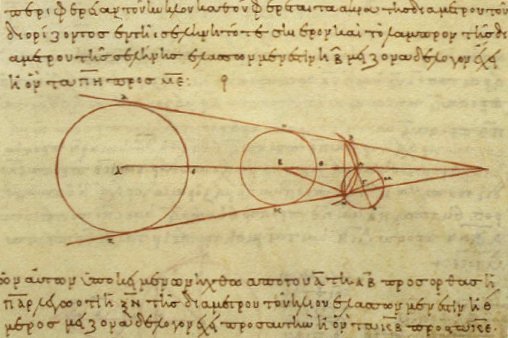
There were many records left by ancient astronomers that show they carefully observed and studied the behavior of the heavenly bodies – and much of what they saw puzzled them and couldn’t be explained by Aristotle’s. For instance, the planets, which they called “wandering stars” seemed to move in very complicated paths, and sometimes their behavior was downright bizarre. Mars, for example, seemed to move some months at a steady pace. Then it would slow down, stand still, and even move backward for a time. Even the sun and moon seemed to occasionally wander off from where they should be.
Ptolemy’s Planetary System
It was Ptolemy who considered these problems and decided the path of the planets around the earth probably wasn’t a simple circle as Aristotle thought. He came up with a complicated system of circles and loops instead, in which the heavenly bodies revolved around the earth in the following order: the moon, Mercury, Venus, the sun, Mars, Jupiter, Saturn, and then the stars. Beyond that was heaven itself. There the gods and goddesses dwelled. Ptolemy made endless calculations and tables and published his work in a book called, Almagest, which also became a standard text in European universities. Almagest establishes the positions of the stars and other heavenly bodies according to the time of year. The amazing thing about Ptolemy’s tables was that they were approximately correct – approximately. The planets were always close to where Ptolemy said they should be, although not on the exact spot. The difference didn’t seem to bother anyone, since the idea that he was so close seemed miraculous enough. Thirteen centuries passed and Ptolemy and Aristotle went unquestioned. More than that, their work became gospel. An earth-centered universe had become such an essential part of Christian faith that challenging it was the same as challenging the scriptures.
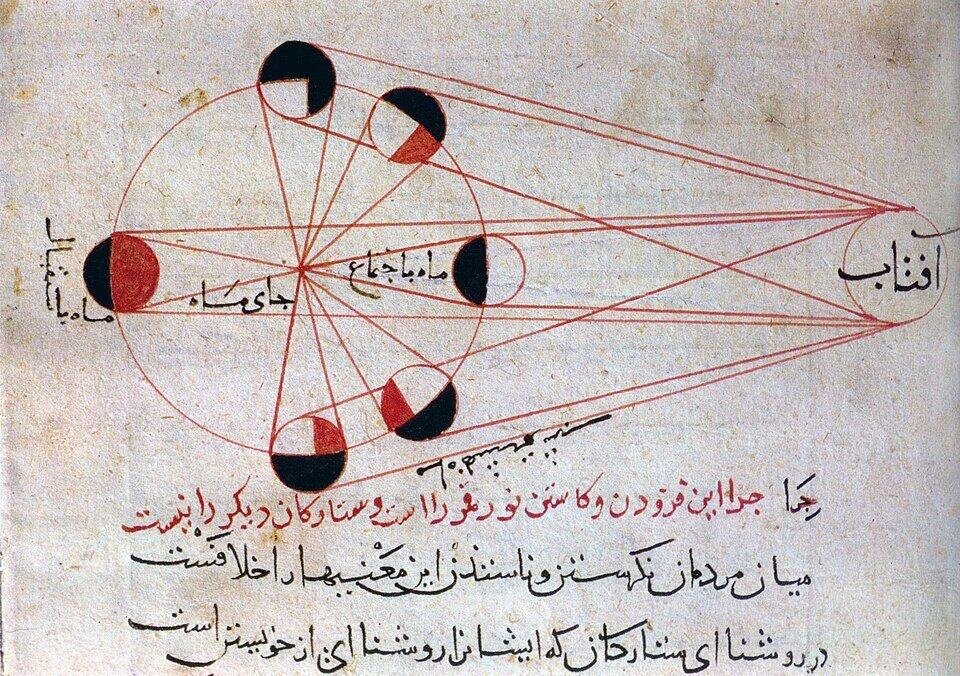
Image credit: Scanned from: Seyyed Hossein Nasr (1976) Islamic Science: An Illustrated Study, World of Islam Festival Publishing Company
For thousands of years before Copernicus, the ideas of Aristotle and Ptolemy together had guided human thinking. Their books were still the basis of science classes throughout Europe; there had been no new discoveries or ideas since their time that seemed important; and all recent works just attempted to elaborate on their original ideas. Just like their view of the earth itself, human learning seemed to be at a standstill. It’s been said that Europe knew less in the year 1500 than some men, like Archimedes or Pythagoras, knew in 200 B.C.
University of Krakow and Italian Studies
In 1492, when Christopher Columbus was discovering the new world, Nicolaus Copernicus was working to discover a new universe. He was 19 at the time, a student at the University of Krakow, and a young man of diverse interests and exceptional curiosity. Nicolaus Copernicus was born on February 19, 1473, in the town of Torun, Poland. His father was a prosperous copper merchant and civic leader; his mother was the relative of a Bishop, a relationship that came in handy for Copernicus later on. Nicolaus was a serious child, who took a strong interest in Greek and Latin, but who also liked to play along the banks of the Vistula River. He was orphaned when he was only ten years old and was raised by an uncle, who at the time was a priest. Uncle Lucas was a proud and energetic man with ambitions for both himself and his nephew. He was harsh, irritable, and lacked a sense of humor, but what he did have was a keen mind and an appreciation of science. He encouraged his shy nephew to develop his own mind, for he hoped to use him later as a personal assistant. Lucas supported Copernicus while he attended the University of Krakow, which was famous for its mathematics, philosophy, and astronomy schools.
It was an exciting time to be at a university – Europe was buzzing with new ideas and discoveries in art and exploration, and only forty years before Gutenberg had invented the printing press. Now presses all over Europe were spilling out books and published works by the greatest thinkers of the time. Copernicus was still in school when Columbus returned from his voyage, proving what most learned people already knew – that the world was round. Meanwhile, other explorers were heading down the coast of Africa, demonstrating it was safe to sail across the equator. Even in religion, people were daring to speak out against the abuses of the church, laying the groundwork for the Protestant revolution that Martin Luther would lead in 1517. Still, in the astronomy school at Krakow, Copernicus was being taught the ancient doctrines of Ptolemy and Aristotle. It’s doubtful if his courses included the thoughts of a great Arab philosopher named Averroes who, after studying astronomy in the late 1100s, wrote: “The Ptolemaic astronomy is nothing so far as reality is concerned, but it is convenient for computing the nonexistent.”
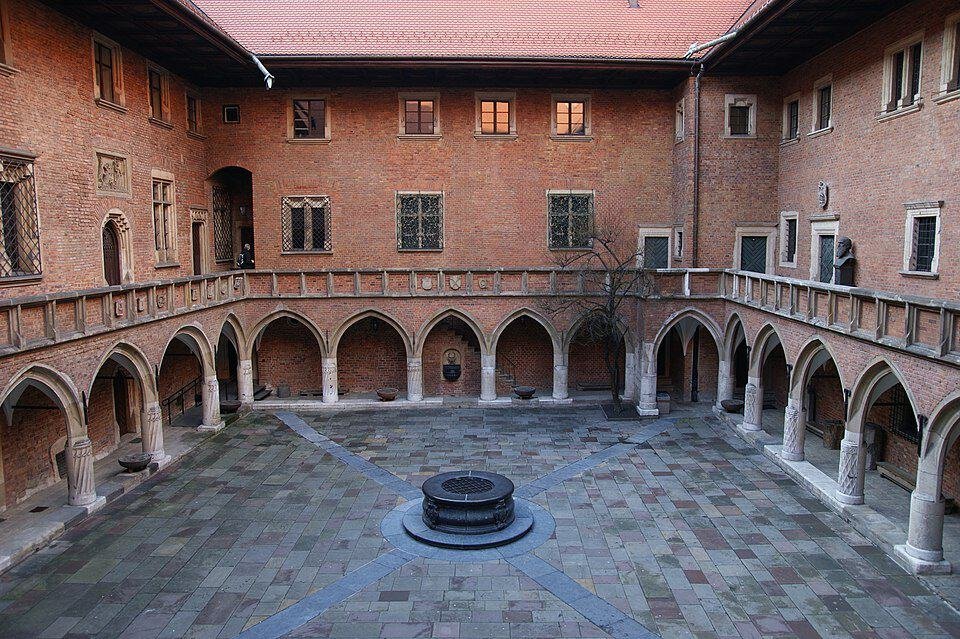
Image credit: Allie Caulfield, licensed under CC BY 2.0.
Return to Frauenburg and Church Duties
After his schooling at Krakow was completed, Copernicus returned home, settling in Frauenburg, a small cathedral town near the Baltic coast. His uncle had by then become a Bishop, a position that made him ruler of the entire district, besides being its highest churchman. He offered Copernicus a position as a canon of the church. A canon was an officer in one of the chapters of the church and was in charge of the financial matters of the diocese. Canons met every now and then to supervise the land and properties owned by the church and to appoint mayors and administer laws in the villages run by the cathedral. It’s likely that Uncle Lucas intended someday to make Copernicus his successor. Copernicus never became a priest, but he did adopt a priest-like lifestyle and never married. There were sixteen canons in Frauenburg and each had many privileges and few responsibilities. As all canons were, Copernicus was given a house in the city and two small country estates. He was also given a sizeable salary. For the rest of his life, Copernicus was freed of financial worry and always had the surplus time he needed to pursue his private interests. The first action he took on receiving his new appointment was to ask for a leave of absence with pay to continue his studies. It was granted.
The brilliant young student then headed straight for Italy, which is where all brilliant students went if they could. It was the days of the Renaissance and Italy was the world center of learning. Copernicus lived in Italy for ten years, initially as a student and then as a teacher. First, he studied liberal arts in Bologna, then medicine at Padua, then law at Ferrara. He took his doctorate in law when he was thirty. Copernicus chose to get his doctorate from the lesser-known university at Ferrara because the grand universities of Bologna and Padua expected graduating doctors to throw a lavish banquet for their teachers and friends. To the shy and thrifty Copernicus, Ferrara offered an escape from this ostentatious social ritual. While studying for his doctorate, Copernicus had meanwhile mastered natural science, political science, theology, and mathematics. He also became a skillful painter and an expert translator of Greek books. He had perfected his own knowledge of Greek so that he could read Plato in the original text. Copernicus had an insatiable appetite for learning and conquered almost every field of knowledge that existed in the 15th century. But his favorite, and the one he pursued in whatever free time he had, was astronomy.
When Copernicus had exhausted the universities in Italy, he returned to Poland and to his duties as canon. His uncle, the Bishop, was so impressed with his nephew’s knowledge and accomplishments, that he made him his personal physician. Copernicus was as capable a doctor as could be found in those days, but by modern standards, this isn’t much of a recommendation. One of the medicines for which he wrote a prescription included gold, silver, sugar, a beetle, the horn of a unicorn, ivory shavings, lemon rind, pearls, and emerald, all mixed together in powder for drinking. What his patient used as “the horn of a unicorn” remains unknown. But Copernicus’ medical skills were so widely respected that he was frequently called to the bedside of the wealthiest and most prominent men in the district. He himself preferred to offer his services to the poor, which he did almost daily. In 1512, when Copernicus was 39, Uncle Lucas died and Copernicus finally took on his own duties as canon with dedication and energy. It seemed the death of his overbearing uncle had freed him to become himself. But his duties as canon, even when carried out with full commitment, still left him all the time he needed to avidly pursue his hobby.
Observations and Early Astronomical Work
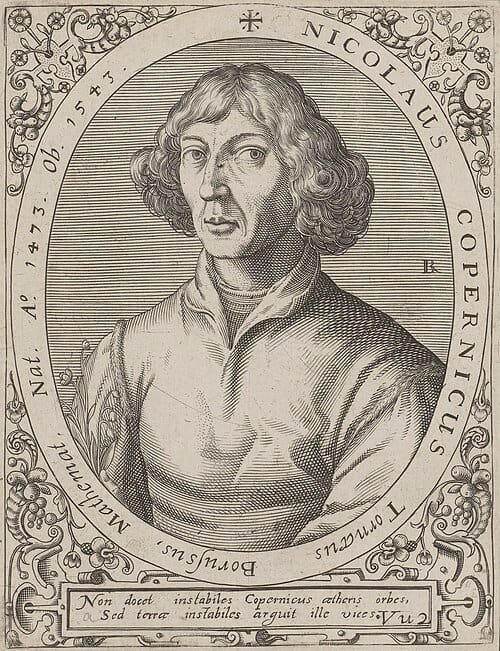
Image credit: Robert Boissard, public domain
Like the man of precision he was, Copernicus carefully divided his day into three parts. The first part he spent on devotional exercises and his religious duties; the second part was spent giving medical care to the poor, and the third part was for the study and meditation of astronomy. He conducted his astronomical observations from one of the turrets in the defensive wall that surrounded the cathedral. From this towering spot alongside the church, he proceeded to make the studies that would soon shake it to the foundation. In the years between 1519 and 1522, new responsibilities fell upon Copernicus when a war developed between Poland and the Teutonic Knights. The Teutonic Knights were a German military order that ruled most of the region later known as East Prussia, and which had once ruled the part of Poland in which Copernicus lived. Apparently, they wanted to rule it again. His city, Frauenburg, fell to the knights and he was forced to flee to safety with all the other church officials. He was given command of a fortress, which became a refuge for hundreds of people trying to escape the war. By then Copernicus was almost fifty years old, and never in his life had he been interested in worldly conflicts and struggles. Even in his younger years, he was known for his distaste for arguments and debates. The task of defending a fort was one he hoped he could fulfill quickly and peacefully. Nevertheless, feeling an obligation to the people who were seeking his protection, he used church funds to buy cannons for the fortress. This earned him sharp criticism from his superiors even though, as the war progressed, the same critics begged him to fight with all his might to hold on to the fortress. Copernicus managed to keep the fortress intact until peace was achieved and the refugees could return home.
After the war was over Copernicus used his new influence as a statesman to try and reform the monetary system in Poland and stave off inflation. It was his theory that as money became devalued, people began to hoard their gold. His idea of establishing a standard value for money was too daring for the minds of the time, and it was rejected. Copernicus gave up government work and returned to Frauenburg and to the field where his real influence would lie – astronomy.
Development of the Heliocentric Theory
Astronomy then was not nearly the science it is today. To start with, there were no telescopes. There were not many other instruments either. Anything Copernicus used, he developed and constructed himself. He made a special study of the planet Mars because he was intrigued by the way its brightness and magnitude seemed to change. Copernicus never liked making observations – he preferred to sit with quill and paper and tackle his problems from a mathematical perspective. But when he did gaze at the skies overhead, year after year, he was astounded by what he saw. It seemed to him amazing that even though all the planets moved differently, were in different positions, and were of different sizes, they all seemed to go around the earth once a day. As he pondered this peculiar circumstance, he was struck with a radical idea. Suppose the earth actually spins, sort of like a top. Then the planets would all APPEAR to be circling around the earth. This idea seemed so logical to him and seemed to open up so many more possibilities, that he decided to pursue it.
The first people who heard about Copernicus’ new theory were not always encouraging. It seemed to them that if the earth moved, people would feel the motion. It also seemed to them that the earth was so big, that it would move at great speed – so that if you jumped in the air, it would whiz by underneath you and you’d land in a different spot. Others simply thought the earth would disintegrate if it turned at such speed. Still, others accepted Ptolemy’s statements that if the earth moved, the current of air would sweep people right off its surface. Copernicus could answer all those questions by pointing to the enormous size of the earth, which modified the effects of its movement. More and more, he questioned Ptolemy’s ideas about the heavens. He launched into an intensive study of ancient Greek writings and was encouraged to find that some authors, including Pythagoras, had suggested long before that the sun might be the center of the universe. They had not been taken seriously in their own time, or in the two thousand years since – but Copernicus took them very seriously. He began to develop a new system by which the earth moved around the sun, and also rotated daily on an axis.
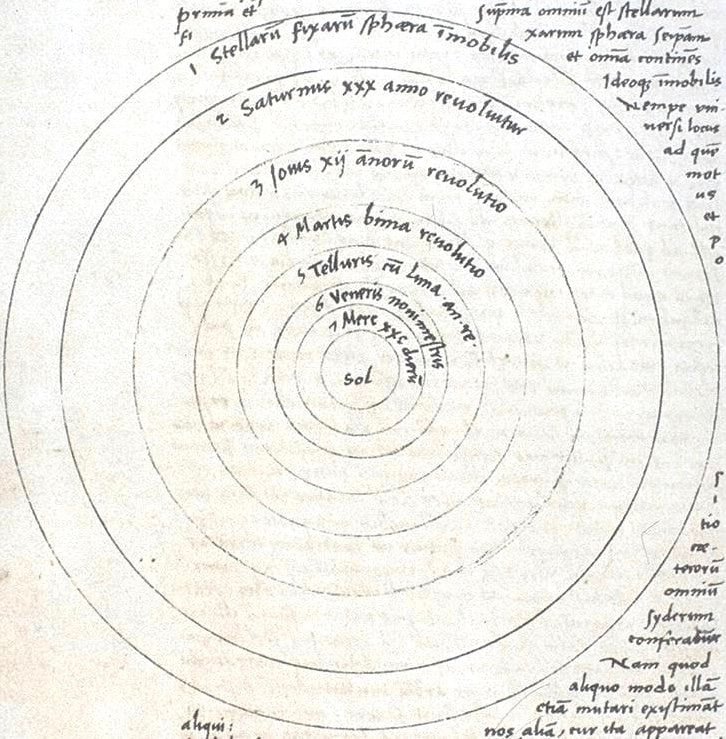
Image credit: Nicolaus Copernicus, public domain
Revolutions of the Heavenly Spheres
Using his skill at mathematics, Copernicus spent thirty years trying to prove his theories. He worked with a crude quadrant to measure planetary movements, and he measured the altitude of stars with a primitive instrument made of three straight edges, which he called a triquetrum. The triquetrum was twelve feet high. By pointing one bar at a star or planet, and squinting through sights attached to the second bar, he could read on the third bar the angle of the planet to the horizon. Other astronomers had much more elaborate instruments – in fact, Ptolemy and Pythagoras had worked with more accurate tools – but Copernicus, in typical fashion, preferred to go it his own way. Soon, although no one is sure how rumors of Copernicus’ work began to spread throughout Europe. Then an admirer published a short synopsis of his theories. The publication caused an immediate sensation among scholars – there was both praise and ridicule. From all over Europe came demands that he publish his complete findings. Copernicus was reluctant, but finally, he wrote all his conclusions in a book called, Revolutions of the Heavenly Spheres. However, when it was done, he hesitated to publish it. First of all, he felt he still couldn’t prove his theories. Some of them still caused him confusion. This was mainly because Copernicus was holding onto the complicated idea of epicycles – the theory that planets revolve in small circles and then those circles, in turn, revolve around the central body, in this case, the sun. It would be up to Johannes Kepler, in the next century, to set everything straight by substituting the mess of circles with the simple ellipse.
Copernicus, who lived almost like a monk, had no ambitions for fame; and he feared, rightly so, that his ideas would upset people. He was a deeply religious man and had no desire to challenge or cause controversy in the church. Revolutions of the Heavenly Spheres could easily cause revolutions of a different kind in scientific and religious spheres. As word leaked out about Copernicus’ work, it also leaked into the Vatican. At first, the pope seemed as curious about the growing fame of his canon in Poland as everyone else. He invited Copernicus to come to Rome and join a committee that was trying to revise the calendar. Copernicus politely declined, saying that the calendar couldn’t be revised until the true motions of the sun and moon were known. After that, the pope heard a lecture on the Copernican system, given in his garden at the Vatican to an audience of cardinals and bishops. A cardinal then sent a secretary to obtain copies of Copernicus’ records. With the secretary came a letter saying, in part, “I have been informed that you not only have an exhaustive knowledge of the teachings of the ancient mathematicians but that you have also created a new theory of the universe according to which the earth moves and the sun occupies the basic and hence central position…I beg you most emphatically to communicate your discovery to the learned world and to send me as soon as possible your theories about the universe, along with the tables and whatever else you have to pertain to the subject…If you fulfill this wish of mine, you will learn how deeply concerned I am for your fame and how I endeavor to win recognition of your deeds.”
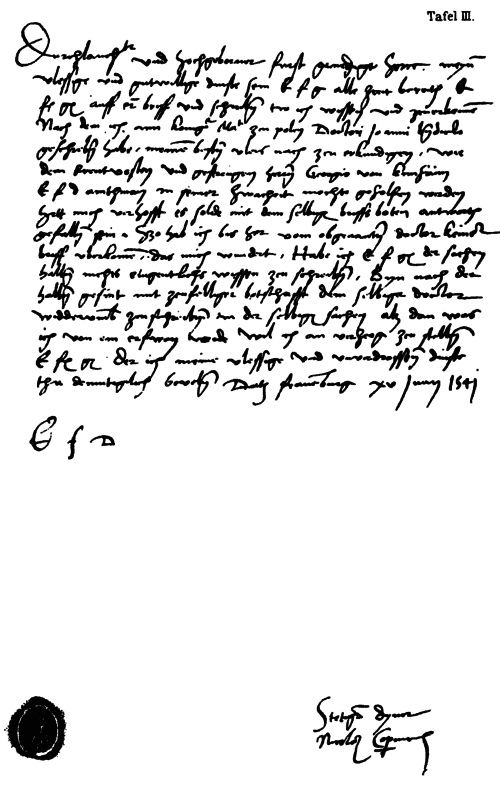
Image credit: Nicolaus Copernicus, public domain
The letter sounded encouraging so Copernicus set to work on finishing the last chapters of his book. But when the cardinal died shortly after, he returned the book to his desk drawer, resolving it would stay there forever. No one has ever been sure whether his reticence was based on fear of religious persecution, which seems unlikely in view of the warm letter from the Cardinal, or whether he still felt insecure that his theories had not been proven. Copernicus had initiated and pursued his astronomical studies to answer his own questions about the universe, not to obtain fame or affect history. Most likely, he was simply retreating from the harsh world and sparing himself the inevitable exposure and controversy. Already, he had been mocked and abused by others, including the Protestant Reformation leader Martin Luther, who made this scathing denouncement of Copernicus: “There is talk of an upstart new astrologer who wants to show that the earth revolves, not the heavens and the sun and the moon, just as if somebody riding in a carriage or ship might argue that he was sitting still while the earth and the trees walked and moved. But this is how things are nowadays; anyone who wants to seem clever must invent some new system. This fool wants to turn the entire science of astronomy upside down.”
It was not his own Catholic church, which condemned Copernicus; it was the Protestants. The Vatican did eventually denounce Copernicus – but not until three generations after his death. In his lifetime, it seemed tolerant, and even supportive. As Copernicus grew older, his friends and fellow scholars continuously encouraged him to share his discoveries. The one-man most responsible for the fact that Copernicus’ theory ever reached the world was a young professor of mathematics and astronomy named Georg Rheticus. Rheticus so believed in Copernicus that he traveled hundreds of miles from Austria, through dangerous territories where Protestants and Catholics were in open conflict, and arrived at Copernicus’ door without invitation, to insist he publish his findings. He came bearing elegant gifts, a great deal of exuberance, and a faith in Copernicus that knocked the aging astronomer off his guard. The men became such good friends that Rheticus’ visit stretched to two years. In that time, he took on the task of refining Copernicus’ calculations and making the work as precise and accurate as possible. This wasn’t easy because Copernicus had been working with the old system of circles and loops, and knew nothing about the elliptical pattern of planetary orbits. In one section on Mars, the task was so confusing that Rheticus began banging his head against the wall, in frustration. He became dazed, fell to the floor, and said later he heard an angel declaring to him: “These are the motions of Mars.” Rheticus recovered, returned to his work, and soon the book was ready for printing. Copernicus, at last, agreed to go public. He added a preface to the book for the pope, which he called a “dedicatory note,” in hopes it would keep him from being charged with heresy – a fate that befell Galileo forty years later when he adopted and expanded on Copernicus’ findings. The dedication to the Pope was really a plea to ignore any assaults on his ideas based on prejudice and to heed instead the opinions of those who were knowledgeable. It read: “If there be some, who, though ignorant of all mathematics, take upon them to judge of these, and dare to reprove this work, because of some passage of the scripture, which they have miserably warped to their purpose, I regard them not, and even despise their rash judgment…What I have done in this matter, I submit principally to your Holiness, and then to the judgment of all learned mathematicians. And that I may not seem to promise your Holiness more concerning the utility of this work than I am able to perform, I pass now to the work itself.”
No sooner did he give his consent to print the book, than Copernicus was struck with a paralytic stroke. Too old and frail to handle the printing himself, he turned the responsibility over to Rheticus. Rheticus was called away on business and in turn passed the task on to a Lutheran minister, not a very prudent choice, since the minister opposed the Copernican theory, in loyalty to Martin Luther. As a result, before he had it printed, he had the audacity to add a disclaimer, allegedly from Copernicus himself. This disclaimer stated the book wasn’t based on actual facts and was simply a device for computing planetary tables. The disclaimer weakened the book and damaged Copernicus’ reputation for many years. Most accepted the minister’s description and dismissed the work as an exercise in speculation and imagination. It wasn’t until 1609, over forty years later, that Kepler discovered the origin of the disclaimer and published the truth. The first printed copy of Copernicus’ book was handed to him, as he lay on his deathbed, too weak to read it. He ran his hands over the cover and leafed through the pages. But he said nothing. A few hours later on May 24, 1543, at the age of 70, Nicolaus Copernicus died. His work had been completed; the effects of it had not yet begun.
Copernicus was buried in the cathedral where he had spent forty years of his life living, working, and studying the stars. His book and ideas received almost no attention for another thirty years when a memorial was finally erected to his memory. By then his book had just begun to shake the very foundations of science, of the church, and of humanity’s relationship to the universe. Tycho Brahe, a Danish poet, and astronomer born only three years after Copernicus died was given the wooden instruments with which he worked. At the time he said: “Copernicus has been able to stop the sun in its path across the sky, and has made the immovable earth move about the sun in a circle. About the earth he caused the moon to turn; he has changed for us the very face of the universe. He has done what was not permitted any other mortal to do since the beginning of the world.” Brahe obtained a self-portrait of Copernicus, which he’d painted in his younger years. This he hung in his museum in Denmark, above an eloquent poem he’d written as a eulogy. The ending reads: “Tis he who bore the Earth entire; Thro space immense around the Solar Fire; The spacious Earth in vain would hold the Man; Who measures Heaven with his ample Span.”
In 1807, over two hundred and fifty years after Copernicus’ death, Napoleon led his troops into Poland and made it a special point to visit the astronomer’s childhood home. He was shocked to see no statue had been erected in Copernicus’ honor. That was corrected in 1839 when the Polish government finally unveiled a statue to Copernicus in Warsaw – but no Catholic priest would officiate at the ceremony.
Nicolaus Copernicus achievements
The conclusions that so transformed human thought about the universe are all contained in the one-volume Revolutions of Heavenly Spheres, which is divided into six different books. The first printing of these books consisted of only a few hundred copies. Many of those still exist – ironically, the Vatican Library has three itself, even though the work remained on its list of banned books until 1835, long after the world had fully accepted the sun as the center of the universe. The book eventually caught on among scientists and scholars and there was a second printing, and then a third. What delighted most people was the absolute simplicity of the Copernican theory.
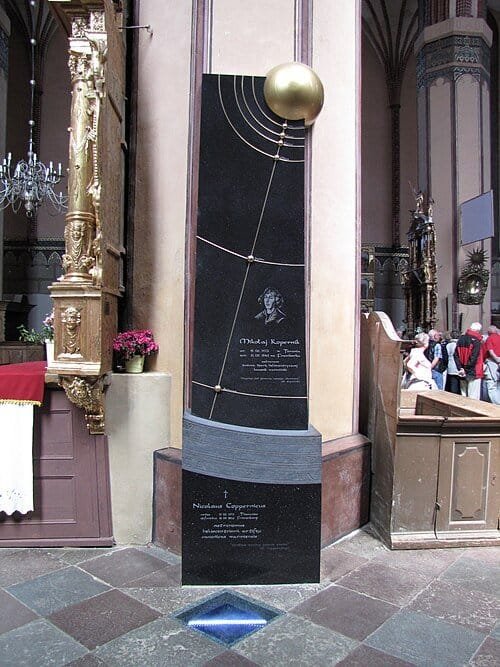
Image credit: Holger Weinandt CC BY-SA 3.0 (via Wikimedia Commons)
The basic premise of Copernicus was that the earth had to move because only then could the changing positions of the stars, the shifting seasons, and the changes of night and day, all occur simultaneously. The earth, said Copernicus, is a planet; and as a planet, it moves around the sun. All the planets move in circular paths around the sun, which is the center point of our universe. In addition, the earth spins around like a top once a day, as it makes its journey around the sun, which takes a year. The spinning of the earth gives us night and days. Its journey around the sun gives us seasons. Copernicus’ vision of the universe was far simpler than that of Ptolemy and, as we know today, far more accurate. But it took the world many years to understand and accept it. What first shocked people was the immensity of the universe Copernicus described. Until that time, the earth was considered not just the center of the universe, but also the largest body in the universe. But what astonished people even more than the insignificant size of the earth, was the scandalous idea that it was NOT the center of the universe. It was left for other geniuses to prove the theories of Copernicus, men like Galileo and Einstein.
Revolutions of the Heavenly Spheres contained detailed descriptions of the motions of the earth, moon, and planets. It provided diagrams and tables showing the course of each planet and predicting its position in relation to the earth, at different times of the year. The actual observations Copernicus made were not always very thorough – supposedly, he never even saw the planet, Mercury. Mercury, however, is the most difficult planet to observe because it’s so close to the sun. Copernicus never enjoyed stargazing – in his 32 years of work, he listed only 27 observations. His real strength was in his calculations and deductions. Copernicus was able to determine the length of the year to within 28 seconds.
It was also Copernicus who first gave the world an explanation for the way planets sometimes seemed to move backward – what we call retrograde motion. In his new hypothesis, the reason for this was very simple. The orbits of Mercury and Venus would naturally never take those planets farther than a certain distance from the sun, as we see it from earth because their orbits are closer to the sun than our own. But since the earth has a smaller orbit than Mars, Jupiter, and Saturn, it would sometimes overtake those planets, which would make them appear to be moving backward. The system of Copernicus also explained the precession of the equinoxes, not by a twisting of the whole celestial sphere, as the ancients thought, but by the wobbling of the earth as it rotated on its axis.
Copernicus made a monumental contribution to human knowledge, one that shattered the ignorance of 2000 years and paved the way for a revolution in science that climaxed 150 years later with the work of Sir Isaac Newton. His great achievement was that he discovered the proper place of the earth in the drama of the universe. Although others before him had believed the sun was the center of the solar system, they had failed to support their belief with sound mathematics and theory. But just as importantly, Copernicus challenged his age, and all future ages, to observe, to question and doubt, to think independently and seek the truth. In an age when the church rigidly enforced its creed, and other scientists formed a tight club around the worship of Aristotle; he alone dared to be different. Today it seems so obvious…but it erased thousands of years of human ignorance and ushered in a new age of science and discovery when Nicolaus Copernicus first wrote his simple statement:
“In the midst of all dwells the sun.”
References:
- Armitage, Angus (1951). The World of Copernicus.;
- Bieńkowska, Barbara (1973). The Scientific World of Copernicus: On the Occasion of the 500th Anniversary of His Birth, 1473–1973.;
- Works by Nicolaus Copernicus at Project Gutenberg;
- Hannam, James (2007). “Deconstructing Copernicus”. Medieval Science and Philosophy.
- Dreyer, John Louis Emil (1953) [1906], A History of Astronomy from Thales to Kepler, New York: Dover Publications
- Finocchiaro, Maurice (2010), Defending Copernicus and Galileo: Critical Reasoning in the two Affairs, Springer,

