

Table of Contents
It’s been almost seven and a half centuries since the legendary Venetian navigator and explorer set off on his incredible 25-year Asian adventure. While we’re wrapping up celebrations for the 500th anniversary of Ferdinand Magellan’s trip around the world, we’re also coming up on 750 years since his predecessor, the famous Marco Polo, started his epic Asian journey in 1271. This medieval Venetian merchant and explorer’s name has been synonymous with adventurous travels to far-off lands for centuries, and his travel book is still one of the most detailed and inspiring ever written.
Who Was Marco Polo?
“The Travels of Marco Polo,” handwritten and published in 1300, was translated into several European languages while he was still alive. The book became a guide for mapmakers of the time and was a huge inspiration for medieval explorers like Christopher Columbus. It’s still an amazing read today. “The Travels of Marco Polo” is split into four books. The first describes the countries of the Middle East and Central Asia, while the second focuses on China and the court of Kublai Khan. The third covers some coastal regions of the East: Japan, India, Sri Lanka, Southeast Asia, and the east coast of Africa. The fourth describes some wars between the Mongols and people from the far north, like Russia.
The Journey to Asia
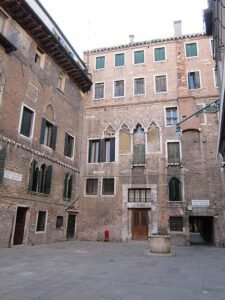
Corte Seconda del Milion, Venice, next to Polo’s house, is named after the nickname of Polo, Il Milione
Gegetti / CC BY-SA 3.0 (via Wikimedia Commons)
Marco Polo was born around 1254 into a wealthy Venetian merchant family. It’s not totally clear if he was born in Venice or on the Dalmatian island of Korčula, where his father and uncle, brothers Niccolò and Maffeo Polo, had set up a trading post. Either way, Marco spent at least part of his childhood in Venice (the Venetian Republic), which was a super important city-state for international trade back then. He got an excellent education there, studying languages, math, trade, and how to manage cargo ships.
While Marco was growing up, his father and uncle made their way to the famous Silk Road—a 5,000-kilometer trade route between Europe and Asia—all the way to China, and by 1266 to the court of Mongol leader Kublai Khan. The grandson of the great conqueror Genghis Khan was a highly respected Chinese ruler and founder of the Yuan (or Mongol) dynasty. He was really interested in the culture and religion of his European guests and asked them to be his ambassadors to the West. He sent them back with a letter to Pope Clement IV, asking him to send monks and holy water to China. The Pope’s death in 1268 kind of threw a wrench in the Polo brothers’ mission, so it wasn’t until 1271 that they headed back to China—after the longest papal election in Catholic Church history. This time, they brought 17-year-old Marco Polo with them.
Along with two monks, the Polo brothers and young Marco carried the Pope’s letter and gifts to Kublai Khan. The monks bailed pretty quickly once they hit the first war zones, so the Polos continued on their own. The three-and-a-half-year journey started with sailing across the Mediterranean to the Middle East, then overland through Persia (modern-day Iran), across the Gobi Desert, through Mongolia, and along the Silk Road to China.
Life at the Court of Kublai Khan
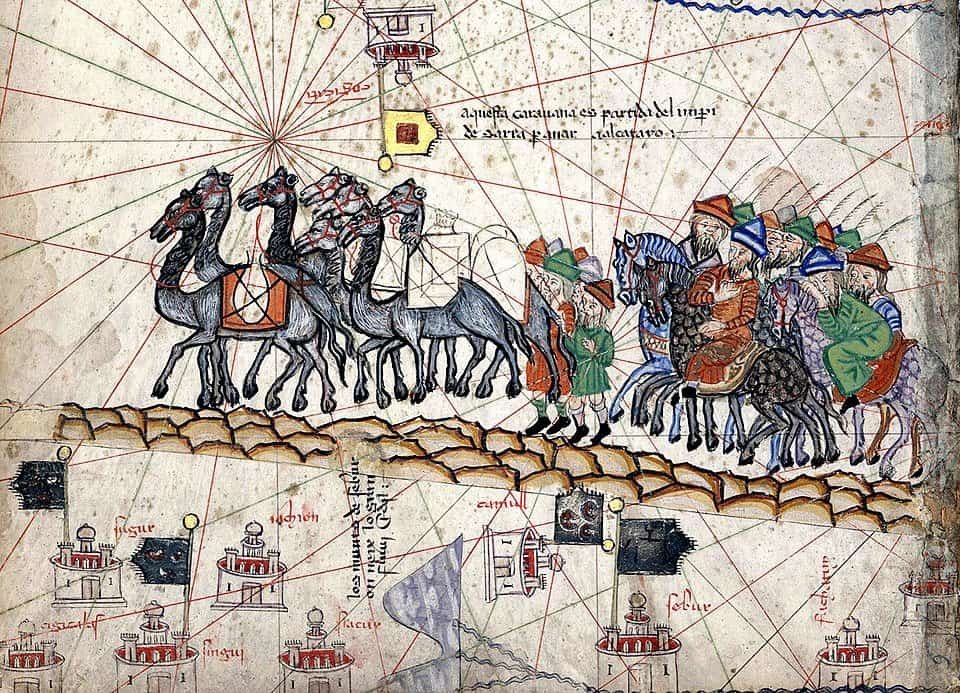
Marco Polo’s interest in Mongolian customs and culture didn’t go unnoticed. As someone who already spoke four foreign languages, Marco quickly picked up the language of his Asian hosts and got really into their style of warfare. Kublai Khan was impressed by the young European and gave him a high-ranking position in his government. He sent Marco on tons of missions throughout China, Burma, and India. Unlike other envoys of the Chinese ruler, Marco Polo packed his mission reports with tons of details about the people and customs he encountered. During his 17 years working for Kublai Khan, Marco Polo visited many far-flung parts of the world that other Europeans wouldn’t see for centuries.
Return to Venice and Imprisonment
Marco and the Polo brothers started thinking about heading home when their protector Kublai Khan was getting up there in years. The Chinese ruler really enjoyed their company and didn’t want them to leave, but he didn’t stop them either. As one last task, he had them escort the Mongol princess Kököchin to Persia, where she was supposed to marry the Persian prince Argun.
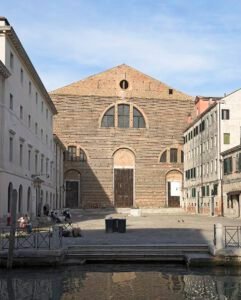
Didier Descouens / CC BY-SA 4.0 (via Wikimedia Commons)
They set out for Persia by sea, sailing along the South China Sea to Sumatra, then across the Indian Ocean to the Persian Gulf. Their voyage to Hormuz—the strait at the entrance to the Persian Gulf—took two years and was brutal. According to Marco Polo’s accounts, about six hundred passengers and crew members died along the way. Since there aren’t many details about it, people have speculated they were victims of disease like scurvy or cholera, or pirates and attacks by various local groups. Princess Kököchin and her companions made it to Persia, where they found out her fiancé had died in the meantime. So Marco and the Polo brothers stuck around for a while until they found another marriage opportunity for the princess. In Persia, they also learned that Kublai Khan had died, but the golden tablet—kind of like a “diplomatic passport” he’d given them—still helped them travel safely and get whatever help they needed.
Their route took them to Trabzon, a city on the Black Sea coast (in what’s now northeastern Turkey), which was an important stop on the Silk Road back then—the gateway to Persia in the southeast and the Caucasus in the northeast. The city was a major destination for Venetian and Genoese merchants who sold linen and wool there. From Trabzon, they sailed along the Black Sea to Constantinople, then through the Mediterranean to Venice, where they arrived in the winter of 1295. After 24 years away, they came back with massive wealth from Asia, including gold and precious stones, plus one incredible novelty—asbestos fabric.
When he got back to Venice, Marco Polo found himself right in the middle of a conflict between the city-states of Venice and Genoa. Since he got involved in the war, he was captured by the victorious Genoese while commanding a Venetian galley. During his time as a prisoner, Marco Polo met the writer Rustichello da Pisa, who was also locked up. In 1298, Rustichello started recording Marco Polo’s stories. He was totally fascinated by Polo’s tales of his 24-year adventure across Asia—from the Gobi Desert to Tibet, and his time serving at Kublai Khan’s court. Around 1300, Rustichello’s records of Marco Polo’s adventures appeared as a manuscript in French, titled “Livre des Merveilles du Monde”—”Book of the Wonders of the World,” better known in English as “The Travels of Marco Polo.” Books were super rare back then because every copy had to be written and illustrated by hand. But “The Travels of Marco Polo” was a hit—which was pretty amazing in the pre-printing era. The book was translated into many European languages during Marco Polo’s lifetime, including Latin, Italian, and English. The original manuscript has been lost. There are about 150 copies in various languages, but they’re all a bit different because of errors made during copying and translation.
The war between Venice and Genoa ended in the summer of 1299, and prisoners of war were released. Marco Polo returned to Venice, where he got married and had three daughters. As a wealthy merchant, he didn’t travel far anymore and stayed in Venice until his death in 1324.
Marco Polo’s Influence on Mapmaking and Exploration
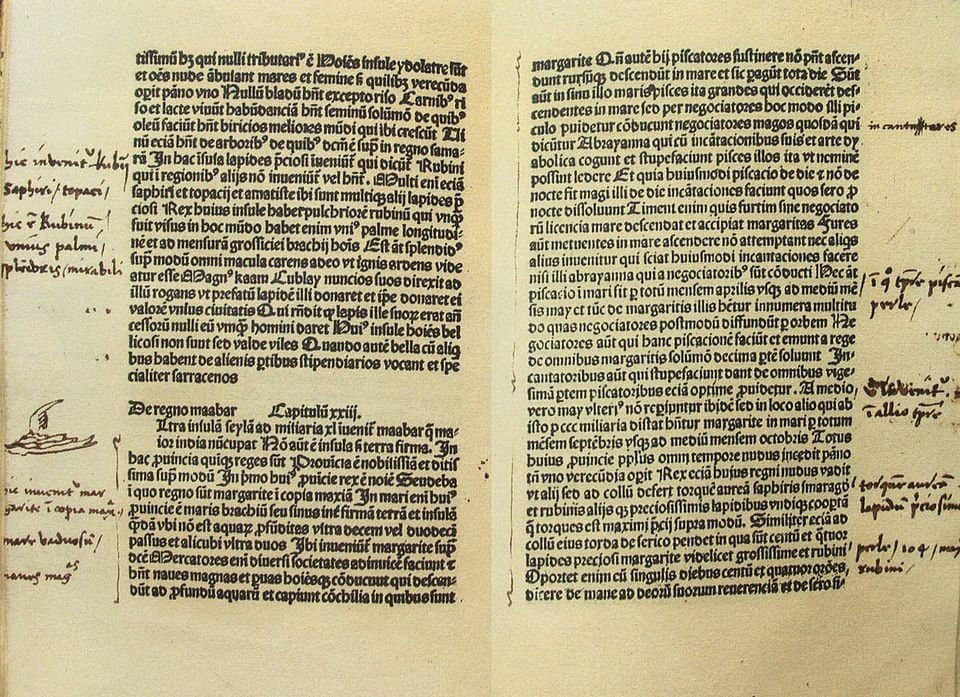
Besides inspiring tons of explorers with “The Travels of Marco Polo,” the information in the book turned out to be crucial for Europeans’ understanding of geography. His descriptions of the Far East and its riches also inspired the famous Christopher Columbus to try reaching Asia by sea. Columbus actually owned a richly illustrated copy of Marco Polo’s book. Marco Polo’s descriptions of the Far East inspired a generation of explorers, including Vasco da Gama, who later found the sea route to India.
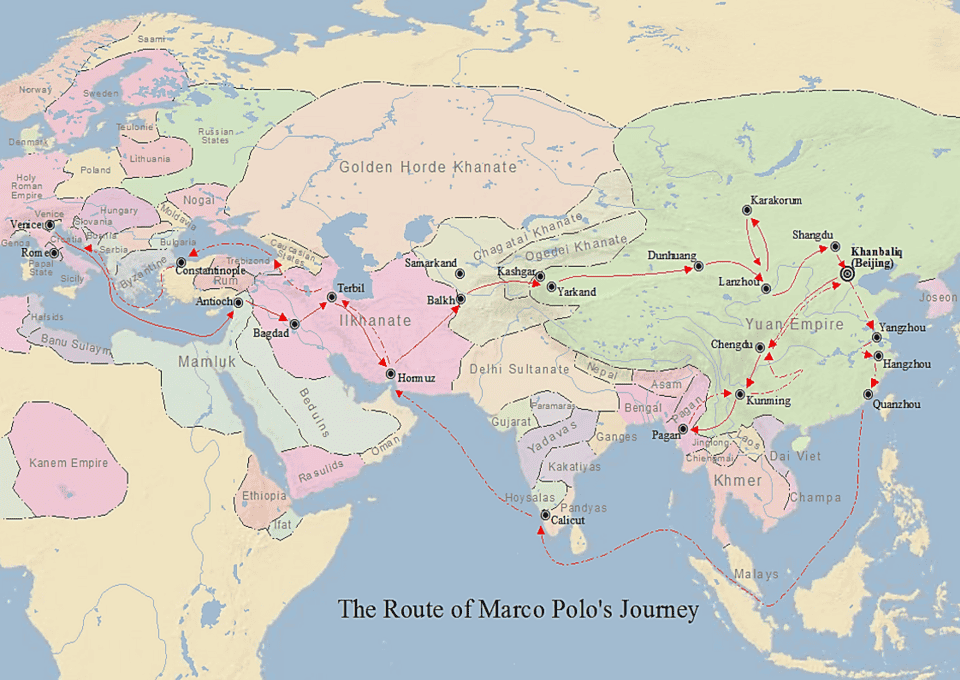
SY / CC BY-SA 4.0 (via Wikimedia Commons)
However, Marco Polo’s travels didn’t really impact mapmakers for another 50 years. The first map that included some of the place names Marco Polo mentioned was part of the Catalan Atlas of Charles V (1375), which came out half a century after Polo’s death. It included thirty location names in China and a few other Asian places Marco Polo talked about. In the mid-1400s, the famous cartographer Fra Mauro carefully included all of Polo’s place names in his 1450 World Map.
Did Marco Polo Really Go to China?
After almost 25 years away from Europe, Marco and the Polo brothers didn’t get the welcome home they’d hoped for in Venice. They’d pretty much forgotten their native language (Venetian), their families barely recognized them, and lots of people didn’t believe their stories about the great journey.
During Marco Polo’s lifetime—and long after—there was skepticism and suspicion about whether the legendary explorer actually made it to China and the court in Beijing. Some historians pointed out that Marco Polo’s name wasn’t recorded in documents from that time, like the Annals of the Empire, and highlighted some glaring omissions in his descriptions of the Far East. More recently, historian Frances Wood claimed in her 1995 book “Did Marco Polo Go to China?” that the famous Venetian never made it past the Black Sea. She pointed out that his travel account didn’t mention the Great Wall of China, the practice of foot-binding, the use of chopsticks, or the tradition of drinking tea.
On the flip side, H.U. Vogel from the German University of Tübingen defends Marco Polo in his research. In the book “Marco Polo Was in China,” this professor of Chinese history takes on the skeptics’ arguments and points out, for example, that Polo doesn’t mention the Great Wall because it wasn’t actually completed until a few hundred years later, during the Ming Dynasty. He also notes that Chinese records from the 13th and 14th centuries routinely skipped over visits from Western envoys. As his strongest evidence supporting Marco Polo, Vogel points to the detailed description of currency and salt production during the Yuan dynasty. According to Prof. Vogel, Polo documents these aspects of Mongol-Chinese civilization in way more detail than any of his Western, Arab, or Persian contemporaries. Polo’s claims about the size of paper money and the value of salt are backed up by archaeological evidence and Chinese documents from that era.
Meanwhile, other researchers and historians have confirmed most of what Marco Polo wrote about. We can pretty much say that today we generally accept that Marco Polo reported everything accurately, though some accounts probably came from other people he met along the way. Either way, the idea that he never visited China raises more questions than it answers. Marco Polo himself, despite all the doubts, stuck by his story his whole life. Supposedly, some of his last words on his deathbed were that “he hadn’t even told half of what he saw.”
References:
- Stephen Feinstein; (2009) Marco Polo: Amazing Adventures in China (Great Explorers of the World) p. 23–24; Enslow Pub Inc, ISBN 1-59845-103-0
- Benedetto, Luigi Foscolo (1965). “Marco Polo, Il Milione”. Istituto Geografico DeAgostini (in Italian).
- Kleinhenz, Christopher. Routledge Revivals: Medieval Italy (2004): An Encyclopedia – Volume II, Volume 2. p. 923.
- “Marco Polo | Biography, Travels, & Influence”. Encyclopedia Britannica. 4 January 2024. Archived from the original on 19 November 2015. Retrieved 26 November 2019.

