

Cover image: Le Petit Atlas Maritime, 1764, by Jacques-Nicolas Bellin., public domain
Table of Contents
A Restless Boy from Yorkshire
James Cook voyages would one day redefine the very boundaries of the known world. But that story began in the most unlikely of places. He was only seventeen years old and like many young men, he was filled with longing – longing for adventure, for something bigger and better than life in this dreary, predictable little town he’d grown up in. James Cook was working in a general merchandise store that sold mostly groceries and clothing. All-day he measured out raisins and ribbon, folded fabrics, and swept floors. Every day he saw the same people who wanted the same things – the housewives who needed candles; the farmers looking for boots; the schoolchildren who wanted rock candy. Nothing ever changed – except the sailors. Sometimes the sailors came in before they set sail, gathering what they needed to tide them over for a long sea voyage. Sometimes they came in after the voyage, filled with stories about what they’d seen in faraway exotic lands, and their daring adventures on the high seas. The ships and the sailors were what filled James with his greatest longing.
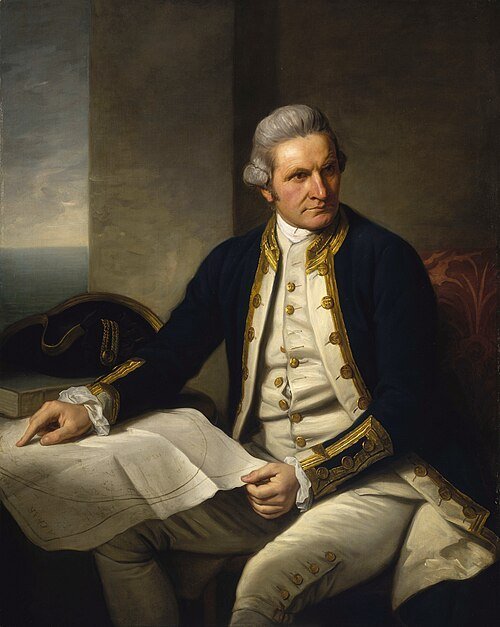
Image credit: from the National Maritime Museum, United Kingdom, Public domain.
Finally, one day the restless teenager came up with a plan. Because he was bound by contract to the store owner for several years, he couldn’t simply quit his job. So instead he began a quarrel with the owner, a silly quarrel about something he really didn’t in the least care about. But it worked. The owner fired him. James Cook leaped over the counter, and out the door where he let out a triumphant yell. He knew just what he was going to do. He was going to the nearest seaport and sign up on the first ship that would take him. He was going to see the world!
James Cook did see the world – eventually, he would see more of the world than any man before him. In the next forty years, he would become famous as the man who: sailed around the world twice; charted and named the islands of the Pacific Ocean, including Hawaii; explored Australia and New Zealand; sailed farther south than anyone else had, and searched the entire west coast of North America for a passage to the Atlantic. Most importantly, James Cook redefined the very role of the explorer – how he should conduct himself and what his highest motives and goals could be. He was the first to transform sea voyages into scientific expeditions and in a sense, he was the first “gentleman” explorer. No one who knew James Cook as a child could ever have predicted what lay ahead for him.
Self-Education and the Making of a Navigator
He was born in a small, obscure village in Yorkshire, England, on October 27, 1728. His father was an agricultural laborer – today he’d be called a migrant farmer – and James was raised in a series of small thatched cottages that belonged to his father’s employers. Because James was a bright little fellow, a neighbor woman took it upon herself to teach him the alphabet. Then he went to a charity school for the poor where he learned to read and do basic math. He was known to have a stubborn streak that sometimes made him hard to deal with. But he was also known for the way he seemed to automatically command the respect of his young friends.
After he escaped from the general store, James Cook headed for the coastal town of Whitby, on the North Sea, and served a three-year apprenticeship with a shipowner. In those years he found both himself and the world he wanted to spend his life in – the world of the sea.
His apprenticeship was over when he was 20 years old and he joined the crew of a vessel that shipped coal around northern Europe. He stayed with the ship for five years and spent all his free time educating himself. He learned geography, mathematics, astronomy, navigation, and all the sciences that would make him an expert seaman. He might have gone on like this forever, sailing around Europe and studying his books, but world events soon steered him on a new course.
From War Hero to Master Surveyor
In 1755, when James Cook was 27, the Seven Years war broke out – a war in which England and France battled it out for domination in the New World. Cook enlisted and within three years was made master of his own ship, the Pembroke. The Pembroke was sent with nineteen other ships to attack French strongholds in Canada, at Louisburg and Quebec. The mission was a success – Quebec fell and with it, the control of Canada went from the French to the British. Cook suddenly found himself a war hero.
The victory in Canada might have excited James Cook, but what excited him far more was a discovery he’d made while wandering in the harbor after the battle had been won. There he came across a man carrying a small, square table on a tripod. The man would squint along the top of this table and then make notations in a pocketbook he carried. James Cook struck up a conversation with the man, who turned out to be a Dutch engineer who was working on maps of the area. Cook insisted the engineer give him lessons on this little table with the tripod, and within only a few months, he had mastered the art of surveying and was helping chart the Gulf of the St. Lawrence River. It was a pivotal point in Cook’s life. His interest and skill in surveying and map-making would be used in his future explorations and would contribute vastly to humankind’s knowledge of the world.
When he’d finished his work, James Cook returned to England, married a young woman named Elizabeth Batts, and settled into a modest house near the Thames River in London. Not much is known about Elizabeth except that she came from a respectable family and bore Cook six children, three of whom died in infancy. The other three, which were all boys, died before they were thirty. When Elizabeth was expecting their first child, Cook received a summons from the Royal Navy, which had heard about his surveying skills. They asked him to spend the next three years mapping out the coast of Newfoundland. Off he went, after a farewell to his wife, with the knowledge that by the time he saw his unborn child it would already be walking and talking. The Cooks would be married for seventeen years and for most of those years Cook was at sea.
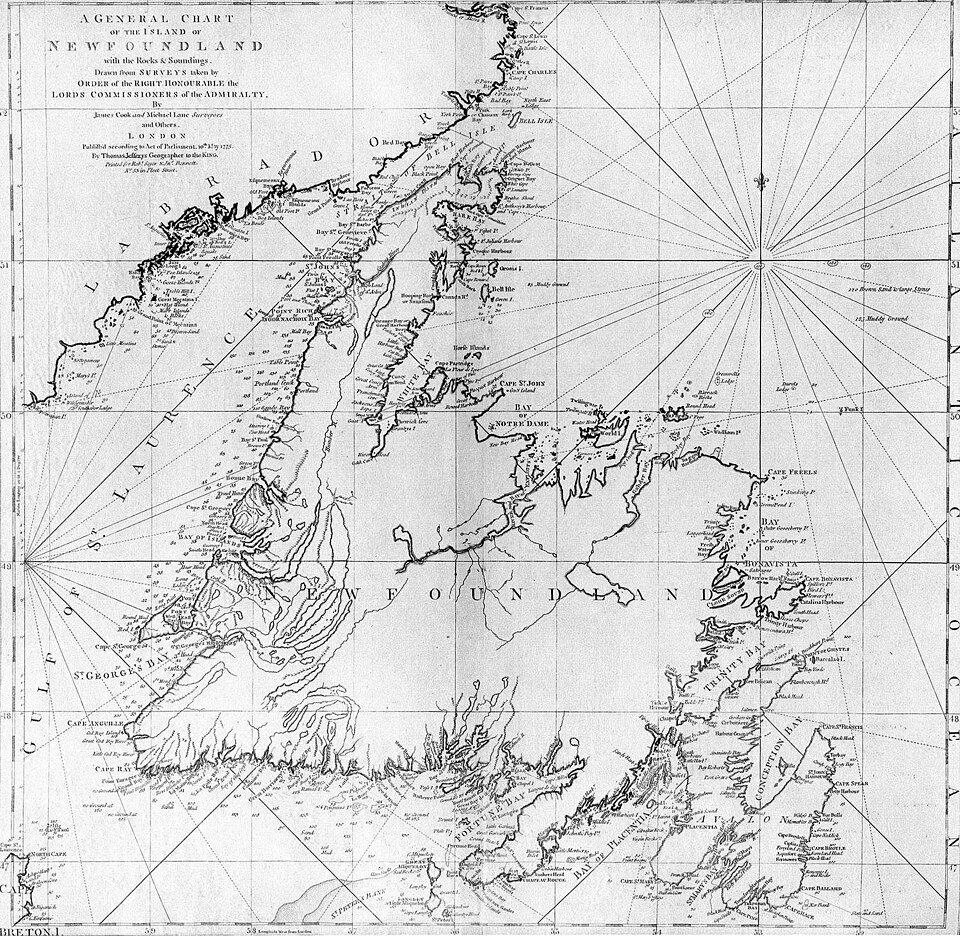
Image credit: Michael Lane and James Cook, Public domain.
Back in Canada, James Cook surveyed the coasts of Labrador, Newfoundland, and Nova Scotia, once even using a solar eclipse to determine Newfoundland’s longitude. The surveys Cook made of Newfoundland were among the most detailed and accurate the British had ever seen. They were impressed – so impressed that the Royal Society, England’s leading scientific organization, asked Cook a very special favor. There was a transit of Venus coming up – when the planet would pass between the earth and the sun – an event that wouldn’t happen again for another 100 years. But the transit would only be visible from the South Pacific. Would Cook lead an expedition to Tahiti so he and a small group of scientists could make observations of the transit? The hope was that scientists might be able to use the transit to discover the sun’s distance from the earth.
James Cook had been home less than two years at this point. He loved his home and was a devoted family man – but he couldn’t resist the call of adventure or the call of science. He said yes and headed out on the first of his three great voyages of discovery. The voyage was made on a 366-ton ship called the Endeavor, which sailed out of England on July 25, 1768. Onboard were two botanists, an astronomer, and skilled artists. A famous young botanist named Joseph Banks headed the scientists. The partnership between Banks and Cook would become one of the most surprising and most successful partnerships in the history of science.
Banks was 25 years old when the Endeavor set sail; Cook was 40. Banks was from an elegant upper-class British family. James Cook was the son of a humble Yorkshire farmer. Banks had been educated at Oxford – Cook had educated himself. But not only did they work well together, they learned from each other. Cook learned so much from the scientists onboard the Endeavor that his notes about the land and the customs of the Tahitians are still regarded as classics in the field of anthropology and geography.
All through the voyage, James Cook was keenly observant of everything he saw. At one point he wrote: “Flying fish have appeared to us, darting gracefully across the water. Their sides have the color and brightness of burnished silver.” At another point, he described jellyfish that flashed light and crabs that gave off light like glowworms.
It was not just his scientific abilities, but also his leadership abilities that came to the front on this first voyage. James Cook was known for his insistence on obedience but he was also known for his fairness. He had a deep concern for the welfare of his crew that was unusual for the times. For many centuries, voyages at sea had been plagued by the disease scurvy, which often killed off half the crew, if not more. Scurvy was caused by a vitamin C deficiency and Cook had always suspected that it could be cured with the proper diet. As a result, the men on Captain Cook’s voyages never came down with scurvy, because he saw to it that they always had plenty of fresh meat, fruits, and vegetables in their diets. His favorite menu for his crew included sauerkraut, cress, and an extract from oranges. He even carried goats on board so there would always be a supply of fresh milk. Unlike other captains, he was concerned about fresh air and made sure the cabins were well ventilated. Cook also made cleanliness a priority on his ships – the deck was regularly washed down with vinegar and he used carefully controlled fires to destroy any vermin on board. As a result, he had not just the healthiest crew in the history of sea travel, but the most grateful and devoted.
The First Voyage (1768–1771): Tahiti and the Transit of Venus
James Cook and his fellow scientists arrived in Tahiti and were delighted to find that the inhabitants of the island were friendly. The Tahitians rowed out in their canoes to greet the sailors, carrying green branches as tokens of peace. In return, the English tied green branches to their masts. In the next few weeks, while Cook waited for the transit, he studied the plants and animals of the island and made notes about the customs of the Tahitians. The names he gave the bays and nearby islands all reflected his interest in science. There was the Royal Society Islands, named after London’s leading scientific organization, and there was Mercury Bay because in that bay Cook studied the planet, Mercury. He also planted seeds in Tahiti that he’d carried from South America, so the Tahitians could grow oranges, limes, lemons, and watermelon. The Tahitians were fond of Captain Cook – they danced and sang for him and gave him the nickname: Captain Toote.
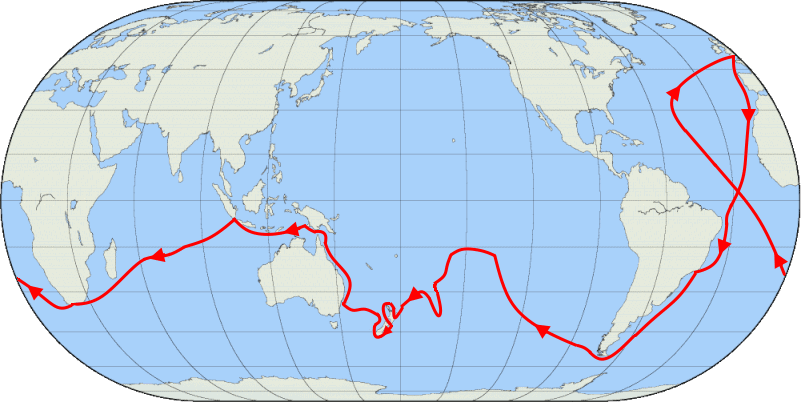
Image credit: Jon Platek / CC BY-SA 3.0 (via Wikimedia Commons)
On the morning of June 3, 1769, Cook and the scientists who had journeyed with him finally observed the transit of Venus, a transit that took six hours. But, to the surprise of the crew, when the transit was completed, the ships didn’t head for home. While preparing for the voyage, James Cook had received a new order from England, an order that would remain a secret for almost a hundred years. What Cook knew then, and no one else on board did, was that he had been directed to roam around the Pacific in search of the mysterious Terra Australis Incognita, which means unknown southern land.
For centuries, geographers believed that there was a vast undiscovered continent that sat at the bottom of the world and kept the earth in balance. In truth, there was Antarctica at the bottom of the world, still undiscovered. But this isn’t what the geographers had in mind. They were convinced that there was a huge continent that stretched all the way from the southern tip of South America to Australia, and maybe even beyond. They believed that without such a huge weight at the bottom of the globe, to balance all the land at the top of the globe, the earth would have wobbled out of orbit long ago. So convinced were geographers of this, that the unknown continent had already been sketched onto numerous maps of the time. Cook’s assignment was to either find it or prove it didn’t exist.
Claiming Australia and Charting the Pacific
To start on this challenging assignment, he sailed towards New Zealand, which had been discovered but not explored. People knew it was there but had no idea of its size or shape. He did the exploring, surveyed and made maps, established that it consisted of two islands, and charted the entire lands of both, a task that took six months. Then he moved on to Australia.
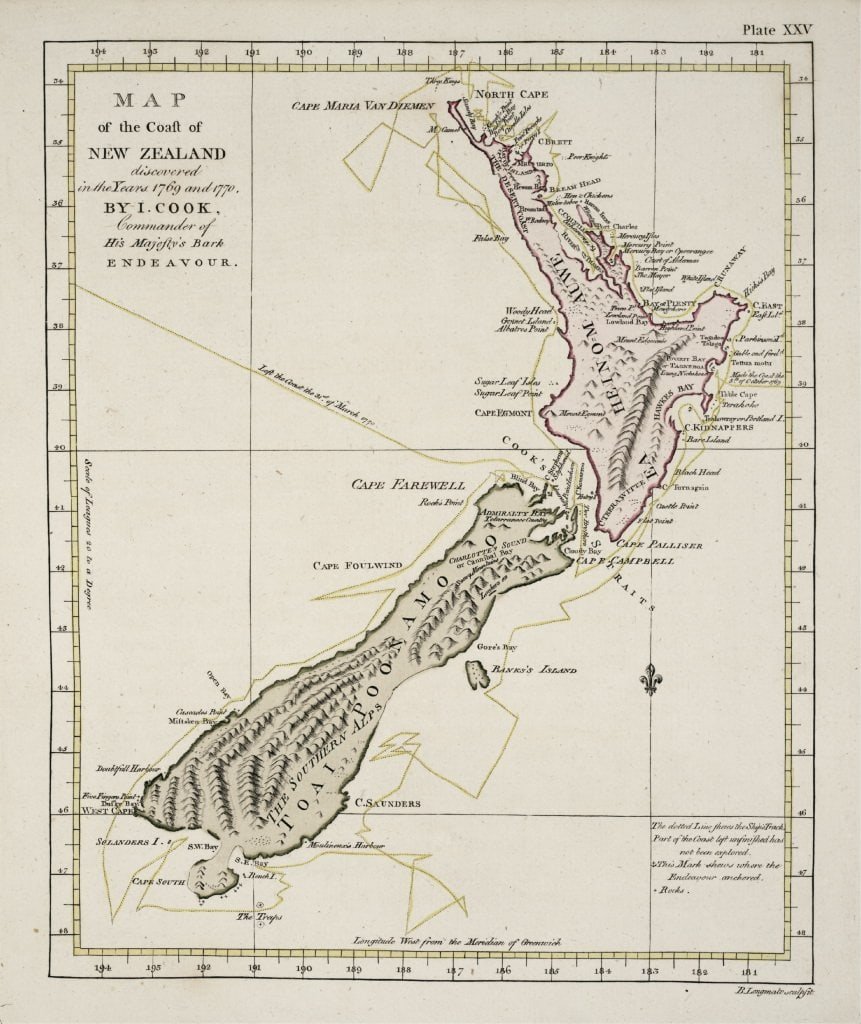
Image credit: drawn by James Cook – International Cartographic Association, Public domain.
Australia too had been discovered, but mostly unexplored. For four months, James Cook explored the 2000 mile eastern coast of Australia, even navigating the treacherous coral formations of the Great Barrier reef, now considered to be one of the greatest navigational hazards in the world. He called the area he explored New South Wales, then he hoisted a Union Jack, and claimed the land for Britain, thus paving the way for England’s colonization of Australia.
In all these travels, James Cook had a clear and consistent policy about how to treat the natives of the lands he explored. They were never to be harmed in any way. Even if natives attacked, his men were ordered to shoot over their heads and try to frighten them away. In many cases, the natives took sport in stealing from the sailors – they would sneak up, take something from an officer’s pocket, and run off giggling as if it were a great game. If the men chased them, the natives cheerfully gave up whatever they had taken. Cook always let the thieves go and allowed no punishment. As a result of his humane treatment, he made friends with many of the islanders and natives he met, some of whom worshipped him almost as a semi-god.
During this voyage, James Cook charted Tonga and Easter Island, discovered New Caledonia in the Pacific, and many other islands in the Atlantic. When he completed his sweep of the Pacific, he rounded Africa and set sail for home, having sailed all the way around the world in almost three years. It is still considered one of the greatest sailing ship voyages in history.
When he arrived in England James Cook had with him – not slaves, or gold, or spices, or jewels, like most previous explorers. Instead, he had detailed charts of unexplored lands, lengthy reports on the customs of the people of these lands, a thousand species of plants, 500 fish preserved in alcohol, 500 bird skins, and 1300 sketches of the people and places he’d discovered. When it came to the question of the great-unfound continent he could only say that it certainly didn’t exist in the South Pacific, but perhaps it existed in the South Atlantic.
The Second Voyage (1772–1775): Into the Antarctic Circle
Anyone could have predicted what happened next. One year later James Cook was sent on a second expedition – to the South Atlantic. His orders were to first find Cape Circumcision – a high snow-covered mountain that explorers had discovered forty years before, off the Cape of Good Hope, and which they felt might be part of the unknown continent. If it wasn’t part of a continent, then Cook was to continue southward towards the South Pole to see if the continent was lurking there. Then he was to circle the globe, looking for new islands in the South Pacific and mapping those that were already known.
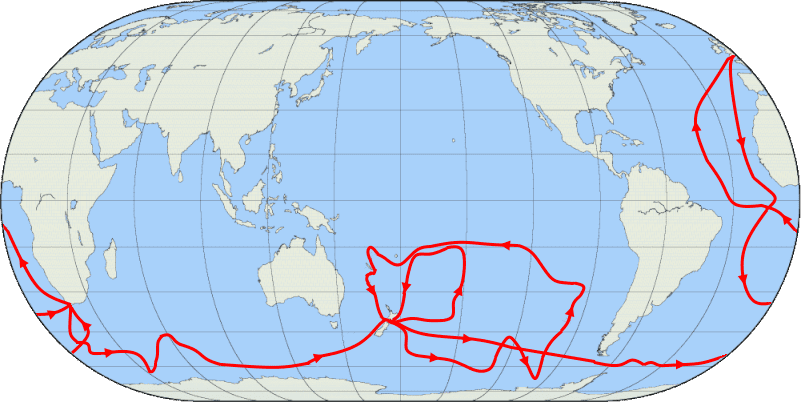
Image credit: Jon Platek / CC BY-SA 3.0 (via Wikimedia Commons)
James Cook set out in 1772 with 186 men and headed south where, five months later, he saw his first icebergs. He couldn’t find Cape Circumcision but he suggested that, based on what he had seen, the Cape was probably just a mountain of ice and since ice usually was found near land, there might be a landmass to the south or west of it. James Cook was exactly right. Today we know Cape Circumcision is a mound of icy rock and beyond it is Antarctica.
In January of 1773, James Cook became the first European to cross the Antarctic Circle and the first person to do so since the year 650, when it’s believed a Polynesian chief wandered into the icy circle in a small boat. Cook continued on, sailing further south than had ever been sailed before. He wrote down observations of sea lions, penguins, and other animals of the lonely region, remarking on how so many different species lived peacefully side-by-side. When James Cook saw that his sails were freezing and were becoming hard to manage, he turned and headed for the South Pacific.
He canvassed the area of the South Pacific, discovered no new continent, and returned to England. On the entire three-year journey only one crewmember of nearly 200 had died of the disease. As he voyaged home, Cook jotted in his notes: “I have now done with the southern Pacific…and flatter myself that no one will think I have left it unexplored.” After Cook’s voyage, geographers began to erase the imagined continent on the south of the globe from their maps.
By now James Cook had achieved great fame in his homeland. He was elected to the eminent Royal Society of scientists, was received at court by King George, had his portrait painted by the most prominent artists, and was invited to all the high society events. None of this impressed him. He kept his modest home in the unfashionable east end of London and preferred to spend his time with his wife and children. He had a steady income and several prestigious appointments and could have easily retired into a comfortable life as one of the English gentries. He chose instead to make another voyage.
The Third Voyage: The Search for the Northwest Passage
The third and final great voyage of James Cook was made in search of the famous Northwest Passage – a passage that explorers had been seeking ever since the discovery of the New World of the Americas. What they were seeking was a waterway across the top of North America by which Europeans could travel to the Orient. Most explorers had looked for this passage on the east side of the Atlantic. Now the Royal society thought it was time to search from the west or Pacific side. When James Cook volunteered for the job, their surprise was matched only by their joy.
![The third voyage searched for a North-West Passage connecting the northern Pacific to the northern Atlantic.[162] The dotted line represents the portion of voyage after Cook's death.](https://corehypothesis.com/wp-content/uploads/2026/02/CooksThirdVoyage58.png "James Cook: Voyages That Changed the Map of the World 6")
Image credit: Jon Platek / CC BY-SA 3.0 (via Wikimedia Commons)
James Cook set sail in 1776, the same month the American colonies signed their Declaration of Independence. He was 48 years old and he was commanding two ships – the Resolution and the Discoverer. His plan was to first find new islands in the Pacific, then make his way to Alaska by way of the Indian and Pacific Oceans. Once in Alaska, he would search for the Northwest Passage.
As they headed for Alaska, the ships made many stops at islands along the way – in Tasmania, New Zealand, Tongatabu, and Tahiti. This time James Cook brought the Tahitians three cows, a bull, a horse and mare, two rams, and ten sheep. Then he gave them root crops like potatoes, turnips, parsnips, and carrots, and taught them how to grow them.
Cook’s behavior on these islands began to undergo some subtle, and then some not-so-subtle changes that puzzled his men. Always known for his patience and humaneness, he became more short-tempered and less tolerant of the antics of the natives. For the first time in his career, he initiated punishment of the natives who stole from his sailors, usually flogging. Compared to the brutal behavior of the explorers who had preceded him, Cook’s revenge was still very mild – but it was out of character. One of his colleagues wrote at the time: “We are troubled to see an unfamiliar James Cook rising up by the side of the scrupulously humane James Cook we have known.” There is no explanation for the shift in Cook’s attitude but some of his men thought it was due simply to exhaustion. This was the third of three long, difficult voyages with little rest in between. He was finding it more and more difficult to forgive the interruptions and annoyances that delayed his voyage and interfered with his work. Whatever the reason, this growing lack of patience soon led to tragedy.
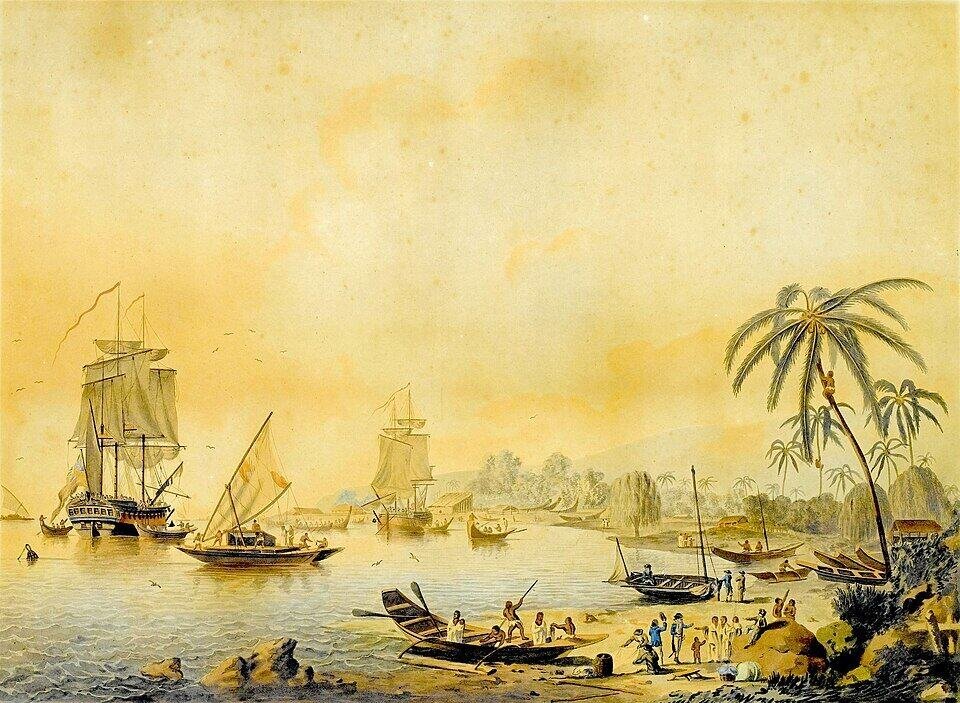
Image credit: John Cleveley the Younger, Public domain.
In January the two ships were nearing the equator when they spotted lands that weren’t marked on their maps. James Cook named them the Sandwich Islands, after the Earl of Sandwich, who was the chief naval minister of Britain. But today we know them as Hawaii. The Hawaiian islands were enticing – warm, the sun sparkled waves lapped on clean sandy shores; palm trees swayed in gentle breezes; and in the distance loomed beautiful green snowcapped mountains. But tempting as it was, James Cook had an assignment, and so he steered northwards towards the Arctic Ocean.
The ships sailed on, up the western coasts of North America. Cook became the first European to land on Vancouver Island in British Columbia. Then in August, he reached the Bering Strait, off northwest Alaska. James Cook drew maps of the area and gave names to its many bays and capes. Then he sailed through the Bering Strait, into the frigid waters of the Arctic. The ships forged their way through thick, blinding fog and tons of drifting ice. Then they ran into an obstacle – a huge wall of ice that made it impossible to proceed. James Cook thought he should explore the area – the ice might mark the frozen entrance to the Northwest Passage – but clearly, this couldn’t happen until summer when the ice would thaw. In the meantime, he decided, the ships would return to the Sandwich Islands and spend the winter there.
Death in Hawaii: The Fall of a Legend
They arrived back at the Sandwich Islands in January and chose to stop at a large island they hadn’t noticed the first time through – the island of Hawaii. The natives of the island were unknown to them but they seemed friendly and spoke a language, not unlike that of the Tahitians. On the day they arrived, Cook decided to go ashore and see what he could find. What he found as he walked into the center of the natives’ village was that some sort of religious ceremony was taking place and he, James Cook, was the center of it. He was led to a paved square, which was surrounded by wooden railings adorned with human skulls, and there the natives honored him as if he were a god. From then on, whenever the natives saw him coming, they would prostrate themselves. His tent, and those of his scientists, were considered sacred ground and were taboo to everyone except the most important priests. James Cook was off to a good start with the people of Hawaii – but soon it all went wrong.
By February the two ships were ready to begin their long voyage back to Alaska. The natives, laden with gifts, came to see them off. They waved as the ships disappeared from view and some even wept, so anguished were they by the idea they would never see their British friends again. As it happened, they saw them only a few weeks later.
Only seven days at sea, the ships ran into a violent gale, and one suffered damage to its mast. There was no choice but to return to Hawaii and make repairs. They arrived back in Hawaii, to the joy of the natives, and set up camp again. But a few days later, in the dark of night, a ship-to-shore boat that belonged to the Discoverer was stolen. When James Cook first heard the news, he handled it like he always had in the old days. He was calm and tried to come up with a sensible plan for getting the vessel returned. However, as the day wore on, he grew angrier. Finally, the plan he came up with was anything but sensible and calm – he decided to march a group of armed sailors onto the shore where they would take a chief hostage and hold him for ransom until the boat was returned. Although angry, Cook never intended violence. His hope was to take the chief peacefully and thereby convince the thief to surrender the boat.
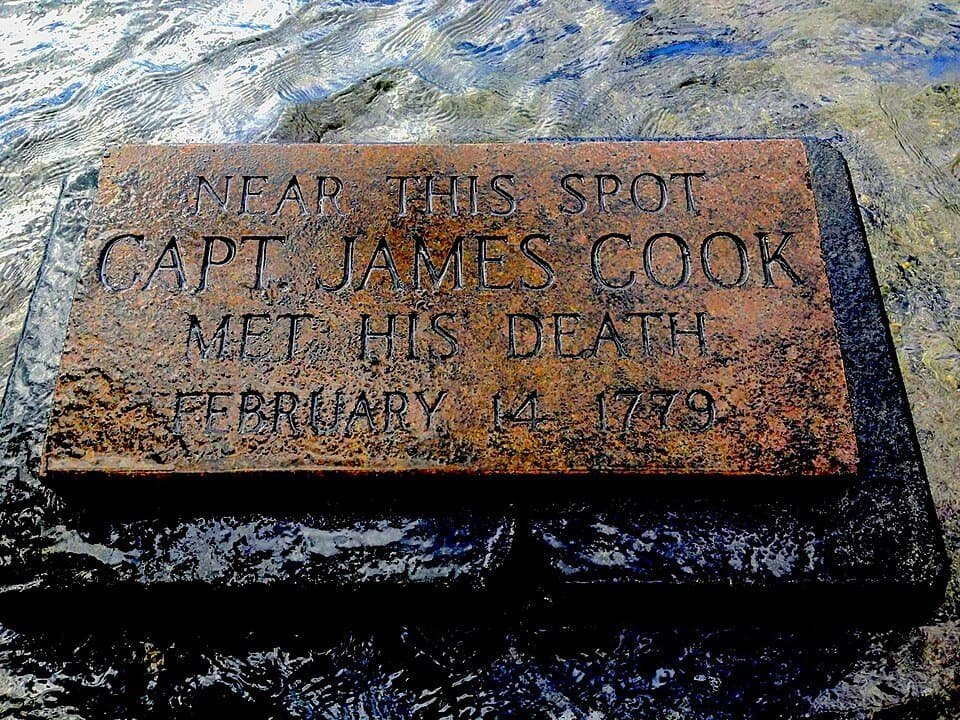
Image credit: Gillfoto, Public domain.
As James Cook and his men marched up the shore a crowd of natives joined them. The natives were agitated when they saw the English were carrying guns. One of the natives threatened Cook with a dagger and a stone. Some of Cook’s men thought the native was just showing off – others thought he might be serious. James Cook, for one, though he was serious. He fired his musket at the man, aiming high, and hitting the native’s elaborate hat. The native was unharmed. But the crowd was frightened and enraged.
The natives descended on their one-time god en masse. He was hit from behind with a club and stabbed in the back of his neck. The injuries didn’t kill him but they were forceful enough to send him falling to the ground, face first. As soon as he fell, the natives were upon him, hacking and beating him to death. Cook’s men could do nothing to save him against such large numbers – their only choice would have been to open fire and slaughter everyone. They returned to the ships where for two days they pleaded with the natives to return their captain’s body. When they finally had his remains, they gave him a burial at sea. After that, they did what he would have wanted them to do, and continued with their mission. They sailed to the Arctic and when they were unable to find the Northwest Passage, they returned to England with their sad news that James Cook had not survived the voyage.
The nation of England went into deep mourning over the loss of Captain James Cook. The British were shocked over how he’d died – he who was known for his humane treatment of all men, crew, and natives alike. For so many years he had gone out of his way to treat natives with fairness and compassion, and now they had murdered him. James Cook, already a hero in life became almost a martyr in death.
Captain James Cook legacy: The Birth of Scientific Exploration
The contributions James Cook made in the field of exploration, of cartography or mapping, and in science are more numerous than any explorer who preceded him. He is without question the greatest explorer of the 18th century and one of the greatest explorers in all of history. Sometimes a great person is known not just for what they did but for how they did it. Such was the case with Captain James Cook. He was one of the few early explorers who demonstrated respect and kindness for the natives of the lands he discovered. Unlike his notorious predecessors, he took no slaves, slaughtered no innocents, and refrained from imposing his religion and beliefs on other cultures. James Cook came not as a conqueror or even as a superior, but as a visitor. As a captain too, he broke new ground. He was among the first to make the health and well being of his crew a priority. He supplied them with nutritious foods, safe and clean working conditions, and fair, just treatment. Unlike the explorers before him, he came to new lands in the spirit of curiosity and scientific discovery, not in the spirit of greed. He researched, studied, mapped, and wrote about the lands and people he found in such accurate and detailed ways that his work is still used by scholars today. His goal was not to gain power but to gain knowledge. He peacefully changed the map of the world more than any other single person in history.
James Cook became a model for the new explorer. Before he was the brutal conquistadors like Cortez and the wealth and fame-seekers like Columbus, Magellan and Vasco da Gama. After he was the researchers like Charles Darwin. He marked the pivotal point at which men ceased to explore for what they could gain personally and for their countries, and began to explore for what they could contribute to human understanding.
References:
- Beaglehole, John Cawte (1974). The Life of Captain James Cook;
- Collingridge, Vanessa (2003). Captain Cook: The Life, Death, and Legacy of History’s Greatest Explorer;
- Fernandez-Armesto, Felipe (2006). Pathfinders: A Global History of Exploration;
- Robson, John (2004). The Captain Cook Encyclopædia. Random House Australia
- Beaglehole, John (1974). The Life of Captain James Cook. Stanford University Press
- Beaglehole, John (1966) [1934]. The Exploration of the Pacific. Stanford University Press

