

Cover image: Osama Shukir Muhammed Amin FRCP(Glasg), CC BY-SA 4.0 (via Wikimedia Commons)
Table of Contents
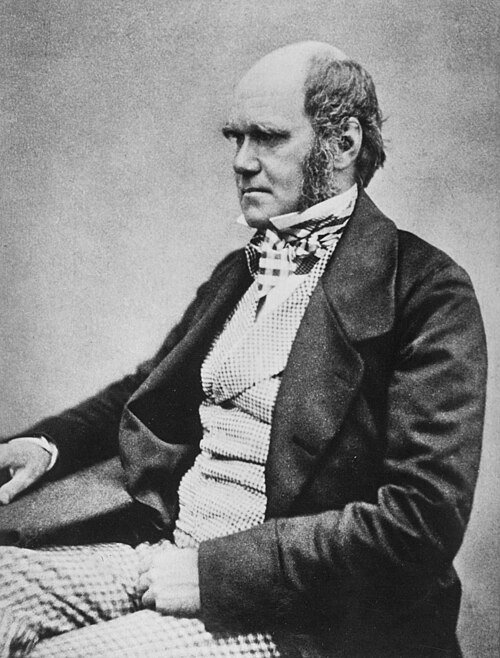
Image credit: Henry Maull (1829–1914), public domain
Charles Darwin was a modest, unambitious scientist, yet he had an enormous effect, not just on science, but also on all human thought. His famous theories on evolution completely redefined man’s relationship to himself, to all other living forms, and even to his God. Charles Darwin achieved this cataclysmic effect with the publication of a single work: his book The Origin of Species. On the surface, it seemed just a natural science text. Darwin himself intended it to be no more than a scientific theory about how biological life develops and evolves – a theory he was anxious to share with the scientific community. But the sensation his work created went far beyond the field of science and had a profound impact on almost every area of human study – philosophy, sociology, theology, psychology, literature, history, and even law. In the long run, it seemed as if the book’s contribution and effect on science might be the least of its importance. Darwin’s theories did revolutionize science, and they also revolutionized world consciousness. Today, almost every educated person on the globe knows of Darwin’s theories of evolution and natural selection.
Early Life and Family Background
The findings in Darwin’s work were less important for what they said than for what they implied. Those implications led to furious debate, re-examination, doubt, and reaffirmation in every field of intellectual pursuit. This vigorous burst of human thought and response has few parallels in all of history. In some ways, Charles Darwin seemed an unlikely candidate for the pivotal role destiny had declared for him. In his youth, there were no particular signs of genius or even of passionate, clear interests.
Charles Robert Darwin was born in 1809 to a family eminent on both sides. His father was from the wealthy Darwin family; he was a distinguished doctor, and his father before him was a physician and scientist. Darwin’s father was a member of the Royal Society, the most prestigious scientific organization in Europe, and rather an awesome personage, standing 6’2″ tall, and weighing well over 300 pounds. One of Darwin’s sisters once said that when their father came home, it “was like the tide rolling in.”
A Poor Student with a Passion for Nature
Darwin’s mother was the daughter of Josiah Wedgwood, the famous potter. She died when Charles Darwin was only eight years old, and he was raised chiefly by his older sisters. As a child, Darwin was secure and happy, content in his family, uninterested in books, and a poor student at school. Years later, he said, “The school as a means of education to me was simply a blank. I learned absolutely nothing except by amusing myself reading and experimenting in chemistry.” His only real interest seemed to be the world of nature, and he had a particular fondness for dogs and for catching rats. He eventually tried to follow in his father’s footsteps by training in medicine at the University of Edinburgh, but he found the studies dull, and after watching surgery being performed without anesthesia, he fled the university and never returned. Lacking any clear sense of direction, he followed his father’s advice and studied for the ministry, earning his B.A. at Cambridge in 1831, at the age of 22. At Cambridge, too, he was a mediocre student, much more interested in collecting beetles than in studying. He liked to tell a story about his early experiences with amateur collecting. One day, on tearing the bark off an old tree, he saw two rare beetles and seized one with each hand. Just then, he saw a third, different beetle. He couldn’t bear to pass it up, so he promptly took one of the beetles in his hand and plopped it into his mouth. The beetle ejected a bitter fluid, which burnt Darwin’s tongue so that he had to spit the beetle out, thus losing this one and the third one, which in the meantime scurried away.
The Voyage of the HMS Beagle
How Darwin Got His Place on the Beagle
After Cambridge, fate, which seemed to have sympathy for Darwin’s love of nature, stepped in and changed the course of his life. His science teacher at Cambridge procured Darwin an invitation to be a volunteer naturalist on a government ship called the HMS Beagle, during a long voyage of exploration that would circumnavigate the globe. His father objected, seeing no way that a stint as a naturalist could help further Darwin’s career as a clergyman. But at his son’s urging, he finally said: “If you can find any man of common sense who would advise you to go, I will give my consent.” Charles immediately ran off to see his Uncle Josiah, a man his father respected and a man Charles thought just might approve of this adventurous journey. Uncle Josiah did approve, probably because he already suspected Charles would never make a good clergyman. Darwin’s father relented; Darwin accepted the invitation and set out shortly after graduation. Before he left, he wrote a letter to a friend saying he expected the voyage to be “a second birth.”
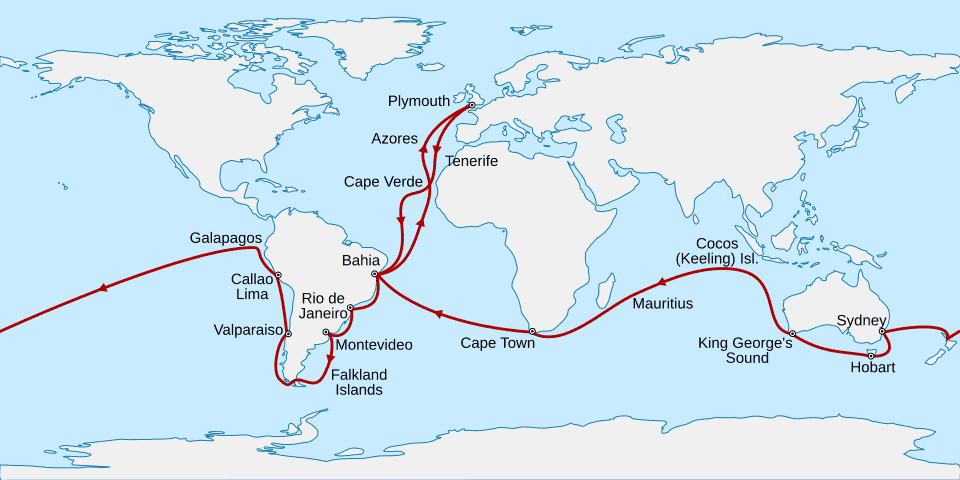
Image credit: Sémhur / CC BY-SA 4.0 (via Wikimedia Commons)
The voyage of the now-famous Beagle was supposed to last two years, but it lasted five instead. During that entire time, Charles Darwin battled with seasickness, often resting in a hammock during the rockiest times, and spending long periods on shore whenever possible. He was brave during the journey and seemed to have a lively sense of adventure. He made his way through armed political rebellions, rode with the gauchos in Argentina, joined the crew in towing the ship’s boats upstream, and once saved the expedition by rescuing a boat from a tidal wave. The captain liked him so much that he shared his cabin with Darwin. What fueled Charles Darwin on the voyage was his curiosity and the chance of discovery. He wrote to his sister: “We have in truth the world before us. Think of the Andes, the luxuriant forest of the Guayaquil, the islands of the South Sea, and New South Wales. How many magnificent and characteristic views, how many curious tribes of men we shall see. What fine opportunities for geology and for studying the infinite host of living beings: Is this not a prospect to keep up the most flagging spirit?”
The Beagle spent much of its time in various South Pacific islands and on the coasts of South America and Australia – waters that had been charted decades earlier by great explorers like James Cook. During the voyage, Charles Darwin became a scientist – he developed into an industrious collector, a keen observer, and an intelligent theorist. He examined stratifications of rock and soil; worked with a lens, compass, clinometers, penknife, blowpipe, and acids; uncovered fossils; collected flowers, birds, insects, and reptiles; and pondered volcanoes, coral reefs, and earthquakes. The sailors took to calling him “The Professor,” or “The Flycatcher.” He was a cautious worker, skeptical of his own theories, and never once suspecting himself of genius. Nevertheless, it was on this journey that his genius would take root when he confronted a problem that would haunt him for the next twenty years: the problem of the origin of species.
The Galapagos Islands and Darwin’s Finches
While traveling the world, Charles Darwin had observed that, despite the great distance between areas he visited, the varieties of flora and fauna were similar. This led him to develop the idea that species were not immutable, or unchanging, but instead were forced to adapt to their ever-changing environments. His most important and best-known research was conducted on the Galapagos Islands, where he found a dazzling array of animal life and found that related but different species lived on different islands, even though the islands were similar. He was particularly interested in the finches of the islands. The finches had beaks that ranged from small to large and delicate to powerful. And he noticed that each different type ate different food. He came up with the theory that each finch was particularly suited to the food that was available in the environment – in other words, each finch had adapted to its environment through generations of evolution. These birds later became famous as “Darwin’s finches.” And they, and other species and observations, first inspired him to consider the theory that would soon change the world.
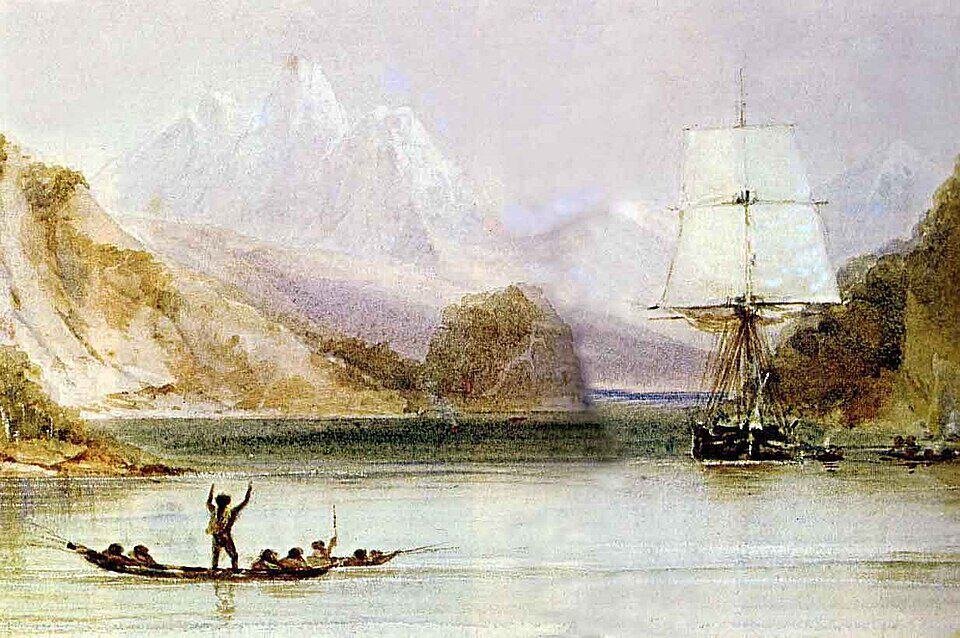
Image credit: Conrad Martens / public domain
From Naturalist to Revolutionary Thinker
Return to England and Early Publications
When he returned to England, Charles Darwin was a different man. He had become adventurous and independent and had developed the courage he would need to propose ideas that would be considered revolutionary and even heretical. Because of his great research aboard the Beagle, Darwin became secretary of the Geological Society and, in 1840, published a paper entitled Zoology of the Voyage of the Beagle.
In 1939, he married his cousin, Emma Wedgwood, after drawing up a list of the benefits of marriage versus the drawbacks. They settled into a little country village named Downe, 16 miles outside of London. Emma was devoted to Charles Darwin, and she was an organized, skilled housewife who enabled him to work in peace for the next forty years. Together, they had ten children, three of whom died in childhood.
Twenty Years of Secret Research
Charles Darwin had a great deal of family money and never needed to worry about making a living. This freed him when he returned to pursue his studies and writings. At this point, Darwin began to live somewhat of a double life. To the outside world, he appeared to be working on traditional scientific research, releasing papers on the study of barnacles, on coral reef formation, and the effects of volcanoes and earthquakes on the geological structure of the earth. But at the same time and over two decades, he collected massive amounts of data relating to species and supporting his theory of natural selection, all of which he kept mostly to himself. He examined the many breeds of the pigeon, the skeletons of rabbits, the wings of ducks, and the variations in 10,000 specimens of barnacles. He kept massive, detailed notes, conferred with a few scientific associates, and tested and re-tested his hypothesis. But he still didn’t feel completely confident in publishing his results, although friends encouraged him to do so. Then, in 1859, he received just the impetus he needed. He discovered that another younger naturalist, Alfred Russell Wallace, had been investigating the same theory and was thinking of publishing his findings. What followed was an inspiring example of the selflessness of two men who were both more dedicated to science than they were to personal glory.
Alfred Russell Wallace and the Race to Publish
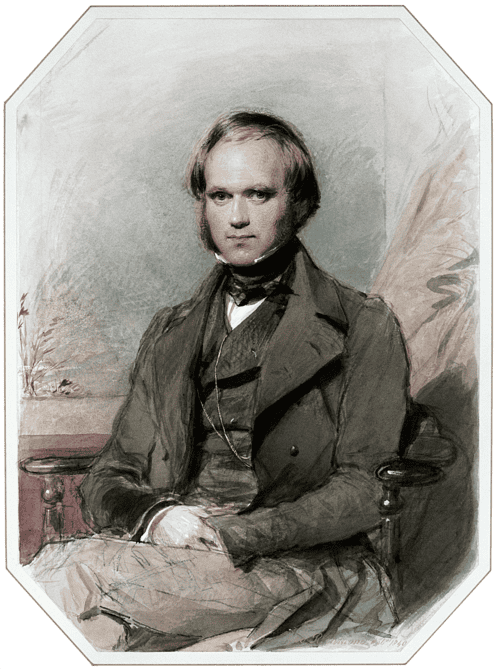
Image credit: George Richmond / public domain
Charles Darwin read Wallace’s paper and decided Wallace should be the one to present this new theory to the world since he had completed his work first. He congratulated Wallace and advised him to go public, never mentioning his own years of work in the same field. Meanwhile, Darwin’s friends, who were concerned about the inequity of this, went to Wallace themselves. When they told him of Darwin’s own research, Wallace immediately offered to withdraw his own paper and let Darwin publish his. Instead, Darwin’s friends arranged that both men would present their findings together at the Linnean Society in July of 1858. Wallace said later that his contribution to evolution, when compared to Darwin’s, “was as two weeks to twenty years.” At Wallace’s encouragement, Charles Darwin agreed to finish an “abstract” of his work, and so in November of that year, he published The Origin of Species and, tired and sickly, waited for a response. The book’s first edition sold out in one day.
Charles Darwin had suffered problems with his health most of his adult life. His symptoms were varied and mysterious – indigestion, vomiting, insomnia, and heart palpitations. Now historians believe he may have contracted a tropical disease during his years on the Beagle. But at the time Charles Darwin was largely dismissed as a hypochondriac, and there is some evidence that his ill health may have indeed been psychosomatic. The most interesting evidence to support this theory is that his illness was severe when he was debating the release of his findings on evolution, yet in his later years, when the controversy had died down, his illness disappeared altogether.
The Publication of The Origin of Species
In his introduction to the first publication of his theory, Darwin said: “I was much struck with certain facts in the distribution of the plants and animals of South America and in the geological relations of the present to the past inhabitants of that continent. These facts seemed to throw some light on the origin of species – that mystery of mysteries, as it has been called by one of our great philosophers.”
Religion and the Church’s Response
The revolution caused by the work of Charles Darwin was immediate and extended far beyond science. It caused a basic change in the approach to all ideas. Hardest hit were the fields of religion, philosophy, and mythology, which virtually collapsed at the time and seemed unable to assimilate the new direction science suggested. The response of religious leaders was swift and ferocious – opposition to Darwin’s work was always strongest from the clergy. The theory of evolution contradicts a literal interpretation of Genesis. And there was no place in Darwin’s scheme of the world for divine intervention. Furthermore, mankind wasn’t placed in a position of superiority to other members of the animal kingdom. Even Pope Pius IX wrote: “It’s a system repudiated by history, by the traditions of all people, by exact science, by the observation of facts, and even by reason itself…The corruption of this century, the guile of the depraved, the danger of oversimplification, demand that such dreaming, absurd as it is, be refuted by science since they wear the mask of science.”
Darwin’s ideas conflicted with the literal interpretation of Genesis because they eliminated the possibility that life, particularly human life, had sprung forth instantly and fully developed, at the whim of God. Rather, he proposed, it had taken eons of slow adaptation and evolvement to form the species we know today. Neither Adam and Eve nor any other life form could have burst spontaneously onto the planet in a form identical to their ancestors of today. But the bigger threat to theologians was that Darwin’s universe didn’t operate by design, but by natural selection. Natural selection was self-regulating as if it required no divine overseer. And it offers an image of a world that’s in a constant process of change, but which lacks a prior intention of going anywhere in particular, or of becoming anything in particular. This implication of a lack of divine purpose not only shocked religion but also filled the common man with a sense of despair. Influenced by his theories, 19th-century writers began to express a bleak and hopeless view of life, or, as in the case of writers like Oscar Wilde, expressed an increasing need for escapism and avoidance. So what affected theologians and people of the time was not just the idea that man evolved, but that he evolved by natural selection, rather than by some cosmic, supernatural urge. Once that idea became clear, a revolution in Western thought was initiated.
As the years passed, and even in Darwin’s own lifetime, this opposition and resistance began to give way, and theology and other fields began to adjust to and integrate his new principles. The change was so complete that Pope Pius XII asserted in 1950 that both the anthropologist and the theologian should professionally study evolution, even of the body of man and woman. Philosophers began to approach evolution from a positive, hopeful point, proposing that perhaps, even if evolution did occur, there was still a purpose to life and a reason to exist, even if it’s for man to respect himself simply as a man, and to see dignity in his highly evolved state. A very beneficial humanism began to develop from Darwin’s theory. And eventually, the most rational spiritual question began to be asked, which was: Couldn’t evolution and natural selection also be part of God’s design and plan? People began to seek and find ways to make science and religion compatible since, with the rapid growth of science and technology, this was becoming more and more critical.
Social Darwinism
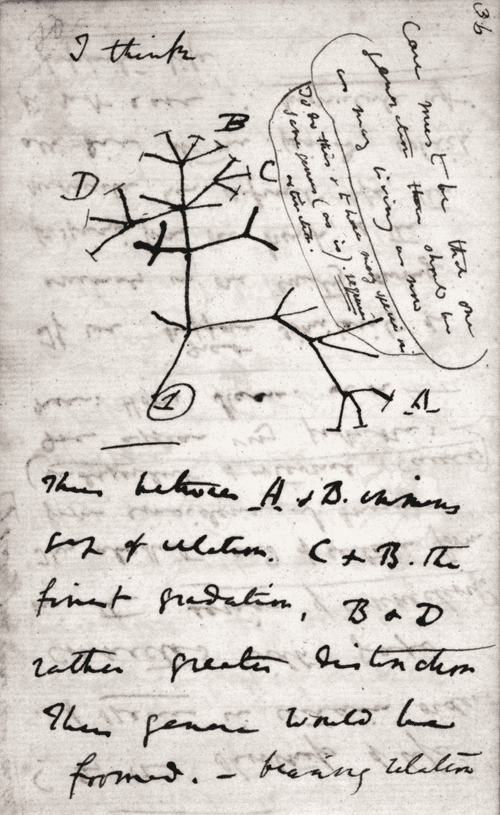
Image credit: Charles Darwin / public domain
Darwin’s work also resulted in a questionable philosophy called SOCIAL DARWINISM. When The Origin of Species was released, the Civil War in America was just about to begin. In the years following those two history-making events, the United States rapidly industrialized. The late nineteenth century was the era of the Rugged Individualist, the Captain of Industry, the Robber Baron, and the wealthy, and often exploitive, capitalist. At the other end were the sweatshops, tenements, poverty, epidemics, and brutality against striking workers. The economic structure of the country had changed and was marked by polarization, extremes, and contradiction. People at the top of the economic ladder began to use Darwin’s theories to support their actions and justify their privileged status. To these people, the theory of natural selection could be applied to the business world: millionaires and magnates were the product of natural selection; they had “evolved” to the top, from where they could then survey other people and select, in turn, the people who met the requirements of the work that needed doing. John D. Rockefeller said the growth of a large business was merely the survival of the fittest. He added: “The American Beauty Rose can be produced in the splendor and fragrance which brings cheer to the beholder, only by sacrificing the early buds which grow up around it. This is not an evil tendency in business. It’s merely the working out of a law of nature and of God.” And steel magnate Andrew Carnegie also stated, during one of his corporate crises that “a struggle is inevitable and it’s a question of survival of the fittest It soon became a popular belief among the upper class that the wealthy and successful must be the fittest and that, therefore, the poor were unfit. Those at the bottom, whom the American Dream had passed by, were the unavoidable by-products of the struggle for existence. It was nature that put them there, and those at the top had no desire to interfere with a natural process.
This sense of elitism provoked a response, and soon there was a more liberal interpretation of Darwin’s theories that would help re-establish balance. Some naturalists broadened the view of evolution to show that nature was not always and not exclusively competitive. Then, certain philosophers stepped in and added that even if there is ruthless competition in nature, that doesn’t mean it’s an appropriate model for human behavior.
Influence on Literature and Philosophy
The world of literature, too, was rebounding from the effects of The Origin of Species. In the 19th century, writers were particularly hostile to Charles Darwin. There were novels, stories, and poems that attacked him both directly and indirectly. But the more open-minded writers were, at the same time, beginning to assimilate his ideas. Some, like Tennyson and Browning, had even discussed evolution in their works before Darwin appeared on the scene. After 1859, it showed up in hundreds of works. Perhaps the most distinguished writers who supported the theory were Thomas Hardy, Samuel Butler, H.G. Wells, and George Bernard Shaw. For people and thinkers of the late 19th century, Darwin’s work generated a difficult process that involved reassessing familiar beliefs, analyzing new ones, adapting them, and then integrating them into every facet of life. It was a turbulent and fiery process, but it was also vital and gave new energy to the sciences, the arts, and intellectual disciplines.
Charles Darwin always remained detached from the immense controversy that greeted this product of his twenty years of labor. He left the defense of his ideas to others, notably the English biologist Thomas Henry Huxley. Huxley was a brave and tireless defender who endured much criticism and even personal insults. Once, when the Bishop of Oxford condescendingly asked him whether it was through his father or his mother that he was descended from an ape, Huxley replied that he was not ashamed of having descended from an ape, but would be ashamed of an ancestor who used his gifts of eloquence in the service of falsehoods.
While the controversy roared on, Charles Darwin remained at home quietly working. He had been worried about the effects his theory might have for many years. He had been concerned that the book would hurt his close friends and his wife, who were devout Christians. The conflict within him – between his dedication to science and fact, and his awareness of what his findings might provoke – had brought him to the brink of a breakdown. He was a semi-invalid before his 40th year. Now, as he watched the explosions the book had generated, he remained in his little house with Emma, shielded as best he could from the tornado of opinion.
Except for his one adventure on the Beagle, Darwin’s life was intellectual and domestic. He was never a complete recluse – he attended scientific meetings in London; he was a member of 57 different scholarly societies, and he was active in the little village of Downe. He was treasurer of the Friendly Club and a Justice of the Peace. He even participated in church functions, although he was a mild agnostic. Charles Darwin was a kind man, benevolent to his fellowman and all other creatures, and he liked to write of the “grandeur,” beauty, and “wonder” of life forms, and of men’s “high destiny” in the future. Throughout the years, he continued to work diligently. The period that followed The Origin of Species produced The Movements and Habits of Climbing Plants; The Expression of the Emotions; The Variation of Animals and Plants Under Domestication; The Descent of Man; and Selection concerning Sex. The last three works were elaborations of his theory of evolution. But Darwin’s genius was by no means confined to the study of this one area. He made important contributions to science on the subjects of the taxonomy of barnacles, the formation of atolls, responses of plants to light, and the role of earthworms in soil fertility. His work on earthworms is now viewed as a major pioneering study in the field of ecology.
Charles Darwin died at home in 1882, at the age of 73. The man who had been criticized and assaulted by many religions and their leaders was buried in Westminster Abbey, a few feet from the other “greatest of British scientists,” Sir Isaac Newton. By the time he died, the theory of evolution through natural selection had become generally accepted throughout the world. Darwin’s legacy continued to shape biology for generations, influencing fields from ecology to medicine — including groundbreaking discoveries such as Alexander Fleming’s penicillin, which revealed how bacteria evolve resistance, a process rooted in the very principles Darwin described.
The Origin of Species
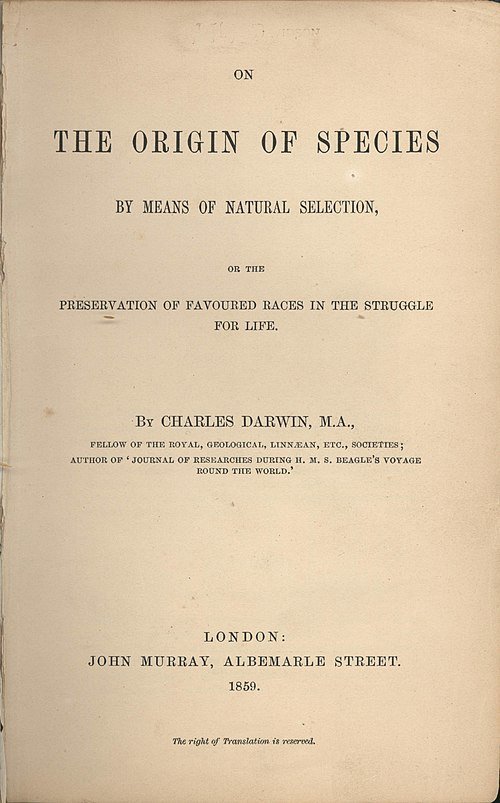
Image credit: John Murray / public domain
To understand the enormous outcry that greeted Darwin’s work, it’s necessary to understand the theories and implications of his groundbreaking book The Origin of Species. The book was released in the year 1859, and its full title reads The Origin of Species by Means of Natural Selection or The Preservation of Favored Races in the Struggle for Life. Charles Darwin was very cautious in his book. Like most scientists, he had built this theory upon those of his predecessors. Then he’d followed up with twenty years of intense personal study and intellectual struggle. He’s very candid in his approach to the topic, presents his ideas in an orderly fashion, and then leaves it to each reader to weigh the evidence. Throughout the book, he openly admits the possibility of error and the need for further investigation; he carefully points out that the idea of evolution by natural selection is, in his words, “one of a long argument.” The result was indeed that – a long and tempestuous argument that spanned a century and a half. In America, it had its climax almost 75 years after the book was released, in the famous Scopes trial. In that trial, schoolteacher John Scopes was accused of violating a Tennessee law that prohibited the teaching of the theory of evolution. Two prominent attorneys squared off in the courtroom, as the world watched and waited – William Jennings Bryan for the prosecution and Clarence Darrow for the defense. In the end, Scopes was convicted. But he was acquitted later on a technicality.
Core Principles of the Theory of Evolution
Here are the basic principles of the book and work that so ignited our 19th-century world. Darwin speaks first about the variation in nature. These variations are first indistinguishable, but gradually they develop into differences that can restrict one group’s ability to survive and enhance another’s. Thus, these varieties lead to new and distinct species. These dominant species tend to become still more dominant by leaving many modified and dominant descendants.
Then he discusses the struggle for existence. When a plant or animal is placed in a new environment amongst new competitors, the conditions of its life will be changed essentially. If its numbers are to increase, it needs an advantage over its competitors or enemies. Each organic being is striving to multiply – to be healthy and survive – often at the expense of members of its own species or those of competing species.
Natural Selection and Survival of the Fittest
The next principle in the book is that of Natural Selection or Survival of the Fittest. An example Charles Darwin offers is a modification involving sexual selection. This occurs, for example, when males must compete for mates. They need an advantage – better weapons, greater energy, or more beautiful song or plumage – these characteristics allow them to attract a mate, defeat competitors, produce progeny, and therefore survive. Over time, these adaptations, along with changing conditions and outside competition, can cause, in Darwin’s words, “infinite diversity in structure, constitution, and habits, advantageous to one set of offspring over another.” This principle of preservation, or survival of the fittest, is what he called Natural Selection.
Darwin also addressed the issue of the laws of variation. Reproductive chance creates variation. When the conditions of a species change, those individuals who survive may have beneficial modifications – organs or limbs that are stronger, or else, if not needed for survival, organs and limbs that weaken and diminish. This doesn’t mean those organs, however, without little purpose, don’t exist – the human appendix testifies to that. But any variation within a species is a long, slow process.
Charles Darwin also wrote about instinct and said that instincts are inherited. Ants and bees build their nests without previous experience. Birds migrate and build homes according to some inner sense. But instincts, too, can change over time as a result of the general law that organic beings advance so they can continue to survive and multiply, and so that the strongest live and the weakest die.
Common Descent — The Most Controversial Idea
Darwin’s observations led him to believe, and to defend as logical and even obvious, a corollary of his theories. That corollary was the probability of common descent for ALL living creatures. This is the “man descended from ape” theory that so shocked and offended civilized man and became a focus of the famous Scopes trial. But Charles Darwin didn’t find the idea shocking. In fact, he found the idea of common descent beautiful and said:
“When I view all beings not as special creations, but as lineal descendants of some few beings which have lived long before the first bed of the Cambrian system was deposited, they seem to me to become ennobled.”
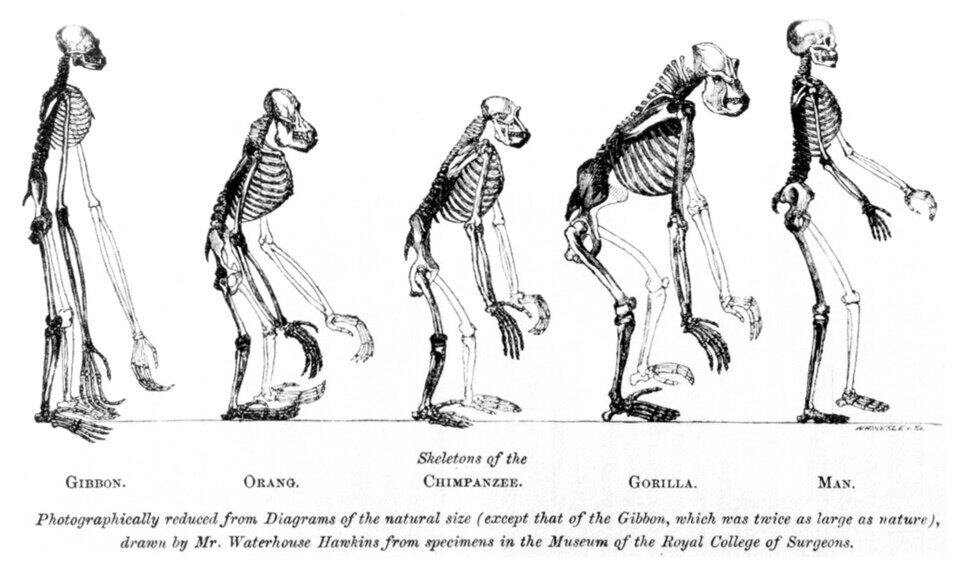
Image credit: Benjamin Waterhouse Hawkins (1807–94) / public domain
It is a comment completely appropriate to a man who revered nature and all life forms – and it’s also the ultimate irony – that this man, who sparked such controversy and division, was a man who saw and admired order, unity, and fellowship with all of earth’s creatures.
Darwin was well aware of the controversy his new theories might spark, and it was one reason he hesitated so long to publish them. When he finally did, he added at the end an optimistic homage to nature and its Creator, which he undoubtedly hoped would assuage people’s fears. It read this way:
“We must suppose that there’s a power represented by Natural Selection, that’s always intently watching each slight variation in the transparent layers and is carefully preserving each which might in any way produce a more distinct image…There is no reason these views should shock the religious views of anyone, for it’s just as noble a conception of God to believe He created a few original forms capable of self- development into other forms, as it is to believe that He required a fresh act of creation to fill the voids. The belief that species were immutable, unchanging productions was almost unavoidable as long as the history of the world was thought to be of short duration, but now that we’ve acquired, through geology, some idea of the lapse of time, that difficulty has been removed.
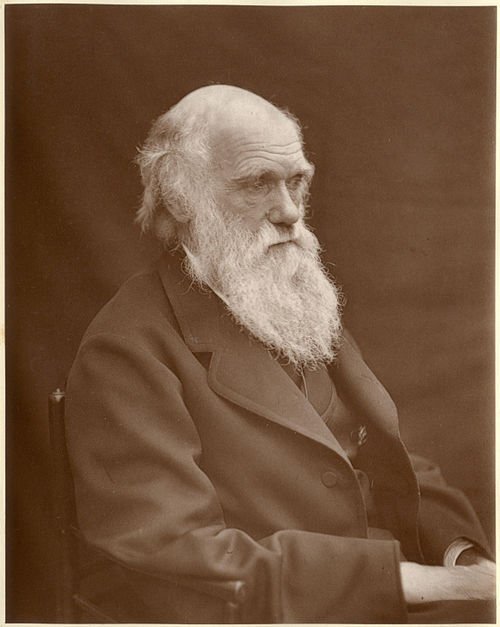
image credit: Leonard Darwin / public domain
Authors of great eminence seem to be fully satisfied with the view that each species has been independently created, but it seems more compatible with the laws of matter that the production and extinction of past and present inhabitants of the world should have been due to secondary causes – like those that determine the birth and death of individuals. There is grandeur in this view of life with its several powers having been breathed by the Creator, into a few forms or into one, so that, while his planet has gone cycling according to the fixed laws of gravity, from a simple beginning, endless forms most beautiful and wonderful, have been and still are being evolved.”
This eloquent attempt to synthesize science and religion may have appeased some, but it did not immediately appease all. It’s an axiom in the world of science that every discovery passes through stages: in the first stage, people say the idea is ridiculous; in the second, they say it’s “contrary to the Bible”; and in the third, they say, “Oh, we’ve known that all along.” The Origin of Species is a classic example of this pattern. In only a short time after it was written, the world had moved from an almost total belief in the permanence of species to an almost total belief in the changeability of species.
By the middle of the 20th century, evolution had become so well-founded and acceptable that it’s now an unconscious assumption in our society. It was a remarkable achievement, for in writing about biological evolution, Darwin had accelerated intellectual evolution.
In the end, he was not just a man who described a revolutionary process – he was the process itself.
References:
- Bowler, Peter J. (2003). Evolution: The History of an Idea (3rd ed.). University of California Press.
- Browne, E. Janet (1995). Charles Darwin: vol. 1 Voyaging. London: Jonathan Cape.
- Browne, E. Janet (2002). Charles Darwin: vol. 2 The Power of Place. London: Jonathan Cape.
- Darwin, Charles (1837). Notebook B: (Transmutation of species). Darwin Online. CUL-DAR121.
- Darwin, Charles (1845). Journal of researches into the natural history and geology of the countries visited during the voyage of H.M.S. Beagle round the world, under the Command of Capt. Fitz Roy, R.N. 2d edition
- Darwin, Charles (1872). The Origin of Species by Means of Natural Selection, or the Preservation of Favoured Races in the Struggle for Life (6th ed.). London: John Murray.
- Reznick, David N. (2009), The Origin Then and Now: An Interpretive Guide to the Origin of Species, Princeton University Press.
- Browne, Janet (2007), Darwin’s Origin of Species: A Biography, Grove Press,

