

Cover image: Inductiveload, public domain
Table of Contents
The discovery of the neutron and its properties was honestly one of the most important things that happened in atomic physics during the first half of the 20th century. Early on, Ernest Rutherford put together a rough model of the atom based on the gold foil experiment that Hans Geiger and Ernest Marsden ran. The basic idea was that atoms had their mass and positive charge packed into a tiny nucleus. By 1920, scientists had figured out chemical isotopes, worked out that atomic masses were roughly whole-number multiples of hydrogen’s mass, and connected atomic number to the charge on the nucleus.
The State of Atomic Physics Before the Neutron
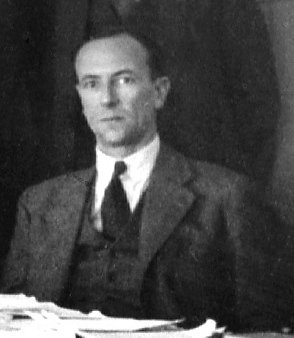
TThrough most of the 1920s, physicists thought the nucleus was basically just protons and electrons crammed together — those were the only two elementary particles anyone knew about at the time. But that picture kept running into problems, both experimentally and theoretically. Everything changed in 1932 when James Chadwick ran his landmark experiment and proved the neutron existed as a brand new elementary particle, completely separate from the proton. That discovery flipped our understanding of atomic structure on its head.
Once scientists had this uncharged neutron to work with, things moved fast. By 1934 they were using it to create new radioactive elements, and by 1938 they’d figured out how to split uranium atoms with it. That led pretty directly to nuclear power and atomic weapons before World War II wrapped up. For a while — until around the 1960s — people thought protons and neutrons were fundamental particles. Turns out they’re not. They’re made of even smaller things called quarks.
Discovery of radioactivity
At the start of the 1900s, scientists were still arguing about whether atoms even existed. Some philosophers, like Ernst Mach and Wilhelm Ostwald, thought atoms were just a useful math trick with no real physical existence. Others, like Arnold Sommerfeld and Ludwig Boltzmann, were convinced physical theories basically required atoms to be real.
Radioactivity itself was stumbled upon in 1896 by French scientist Henri Becquerel while he was messing around with phosphorescent materials. Then in 1898, Rutherford at the Cavendish Laboratory sorted out that there were actually two different types of radioactivity — he called them alpha rays and beta rays, and they behaved pretty differently when it came to penetrating ordinary matter. A couple years after that, Paul Villard discovered gamma rays, which were even more penetrating than the other two.
It didn’t take long to figure out what these radiations actually were. By 1902, Walter Kaufmann showed beta rays were electrons. Rutherford and Thomas Royds proved in 1907 that alpha rays were helium ions. And by 1914, Rutherford and Edward Andrade confirmed gamma rays were just electromagnetic radiation — basically a form of light. Since all these radiations came from atoms, they gave scientists useful clues about what was going on inside them, and also turned out to be handy tools for probing atomic structure through scattering experiments.
The gold foil experiment and the discovery of the atomic nucleus
Between 1908 and 1913 at the University of Manchester, Rutherford had Geiger and Marsden running experiments to see what happened when alpha particles bounced off metal foil. What they found was pretty surprising — sometimes alpha particles would scatter at really steep angles when passing through thin gold foil. That kind of deflection pointed to something small but incredibly dense inside atoms. By 1911, Rutherford had worked out that atoms must have a tiny, heavy nucleus with a positive charge, surrounded by a much bigger cloud of negatively charged electrons. He built a mathematical model to explain the scattering, and it was hugely influential — it inspired Bohr’s model of electron orbits in 1913 and eventually helped lead to quantum mechanics by the mid-1920s.
Discovery of isotopes
Around the same time Rutherford’s team was doing their foil experiments, a radiochemist named Frederick Soddy over at the University of Glasgow was digging into chemistry problems related to radioactive materials. He’d previously worked with Rutherford at McGill. By 1910, about 40 different radioactive elements had been identified between uranium and lead — way more than the 11 slots available in the periodic table at the time.
In 1913, Soddy and Kazimierz Fajans independently figured out that when an element goes through alpha decay, it moves two spots to the left in the periodic table, and beta decay moves it one spot to the right. Elements that land in the same spot are chemically identical — Soddy called these isotopes. That work earned him the 1921 Nobel Prize in Chemistry.
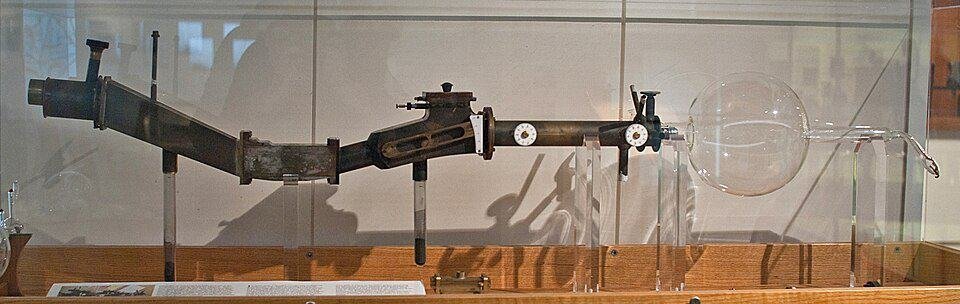
Image credit: Jeff Dahl, licensed under CC BY 3.0.
Meanwhile, Francis Aston built the first mass spectrograph at the Cavendish Laboratory in 1919, building on earlier work by J.J. Thomson. He used it to separate neon’s two isotopes and discovered what he called the whole number rule — basically that isotope masses are whole-number multiples of hydrogen’s mass. The one weird exception was hydrogen itself, sitting at 1.008 instead of a clean 1. Aston and others realized pretty quickly that this was due to atomic binding energy — when hydrogen atoms bind together, the combined mass comes out slightly less than the sum of the parts. Aston’s isotope work won him the 1922 Nobel Prize in Chemistry. And in 1920, Arthur Eddington picked up on this binding energy idea and suggested stars might get their energy by fusing hydrogen into helium.
Moseley’s Law and Atomic Number
Rutherford and others had noted the disparity between the mass of an atom, computed in atomic mass units, and the approximate charge required on the nucleus for the Rutherford model to work. The required charge of the atomic nucleus was usually about half its atomic mass. Antonius van den Broek boldly hypothesized that the required charge, denoted by Z, was not half of the atomic weight for elements, but instead was exactly equal to the element’s ordinal position in the periodic table. At that time, the positions of the elements in the periodic table were not known to have any physical significance. If the elements were ordered based on increasing atomic mass, however, periodicity in chemical properties was exhibited. Exceptions to this periodicity were apparent, however, such as cobalt and nickel.
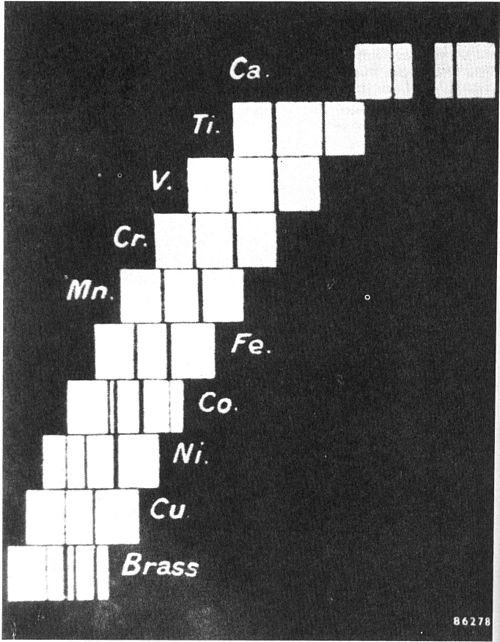
Image credit: Henry Moseley (1887 – 1915), public domain
At the University of Manchester in 1913, Henry Moseley discussed the new Bohr model of the atom with the visiting Bohr. The model accounted for the electromagnetic emission spectrum from the hydrogen atom, and Moseley and Bohr wondered if the electromagnetic emission spectra of heavier elements, such as cobalt and nickel, would follow their ordering by weight or by their position in the periodic table. In 1913-1914, Moseley tested the question experimentally by using X-ray diffraction techniques. He found that the most intense short-wavelength line in the X-ray spectrum of a particular element, known as the K-alpha line, was related to the element’s position in the periodic table, that is, its atomic number, Z. Indeed, Moseley introduced this nomenclature. Moseley found that the frequencies of the radiation were related in a simple way to the atomic number of the elements for a large number of elements.
Within a year, it was noted that the equation for the relation, now called Moseley’s law, could be explained in terms of the 1913 Bohr model, with reasonable extra assumptions about atomic structure in other elements. Moseley’s result, by Bohr’s later account, not only established atomic number as a measurable experimental quantity, but gave it a physical meaning as the positive charge on the atomic nucleus. The elements could be ordered in the periodic system in order of atomic number, rather than atomic weight. The result tied together the organization of the periodic table, the Bohr model for the atom, and Rutherford’s model for alpha scattering from nuclei. It was cited by Rutherford, Bohr, and others as a critical advance in understanding the nature of the atomic nucleus.
Further research in atomic physics was interrupted by the outbreak of World War I. Moseley was killed in 1915 at the Battle of Gallipoli, while Rutherford’s student James Chadwick was interned in Germany for the duration of the war, 1914–1918. In Berlin, Lise Meitner’s and Otto Hahn’s research work on determining the radioactive decay chains of radium and uranium by precise chemical separation was interrupted. Meitner spent much of the war working as a radiologist and medical X-ray technician near the Austrian front, while Hahn, a chemist, worked on research in poison gas warfare.
The Rutherford Atom and the Neutron Hypothesis
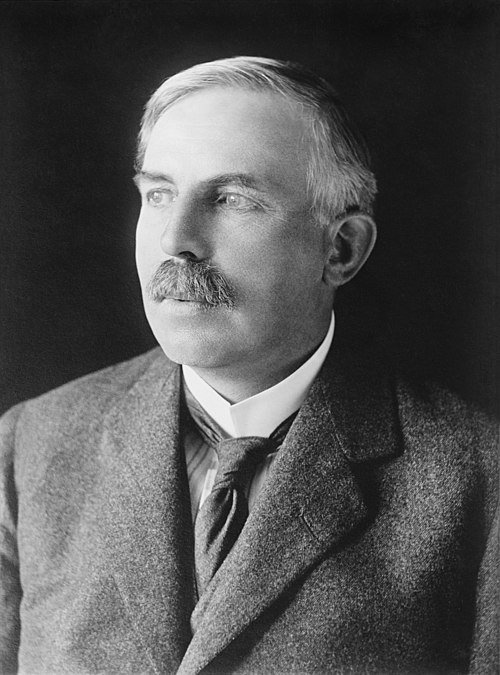
Image credit: Bain News Service, publisher, public domain
In 1920, Rutherford gave a Bakerian lecture at the Royal Society entitled “The Nuclear Constitution of Atoms”, a summary of recent experiments on atomic nuclei and conclusions as to the structure of atomic nuclei. By 1920, the existence of electrons within the atomic nucleus was widely assumed. It was assumed the nucleus consisted of hydrogen nuclei in a number equal to the atomic mass. But since each hydrogen nucleus had a charge of +1, the nucleus required a smaller number of “internal electrons”, each of charge -1, to give the nucleus its correct total charge. The mass of protons is about 1800 times greater than that of electrons, so the mass of the electrons is incidental in this computation. Such a model was consistent with the scattering of alpha particles from heavy nuclei, as well as the charge and mass of the many isotopes that had been identified. There were other motivations for the proton–electron model. As noted by Rutherford at the time, “We have strong reason for believing that the nuclei of atoms contain electrons as well as positively charged bodies…”, namely, it was known that beta radiation was electrons emitted from the nucleus.
In that lecture, Rutherford conjectured the existence of new particles. The alpha particle was known to be very stable, and it was assumed to retain its identity within the nucleus. The alpha particle was presumed to consist of four protons and two closely bound electrons to give it a +2 charge and mass 4. In a 1919 paper, Rutherford had reported the apparent discovery of a new doubly charged particle of mass 3, denoted the X++, interpreted to consist of three protons and a closely bound electron. This result suggested to Rutherford the likely existence of two new particles: one of two protons with a closely bound electron, and another of one proton and a closely bound electron. The X++ particle was later determined to have mass 4 and to be just a low-energy alpha particle. Nevertheless, Rutherford had conjectured the existence of the deuteron, a +1 charge particle of mass 2, and the neutron, a neutral particle of mass 1. The former is the nucleus of deuterium, discovered in 1931 by Harold Urey. The mass of the hypothetical neutral particle would be little different from that of the proton. Rutherford determined that such a zero-charge particle would be difficult to detect by the available techniques.
By 1921, Rutherford and William Harkins had independently named the uncharged particle the neutron, while about that same time, the word proton was adopted for the hydrogen nucleus. Neutron was apparently constructed from the Latin root for neutral and the Greek ending -on (by imitation of electron and proton). References to the word neutron in connection with the atom can be found in the literature as early as 1899, however.
Rutherford and Chadwick immediately began an experimental program at the Cavendish Laboratory in Cambridge to search for the neutron. The experiments continued throughout the 1920s without success. Rutherford’s conjecture was not widely accepted. In his 1931 monograph on the Constitution of Atomic Nuclei and Radioactivity, George Gamow, then at the Institute for Theoretical Physics in Copenhagen, did not mention the neutron. At the time of their 1932 measurements in Paris that would lead to the discovery of the neutron, Irène Joliot-Curie and Frédéric Joliot were unaware of the conjecture.
Problems with the Proton-Electron Model
Throughout the 1920s, physicists assumed that the atomic nucleus was composed of protons and “nuclear electrons”. Under this hypothesis, the nitrogen-14 (14N) nucleus would be composed of 14 protons and 7 electrons, so that it would have a net charge of +7 elementary charge units and a mass of 14 atomic mass units. This nucleus would also be orbited by another 7 electrons, termed “external electrons” by Rutherford, to complete the 14N atom. However, problems with the hypothesis soon became apparent.
Ralph Kronig pointed out in 1926 that the observed hyperfine structure of atomic spectra was inconsistent with the proton–electron hypothesis. This structure is caused by the influence of the nucleus on the dynamics of orbiting electrons. The magnetic moments of supposed “nuclear electrons” should produce hyperfine spectral line splittings similar to the Zeeman effect, but no such effects were observed. It seemed that the magnetic moment of the electron vanished when it was within the nucleus.
While on a visit to Utrecht University in 1928, Kronig learned of a surprising aspect of the rotational spectrum of N2+. The precision measurement made by Leonard Ornstein, the director of Utrecht’s Physical Laboratory, showed that the spin of the nitrogen nucleus must be equal to one. However, if the nitrogen-14 (14N) nucleus was composed of 14 protons and 7 electrons, an odd number of spin-1/2 particles, then the resultant nuclear spin should be half-integer — a contradiction explored in detail by the Stern-Gerlach experiment. Kronig therefore suggested that perhaps “protons and electrons do not retain their identity to the extent they do outside the nucleus”.
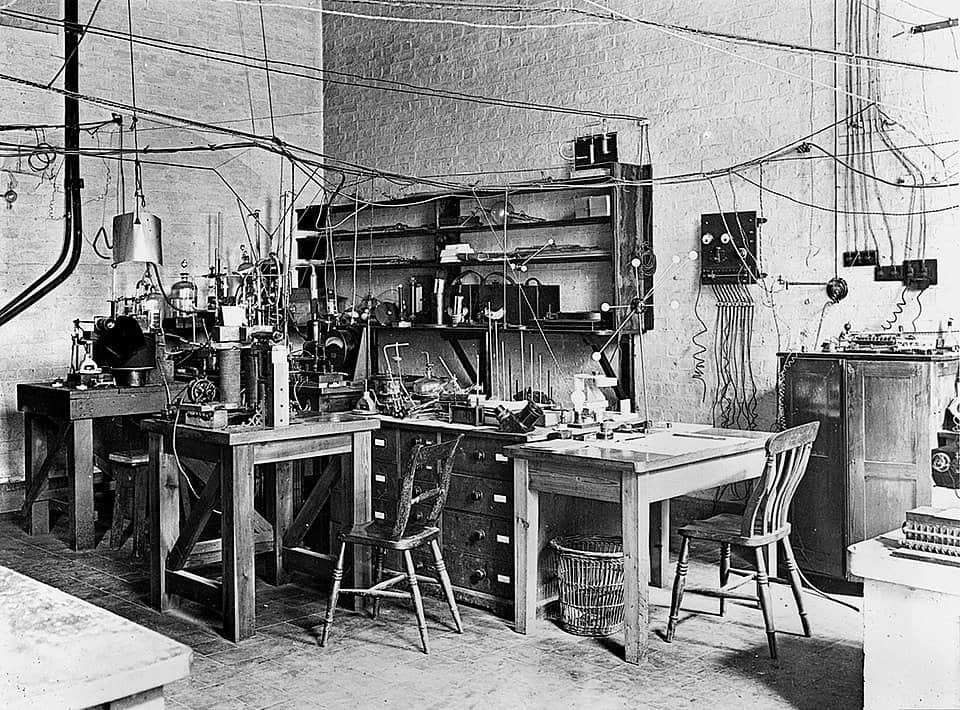
Image credit: Science Museum London, licensed under CC BY 2.0.
Observations of the rotational energy levels of diatomic molecules using Raman spectroscopy by Franco Rasetti in 1929 were inconsistent with the statistics expected from the proton–electron hypothesis. Rasetti obtained band spectra for H2 and N2 molecules. While the lines for both diatomic molecules showed alternation in intensity between light and dark, the pattern of alternation for H2 is opposite to that of the N2. After carefully analyzing these experimental results, German physicists Walter Heitler and Gerhard Herzberg showed that the hydrogen nuclei obey Fermi statistics and the nitrogen nuclei obey Bose statistics. However, an unpublished result of Eugene Wigner showed that a composite system with an odd number of spin-1/2 particles must obey Fermi statistics; a system with an even number of spin-1/2 particles obeys Bose statistics. If the nitrogen nucleus had 21 particles, it should obey Fermi statistics, contrary to fact. Thus, Heitler and Herzberg concluded: “the electron in the nucleus … loses its ability to determine the statistics of the nucleus.”
The Klein paradox, discovered by Oskar Klein in 1928, presented further quantum mechanical objections to the notion of an electron confined within a nucleus. Derived from the Dirac equation, this clear and precise paradox suggested that an electron approaching a high potential barrier has a high probability of passing through the barrier by a pair creation process. Apparently, an electron could not be confined within a nucleus by any potential well. The meaning of this paradox was intensely debated at the time.
By about 1930, it was generally recognized that it was difficult to reconcile the proton–electron model for nuclei with the Heisenberg uncertainty relation of quantum mechanics. This relation, Δx⋅Δp ≥ 1⁄2ħ, implies that an electron confined to a region the size of an atomic nucleus typically has a kinetic energy not less than 40 MeV, which is larger than the observed energy of beta particles emitted from the nucleus. Such energy is also much larger than the binding energy of nucleons, which Aston and others had shown to be less than 9 MeV per nucleon.
In 1927, Charles Ellis and W. Wooster at the Cavendish Laboratory measured the energies of β-decay electrons. They found that the distribution of energies from any particular radioactive nuclei was broad and continuous, a result that contrasted notably with the distinct energy values observed in alpha and gamma decay. Further, the continuous energy distribution seemed to indicate that energy was not conserved by this “nuclear electrons” process. Indeed, in 1929, Bohr proposed to modify the law of energy conservation to account for the continuous energy distribution. The proposal earned the support of Werner Heisenberg. Such considerations were apparently reasonable, inasmuch as the laws of quantum mechanics had so recently overturned the laws of classical mechanics.
While all these considerations did not “prove” an electron could not exist in the nucleus, they were confusing and challenging for physicists to interpret. Many theories were invented to explain how the above arguments could be wrong. In his 1931 monograph, Gamow summarized all these contradictions, marking the statements regarding electrons in the nucleus with warning symbols.
James Chadwick and the Discovery of the Neutron
In 1930, Walther Bothe and Herbert Becker in Germany discovered something weird — when alpha particles from polonium hit certain light elements like beryllium, boron, or lithium, they produced a strangely penetrating radiation. Beryllium gave the strongest effect. Unlike alpha radiation, this new radiation wasn’t affected by electric fields, so they figured it was probably gamma rays. But it was more penetrating than any gamma rays anyone had seen before, and the experimental results were hard to make sense of.
Two years later, Irène Joliot-Curie and Frédéric Joliot in Paris found that when this mystery radiation hit paraffin wax or anything else with lots of hydrogen, it knocked out protons with really high energy — around 5 MeV. That was hard to explain with gamma rays. For a gamma ray to scatter a proton like that through Compton scattering, it would’ve needed about 50 MeV of energy, which was basically impossible. A young physicist in Rome named Ettore Majorana suggested the radiation must actually be a new neutral particle.
When Rutherford and Chadwick heard about the Paris results, neither of them bought the gamma ray explanation. Chadwick, with help from Norman Feather, quickly ran his own series of experiments. He repeated the beryllium experiment — 9Be + 4He → 12C + 1n — then aimed the resulting radiation at paraffin wax and measured what happened to the protons. He also tested how the radiation interacted with various gases. His conclusion: this wasn’t gamma radiation at all. It was uncharged particles with roughly the same mass as a proton. Those particles were neutrons. Chadwick got the Nobel Prize in Physics in 1935 for the discovery.
1932 later got nicknamed the “annus mirabilis” for nuclear physics at Cavendish — that one year saw the discovery of the neutron, the first artificial nuclear disintegration using the Cockcroft-Walton accelerator, and the positron.
Proton–neutron model of the nucleus
Given the problems of the proton–electron model, it was quickly accepted that the atomic nucleus is composed of protons and neutrons, although the precise nature of the neutron was initially unclear. Within months after the discovery of the neutron, Werner Heisenberg and Dmitri Ivanenko had proposed proton–neutron models for the nucleus. Heisenberg’s landmark papers approached the description of protons and neutrons in the nucleus through quantum mechanics. While Heisenberg’s theory for protons and neutrons in the nucleus was a “major step toward understanding the nucleus as a quantum mechanical system,” he still assumed the presence of nuclear electrons. In particular, Heisenberg assumed the neutron was a proton–electron composite, for which there is no quantum mechanical explanation. Heisenberg had no explanation for how lightweight electrons could be bound within the nucleus. Heisenberg introduced the first theory of nuclear exchange forces that bind the nucleons. He considered protons and neutrons to be different quantum states of the same particle, i.e., nucleons distinguished by the value of their nuclear isospin quantum numbers.
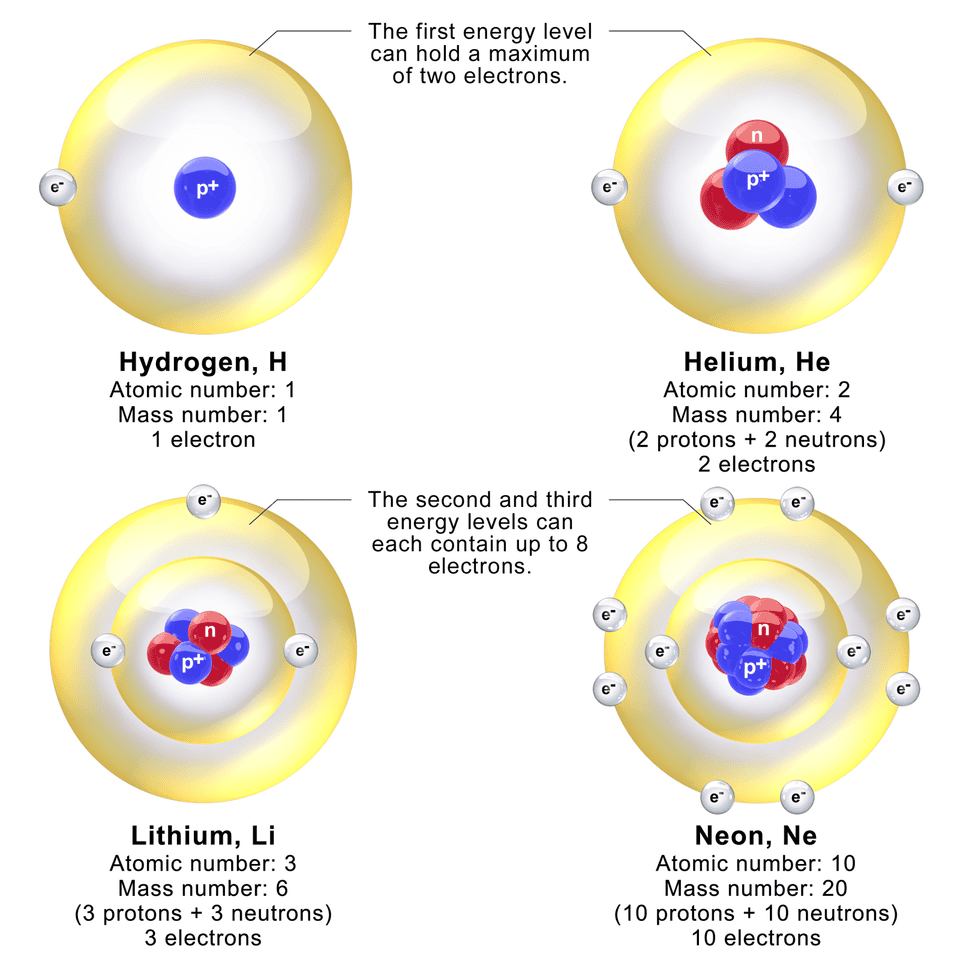
image credit: BruceBlaus, licensed under CC BY 3.0.
The proton–neutron model explained the puzzle of dinitrogen. When 14N was proposed to consist of 3 pairs each of protons and neutrons, with an additional unpaired neutron and proton each contributing a spin of 1⁄2 ħ in the same direction for a total spin of 1 ħ, the model became viable. Soon, neutrons were used to naturally explain spin differences in many different nuclides in the same way.
Fermi and Beta Decay
If the proton–neutron model for the nucleus resolved many issues, it highlighted the problem of explaining the origins of beta radiation. No existing theory could account for how electrons, or positrons, could emanate from the nucleus. In 1934, Enrico Fermi published his classic paper describing the process of beta decay, in which the neutron decays to a proton by creating an electron and a (as yet undiscovered) neutrino. The paper employed the analogy that photons, or electromagnetic radiation, were similarly created and destroyed in atomic processes. Ivanenko had suggested a similar analogy in 1932. Fermi’s theory requires the neutron to be a spin-1⁄2 particle. The theory preserved the principle of conservation of energy, which had been thrown into question by the continuous energy distribution of beta particles. The basic theory for beta decay proposed by Fermi was the first to show how particles could be created and destroyed. It established a general, basic theory for the interaction of particles by weak or strong forces. While this influential paper has stood the test of time, the ideas within it were so new that when it was first submitted to the journal Nature in 1933, it was rejected as being too speculative.
The nature of the neutron
The question of whether the neutron was a composite particle of a proton and an electron persisted for a few years after its discovery. In 1932, Harrie Massey explored a model for a composite neutron to account for its great penetrating power through matter and its electrical neutrality, for example. The issue was a legacy of the prevailing view from the 1920s that the only elementary particles were the proton and electron.
First Accurate Measurement of the Neutron’s Mass
The nature of the neutron was a primary topic of discussion at the 7th Solvay Conference held in October 1933, attended by Heisenberg, Niels Bohr, Lise Meitner, Ernest Lawrence, Fermi, Chadwick, and others. As posed by Chadwick in his Bakerian Lecture in 1933, the primary question was the mass of the neutron relative to the proton. If the neutron’s mass were less than the combined masses of a proton and an electron (1.0078 u), then the neutron could be a proton-electron composite because of the mass defect from the nuclear binding energy. If greater than the combined masses, then the neutron was elementary like the proton. The question was challenging to answer because the electron’s mass is only 0.05% of the proton’s, hence exceptionally precise measurements were required.
The difficulty of making the measurement is illustrated by the wide-ranging values for the mass of the neutron obtained from 1932 to 1934. The accepted value today is 1.00866 u. In Chadwick’s 1932 paper reporting on the discovery, he estimated the mass of the neutron to be between 1.005 u and 1.008 u. By bombarding boron with alpha particles, Frédéric and Irène Joliot-Curie obtained a high value of 1.012 u, while Ernest Lawrence’s team at the University of California measured the small value 1.0006 u using their new cyclotron.
In 1935, Chadwick and his doctoral student Maurice Goldhaber resolved the issue by reporting the first accurate measurement of the mass of the neutron. They used the 2.6 MeV gamma rays of Thallium-208 (208Tl) (then known as thorium C”) to photodisintegrate the deuteron.
In this reaction, the resulting proton and neutron have about equal kinetic energy, since their masses are about equal. The kinetic energy of the resulting proton could be measured (0.24 MeV), and therefore the deuteron’s binding energy could be determined (2.6 MeV − 2(0.24 MeV) = 2.1 MeV, or 0.0023 u). The neutron’s mass could then be determined by the simple mass balance
where md,p,n refer to the deuteron, proton, or neutron mass, and “b.e.” is the binding energy. The masses of the deuteron and proton were known; Chadwick and Goldhaber used values 2.0142 u and 1.0081 u, respectively. They found that the neutron’s mass was slightly greater than the mass of the proton, 1.0084 u or 1.0090 u, depending on the precise value used for the deuteron mass. The mass of the neutron was too large to be a proton-electron composite, and the neutron was therefore identified as an elementary particle. Chadwick and Goldhaber predicted that a free neutron would be able to decay into a proton, electron, and neutrino (beta decay).
Neutron physics in the 1930s
Soon after the discovery of the neutron, indirect evidence suggested the neutron had an unexpected non-zero value for its magnetic moment. Attempts to measure the neutron’s magnetic moment originated with the discovery by Otto Stern in 1933 in Hamburg that the proton had an anomalously large magnetic moment. By 1934, groups led by Stern, now in Pittsburgh, and I. I. Rabi in New York had independently deduced that the magnetic moment of the neutron was negative and unexpectedly large by measuring the magnetic moments of the proton and deuteron. Values for the magnetic moment of the neutron were also determined by Robert Bacher (1933) at Ann Arbor and I.Y. Tamm and S.A. Altshuler (1934) in the Soviet Union from studies of the hyperfine structure of atomic spectra. By the late 1930s, accurate values for the magnetic moment of the neutron had been deduced by the Rabi group using measurements employing newly developed nuclear magnetic resonance techniques. The large value for the proton’s magnetic moment and the inferred negative value for the neutron’s magnetic moment were unexpected and raised many questions.
Nuclear Fission: From Neutrons to the Atomic Bomb
The discovery of the neutron immediately gave scientists a new tool for probing the properties of atomic nuclei. Alpha particles had been used over the previous decades in scattering experiments, but such particles, which are helium nuclei, have a +2 charge. This charge makes it difficult for alpha particles to overcome the Coulomb repulsive force and interact directly with the nuclei of atoms. Since neutrons have no electric charge, they do not have to overcome this force to interact with nuclei. Almost coincident with its discovery, neutrons were used by Norman Feather, Chadwick’s colleague and protege, in scattering experiments with nitrogen. Feather was able to show that neutrons interacting with nitrogen nuclei scattered to protons or induced nitrogen to disintegrate to form boron with the emission of an alpha particle. Feather was therefore the first to show that neutrons produce nuclear disintegration.
In Rome, Enrico Fermi bombarded heavier elements with neutrons and found the products to be radioactive. By 1934, Fermi had used neutrons to induce radioactivity in 22 different elements, many of which were of high atomic number. Noticing that other experiments with neutrons at his laboratory seemed to work better on a wooden table than a marble table, Fermi suspected that the protons of the wood were slowing the neutrons and so increasing the chance for the neutrons to interact with nuclei. Fermi therefore passed neutrons through paraffin wax to slow them and found that the radioactivity of bombarded elements increased by a hundredfold. The cross-section for interaction with nuclei is much larger for slow neutrons than for fast neutrons. In 1938, Fermi received the Nobel Prize in Physics “for his demonstrations of the existence of new radioactive elements produced by neutron irradiation, and for his related discovery of nuclear reactions brought about by slow neutrons”.
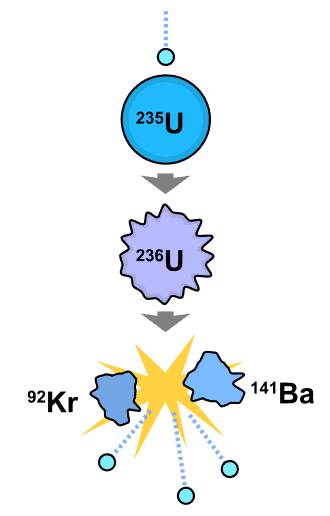
Image credit: Fastfission, public domain.
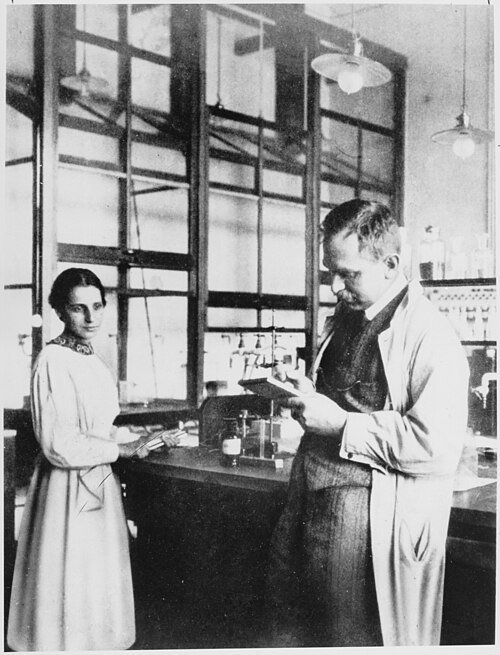
In Berlin, the collaboration of Lise Meitner and Otto Hahn, together with their assistant Fritz Strassmann, furthered the research begun by Fermi and his team when they bombarded uranium with neutrons. Between 1934 and 1938, Hahn, Meitner, and Strassmann found a great number of radioactive transmutation products from these experiments, all of which they regarded as transuranic. Transuranic nuclides are those that have an atomic number greater than uranium (92), formed by neutron absorption; such nuclides are not naturally occurring. In July 1938, Meitner was forced to escape antisemitic persecution in Nazi Germany after the Anschluss, and she was able to secure a new position in Sweden. The decisive experiment on 16–17 December 1938 (using a chemical process called “radium–barium–mesothorium fractionation”) produced puzzling results: what they had understood to be three isotopes of radium were instead consistently behaving as barium. Radium (atomic number 88) and barium (atomic number 56) are in the same chemical group. By January 1939, Hahn had concluded that what they had thought were transuranic nuclides were instead much lighter nuclides, such as barium, lanthanum, cerium, and light platinoids. Meitner and her nephew Otto Frisch immediately and correctly interpreted these observations as resulting from nuclear fission, a term coined by Frisch.
Hahn and his collaborators had detected the splitting of uranium nuclei, made unstable by neutron absorption, into lighter elements. Meitner and Frisch also showed that the fission of each uranium atom would release about 200 MeV of energy. The discovery of fission electrified the global community of atomic physicists and the public. In their second publication on nuclear fission, Hahn and Strassmann predicted the existence and liberation of additional neutrons during the fission process. Frédéric Joliot and his team proved this phenomenon to be a chain reaction in March 1939. In 1945, Hahn received the 1944 Nobel Prize in Chemistry “for his discovery of the fission of heavy atomic nuclei.”
Legacy of the Neutron Discovery
The discovery of nuclear fission at the end of 1938 marked a shift in the centers of nuclear research from Europe to the United States. Large numbers of scientists were migrating to the United States to escape the troubles and antisemitism in Europe and the looming war (See Jewish scientists and the Manhattan Project). The new centers of nuclear research were the universities in the United States, particularly Columbia University in New York and the University of Chicago, where Enrico Fermi had relocated, and a secret research facility at Los Alamos, New Mexico, established in 1942, the new home of the Manhattan Project. This wartime project was focused on the construction of nuclear weapons, exploiting the enormous energy released by the fission of uranium or plutonium through neutron-based chain reactions.
The discoveries of the neutron and positron in 1932 were the start of the discoveries of many new particles. Muons were discovered in 1936. Pions and kaons were discovered in 1947, while lambda particles were discovered in 1950. Throughout the 1950s and 1960s, a large number of particles called hadrons were discovered. A classification scheme for organizing all these particles, proposed independently by Murray Gell-Mann and George Zweig in 1964, became known as the quark model. By this model, particles such as the proton and neutron were not elementary, but composed of various configurations of a small number of other truly elementary particles called partons or quarks. The quark model received experimental verification beginning in the late 1960s and finally provided an explanation for the neutron’s anomalous magnetic moment.
References:
- Longair, M.S. (2003). Theoretical concepts in physics: an alternative view of theoretical reasoning in physics;
- Chadwick, James (1932). “Existence of a Neutron”. Proceedings of the Royal Society A;
- Stuewer, Roger H. (1983). “The Nuclear Electron Hypothesis”, Rife, Patricia (1999). Lise Meitner and the dawn of the nuclear age;
- Rutherford, E. (1920). “Bakerian Lecture: Nuclear Constitution of Atoms”;
- Herwig Schopper, Weak interactions and nuclear beta decay
- Bacher, Robert F.; Condon, Edward U. (1932). “The Spin of the Neutron”. Physical Review.
- Roger H. Stuewer, “The Nuclear Electron Hypothesis”. In Otto Hahn and the Rise of Nuclear Physics,

